You’ve probably seen them. At the serene temples of Kyoto or the grand shrines of Tokyo, you’ll spot people waiting patiently at a small office window, holding beautiful, brocade-covered books. A priest or a shrine attendant, brush in hand, will gracefully paint thick, black characters onto a page, then press a series of vermilion seals with focused intent. This is the ritual of receiving a goshuin, and the book is a goshuincho.
To the casual observer, it looks like a refined way to collect souvenirs. A high-concept stamp rally. And in a superficial sense, it is. Each goshuin is a unique memento of a visit to a specific sacred site. But to leave the understanding there is to mistake the frame for the painting. The goshuincho is not just a scrapbook of places you’ve been; it’s a physical manifestation of a personal journey, a tradition with deep roots in pilgrimage, faith, and the Japanese appreciation for tangible, handcrafted beauty. It’s a passport of the soul, where each entry is less a stamp and more a quiet, meaningful conversation with history itself. Understanding the goshuincho is to understand how the sacred past remains a living, breathing part of daily life in Japan.
Many who appreciate the interplay of faith, history, and artistry behind these treasured records might also enjoy exploring the rich legacy of sacred stamp books for a deeper insight into their enduring significance.
More Than a Stamp: The Art and Anatomy of a Goshuin
Before we travel back in time, let’s take a closer look at what you’re actually receiving on that crisp page of washi paper. A goshuin is not just a simple rubber stamp you apply yourself. It is a work of art—a blend of calligraphy and seals—granted to you by the temple or shrine. Each one is unique, embodying the hand of the calligrapher and the spirit of the day.
The Calligraphy: A Living Brushstroke
The most striking feature is the bold, black calligraphy, or shodo. This is almost always created by hand, right before your eyes. The characters generally include the name of the temple or shrine, often along with the name of the principal deity or Buddha enshrined there. This is more than handwriting; it is a meditative art form. The person writing it—whether a head priest, a monk, or a dedicated attendant—has trained for years. The flow of the ink, the pressure of the brush, the balance of the characters—it’s a moment of focused creation.
Watching them at work is part of the experience. There’s a quiet intensity to it. The world seems to slow as the brush glides across the paper, leaving a mark that is both powerful and elegant. The subtle variations—the way the ink feathers at the edge of a stroke, the slight differences in spacing from one day to the next—make your goshuin a one-of-a-kind piece. It records a specific person, at a specific moment in time, creating something just for you.
The Vermilion Seals: Sacred Imprints
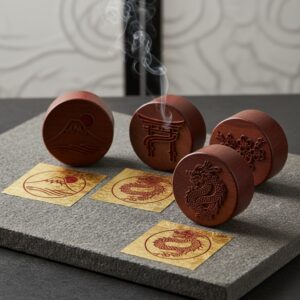
Complementing the black ink are the vibrant red seals, the shuin. These are the “stamps,” but they carry far more significance than a postmark. Each temple and shrine has several official seals, each serving a distinct purpose. Typically, one large seal will bear the name of the institution. Another, often written in a more stylized or ancient script, might represent the main Buddhist figure or Shinto kami it honors. Think of these seals not as mere decoration, but as the official insignia of the sacred site, a direct connection to its spiritual authority.
Pressing the seal is the final step that authenticates the entry. It transforms the calligraphy from a piece of art into official proof of your visit and your prayer. The vermilion ink—a color associated with protection, divinity, and life force in East Asia—literally imprints the essence of the place onto your book.
The Book Itself: A Pilgrim’s Vessel
The goshuincho itself is a beautiful object. It’s not just any notebook. Traditionally, it’s an accordion-style book called an orihon, designed to lay flat for display or stand upright. The paper is typically high-quality washi, thick enough to prevent the rich ink from bleeding through. The covers reveal personality. They can be adorned with traditional silk brocades, simple indigo-dyed fabrics, or intricately embroidered cherry blossoms, dragons, or symbols specific to famous temples. Recently, some shrines have collaborated with artists or even anime franchises to create modern, eye-catching designs, drawing a new generation into the tradition.
Choosing your first goshuincho is a meaningful decision. This book will become your companion, a vessel to hold the memories, prayers, and artistry of your travels across Japan. It is meant to be filled, page by page, creating a visual story of your journey.
A Pilgrim’s Proof: Tracing the Historical Roots
The modern goshuin boom may seem like a recent phenomenon, but its roots extend back centuries, closely connected to the history of pilgrimage in Japan. It was never about tourism; rather, it centered on devotion, proof, and passage.
From Votive Slips to Divine Receipts
The most widely accepted theory traces the goshuin’s origins to nōsatsu, or votive slips. In medieval Japan, devoted pilgrims undertaking difficult journeys to sacred sites demonstrated their faith by copying a sutra (a Buddhist scripture) by hand. Upon arrival, they would present this handwritten sutra to the temple as a token of their piety. In return, the temple would provide a receipt—a stamp and a brief inscription—confirming that the pilgrim had completed their offering and that their prayer was received.
This exchange held deep significance. For the pilgrim, who might have spent months traveling on foot, this small piece of paper was tangible proof of their connection to the divine. It served as a receipt for their faith. Over time, as literacy was not widespread and copying entire sutras was extremely time-consuming, the practice evolved. Instead of requiring a full sutra, the offering became a modest monetary donation, and the temple’s proof of prayer—the goshuin—became more standardized while still being artistically rendered.
The Edo Period: Pilgrimage for the People
The practice truly flourished during the Edo period (1603–1868). After centuries of civil war, Japan entered an era of unprecedented peace and stability under the Tokugawa shogunate. With a developing road network and relative safety, travel for common people became possible for the first time. Pilgrimage was one of the few socially acceptable reasons for ordinary people to journey beyond their home provinces.
Renowned pilgrimage routes, such as the trip to Ise Grand Shrine (Japan’s most sacred Shinto site) or the 88-temple circuit on Shikoku Island, became national phenomena. People saved for years to undertake these once-in-a-lifetime journeys. The goshuincho evolved into a sort of spiritual passport. At each sacred stop along their long, demanding route, a pilgrim would receive their goshuin. The book became a sequential record of their journey, a testament to their endurance and faith. Filling a goshuincho wasn’t about collecting; it was about completing a sacred quest. Each page represented miles traveled, mountains crossed, and prayers offered.
This historical context is essential. The goshuincho you hold today is a direct descendant of those pilgrims’ books. It carries the weight of those journeys. It is a link to a time when travel was not for leisure, but for salvation.
The Unspoken Etiquette: Receiving with Respect
Because the goshuin is a spiritual artifact rather than a commercial product, there is a certain etiquette to follow when receiving one. This isn’t about strict rules, but about showing respect for the tradition and the place you are visiting. It requires a shift in mindset from being a consumer to becoming a participant in a ritual.
Pray First, Receive Second
This is the most important and often overlooked step. The goshuin serves as proof of your prayer and visit. Therefore, you should always go to the main hall of the temple or shrine first. Take a moment to offer a prayer, bow, and pay your respects in the customary manner. Only after communing with the spirit of the place should you proceed to the office (shamusho or nōkyōsho) where goshuin are granted. Approaching the window before praying is like asking for a diploma without attending classes—it misses the entire point.
The Offering, Not a Payment
When receiving a goshuin, you will be asked for a small fee, usually between 300 and 500 yen. It’s important to view this not as payment for a service, but as an offering or donation (hōnō) to the temple or shrine. You are supporting the maintenance of the sacred grounds and expressing gratitude. Having the exact change ready shows respect and helps avoid an awkward transaction. Present your book open to the blank page where you’d like the goshuin to be inscribed. This small preparation smooths the process for the calligrapher.
A Moment of Silent Veneration
While the priest or attendant prepares your goshuin, remain quiet and attentive. Put away your phone and avoid loud conversations with friends. This is a moment of focused, artistic, and spiritual creation. Observe the brush strokes and see the seals being pressed. Appreciate the care and skill involved. When they hand the book back, receive it with both hands, offer a slight bow, and say a quiet “Arigatou gozaimasu” (Thank you very much). The book often comes with a thin sheet of paper inside to prevent the ink from smudging the facing page. Don’t remove it immediately; leave it until the ink is fully dry.
Following this etiquette transforms the experience. It stops being a simple transaction and becomes a meaningful, respectful exchange—a quiet memory that becomes part of the artwork itself.
The Modern Revival: A Tangible Connection in a Digital World
So why is this centuries-old tradition not only surviving but thriving in hyper-modern Japan? The goshuin’s revival reveals a widespread longing for meaning, authenticity, and a connection to the tangible world.
A Search for the Real
In an era dominated by fleeting digital images and instant gratification, the goshuin offers something deeply tangible and lasting. Each one is a distinct, handcrafted artifact. The texture of the paper, the scent of the ink, the subtle imperfections of a human hand—these sensory details cannot be duplicated on a screen. The process of traveling to a site, waiting in line, and watching your page being inscribed is slow and intentional. It compels you to be present. For many, especially younger Japanese, this serves as a welcome counterbalance to the relentless pace and virtual nature of contemporary life.
Art, Design, and Personal Expression
The visual appeal of goshuin and their books is undeniable. Temples and shrines have embraced this, producing stunningly beautiful and unique goshuin for special events, seasons, or festivals. Some use colorful inks, artistic illustrations, or are created on special paper. This has drawn a new crowd of art enthusiasts, designers, and collectors who may not be particularly religious but appreciate the beauty and craftsmanship of the tradition.
The goshuincho itself has evolved into a means of personal expression. Selecting a book that matches your style—whether classic and understated or bold and modern—is part of the enjoyment. It becomes a personal project, a creative endeavor as much as a spiritual one.
Your Journey, Your Story
Ultimately, the lasting power of the goshuincho lies in its capacity to tell an individual story. It is neither a competition nor a checklist to be completed. Your book is a private chronicle of your own journey. It charts the places that touched you, the moments of quiet reflection you experienced, and the beauty you observed. It might include a goshuin from a famous Kyoto temple alongside one from a small, overlooked shrine you discovered in the countryside. The famous one is impressive, but the unexpected one holds the personal significance.
Years later, flipping through the pages, you won’t see just a collection of stamps. You will recall the warmth of the sun on your face that day, the sound of the temple bell, the scent of incense drifting through the air. You will see a physical timeline of your own journey, recorded in the elegant, living language of ink and seal. It serves as a reminder that a pilgrimage is not always about arriving at a final destination, but about the profound beauty found in the steps taken along the way.