My first real “I’m not in Spain anymore” moment in Japan didn’t happen at a serene temple or in the middle of Shibuya’s frantic scramble. It happened on a quiet, residential side street in Kyoto at two in the morning. I was battling a formidable case of jet lag, walking aimlessly under the moonlight, when I saw it: a warm, gentle glow emanating from a row of machines. One sold the usual array of teas and coffees. But the one next to it was offering cans of hot corn potage soup and steaming bottles of dashi, the savory broth that forms the foundation of Japanese cuisine. My mind tilted. Who is buying hot fish broth from a machine in the middle of the night? And more importantly, why does this feel so completely, utterly normal here?
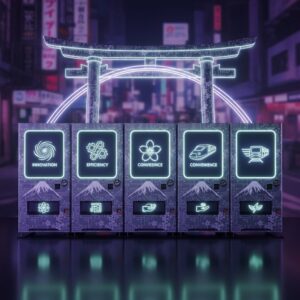
It’s a question that visitors to Japan inevitably ask. The sheer number and variety of vending machines, or jidouhanbaiki (自動販売機), are staggering. There are roughly one for every 30 people in the country, the highest per capita rate in the world. They line city streets, cluster in train stations, stand sentinel in rural rice paddies, and even perch on the slopes of Mount Fuji. They dispense not just drinks, but hot meals, fresh flowers, surgical masks, collectible toys, umbrellas, and even sake. It’s easy to dismiss this as a quirky novelty, a fun bit of local color for a travel blog. But that’s missing the point entirely. These silent, humming salesmen aren’t just a convenience; they are a profound reflection of Japanese society. To understand the logic of the vending machine is to get a crash course in the cultural software that runs Japan itself—a complex operating system built on trust, efficiency, and a very particular definition of public space.
Just as Japan’s vending machines offer a glimpse into the nation’s intricate societal fabric, exploring the subtle language of Japanese sento further reveals the depth of everyday cultural expression.
The Unspoken Agreement: Safety, Density, and Trust
Before we even discuss what’s inside the machines, we first have to consider why they can exist at all, scattered seemingly without care across the landscape. In many other countries, a glass-fronted box stocked with cash and goods, left on a quiet street corner overnight, would be an open target for theft and vandalism. Its lifespan would be measured in hours, not years. Yet in Japan, these machines remain, generation after generation, largely untouched. This isn’t due to some magical force field but is the tangible outcome of one of the country’s most defining traits: an exceptionally low crime rate and a high-trust social fabric.
A Society Built on Trust
The typical Japanese person assumes others will not break rules, steal, or cause public harm. This belief is woven throughout daily life, from children commuting alone on crowded subways, to lost wallets being faithfully returned to the local police box, or koban, often with their cash intact. Vending machines benefit the most from this unspoken social contract. The risk of vandalism is so minimal that operators can confidently place them nearly anywhere, maximizing utility without the burden of high security and repair costs that would be prohibitive elsewhere. These machines stand as quiet, constant proof of a collective commitment to respect shared spaces and property. Crime isn’t absent, but it’s rare enough to make vending machines a viable, profitable business model nationwide. Seeing a pristine machine on a deserted street isn’t just witnessing convenience; it’s witnessing a society where respect for the commons is the default.
The Urban Puzzle of Population Density
Another piece of the explanation lies in spatial logic. Japanese cities are incredibly dense. Every square meter of land is valuable, and businesses pay a premium for retail space. This is where the vending machine’s compact size proves ingenious. They fit into the “dead spaces” of urban environments that are otherwise unusable: narrow gaps between buildings, awkward corners under staircases, tiny alcoves along long walls. They need no staff, minimal electricity, and occupy a footprint too small to support a traditional store. In effect, they create retail opportunities out of thin air.
This leads to an astonishing level of service saturation. You are rarely more than a few minutes’ walk from a cold drink on a sweltering summer day or a hot coffee on a freezing winter morning. This isn’t a luxury; in a country where millions commute long hours via public transport and on foot, it’s a deeply integrated part of urban infrastructure. The vending machine addresses the challenge of providing 24/7 refreshment to a massive, continuously mobile population in a way perfectly suited to the spatial constraints of Japanese cities.
Convenience as a Form of Care
Once you understand the fundamental logic of safety and density, the vast array of products begins to take on a new kind of meaning. It’s not merely about randomness; it represents a highly advanced form of automated service that anticipates needs with remarkable precision. This is a machine-driven extension of omotenashi—Japan’s renowned concept of anticipatory hospitality, where a host predicts a guest’s needs before they are even expressed.
Anticipating Every Need, Everywhere
The items found in a vending machine are rarely accidental. They are carefully selected based on their specific location and the likely preferences of the people passing by. In business districts and near train stations, machines offer beer, sake, and chuhai (shochu highballs) catering to office workers on their way home. Near hospitals, machines are stocked with surgical masks and health drinks. In rural areas, you might come across machines selling fresh, locally grown produce or even bags of rice sold directly by farmers. The hot dashi machine I discovered in Kyoto? It was probably situated in a residential neighborhood, providing a key ingredient for home cooking at any time.
This goes beyond simple beverages. A machine dispensing umbrellas that appears outside a subway station on a rainy day feels like a small act of civic kindness. A machine offering hot, ready-to-eat meals such as ramen or takoyaki at a highway rest stop serves as a lifeline for tired truck drivers. Here, convenience transcends basic efficiency to become a form of collective care. Through these machines, society addresses its citizens’ small, immediate needs 24 hours a day, without judgment or the necessity of human interaction.
The Human-Free Transaction
That last point—the absence of human interaction—is more important than it might appear. While Japanese culture highly values politeness and excellent customer service, there are moments when an anonymous, frictionless transaction is preferred. Vending machines provide a private experience. There’s no need for small talk with a cashier or embarrassment over your purchase, whether it’s a can of beer at 10 a.m. or ice cream late at night. This can serve as a welcome form of social relief in a society that is often highly structured and formal.
This also relates to Japan’s demographic challenges. With a rapidly aging population and a shrinking workforce, staffing 24/7 operations such as convenience stores can be difficult and costly. Vending machines offer the perfect solution. They are tireless, efficient workers filling gaps in the labor market, ensuring that services remain available around the clock despite a declining human workforce. In this way, they stand as the robotic forefront of the service economy.
A Mirror to the Culture
Beyond the practical concerns of safety and economics, the vending machine landscape also acts as a surprisingly accurate reflection of wider cultural trends and peculiarities. They serve as a canvas on which the nation’s hobbies, tastes, and even its anxieties are projected.
The Otaku and the Niche
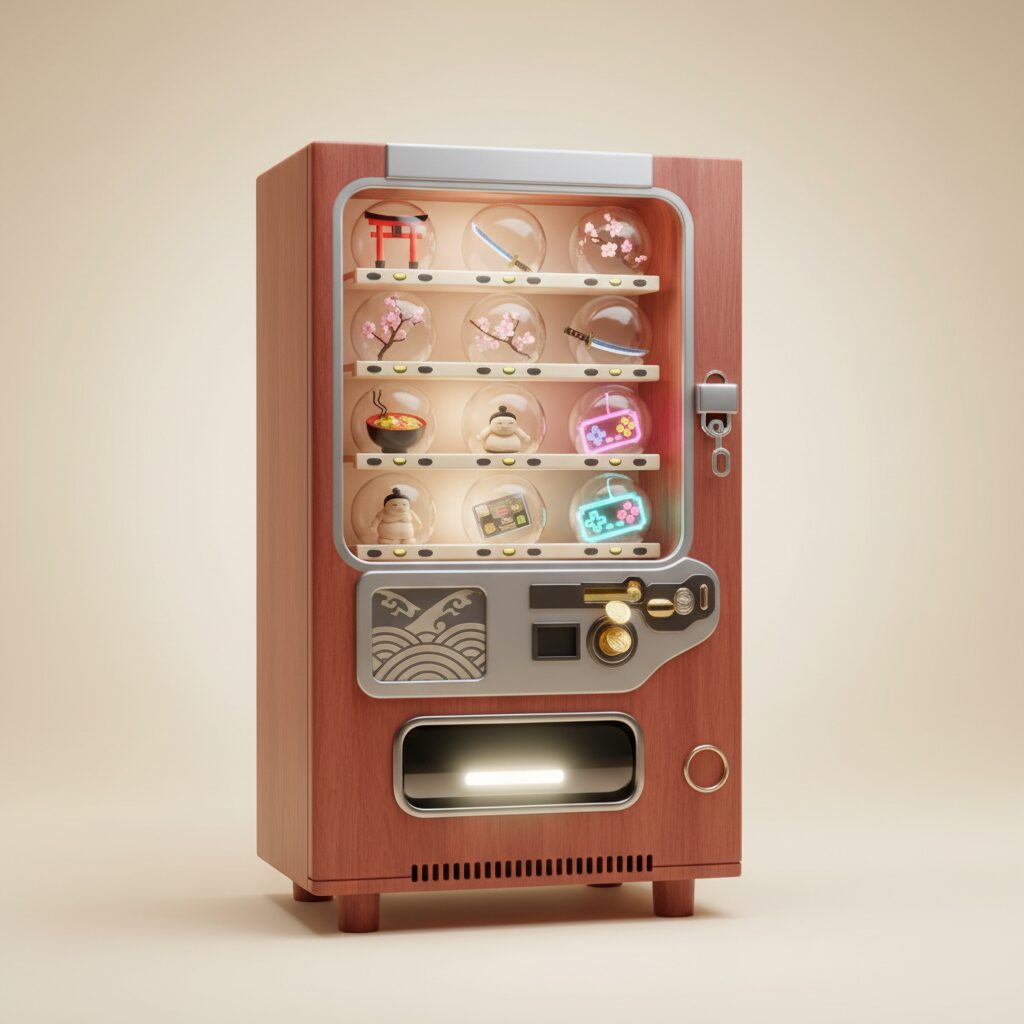
Japan is a culture that embraces the niche, the specialized, and the collectible. This is the realm of the otaku, the devoted enthusiast. Vending machines cater to this wonderfully. You can find machines dedicated solely to dispensing high-quality, collectible figurines from particular anime series. There are gachapon machines, which provide a randomized toy in a capsule, fueling a love for surprise and collection. I’ve come across machines that sell nothing but regional varieties of instant ramen, or rare insects preserved in resin. These aren’t designed for the general public; they are small, automated shrines for specific subcultures, enabling enthusiasts to indulge their passions anytime.
The Aesthetics of Automation
Even the machines’ designs are telling. They are almost invariably clean, well-kept, and brightly lit. The product displays are neat and attractive, with perfectly aligned cans and plastic food models (sampuru) that show you exactly what you’re purchasing. There is a distinct pride in the presentation, a belief that even an automated transaction should be a pleasant and trustworthy experience. The whirring of the internal mechanics, the soft clunk of the dropped can—it’s a familiar and comforting element of the Japanese soundscape. The process is transparent and reliable. You insert your money, make your choice, and receive exactly what was promised. In a world of uncertainties, the Japanese vending machine stands as a bastion of absolute dependability.
So, the next time you find yourself in Japan, take a moment to truly observe these machines. Don’t just regard them as places to get a drink. See them for what they truly are: a reflection of a society that has expertly blended technology, social trust, and a deep understanding of human needs into a seamless, ever-present network of silent service. That glowing box on the corner isn’t just selling corn soup. It’s selling a piece of Japan itself.