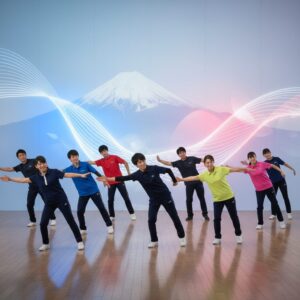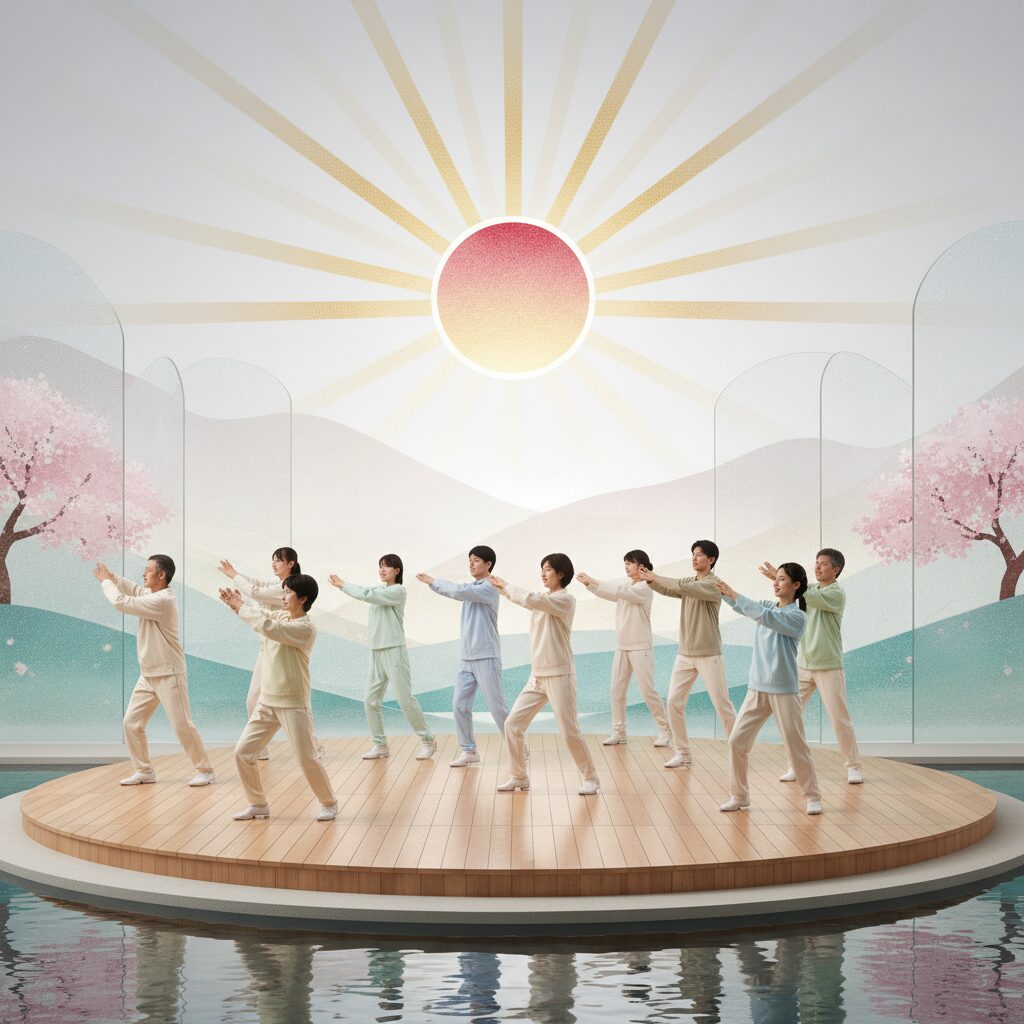
Every morning in Japan, just before the daily rush swallows the silence, a quiet ritual unfolds. At precisely 6:30 AM, a familiar piano melody drifts from radios across the archipelago. In parks, elderly neighbors gather on gravel squares, moving with a gentle, practiced synchronicity. On construction sites, helmeted workers form neat rows, stretching in unison before the day’s labor begins. In countless elementary schools, children line up in the schoolyard, their small bodies mirroring the movements their grandparents have known for a lifetime. This is Radio Taiso, or Radio Calisthenics, a three-minute sequence of thirteen exercises that has been a cornerstone of Japanese daily life for nearly a century. To an outsider, it can look like a curious relic—a scene of mass conformity seemingly at odds with the hyper-modern, individualistic image of contemporary Japan. It’s easy to dismiss it as a quaint, slightly bizarre national habit. But that would be missing the point entirely. This simple routine is far more than just a morning stretch. It’s a living artifact, a physical archive of Japan’s turbulent 20th-century journey. Its story is one of public health, wartime nationalism, post-war reinvention, and remarkable social resilience. To understand why millions still turn on the radio and move to that simple tune is to understand how Japan’s past isn’t really past at all; it’s woven into the very fabric of the present, reenacted every day at 6:30 AM.
The daily ritual of radio calisthenics not only embodies Japan’s deep-rooted traditions but also sets the stage for exploring how bubble-era ski resorts capture the nation’s evolving cultural landscape.
An American Idea, Remade for a Japanese Morning
The story of Radio Taiso originates not in Tokyo, but in New York City. Its beginnings provide a compelling example of cultural borrowing and adaptation, characteristic of Japan’s Meiji and early Showa-era modernization. While the nation was industrializing rapidly, the swift urbanization brought new public health challenges. The government actively sought ways to enhance the physical fitness and well-being of its people.
A Trans-Pacific Transmission
In the 1920s, the American Metropolitan Life Insurance Company began sponsoring a fifteen-minute radio broadcast featuring warm-up exercises to promote the health of its policyholders. The program became very popular, reaching millions of households across the U.S. Japanese officials from the Postal Life Insurance Bureau, then a government agency, traveled to America to study their systems. They were deeply impressed by the American radio calisthenics program, viewing it as a powerful and modern tool to achieve a national objective: cultivating a healthier, stronger population. They recognized its potential not only for improving individual health but also for fostering national unity and shared purpose through a simple, daily collective activity. The idea was brought back to Japan, not as a direct copy, but as a concept carefully adapted to the Japanese context. In 1928, to mark the formal enthronement of Emperor Hirohito, the government officially launched the “National Health Exercises,” broadcast nationwide by NHK, the public broadcaster. Thus began the era of Radio Taiso.
Designing the Perfect National Routine
The routine’s creation was a well-considered process, not merely a random set of stretches. The Postal Life Insurance Bureau gathered experts from the Ministry of Education, the Japanese Army, and leading medical and physical education institutions. Their mission was to design exercises that were scientific, efficient, and universally accessible. The movements needed to be simple enough for children and the elderly to perform safely, yet effective enough to deliver real physical benefits. They required no special equipment and could be done in small spaces such as classrooms, factory floors, or living rooms. The result was a sequence that systematically engaged every major part of the body. It starts with gentle arm stretches to stimulate circulation, continues with torso twists and bends to enhance flexibility, includes leg and back exercises, and concludes with deep, rhythmic breathing to soothe the body and mind. It is a full-body warm-up perfected for mass participation. Equally important was the music. The simple, upbeat, and somewhat nostalgic piano melody composed by Tadashi Hattori was brilliant. It serves as an auditory cue instantly recognizable to anyone raised in Japan, evoking vivid memories of summer mornings and school sports days. The music transformed the exercises from a dry health prescription into a familiar, almost comforting, daily ritual.
The Routine’s Shifting Allegiance: From Imperial Tool to Civic Ritual
Like many facets of daily life in pre-war Japan, Radio Taiso was soon engulfed by the surge of militarism and ultranationalism. Its role shifted significantly from a harmless public health initiative to a potent instrument of state ideology. Its trajectory through the war and subsequent post-war transformation illustrates how a simple physical exercise can become imbued with political significance.
A Warm-up for the Empire
During the 1930s and throughout World War II, the Japanese government mobilized every aspect of society in support of the war effort. The National Spiritual Mobilization Movement aimed to instill martial discipline, collective duty, and sacrifice among the population. Radio Taiso became an ideal vehicle for these ideals. The morning exercise ceased to be merely about personal health; it became about preparing both body and spirit for service to the Emperor and the nation. Group participation was strongly encouraged and often mandatory in schools, factories, and neighborhood associations (tonarigumi). Performing the exercises in perfect unison was a daily demonstration of Japan’s collective strength and unwavering unity. It physically embodied the slogan ichioku isshin (one hundred million hearts as one). The routine itself adopted a more martial tone, highlighting sharp, vigorous movements reminiscent of military drills. This served to condition the entire population, from youngest child to oldest citizen, for the discipline and rigor demanded by a nation at total war.
The Post-War Ban and Democratic Rebirth
After Japan’s surrender in 1945, the country came under the authority of the Allied Occupation, led by the United States. The Supreme Commander for the Allied Powers (SCAP) launched a comprehensive effort to demilitarize and democratize every aspect of Japanese society. Anything reminiscent of the former militaristic, ultranationalist ideology was targeted for eradication. Radio Taiso was quickly recognized as one such symbol. Because of its strong ties to wartime mobilization and its collectivist, quasi-military nature, the broadcasts were banned in 1946. Authorities viewed it as a tool that had encouraged the very conformity and groupthink they sought to dismantle. However, the routine had become too deeply ingrained in everyday life to vanish entirely. There was public demand for its revival—not as a state instrument, but as a beloved health practice. Acknowledging this, Japanese authorities and NHK returned to the drawing board. In 1951, a new version of Radio Taiso was introduced. This revised routine, which is the one chiefly practiced today, was carefully purged of militaristic elements. The movements were reimagined to be smoother, more flowing, and focused on balanced physical well-being. It was deliberately rebranded as a democratic and scientific exercise for the new, post-war Japan—a ritual for citizens rather than imperial subjects. This revision is important; today’s Radio Taiso is not a direct, unbroken continuation of the pre-war version but a conscious post-war creation, carrying the memory of its past while addressing the needs of a different era.
The Mechanics of a National Morning
To truly appreciate the enduring appeal of Radio Taiso, it’s essential to understand not only its history but also its mechanics—both the physical exercises and the social structures surrounding them. These aspects combine to turn a simple broadcast into a meaningful community-building ritual handed down through generations.
The Thirteen Steps to Wakefulness
The best-known and most widely performed version is Radio Taiso Dai Ichi (Radio Calisthenics Number 1). It is a model of efficiency, lasting just over three minutes. The thirteen movements flow seamlessly from one to the next, designed to gently awaken the body and ready it for the day ahead.
The routine begins with basic arm stretches and rotations to loosen the shoulders and upper back. This is followed by leg and knee bends to stimulate blood flow to the lower body. Next, exercises focused on opening the chest and improving posture counteract the hunched-over position common in modern life. Midway, the sequence includes bending forward and sideways, and twisting the torso to enhance spinal flexibility and activate internal organs. The movements build up to more energetic actions like swinging the arms and lightly jumping in place, slightly raising the heart rate. It ends with deep breathing exercises to calm the nervous system and focus the mind. There is also a Radio Taiso Dai Ni (Number 2), a more vigorous routine aimed at building muscle strength and intended for younger, more active participants. This is often the version used in factories or by sports teams. The beauty of Dai Ichi lies in its accessibility; anyone can perform it at their own level by adjusting the movements accordingly.
The Social Glue of the Stamp Card
Perhaps the most brilliant social innovation linked to Radio Taiso is the rajio taisō kaado—the stamp card. This plays a crucial role in the experience of Japanese children during their long summer break. With school out, there’s a high risk of kids slipping into unstructured, sedentary routines. The stamp card system is the community’s solution. Each morning, children in a neighborhood are encouraged to gather at a set location, typically a local park or shrine grounds. An adult volunteer—often a parent or a senior in the neighborhood association—sets up a radio. For three minutes, the group—a mix of drowsy children, lively toddlers, and supervising adults—performs the exercises together. Once finished, each child shows their card to receive a stamp for that day. By the end of the week or vacation, a full or nearly complete card can be exchanged for a small prize, such as candy, a notebook, or a low-cost toy. This simple system is a strong motivator. It gamifies participation and fosters routine and discipline beyond the structured school environment. More importantly, it fulfills a vital social purpose. It encourages children to leave the house and get fresh air, ensures interaction with peers and the older generation, and strengthens community ties. For many Japanese adults, the memory of rushing to the park on a warm summer morning, stamp card in hand, remains a cherished part of their childhood.
A Ritual for the 21st Century: Fading Habit or Enduring Tradition?
In a fast-paced, technologically advanced country like Japan, what role does a century-old, low-tech synchronized exercise routine hold? The answer is nuanced. Although Radio Taiso no longer serves as the universal, quasi-mandatory practice it once was, it has shown remarkable adaptability, gaining new significance in response to the very challenges facing modern Japanese society.
Where the Rhythm Lives On
Radio Taiso continues to flourish in three main areas. First, it remains a fundamental part of physical education in schools and is most prominently featured as the official warm-up for the annual undōkai, or school sports day. Watching an entire school—from first graders to graduating seniors—move in perfect unison is a powerful expression of school spirit and collective effort. The second area is the workplace, especially in traditional sectors like manufacturing, construction, and transportation. Many companies start the day with group Radio Taiso sessions. This practice serves two purposes: it physically prepares workers for manual labor, reducing injury risks, and mentally sharpens the team, fostering unity and shared purpose before a shift. The third, perhaps most crucial domain is the local community. In parks and public spaces throughout Japan, groups of residents, mainly senior citizens, gather each morning. For Japan’s rapidly aging population, these meetings are a lifeline. The exercises help maintain mobility, balance, and overall health, but the social connection is equally vital. It offers daily social interaction, a reason to leave home, and a peer community that helps counter loneliness and isolation among the elderly.
Voices of Dissent and Decline
Naturally, not everyone embraces the tradition. Many younger, urban, white-collar workers view synchronized exercises with colleagues as an outdated custom. It can symbolize the rigid, collectivist corporate culture they are striving to leave behind, representing a demand for conformity that infringes on personal freedom. In numerous modern offices, especially in tech and creative fields, Radio Taiso is entirely absent. Participation has definitely decreased since its mid-century peak. The morning NHK television broadcast was eventually canceled, although the routine remains a radio staple. The summer stamp card activity, though still practiced, is less widespread than a generation or two ago, as children now fill their vacations with cram schools, extracurriculars, and digital entertainment.
A Surprising Modern Resonance
Yet, while some turn away, others rediscover Radio Taiso’s benefits. In a time of wellness apps and costly gym memberships, its simplicity and accessibility are gaining new appreciation. It offers a free, effective, and time-efficient way to counteract modern sedentary lifestyles. Health and elder-care industries utilize it in nursing homes and rehabilitation centers to help seniors maintain physical function. It even carries a certain “retro” charm. Nintendo famously incorporated the exercises into its Wii Fit game, introducing the routine to a new global audience. During the COVID-19 pandemic, when people were confined at home, Radio Taiso quietly experienced a resurgence. It was the perfect lockdown workout: simple, familiar, and doable anywhere, providing a touch of structure and normalcy amid chaos. It connected people to a shared national experience despite physical isolation.
Radio Taiso endures because it has served many purposes for many people over a long period. It is simultaneously a nostalgic reminder of childhood summers, a corporate cohesion tool, a vital community activity for seniors, and a practical health regimen. The gentle piano melody that signals its start is more than a cue to exercise; it is an audible thread linking today’s Japan to its pre-war dreams, post-war struggles, and ongoing quest to balance the collective and the individual. Raising your arms to that tune is, whether consciously or not, a daily reenactment of a complex and ongoing national story. It quietly affirms that some of the most profound traditions are not housed in grand temples or elaborate ceremonies but in the simple, shared movements of ordinary people greeting the morning together.