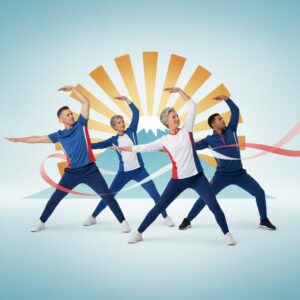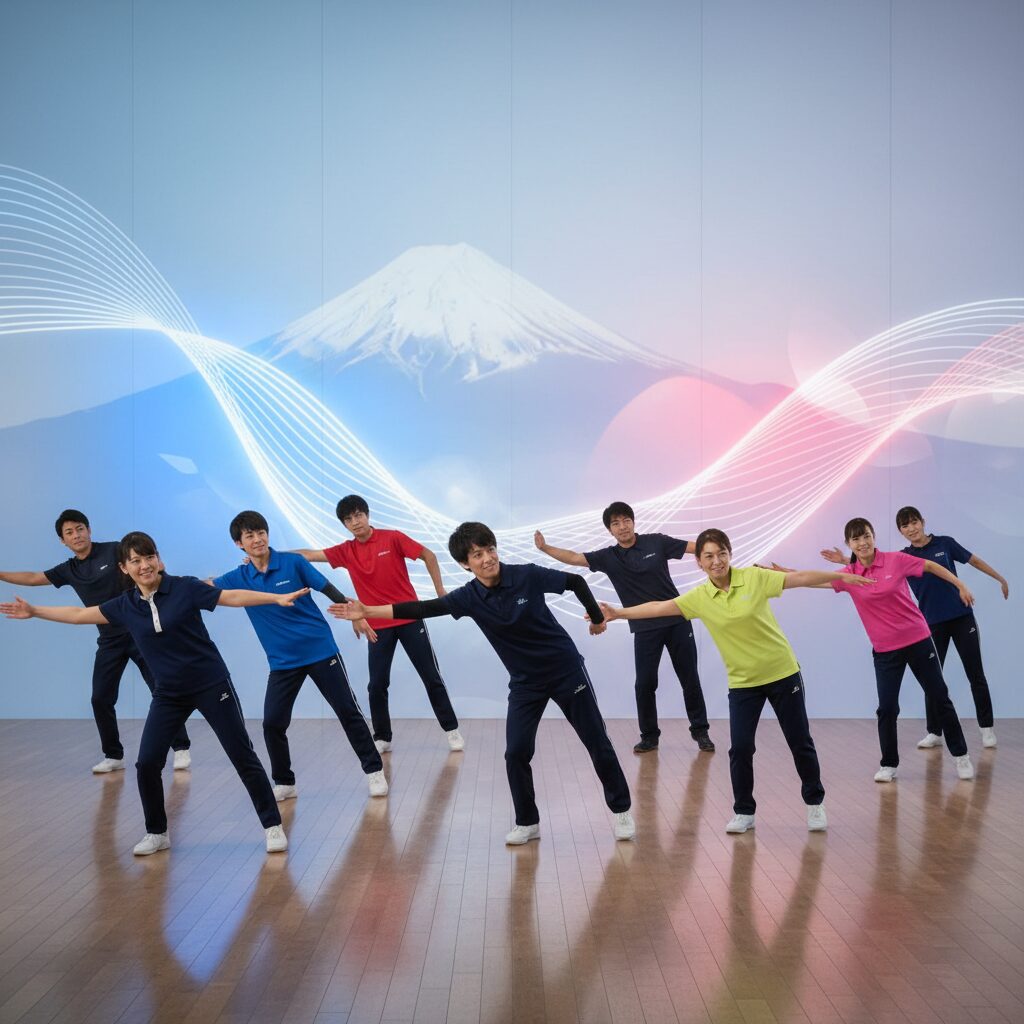
If you find yourself in a Japanese neighborhood park around 6:30 in the morning, you’ll witness a quiet, near-sacred ritual. As the sun begins to burn off the early mist, people start to gather. Retirees in tracksuits, office workers on their way to the station, young mothers with toddlers in tow. They don’t speak much. They simply find a spot, space themselves out, and wait. Then, a gentle, slightly nostalgic piano melody drifts from a portable radio or a park loudspeaker. A calm, encouraging voice begins to count: “Ichi, ni, san, shi… go, roku, shichi, hachi…” In perfect, unthinking unison, the group begins to move. They raise their arms, rotate their bodies, bend at the waist, and stretch their limbs in a sequence of thirteen familiar movements.
This is Radio Taiso, or Radio Calisthenics. It’s a national institution, a piece of living history broadcast every single day by Japan’s public broadcaster, NHK. For millions, from the northern tip of Hokkaido to the southern islands of Okinawa, this three-minute routine is as ingrained in the daily rhythm as a morning cup of tea. It happens in schools before first period, in factories before the machinery whirs to life, and in offices before the first emails are answered. During summer vacation, children across the country gather with stamp cards in hand to perform it together, a foundational memory for generations.
To an outsider, it might seem like a quaint, slightly bizarre throwback—a relic of a more collectivist era. Why would a hyper-modern, technologically advanced society still cling to a synchronized group exercise routine that originated nearly a century ago? It seems to defy the logic of our individualistic age. But to understand Radio Taiso is to understand something fundamental about modern Japan. It’s a story that weaves together American public health initiatives, pre-war imperial propaganda, post-war reconstruction, and the enduring cultural emphasis on community, discipline, and the quiet power of a shared daily rhythm. This simple set of exercises is a physical archive, a routine that has shaped the nation’s body and mind, proving to be far more than just a morning stretch.
Japan’s enduring tradition of synchronizing bodies and minds through Radio Taiso is matched by the way other cultural phenomena, like the mermaid cure, continue to weave myth and modernity into the fabric of daily life.
The Sound of a Japanese Morning
Before exploring its fascinating history, it’s important to recognize how deeply Radio Taiso is embedded in the sensory fabric of Japanese life. The experience is primarily auditory. Each broadcast always begins with the same iconic piano prelude—a bright, slightly wistful tune that has echoed from radios for decades. It’s one of those melodies that every Japanese person, regardless of age or background, can recognize within the first few notes. It serves as the sonic wallpaper of the nation’s morning.
After the music, the voice follows—a clear, calm, and rhythmic announcer who leads listeners through the exercises. The count is steady and encouraging, not like a drill sergeant, but more like a gentle guide. “Ōkiku, senobi no undō kara!” the voice instructs—”Let’s start with a big, stretching movement!” For those three minutes, that voice becomes a unifying presence across millions of separate lives. A fisherman repairing his nets by the sea, a CEO in a high-rise apartment, and a group of elementary school students in their playground all move to the same count, connected by the invisible threads of the airwaves.
Visually, the scene is one of subtle, hypnotic conformity. In a park, dozens of people, strangers to one another, mirror the same motions with practiced ease. There’s no self-consciousness, no hesitation. The movements are ingrained in their muscle memory, formed in childhood. Arm circles, torso twists, leg stretches—each transition is seamless. This shared physical language fosters a powerful, if temporary, sense of community. For a few minutes, individual identities dissolve, and everyone becomes part of a larger, coordinated whole. It is a quiet expression of wa (和), the cultural ideal of group harmony, communicated not through words, but through synchronized movement.
This ritual is not limited to parks. Passing a construction site at 8:00 AM, you might see workers in hard hats performing the routine together before starting their day, a practice intended to prevent injuries. Peering into a traditional manufacturing company, you’ll find assembly line workers stretching in unison. And most famously, there is the summer vacation tradition. For about a month in August, local children’s associations or PTAs organize daily Radio Taiso sessions. Kids, often still sleepy-eyed, dutifully gather at the designated spot with their attendance cards. For each day they participate, they earn a cute stamp. Completing the card becomes a summer goal, and at the end of the month, they might be rewarded with a small prize like candy or a pencil case. It’s a child’s first experience with civic involvement and the satisfaction of steady, collective effort.
An Unlikely American Import
The most surprising aspect of this quintessentially Japanese ritual is that it is not originally Japanese at all. Its origins trace back halfway across the world, to the corporate environment of 1920s America. The concept emerged from a public health and marketing campaign by the Metropolitan Life Insurance Company, or MetLife.
In the early 20th century, selling life insurance was challenging. To increase business, companies like MetLife recognized they had a vested interest in their customers living longer, healthier lives. They launched extensive public health campaigns, distributing pamphlets on hygiene, funding nursing programs, and seeking innovative ways to promote wellness. Radio, as a new and powerful medium, was used in 1925 when MetLife sponsored a 15-minute morning exercise program broadcast from its New York City headquarters. The show featured calisthenics set to music, aimed at motivating Americans to move and enhance the nation’s overall fitness.
This American radio program became extraordinarily popular. It was a novel method of delivering guided exercise directly into people’s homes, promoting health on a large scale. This success captured the attention of visiting Japanese officials.
Crossing the Pacific: Japan’s Quest for a Healthy Nation
In the mid-1920s, a delegation from Japan’s Postal Life Insurance Bureau (Kan’i Hoken Kyoku) visited the United States to study the American insurance industry. What they witnessed at MetLife was eye-opening. They observed how the company used radio to improve public health, which in turn bolstered their business model. For the Japanese officials, this represented more than just a clever marketing strategy; it was a powerful nation-building tool.
At the time, Japan was transitioning from the Taisho era (1912-1926) into the Showa era. The nation was rapidly industrializing and modernizing. However, industrialization brought public health challenges. The overall physical fitness of the population was a national concern, especially regarding military conscription and labor productivity. The government sought ways to cultivate a healthier, stronger, and more unified citizenry. The American model of radio calisthenics appeared to be an ideal solution: modern, efficient, and capable of reaching the entire country simultaneously.
The officials introduced the idea to Japan. The Postal Life Insurance Bureau, in partnership with the Ministry of Education and what would become NHK, began developing a uniquely Japanese version of the program. Rather than merely copying the American exercises, they carefully designed a routine tailored to Japanese bodies and lifestyles. The aim was to create something that anyone—young or old, man or woman, urban resident or farmer—could perform easily and safely.
Birth of a National Ritual
On November 1, 1928, the first broadcast of Kokumin Hoken Taiso (National Health Exercises) aired throughout Japan. The timing was intentional, coinciding with the grand celebrations of Emperor Hirohito’s (Emperor Showa) official coronation. From its very beginning, the exercise routine carried a sense of national purpose and imperial significance.
The program was an immediate and overwhelming success. The government promoted it with tremendous enthusiasm. The Ministry of Railways encouraged station workers and passengers to participate on train platforms. The Ministry of Education advocated its adoption in schools nationwide. The Postal Life Insurance Bureau, the initiative’s originator, dispatched representatives across the country with pamphlets and phonographs to demonstrate the exercises in remote villages.
Radio Taiso, as it quickly became known, evolved into a symbol of modernity and national unity. It was a daily, collective act of building a stronger Japan, one stretch at a time. The simple piano accompaniment and straightforward movements made it accessible to everyone, fostering a shared experience that transcended class, geography, and occupation. It was the sound of a nation syncing its rhythm. Yet, this seemingly benign public health tool would soon be repurposed for a far darker objective.
Weaponized Wellness: Radio Taiso in Wartime
As Japan moved toward militarism in the 1930s and plunged into World War II, nearly every aspect of civilian life was redirected to support the war effort. Radio Taiso was no exception. Originally a gentle public health initiative, it was transformed into a tool for promoting discipline, physical endurance, and nationalist zeal.
The government viewed the daily routine as an ideal way to mobilize the population. The exercises became more demanding and martial in nature. New versions were introduced with names reflecting the era’s ideology. The objective was no longer just general wellness; it aimed to shape bodies and minds capable of aiding the Empire’s victory. Performing the exercises became a daily pledge of allegiance, a physical expression of one’s duty to the Emperor and the state.
Participation was effectively compulsory. In schools, it was central to physical education, preparing boys for military service and girls for their supportive role on the home front. Factories producing war materials began the day with vigorous Radio Taiso sessions to keep workers alert and productive. Neighborhood associations, or tonarigumi, which monitored citizens and enforced government orders, organized mass morning exercises in public squares. Opting out was seen as unpatriotic.
The broadcasts’ tone also changed. The gentle, encouraging guidance gave way to a more commanding and forceful delivery. The message, both explicit and implicit, stressed that a strong body was vital for a nation at war. The synchronized movements of millions each morning became a powerful symbol of a unified, disciplined population aligned with the government’s ambitions.
Post-War Purgatory and Rebirth
When Japan surrendered in August 1945, the country lay in ruins and its national identity was fractured. The Allied Occupation, led by the United States, began dismantling Japan’s militarist and ultranationalist systems. Everything tied to the wartime regime was scrutinized, and Radio Taiso was quickly labeled a tool of state propaganda.
In 1946, the General Headquarters (GHQ) of the Occupation forces officially banned Radio Taiso broadcasts. They viewed its emphasis on group conformity and martial character as part of the system that led Japan to war. The familiar piano melody vanished from the airwaves. For a few years, it seemed the national morning ritual had ended, a casualty of a defeated ideology.
Yet the routine was too deeply ingrained in public consciousness to disappear entirely. People continued practicing the exercises from memory. The public’s demand for its return stemmed not from ideology but from reliance on it as a simple, effective way to maintain health and community connection. It had become a habit, a source of comfort.
Recognizing its enduring popularity and its potential to promote public health during difficult post-war years, NHK and the Ministry of Education petitioned for its revival. They proposed a completely new set of exercises, free of militaristic associations and redesigned according to modern principles of physiology and sports medicine. The goal was to create a democratic, peaceful, and scientific version of Radio Taiso for a new Japan.
In May 1951, their efforts succeeded. A new Radio Taiso was broadcast for the first time—the version still practiced today. It consists of two main routines:
- Radio Taiso Dai Ichi (First Exercise): A 13-movement routine designed for people of all ages and fitness levels, primarily to improve circulation, flexibility, and posture. This is the most widely known and practiced version.
- Radio Taiso Dai Ni (Second Exercise): A somewhat more vigorous routine aimed at building muscle strength and increasing physical intensity, often favored in workplaces and by younger, more active individuals.
The new Radio Taiso was carefully choreographed to be balanced, safe, and beneficial for the whole body. The accompanying music was rewritten to be more cheerful and uplifting. The new program symbolized Japan’s post-war reconstruction—a familiar tradition reborn with values of peace, health, and democracy. Its return was warmly welcomed, and it quickly reclaimed its place as Japan’s morning soundtrack.
The Mechanics of Movement: Deconstructing the Routine
To truly appreciate Radio Taiso, it’s helpful to understand the design and intent behind its well-known movements. The routines practiced today are the result of careful post-war planning, developed by a team of doctors, physical education specialists, and physiologists. Their aim was to create a perfectly balanced, full-body workout that could be completed in just over three minutes. The outcome is a masterpiece of accessible and efficient exercise science.
Radio Taiso Dai Ichi: The Universal Warm-Up
The First Exercise, Radio Taiso Dai Ichi, is the most familiar version. It’s the one taught in elementary schools and practiced by community groups in parks. Designed as a gentle awakening for the body, it focuses on dynamic stretching and enhancing range of motion. Each of its thirteen movements targets a different part of the body in a logical sequence.
It starts with a simple arm stretch overhead, intended to lengthen the spine and encourage a deep, cleansing breath. This is followed by arm and leg movements that stimulate blood flow to the extremities. Next, the arms are rotated to loosen the shoulder joints—an area prone to stiffness for many people. The routine then shifts to the core, with chest-opening exercises to counteract the slouched posture common in modern life, followed by deep side bends that stretch the obliques and torso.
One of the most recognizable movements is the forward and backward bend, which focuses on the lower back and hamstrings. This is followed by a twisting motion for the torso to improve spinal mobility. The sequence continues with exercises for the arms and shoulders, a one-legged balance movement to engage stabilizer muscles, and finally, a series of jumping jacks (or a low-impact modified version) to raise the heart rate. The routine ends with deep breathing exercises, calming both body and mind for the day ahead.
Every movement is intentional, with no wasted effort. The flow is designed to gradually increase intensity before cooling down, ensuring a safe and effective full-body warm-up.
Radio Taiso Dai Ni: Upping the Intensity
The Second Exercise, Radio Taiso Dai Ni, is less common in public parks but often used in workplaces, especially those involving physical labor. It assumes a certain level of fitness and aims to build strength and conditioning. The movements are more dynamic and require greater coordination.
While Dai Ichi emphasizes stretching and mobility, Dai Ni focuses on muscle engagement. It includes moves like hopping on one foot, powerful arm swings, and deeper squats. The tempo is slightly faster, creating a more invigorating effect. It’s designed to shake off the last traces of sleep and prepare the body for an active day. Companies frequently choose this version to promote workplace safety, believing that well-warmed workers are less likely to get injured.
The Unseen Variations
Beyond the two main routines, other versions exist that reflect the program’s commitment to inclusivity. Minna no Taiso (Everyone’s Exercise) was introduced in 1999. It was created to be performed while seated, making it accessible for the elderly and people with physical disabilities. Its movements focus on exercises that can be done from a chair, ensuring everyone, regardless of mobility, can participate in this national ritual.
There is also a Radio Taiso Dai San (Third Exercise), which is significantly more complex and fast-paced. Created in the post-war era, it was deemed too difficult for the general public and was quickly discontinued. Today, it remains a historical curiosity, illustrating the experimental phase of the program’s revival.
A Lifelong Habit: From the Schoolyard to the Golden Years
The true brilliance of Radio Taiso lies in its seamless integration into a person’s life from early childhood through old age. It is not a fleeting fitness trend to be adopted and abandoned; rather, it is a constant habit nurtured over a lifetime.
The journey starts with the summer vacation stamp card. For children, this is more about community and rewards than health. It teaches them to show up, participate, and belong to a group. The physical exercises are almost secondary to the social lesson. This shared experience creates a strong sense of nostalgia for adults, linking them to their own childhoods and to a ritual passed down from their parents and grandparents.
As students move through the education system, Radio Taiso remains a staple. It is the customary warm-up before a school sports festival (undōkai), where students from first grade to high school senior move in perfect harmony. This synchronized mass exercise serves as a powerful symbol of school unity and collective spirit.
Upon entering the workforce, the habit continues for many. Although less common in modern tech startups or international companies, numerous Japanese firms—especially in manufacturing, construction, and traditional sectors—still start the workday with Radio Taiso. It has a practical function: warming up muscles to reduce workplace injuries. But it also serves a social purpose. It is a non-hierarchical activity in which the company president and the newest employee perform the same movements side by side. For three minutes, it flattens corporate hierarchy and fosters a shared sense of purpose before the day’s pressures begin.
Finally, in retirement, Radio Taiso assumes its most vital social role. For millions of seniors, the morning gathering in the park is the highlight of their day. With Japan’s rapidly aging population and the growing issue of social isolation among the elderly, the daily Radio Taiso group offers an essential point of connection. It encourages people to leave their homes, get fresh air, and see familiar faces. While the exercises help maintain mobility and health, the community it builds is arguably even more important for mental and emotional well-being. Friendships form, news is shared, and members look out for each other. When a regular participant misses a few days, others reach out to check on them. Essentially, it functions as a low-key, highly effective community-based wellness program.
Why Does It Endure? The Cultural DNA of Radio Taiso
In an age dominated by personalized fitness apps, boutique yoga studios, and high-intensity interval training, the continued existence of a standardized, one-size-fits-all radio calisthenics routine from the 1920s might seem unlikely. Yet, Radio Taiso not only endures; it thrives. Its longevity is due to how seamlessly it aligns with several fundamental principles of Japanese culture.
The Power of Simplicity and Accessibility
Above all, Radio Taiso is incredibly accessible. It demands no special clothing, costly equipment, or gym membership. All that’s required is a space to stand and a radio or smartphone. The movements are simple enough for a child to pick up and gentle enough for a 90-year-old to perform. This inclusive nature eliminates barriers to participation. In a society that can be highly stratified, it stands as a truly democratic form of wellness.
A Shared National Rhythm
In a world saturated with endless choices and media fragmentation, Radio Taiso provides a rare shared experience. Knowing that millions of your fellow citizens are performing the exact same movements simultaneously creates a powerful, invisible connection. It acts as a form of cultural muscle memory that bridges generations and regions. This common rhythm offers a subtle sense of stability and unity in an ever-changing world.
The Comfort of Routine
Routine, form, and consistency (kata) hold significant value in Japanese culture. Daily rituals offer structure and a calming influence in a hectic and demanding life. Radio Taiso serves as the ultimate morning ritual. It is a predictable, reassuring, and productive way to begin the day. This three-minute routine is a small, manageable act of self-care that sets a positive tone for what lies ahead.
Group Harmony in Motion
Perhaps most significantly, Radio Taiso physically embodies the concept of wa (group harmony). Moving in unison with others, prioritizing collective unity over individual expression, is deeply rooted in the Japanese social mindset. Performing Radio Taiso means joining in a silent agreement to act as one. You are not merely an individual stretching; you are part of a community awakening together. This simple daily affirmation of group identity resonates deeply within Japanese culture.
Radio Taiso has persisted because it is much more than mere exercise. It is a historical record, a social catalyst, and a cultural landmark. It has survived imperial expansion, devastating war, economic miracles, and technological revolutions. Its meaning has evolved—from a modernization tool to a nationalism symbol to an emblem of peaceful reconstruction—while its fundamental form remains unchanged. It continues to provide a simple, elegant answer to the timeless human needs for health, community, and a steady rhythm to start the day. It is the quiet, reliable heartbeat of a nation.