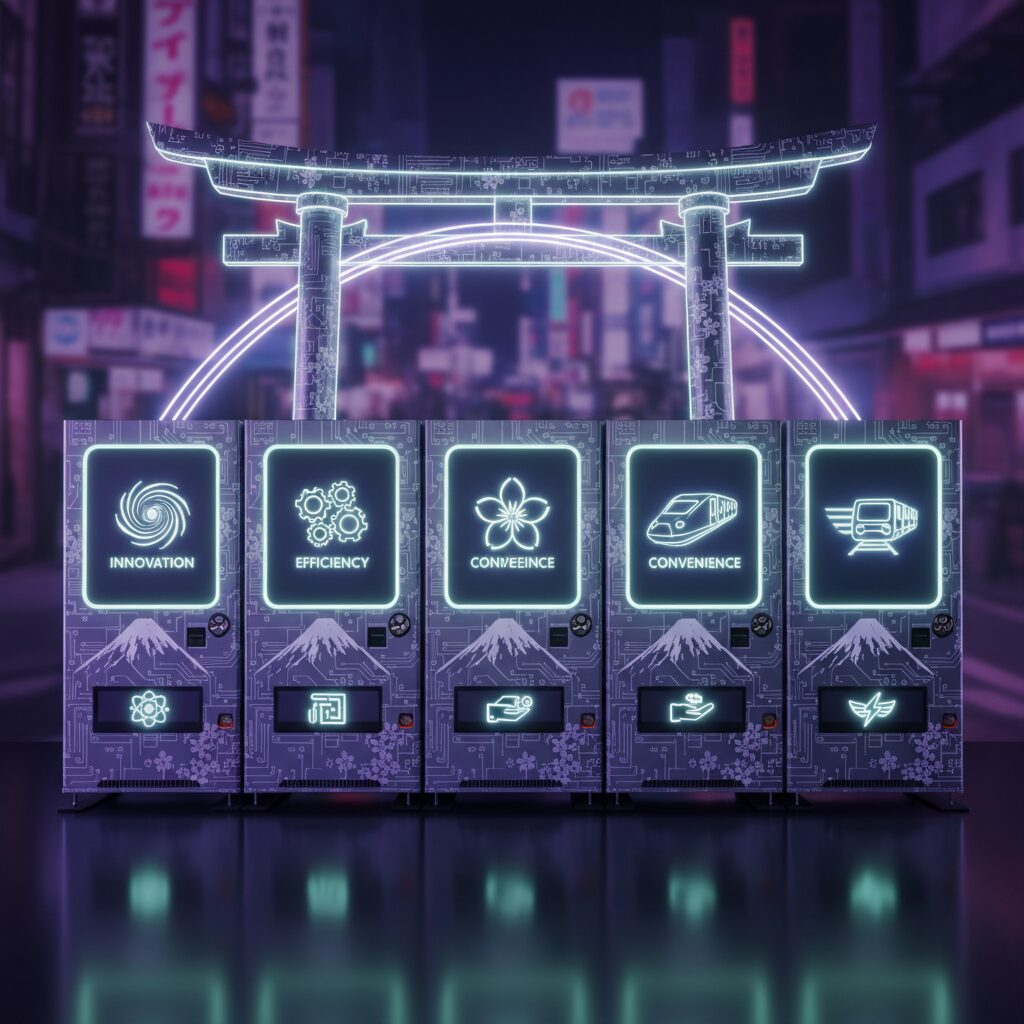
Walk down any street in Japan, and you’ll feel it. It’s not just the orderly flow of people or the hum of a distant train. It’s a quiet, constant presence. On a bustling Tokyo corner, tucked into a quiet Kyoto alley, or standing sentinel on a lonely mountain pass, you’ll find them: the glowing, humming rectangles of the jidōhanbaiki, or vending machine. They are Japan’s silent, tireless retailers, and they are absolutely everywhere.
To a first-time visitor, the sheer number is staggering. It feels less like a convenience and more like a fundamental piece of the urban furniture, as integral as a streetlight or a mailbox. These machines offer far more than the predictable selection of sugary drinks and snacks you might find elsewhere. Here, you can buy a can of hot, sweet coffee on a chilly morning, a bottle of sophisticated fish-based soup stock for your dinner, a crisp apple, a hot bowl of noodles, or even an umbrella during a sudden downpour. They are a 24/7, all-weather lifeline.
The immediate question that follows the initial wonder is a simple one: why? Why does one country have such an astonishingly dense and diverse vending machine culture? The answer isn’t a single, easy soundbite. It’s a complex and fascinating reflection of Japanese society itself—a story of trust, technology, demographics, and a deep-seated appreciation for a particular kind of convenience. The jidōhanbaiki isn’t just a machine that sells you things; it’s a window into the Japanese mindset.
This subtle interplay of innovation and tradition is also evident in Japan’s evolving mask culture, which before the pandemic encapsulated the nation’s blend of practicality and refined aesthetics.
A Nation of Machines: Understanding the Density
Before delving into the cultural context, it’s useful to understand the scale. Japan boasts one of the highest densities of vending machines in the world. Although the numbers vary, estimates commonly suggest there is roughly one machine for every 30 to 40 people. Imagine that—each small classroom or extended family has a dedicated, automated shop ready to serve them. This phenomenon is not limited to cities. While Tokyo and Osaka are densely packed, vending machines can also be found in the most remote rural villages, often grouped near a bus stop or a small local shrine, providing a little beacon of modern convenience amid traditional surroundings.
They line train platforms, ensuring no commuter misses out on a refreshing green tea or a caffeinated boost. They are installed deep inside office buildings, fueling late-night work sessions. You’ll even encounter them partway up hiking trails on mountains like Fuji, offering water and energy-boosting snacks to tired climbers. Their locations aren’t random; they form a carefully planned network intended to fulfill a need exactly when it arises. The system is based on the principle that you should never be more than a few steps away from a cold drink on a hot day or a warm one on a cold day.
The Cultural Bedrock: Why Vending Machines Thrive Here
The mere existence of this automated ecosystem is made possible by several fundamental pillars of Japanese society. Without these, the entire system would collapse under the pressures of theft, vandalism, and logistical issues. It relies on a distinctive combination of social trust and economic pragmatism.
The Unspoken Contract of Public Safety
This is arguably the most crucial element. Japan experiences remarkably low levels of petty crime and vandalism. You can set up a machine stocked with cash and valuables on a poorly lit side street, and the prevailing expectation is that it will remain undisturbed. There’s no need for heavy cages or stringent security measures. This isn’t due to aggressive policing but a deeply rooted social respect for public and private property. Tampering with a vending machine is simply not something most people would consider. It breaches a powerful, unspoken social agreement.
This high-trust atmosphere allows vending machines to be economically viable. Owners don’t have to worry about significant losses from theft or damage, costs that would render the model impractical in many other places. These machines quietly demonstrate a society where people generally act rightly, even when no one is watching.
The Labor Question and an Aging Population
Japan faces a notable demographic challenge: a rapidly aging population alongside a shrinking workforce. Securing staff for 24/7 service jobs is both difficult and costly. The jidōhanbaiki offers a refined technological solution. One worker can restock and maintain dozens of machines per day, which is a far more efficient use of labor than staffing an equal number of small kiosks or shops. These machines deliver round-the-clock access to goods without requiring continuous human presence.
This economic reasoning explains why such machines appear in locations where a convenience store would not survive—quiet residential areas, low-traffic business parks, or remote scenic spots. The machine meets the needs of a small population without the expenses of a full retail operation. It exemplifies Japan’s practical adoption of automation to address societal challenges.
A Culture of Convenience and Efficiency
Life in Japan, particularly in urban areas, moves at a fast pace. There is a strong cultural appreciation for anything that saves time and removes obstacles from everyday routines. Vending machines perfectly embody this mindset. The transaction is smooth and anonymous. There’s no need for small talk, waiting in line, or searching for the right words. You insert coins or tap your IC card (such as a Suica or Pasmo), choose your product, and it’s dispensed within seconds.
This focus on efficiency extends to the products themselves. The canned coffee craze is a prime example. Japan’s “salarymen” and office workers often need a quick caffeine boost. Vending machines provide a wide range of choices, from sweet and creamy to strong and black, served hot or cold from the same machine. You can grab one on your way to the station, enjoy it during your commute, and then easily recycle the can in bins conveniently placed next to the machine. It’s a complete, self-contained ritual of convenience.
Beyond Drinks: An Endless Catalog of Automated Goods
While beverages account for the vast majority of vending machine sales, it’s the remarkable variety of other products that truly sparks the imagination. These machines are incredibly adaptable, tailored to meet the hyper-specific needs of a location and its people.
From Hot Meals to Farm-Fresh Staples
In some parts of Japan, you can find machines that function as miniature, automated restaurants. These retro-style vendors, commonly located at highway rest stops or in older game centers, serve hot food like ramen, udon noodles, toasties, and even french fries. They represent an earlier generation of vending technology but persist thanks to a mix of nostalgia and practical convenience.
Even more surprising to outsiders are machines that sell everyday grocery items. In rural areas, you might find machines offering fresh eggs from a local farm, bags of rice, or loaves of bread. A particularly well-known example is the dashi vending machine, which dispenses bottles of artisanal soup stock. These machines are not mere novelties; they fulfill a vital role by acting as lifelines for communities without a supermarket within easy walking distance. They connect local producers and consumers with automated efficiency.
Meeting Niche Needs on Demand
The true genius of the jidōhanbaiki lies in their adaptability. They are often stocked with items specific to their location. Near a business district, you might find a machine selling neckties or dress socks for an unexpected meeting or wardrobe mishap. Outside a train station, an umbrella machine will see heavy use on rainy days. In tourist areas, they might offer local souvenirs or character goods.
There are machines for batteries, disposable cameras, surgical masks, and ice cream. The gachapon, or capsule toy machines, are a related phenomenon, distributing collectibles and trinkets with the same automated charm. This specialization reflects a keen understanding of situational needs. The machine anticipates what you might require, precisely where you might need it, and delivers it instantly.
The Machine as a Social Landmark
Over time, the jidōhanbaiki has evolved into more than just a retail channel. It has become an integral part of the country’s social fabric, subtly yet significantly woven into the everyday landscape. Its function goes beyond simple commerce.
At night, especially on quiet residential streets, the bright light of a vending machine offers a comforting presence. It casts a small pool of illumination and a sense of safety, acting as a silent guardian on an otherwise dark corner. People naturally use them as landmarks. “Meet me by the vending machines near the park” is a common and easily understood direction.
They also provide a moment for private reflection. For an office worker, stepping out to grab a canned coffee from the machine offers a brief respite, a few minutes of quiet solitude away from the pressures of the desk. For students walking home, it serves as a social spot, a place to pause and chat with friends over a cold drink. The machine itself may be impersonal, but it creates a space for these small, personal human interactions.
Moreover, the system encourages a sense of civic duty. Nearly every vending machine is equipped with a recycling bin specifically designed for the bottles and cans it dispenses. The expectation is clear: consume your drink, and promptly dispose of the container properly. It’s a small, elegant cycle of consumption and responsibility that unfolds millions of times daily across the country.
The Evolving Face of Automation
The world of the jidōhanbaiki is constantly evolving. As technology advances, so do the machines. Traditional coin-and-button interfaces are increasingly being replaced by large, interactive touch screens. These new machines can showcase animations, nutritional details, and targeted advertisements. Payment methods have also modernized, with nearly all new machines accepting the tap-and-go convenience of IC cards and other forms of e-money.
Some of the most sophisticated machines are being integrated into the national infrastructure in unexpected ways. Following natural disasters, certain models are programmed to dispense their entire stock of beverages for free, offering a crucial source of hydration to affected residents and emergency responders. This shifts their role from a commercial convenience to a genuine public service utility.
Ultimately, the Japanese vending machine serves as a perfect microcosm of the society it serves. It reflects a high-trust, low-crime environment. It offers a practical solution to demographic and economic challenges. It embodies an ongoing quest for convenience and efficiency. It is quiet, dependable, and fulfills its purpose with minimal fuss. The next time you spot one on a Japanese street corner, take a moment to look closer. You’re not just seeing a box that sells drinks; you’re seeing a reflection of Japan itself.