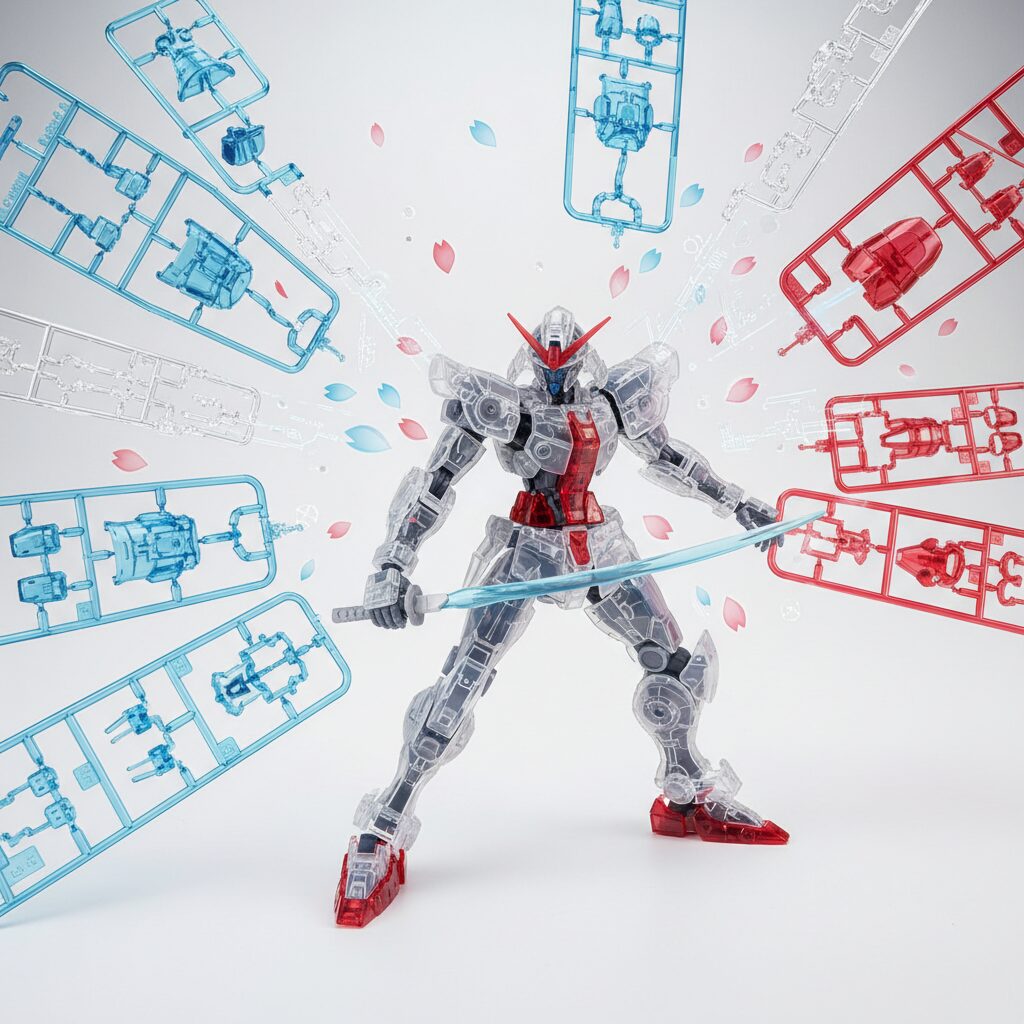
When you picture a hobby in Japan, your mind might jump to the serene precision of a tea ceremony, the focused intensity of martial arts, or maybe the vibrant chaos of a cosplay convention. You probably don’t picture a salaryman, home after a ten-hour workday, sitting alone at his desk, meticulously sanding a plastic shard the size of a rice grain. Yet, for millions of Japanese adults, this is their sanctuary. This is the world of puramo, or plastic models, a subculture that has elevated a simple pastime into a form of active mindfulness, a quiet rebellion against the relentless pace of modern life.
Forget the crude airplane models you might have slapped together with sticky, toxic glue as a kid. In Japan, puramo is a serious pursuit, a deeply involved craft where the process is just as important, if not more so, than the finished product. It’s a universe of hyper-detailed kits, specialized tools, and techniques honed over decades. It’s an analog escape, a tangible act of creation in an increasingly digital and abstract world. To understand puramo is to understand a key aspect of the modern Japanese psyche: the deep-seated need to find order, control, and beauty within a small, manageable space, whether it’s a tiny apartment, a bento box, or the cockpit of a 1/72 scale Zero fighter.
Drawing a parallel with the mindful intricacies of puramo, the innovative pulse of Japanese city pop also reflects Japan’s unique ability to transform everyday hobbies into profound cultural expressions.
From Post-War Pastime to a Nation’s Obsession

The story of puramo goes beyond being merely a hobby; it is deeply intertwined with Japan’s post-war recovery. During the 1950s and 60s, as the country rebuilt itself into an industrial powerhouse, plastic models emerged as symbols of modernity and manufacturing skill. Companies like Tamiya, headquartered in Shizuoka—now recognized as the global capital of plastic models—began by producing wooden models before embracing the precision and possibilities of plastic injection molding. Their early kits, often featuring military vehicles and cars, were praised for their accuracy and engineering. These were not just toys; they were intricate replicas and educational tools that enabled a generation of children to hold complex machinery in their hands.
However, the true cultural breakthrough came in 1979 with an anime that changed the landscape: Mobile Suit Gundam. The show portrayed giant humanoid robots not as invincible heroes, but as realistic, mass-produced weapons of war. They could be damaged, run out of ammunition, and required maintenance. This gritty realism struck a deep chord. When Bandai launched the first Gunpla (Gundam plastic model) kits in 1980, they were offering more than just toy robots—they were offering fans a tangible piece of that universe. Fans could now assemble the very machines they saw on screen, sparking a phenomenon.
Gunpla revolutionized the market single-handedly. It established a direct, powerful connection between beloved media and a physical, interactive product. As the first generation of Gundam fans matured, their expectations evolved. They demanded greater detail, complexity, and articulation. Bandai met this demand by developing increasingly sophisticated kits aimed at adults. This advancement propelled the entire industry forward, creating an environment where building models was not something one outgrew, but something one grew into.
The Anatomy of the Box: A Masterclass in Design
To truly understand what sets Japanese puramo apart, you need to begin with what’s inside the box. Opening a modern kit from companies like Bandai, Tamiya, or Kotobukiya is an experience in itself. There’s no chaotic pile of loose parts; instead, you’re met with neatly packed plastic frames called “runners” or “sprues.” Each runner showcases remarkable precision engineering, featuring dozens, sometimes hundreds, of perfectly molded parts connected by tiny gates.
There’s a subtle elegance to it. The lines are sharp, the details incredibly fine—tiny rivets on an aircraft wing, the texture of a soldier’s uniform, the intricate panel lines on a robot’s armor. This goes beyond manufacturing; it’s a form of industrial artistry. Many kits now employ multi-color injection molding, allowing a single part to be produced in multiple colors, greatly reducing the need for painting and making the hobby more accessible to beginners.
The instruction manual is another crucial element. Typically a small booklet, it is filled not with dense text but with clean, clear, step-by-step diagrams. It serves as a universal language of arrows, numbers, and symbols that guides you through complex assembly with minimalist elegance. Following these instructions feels less like a task and more like decoding a blueprint. You engage in a silent dialogue with the kit’s designers, admiring the clever engineering as you watch a dozen flat plastic pieces come together to form a three-dimensional, functional part, such as a fully articulated hand for a giant robot.
The kits themselves are often classified by difficulty and detail levels, especially within Gunpla. There’s the straightforward High Grade (HG), the more intricate Master Grade (MG), and the highly detailed, multi-layered Perfect Grade (PG), which can consist of over a thousand parts. This tiered system offers a clear path for growth, allowing builders to progress from a simple weekend project to a months-long challenge that continuously tests their skills.
The Ritual of the Build: A Path to Flow State
The true core of the puramo experience resides in the building process. It is a careful, intentional ritual that requires total concentration. This isn’t about rushing to the finish. For most builders, the hours spent at their desk become a form of meditation—a way to silence the outside world and enter a deep state of focus, often referred to as a “flow state.”
The Workspace as a Modern Dojo
Every dedicated builder has a special area. Whether it’s a corner of their apartment or a fully equipped workshop, it always serves as their personal sanctuary. The centerpiece is the cutting mat, a self-healing surface marked by the traces of countless projects. Surrounding it are the essential tools, each with a distinct purpose. There are the nippers for clipping parts from the runner; the hobby knife for removing leftover nub marks; files and sandpaper in various grits for smoothing plastic to a flawless finish. Then come the more advanced tools: panel-lining pens to highlight details, tiny brushes for hand-painting, and perhaps an airbrush for achieving smooth, professional-quality paint jobs.
This space is organized, practical, and personal. It represents a microcosm of control. In a life often filled with crowded trains, open-floor offices, and constant digital interruptions, the builder’s desk becomes a realm of complete command. Every tool has its place, and every action serves a clear purpose. It’s a contemporary take on the traditional craftsman’s workshop.
The Process is the Purpose
Building is a series of small, repetitive, and deeply rewarding tasks. You snip a part from the runner with a crisp click. You carefully remove the tiny plastic nub where it was attached. You feel the plastic smooth beneath the gentle friction of a fine-grit sanding stick. Each step is a little problem solved, a small piece of perfection attained. There is immense tactile satisfaction in fitting two parts together with a firm, gratifying snap—a testament to the kit’s precise engineering.
The process is methodical. You assemble the kit section by section: the head unit, torso, arms, legs, weapons. As each component is finished, a sense of progress builds, watching a complex machine emerge under your hands. The focus required is absolute. When applying a water-slide decal smaller than a sesame seed onto a miniature figure’s shoulder, your mind has no space for work stress or social worries. Your world narrows to the tip of your tweezers. This is the essence of its meditative power. It doesn’t empty your mind; rather, it fills it so fully with a single, tangible task that everything else fades away.
This reflects the Japanese concept of shokunin, the spirit of craftsmanship. It embodies dedication to a craft and a pursuit of perfection, no matter how small the task. A puramo builder is not merely assembling a toy; they are practicing a discipline, refining skills in cutting, sanding, painting, and weathering. They are on a path toward their own version of mastery.
The Modern Builder: A Profile in Quiet Defiance

So who is the person spending their evenings and weekends immersed in this world of plastic and paint? The stereotype of the reclusive, socially awkward nerd is seriously outdated. Today’s puramo builder in Japan might just as well be a doctor, designer, programmer, or parent. They come from all walks of life, connected by a shared desire for a different kind of interaction with the world.
For many, especially office workers, the hobby serves as a direct counterbalance to the abstraction of their professional routines. Much of modern work involves staring at screens, attending meetings, and sending emails—activities that seldom produce a finished, physical result. After a long day, there is often little to show beyond an empty inbox. Building a model offers a completely different experience. It is a concrete, hands-on process that yields a physical object you can hold, display, and take pride in. It’s a powerful statement: “I made this with my own hands.”
It also provides a vital break from the dominance of screens. In a world saturated with digital media, puramo stands as a defiantly analog activity. It engages your fine motor skills, spatial reasoning, and tactile sense in ways that mindless scrolling on a smartphone never could. It reclaims leisure time, transforming passive consumption into active creation.
There is also a strong element of nostalgia. Many adult builders are men in their 30s, 40s, and 50s reconnecting with a hobby from their youth, but now with the patience, resources, and expertise of adulthood. They might be assembling the same Gundam or battleship they cherished as children, but this time they are doing it “right”—meticulously sanding each part, carefully painting every detail, and using advanced weathering techniques to achieve realism. It’s a way of honoring their past while demonstrating their current skill.
A Community Built on Shared Passion
While building is often a solitary activity, the puramo subculture is surprisingly social. This community flourishes both online and offline, providing a space for builders to showcase their work, exchange techniques, and find camaraderie. Websites and social media platforms abound with galleries of completed models, ranging from pristine, out-of-the-box builds to heavily customized and weathered dioramas that are true works of art.
The tone within these communities is overwhelmingly positive and supportive. The emphasis is on mutual respect for the time, skill, and passion invested. Builders share their works-in-progress, seeking advice on challenging painting techniques or complex modifications. Others respond with helpful suggestions and words of encouragement. It’s a collaborative environment aimed at elevating the craft for everyone.
Offline, hobby shops organize local building competitions, and major manufacturers like Bandai sponsor large international events like the Gunpla Builders World Cup. These events showcase incredible creativity and technical skill. Models feature custom LED lighting, intricate dioramas depicting epic battle scenes, and paint jobs so flawless they resemble computer renderings. Yet, even in these competitive settings, the atmosphere remains one of shared admiration. Builders walk among the displays, closely examining each other’s work, marveling at clever modifications or stunningly realistic rust effects. It’s a community founded not on rivalry, but on a shared passion for a demanding craft.
Ultimately, puramo is much more than just a hobby. It serves as a cultural touchstone reflecting a desire for order, respect for craftsmanship, and a need for a tangible connection to the world. It is a quiet space where patience is rewarded, focus brings peace, and a box of plastic parts can be transformed into a small, perfect universe of one’s own creation. Amid the hum of the city, behind the closed doors of countless apartments, this silent, focused work continues—a testament to the enduring human urge to create, perfect, and find a moment of quiet zen in an otherwise noisy world.