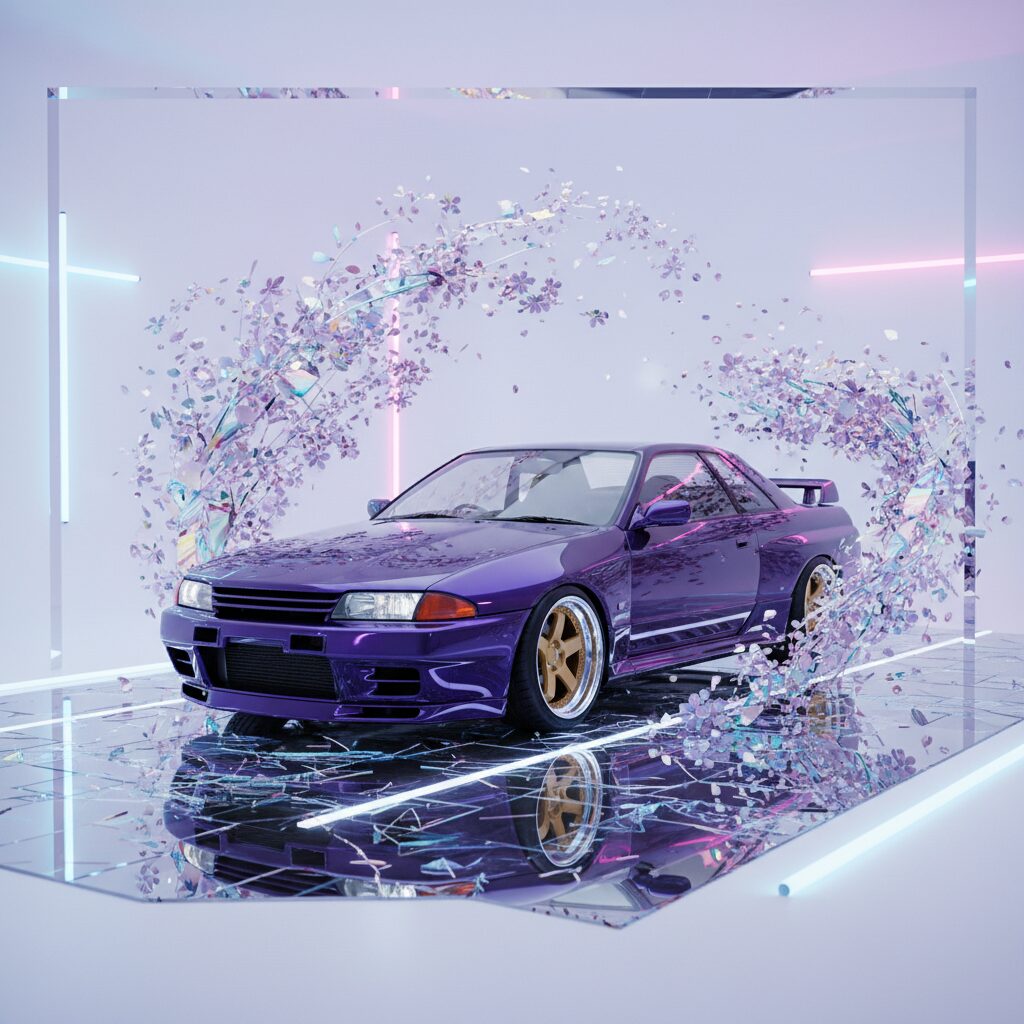
Ask someone outside Japan what “JDM car culture” means, and you’ll likely get a cinematic highlight reel in response. Drifting through mountain passes in a souped-up Toyota AE86. Neon-drenched Nissan Skylines tearing through Tokyo highways. The whole scene feels ripped from a video game or an action movie, a world powered by nitrous oxide and a singular obsession with being the fastest.
And while that high-octane image isn’t entirely fiction—speed is certainly part of the equation—it’s a dramatic oversimplification. It’s like describing painting as just the act of covering a canvas as quickly as possible. The Western lens often focuses on the horsepower, the quarter-mile times, the competitive aspect. But to truly understand the soul of Japanese car customization, you have to look past the finish line. On the ground, here in Japan, the culture is often less about outright performance and more about a deeply personal, almost fanatical, form of self-expression. It’s a world where craftsmanship, aesthetic identity, and meticulous detail are the real currencies. This isn’t just about building a faster car; it’s about building your car, a machine that is an uncompromising extension of your personality, your taste, and your place in a vibrant subculture.
This pursuit of authentic personal expression extends well beyond automotive customization, as evidenced by the subtle artistry of crafting an idealized self in Japan’s purikura culture.
The Meaning of “Made in Japan”
First, let’s clarify the term itself. JDM stands for “Japanese Domestic Market.” In its truest sense, it refers to cars and parts manufactured specifically for the Japanese market. These vehicles often featured different specifications—sometimes more powerful engines, unique features, or distinct styling—compared to their export-market versions. For international enthusiasts, owning a genuine JDM car or part was a mark of authenticity, a piece of the real deal.
Over time, however, “JDM” has evolved into a global catch-all term for a particular style: clean lines, practical modifications, and a subtle coolness. Yet the philosophy behind this style is rooted in a much broader Japanese cultural concept: monozukuri. This word roughly translates to “the art of making things,” though that doesn’t fully capture its significance. Monozukuri is a mindset, a national ethos that values craftsmanship, continuous improvement, and deep pride in the manufacturing process. It’s the spirit that helped transform Japan into a global leader in electronics and automobiles after the war.
This principle directly influences car customization. An owner modifying their car isn’t just attaching parts—they are practicing their own form of monozukuri. The emphasis is on the process—the thoughtful choice of components, the precision of the installation, and the harmony of the finished product. An engine bay isn’t merely a jumble of tubes and wires; it can be a work of art, with every hose expertly routed, every wire neatly tucked away, and every metal surface polished to a mirror shine. This isn’t about performance alone. It’s about the satisfaction of creating something perfect, even if it’s a part of the car most people won’t see.
This stands in stark contrast to some other car cultures, where the loudest, most powerful, and most ostentatious car wins. Here, there is a profound respect for kodawari—an obsessive attention to the smallest details. It’s the difference between simply adding a turbocharger and meticulously engineering the entire system so it not only performs flawlessly but also looks like it came from the factory that way, only better. This quest for perfection is a quiet dialogue between the owner and the machine.
A Canvas on Four Wheels: Styles as Identity
Because the focus is on self-expression rather than a single measure like speed, Japanese car culture has fragmented into a captivating variety of highly specific and visually unique sub-genres. Each style possesses its own history, rules, and philosophy. To belong to a style is to communicate through a distinct visual language.
VIP Style: The Understated Overlords
VIP Style, or bippu as it’s called in Japanese, perfectly exemplifies style over speed. The canvas is not a nimble sports coupe but a large, premium Japanese sedan—a Toyota Crown, a Nissan Cima, or a Lexus LS. The aim is to evoke an aura of imposing, luxurious presence, reportedly inspired by Yakuza vehicles.
These cars are lowered to the ground, often using air suspension, with wheels tucked deeply into the fenders. The wheels themselves are essential: large-diameter, deep-dish, and polished to a dazzling shine. Colors are almost exclusively monochromatic—gloss black, pearl white, deep silver. Loud graphics or massive spoilers are absent here. The statement is made through stance, fitment, and an almost architectural sense of proportion. The interior is equally important, featuring custom leatherwork, window curtains, and plush neck pillows. A bippu car isn’t built for racing; it’s made to cruise slowly, projecting an image of quiet, almost intimidating power. It’s about presence, not performance.
Shakotan and Zokusha: The Rebels’ Roar
At the opposite end of the spectrum lies the world of shakotan (literally “low car”) and the broader zokusha (“gangster car”) culture, which developed from the rebellious bosozoku motorcycle gangs of the 70s and 80s. If bippu embodies subtle intimidation, zokusha represents loud, unapologetic defiance.
These are older cars, typically from the 70s and 80s, modified with wildly exaggerated features. Imagine vehicles lowered almost to the point of being undriveable, with stretched tires, massive front spoilers scraped raw from pavement contact, and ridiculously long, upward-facing exhaust pipes called takeyari (“bamboo spears”). External oil coolers with braided lines often run across the front grille, and bolt-on fender flares look like they were riveted on in an alleyway. The aesthetic is deliberately aggressive and impractical. It’s a visual middle finger to mainstream society and automotive norms. It has absolutely nothing to do with going fast in a straight line or around curves. The entire point is the look—a look that screams rebellion and a nostalgic affection for a bygone era of Japanese delinquency.
Itasha: Wearing Your Heart on Your Fender
Perhaps the most misunderstood style outside Japan is itasha. The name literally means “painful car,” with “pain” being a self-deprecating reference to how cringeworthy or embarrassing it may seem to outsiders. An itasha is a vehicle covered bumper to bumper in elaborate vinyl wraps featuring characters from anime, manga, or video games.
This is the ultimate blend of car culture and otaku (geek) culture. For its owner, the car becomes a mobile shrine to their favorite character or series. The level of artistry and expense involved can be staggering. These are not mere stickers; they’re often custom-designed, professionally printed, and meticulously applied full-body wraps. The focus is completely on the visual tribute. The car’s performance is almost irrelevant. You’re just as likely to see a cute, anthropomorphized anime girl on the side of a modest Suzuki Wagon R as on a high-performance Nissan GT-R. Itasha culture is about community and passion. Owners gather at events to showcase their creations and bond over their shared love of both cars and Japanese pop culture. It is the most literal form of self-expression—turning your car into a declaration of your passions.
Kei Cars: The Art of the Small
Lastly, no discussion of Japanese car culture is complete without mentioning the vibrant world of kei cars. These are Japan’s unique category of microcars, with engine sizes capped at 660cc and strict overall size limits. They stem from Japan’s narrow streets and tax regulations. Naturally, a massive scene has developed around modifying them.
Kei car tuning is a testament to creativity born from limitation. You can’t extract immense power from a 660cc engine, so the focus shifts elsewhere. Some owners meticulously replicate famous sports cars, creating miniature, cartoon-like versions of GT-Rs or Lancers. Others adopt the shakotan style, slamming their tiny vans and hatchbacks to the ground. There are off-road kei trucks lifted on massive tires, and turbocharged kei sports cars like the Honda S660 or Daihatsu Copen tuned for nimble handling on tight mountain roads. The kei scene is playful, inventive, and uniquely Japanese. It embodies the idea of making the absolute most of what you have, finding beauty and fun within strict limitations.
The Parking Area as a Cathedral
The social hub of this culture isn’t the racetrack; it’s the parking lot. Late at night, especially on weekends, large parking areas (PAs) along Japan’s major highways, like the famous Daikoku Futo PA near Yokohama, turn into living museums of automotive culture. These gatherings are not illegal street races but informal, spontaneous car shows.
People don’t come here to race. They come to park, to observe, and to be noticed. Every subculture imaginable is represented. A line of polished bippu sedans will be parked beside a group of roaring zokusha, facing a vibrant cluster of itasha. Owners open their hoods and trunks, not to boast about horsepower, but to showcase the craftsmanship of their engine bays or the intricacy of their audio systems.
There’s a quiet, mutual respect. People stroll around, appreciating the effort put into each vehicle. They recognize the hours of work, the financial commitment, and the passion involved. Conversations between strangers might not focus on “How fast is it?” but rather “How did you achieve that perfect wheel fitment?” or “Where did you find that vintage part?” The car serves as a conversation starter, a tangible expression of its owner’s dedication. This social ritual is the bond that unites the scene. It’s a community founded not on competition, but on shared admiration for a highly personal craft.
In the end, JDM culture mirrors the society that shaped it. It’s a world where the group matters, yet individuality is expressed through careful dedication to a craft. The car is merely the medium. It’s a way to stand out in a society that values conformity, a way to be bold in a culture that emphasizes quietness. It’s not always about the adrenaline rush of speed; it’s about the deeper fulfillment of creating something unique, detailed, and unmistakably your own.