You’ve probably seen the signs, even if you didn’t know what you were looking at. A woman on the train with a tote bag window displaying a meticulous, almost alarming, number of keychains and badges—all featuring the same pastel-haired anime character. A pop-up café in Shibuya with a two-hour queue, not for the food, but for the limited-edition acrylic stand that comes with a themed parfait. A friend who suddenly plans their entire vacation around visiting a provincial town because it was the setting for a minor scene in a TV show. This isn’t just being a fan. This is something else entirely. This is oshikatsu.
On the surface, the word translates easily enough. Oshi (推し) comes from the verb osu, meaning “to push” or “to endorse.” It’s the person or character you champion. Katsu (活) is short for katsudou (活動), meaning “activity.” So, oshikatsu is, literally, “the act of pushing your favorite.” But this simple translation misses the sheer gravitational pull of the concept. It’s the difference between saying you like astronomy and dedicating your life to building a spaceship. In Japan, oshikatsu has evolved from a niche slang term into a mainstream lifestyle—a powerful engine for identity, community, and personal fulfillment that reshapes how people spend their time, their money, and their emotional energy. It’s not a hobby that fits into your life; it’s a core around which a life is built.
This relentless passion for one’s favorite goes beyond typical fandom, echoing a broader cultural devotion that can also be seen in the onsen’s unspoken codes where personal identity meets traditional nuance.
From ‘My Fave’ to ‘My Oshi’: A Crucial Distinction
To truly grasp oshikatsu, you first need to appreciate the significance of the word oshi. In English, we have a range of affection — favorites, crushes, idols. We “stan” someone. But an oshi is a declaration. It’s a singular commitment. You don’t merely admire your oshi from afar; you actively support them, invest in their success, and feel a genuine sense of responsibility for their journey. When their album climbs the charts or their anime gets renewed for a second season, it feels like a personal triumph.
This isn’t limited to J-pop idols or boy bands, although they are a major part of the scene. Your oshi can be anyone or anything. It might be a stoic supporting character in a video game, a specific actor from the Takarazuka Revue, a voice actor (seiyuu) you recognize from just a single syllable, a K-pop group, a historical figure from the Sengoku period, or—even more surprisingly—a particular Shinkansen train model. The object of affection almost takes a backseat to the structure of devotion itself. The relationship is parasocial, naturally, but the commitment is real. It’s a one-way street paved with genuine dedication.
This marks a fundamental difference from much of Western fan culture, which often revolves around critique or a more casual appreciation. In oshikatsu, the main focus is support. You buy their merchandise not simply because you want it, but because your purchase helps their success. You celebrate their birthday as if they were a close friend. This shift from passive consumption to active participation is the driving force behind the entire phenomenon.
The Anatomy of Oshikatsu: A Universe of Ritual and Consumption
So what does this active support actually look like? Oshikatsu is a highly organized world with its own rituals, language, and sacred artifacts. It consists of a series of intentional actions that shape abstract feelings of devotion.
The Pilgrimage for ‘Goods’
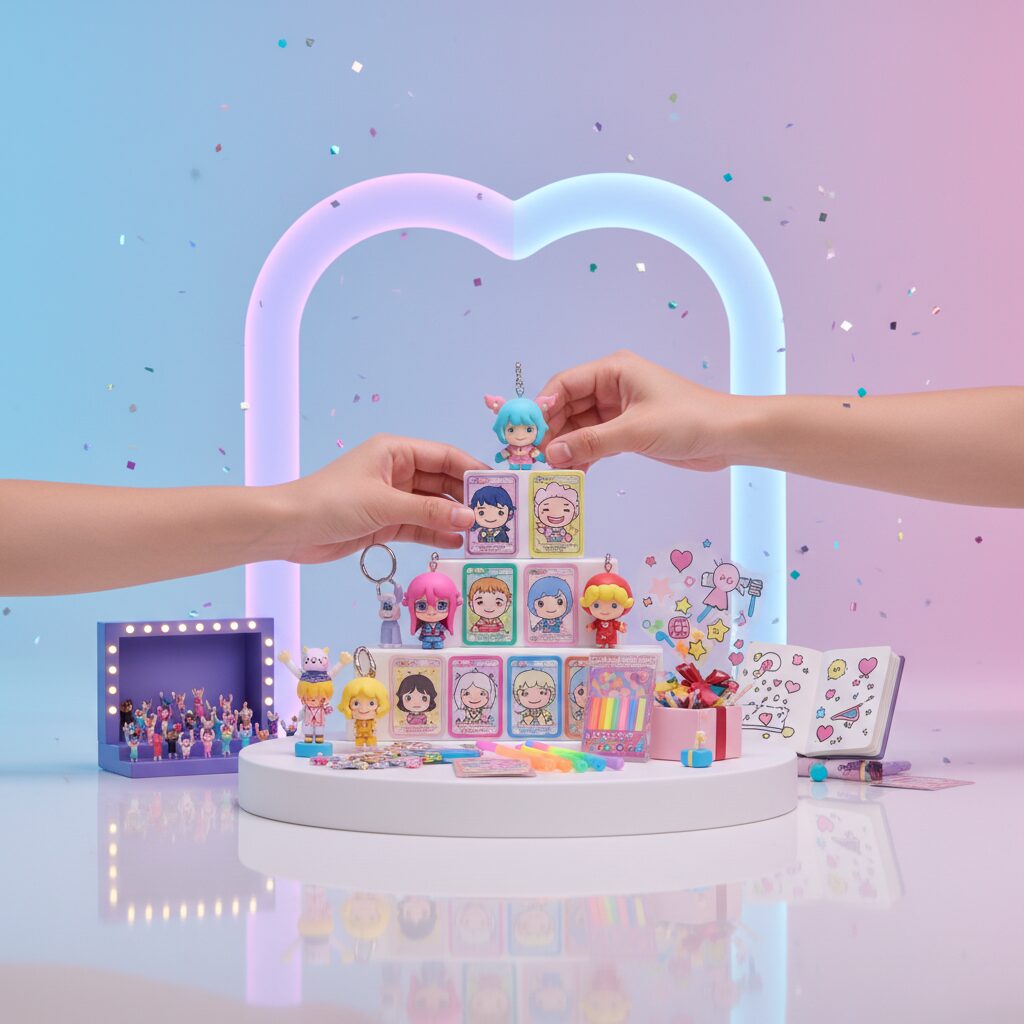
Merchandise, commonly called guzzu (グッズ, derived from the English word “goods”), is the heart of oshikatsu. But this is more than just buying a concert t-shirt. It involves acquiring specific, often limited-edition items that reflect your level of dedication. The most prized goods include acrylic stands (akusuta), character-themed keychains, and collectible pin badges (kan bajji).
Frequently, these goods come in “blind boxes,” where the character inside remains a mystery until opened. This turns collecting into a form of gambling, encouraging a lively trading culture both online and offline. You’ll find groups of fans gathered outside stores in Ikebukuro or Akihabara, spreading out their duplicate items on cloths, hoping to trade for their oshi. The quest for these goods is itself a journey—a pilgrimage demanding careful planning, patience, and often considerable expense.
The ultimate expression of this is the itabag (痛バッグ), which literally means “painful bag.” It’s a handbag or backpack, generally with a clear vinyl window, filled to the brim with merchandise featuring a single character. Far from being embarrassing, an itabag is a public declaration of love—a meticulously curated shrine you carry around. It instantly signals your identity to other fans, acting as a silent invitation into the community. It says, “This is who I am. This is what matters to me.”
Crafting the Altar: The Birthday Shrine
One of the most captivating rituals is the seitan-sai (生誕祭), or birthday festival, for one’s oshi. This isn’t a party you attend; it’s a celebration you create. On the oshi’s birthday, fans carefully arrange all their collected goods into a shrine-like display in their home. This often includes dozens of acrylic stands, posters, and photos, all artfully positioned around a centerpiece.
The centerpiece is almost always a custom-ordered cake, decorated with the oshi’s “image color”—a specific hue assigned to each character or idol member. Fans light candles, pour champagne or a symbolic drink, and take beautiful photos of their shrine to share on social media with a dedicated hashtag. It’s a deeply personal, almost reverent way to celebrate someone they have never met. It’s a means of making the parasocial relationship tangible, carving out a physical space in one’s life to honor their existence.
The Communal Experience: Live Shows and Viewing Parties
While much of oshikatsu can be pursued alone, its energy reaches its peak in communal settings. Concerts, stage plays, and fan meetings are the ultimate experiences. Attending these events isn’t passive; it’s a collaborative performance between fans and the star.
Fans come equipped with specific gear, especially the penlight, a battery-powered light stick. At idol concerts, fans might carry a dozen, skillfully changing their colors to match the member singing or the mood of the song. The sight of synchronized, color-shifting lights is stunning. Then there are the fanchants—specific words or phrases shouted by the audience at exact moments in songs. These aren’t random shouts; they’re learned, practiced, and perfectly timed, creating a powerful surge of collective energy that fills the venue. Being part of this experience brings a profound sense of unity and purpose.
Even if you can’t get a ticket, the community finds ways to come together. Fans rent karaoke rooms not to sing but to hold viewing parties for new Blu-ray releases. They bring their penlights and perform the fanchants just like at a live show, replicating the collective joy in a private setting.
Why Here? Why Now? The Social Roots of Devotion
This level of organized, all-encompassing devotion doesn’t simply emerge out of nowhere. Oshikatsu has thrived in Japan due to specific cultural and social factors. It fulfills needs that might otherwise remain unmet in a society characterized by structure, pressure, and a subdued sense of conformity.
A Structured Pursuit in a Structured Society
Japanese culture has long valued the michi (道), or “the way”—the committed, lifelong dedication to a single art or discipline, such as judo (the gentle way) or sadō (the way of tea). Oshikatsu offers a contemporary, accessible, and deeply personal interpretation of this. It presents a clear path with concrete goals. You aim to collect a full set of badges. You save money to attend every performance of a stage play. You strive to perfect your itabag layout. This delivers a gratifying sense of progress and achievement that can feel more immediate and manageable than the traditional routes of career or family.
In a world full of uncertainty, oshikatsu is refreshingly straightforward. Your effort yields results. Your spending has a visible effect. It provides a framework for organizing your time and resources that is profoundly rewarding on its own terms.
Finding Your People: Community and Belonging
Despite its crowded cities, Japan can be a deeply isolating place. The cultural emphasis on harmony and non-imposition (enryo) can sometimes make it hard to form close, expressive friendships. Oshikatsu breaks that barrier wide open. The moment you discover someone else shares your oshi, an instant, profound connection forms. You share a highly specific vocabulary, inside jokes, and a mutual understanding that needs no explanation.
Social media, especially X (formerly Twitter), serves as the central nervous system of this community. It’s where fans coordinate ticket lotteries, arrange merchandise trades, and collectively celebrate an oshi’s latest achievement. It creates a sense of constant, ambient connection to a nationwide network of people who truly get it. This shared identity forges powerful bonds, creating friendships just as real and meaningful as those formed at school or work.
The Economics of Emotion
We also must acknowledge the commercial engine driving this phenomenon. The entire idol and anime industry is expertly crafted to cater to the desires of oshikatsu. Merchandise is released in waves, often linked to specific events and available only for a limited time, fostering a strong sense of urgency. An artist’s success is frequently tied directly to sales figures, so fans feel their financial support acts as a direct vote for their oshi’s future career.
Spending money becomes an expression of love. Buying another CD, even when you already own the music, is about boosting their chart position. It’s a way to contribute tangibly. This creates a symbiotic relationship: fans supply the financial fuel, and in return, the oshi provides the content, the emotional anchor, and the entire world around which the fan’s life can revolve.
The ‘Aha!’ Moment: When a Hobby Becomes an Identity
The real turning point in understanding oshikatsu is recognizing that it’s not ultimately about the object of affection. It’s about the person engaging in the activity. The oshi acts as the catalyst, the focal point, yet the true subject is the fan.
Oshikatsu offers a ready-made identity and a sense of purpose. It answers questions like: What do I do with my free time? Who are my friends? What do I look forward to? Your week revolves around new episode releases or merchandise drops. Your year is planned according to tour schedules. Your oshi becomes a lens through which you view the world. You might pick up a new skill, such as drawing or video editing, to create fan works. You might travel to parts of the country you’d never normally visit because it’s your oshi’s hometown.
Their victories feel like your own. Their challenges inspire you. It’s a form of self-actualization through devotion to an external figure. The happiness gained from celebrating someone else’s success becomes a powerful source of personal joy. It’s a complete, self-contained ecosystem of meaning.
So next time you see that meticulously decorated bag on the train, take a closer look. It’s not just a collection of plastic and metal. It’s a portable shrine, a social signal, and a statement of identity. It embodies a life organized around a passionate, joyful purpose—a purpose that transforms the mundane into the meaningful, one acrylic stand at a time.