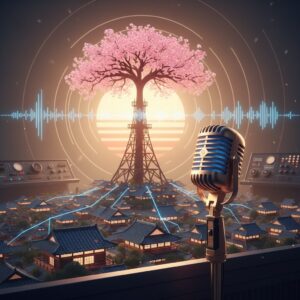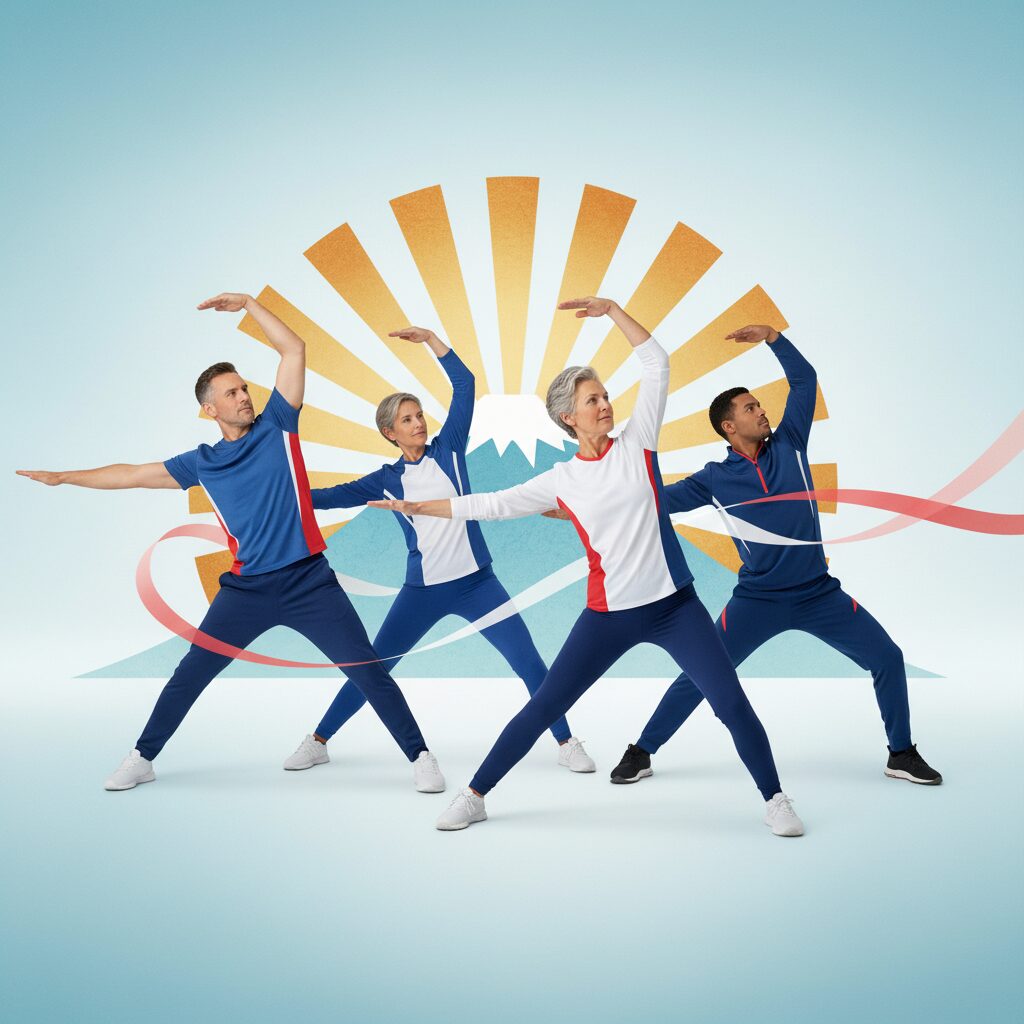
Walk through a Japanese neighborhood park around 6:30 in the morning, especially in the summer, and you’ll encounter a scene that feels like a glitch in the modern world. A small, portable radio, perched on a bench, crackles to life. A gentle but insistent piano melody begins, a tune as instantly recognizable to a Japanese person as their own national anthem. Then, in near-perfect synchrony, the assembled group—retirees in tracksuits, mothers in aprons, sleepy children in their pajamas—begins to move. They stretch their arms skyward, bend their knees, twist at the waist, all in unison. It’s a quiet, three-minute ballet of the everyday. This is Radio Taiso, or Radio Calisthenics, and for an outsider, it can seem both endearingly quaint and slightly baffling. Is it a fitness cult? A mandatory morning ritual? A remnant of a bygone era?
The truth is far more interesting. Radio Taiso is not merely a set of stretches broadcast nationwide every single day. It is a living historical document, a daily ritual that reveals deep truths about Japan’s relationship with community, discipline, and the state. It’s an idea imported from America, weaponized for imperial ambition, banned by occupiers, and then reborn as a symbol of peaceful, collective well-being. To understand this simple morning routine is to understand something fundamental about the forces that have shaped modern Japan. It’s a story of how the past isn’t just remembered here; it’s physically re-enacted, every single day, to the count of a piano.
This enduring cultural practice, steeped in reinvention, resonates with the hidden influence of post-war market legacies that quietly reshaped Japan’s communal spirit.
An American Idea, Remixed for an Empire
One of the most surprising aspects of this quintessentially Japanese tradition is that it actually isn’t Japanese in origin. The concept was directly adopted from the United States. In the mid-1920s, the Metropolitan Life Insurance Company (MetLife) sponsored a fifteen-minute radio program in major American cities promoting guided morning exercises. The reasoning was straightforward and capitalist: a healthier population meant fewer insurance claims and increased profits. It was a public health initiative motivated by corporate interests.
Japanese officials visiting the United States took notice. At that time, Japan was a rising power, a growing empire eager to adopt and adapt Western ideas to support its own national agenda. Two officials from the Postal Life Insurance Bureau (a government agency) were impressed by the potential of the American program. However, they envisioned it serving a far greater purpose than merely reducing insurance payouts. They saw it as a tool for nation-building.
From Health Promotion to National Mobilization
When Radio Taiso was officially launched in Japan in 1928, it was no ordinary health broadcast. Its introduction was timed to coincide with the formal enthronement of Emperor Hirohito, linking the exercises from the very start to the authority and divinity of the state. It was fully supported by the government and broadcast by the national radio network that would become NHK. The aim was not only to enhance individual health but to cultivate kokumin kenkō—national health. A strong nation required strong and unified citizens, and Radio Taiso was designed to create them, one synchronized stretch at a time.
This was not about personal comfort; it was about being a loyal subject of the Emperor. The program was broadcast in schools, factories, and neighborhood associations throughout the country. Participation was encouraged and often implicitly mandated. It became a tool for instilling virtues seen as vital to an industrializing, militarizing society: punctuality, discipline, and above all, collective action. Waking up and moving together with millions of unseen compatriots reinforced a powerful sense of national unity. Your body was not merely your own; it was a resource for the nation. Maintaining its health and readiness was a patriotic obligation. The simple act of a morning stretch was transformed into a daily pledge of allegiance, expressed not through words but through the body itself.
The Post-War Purge and Unlikely Revival
The end of World War II brought the American occupiers, led by General Douglas MacArthur’s Supreme Commander for the Allied Powers (SCAP), to Japan. Their mission was to demilitarize and democratize the country, dismantling the ideological foundations that had led to war. In this extensive cultural purge, even the modest morning exercise routine was closely examined.
Banned as a Tool of Militarism
To the American occupiers, Radio Taiso was seen as tainted. They viewed it as part of the totalitarian state apparatus—a means of mass conditioning designed to ready the Japanese population for war. The synchronized, uniform movements were considered too militaristic, and the collectivist spirit too closely aligned with the emperor-worshiping nationalism they aimed to eliminate. In 1946, the broadcasts were officially discontinued. The familiar piano music that had served as the nation’s alarm clock for nearly twenty years fell silent. The occupation authorities believed they were freeing the Japanese people from another form of state control.
Reborn for a New, Democratic Japan
What the occupiers had not fully realized was how deeply the routine was ingrained in everyday life. People genuinely missed it—the structure, the communal activity, and the straightforward physical benefits. Public demand for its return steadily increased. Thus, in 1951, just before the end of the occupation, a new and improved Radio Taiso was reintroduced.
This was a brilliant act of cultural rebranding. The national broadcaster NHK, together with the Ministry of Education and other public institutions, carefully crafted a new set of exercises. They retained the accessible format and iconic piano accompaniment, but the philosophy was completely transformed. All references to national strength for imperial glory were removed. The new program was explicitly democratic and scientific. The movements were redesigned by medical and physical education experts to promote balanced health for people of all ages. The emphasis shifted from national duty to personal well-being, longevity, and community spirit in a peaceful, rebuilding nation. The same practice once used to forge imperial subjects was now employed to nurture healthy, democratic citizens. It was a phoenix rising from the ashes of war, symbolizing a nation determined to create a new, healthier future.
The Mechanics of a National Habit
Part of Radio Taiso’s lasting brilliance lies in its exceptional design. It is a masterpiece of accessibility and behavioral psychology, crafted to become an easy, lifelong habit. The entire system revolves around simplicity, repetition, and gentle social encouragement.
The Music and the Movements
Central to the experience is the music. The simple, unembellished piano melody is ingrained in the national consciousness. It’s soothing, predictable, and perfectly timed to lead the listener through the sequence of thirteen exercises. The announcer’s clear, supportive voice counts the rhythm—ichi, ni, san, shi (one, two, three, four)—establishing a steady, meditative pace.
There are two main routines. Radio Taiso Dai Ichi (Number One) is the classic version, well-known to everyone. It’s designed for universal participation, aimed at waking up the body and enhancing flexibility and circulation. The movements are gentle and rhythmic: rotating the arms, bending sideways, stretching the chest. Radio Taiso Dai Ni (Number Two) is somewhat more vigorous, intended to build muscle strength and athletic ability. It’s commonly practiced in schools or by office workers seeking a more dynamic warm-up. This two-level system ensures that everyone, from a frail elderly person to a factory worker, can participate at their own pace. The entire routine is a full-body workout condensed into just over three minutes—a marvel of physiological efficiency.
The Stamp Card and the Summer Ritual
For generations of Japanese children, Radio Taiso has been synonymous with summer vacation. While children in other countries might sleep late, Japanese kids have traditionally been expected to gather at the local park or shrine by 6:30 AM for the daily broadcast. The key to ensuring their participation is the rajio taisō kādo—the stamp card.
Each child receives a card with a grid representing every day of the summer break. After completing the exercises each morning, they run to a neighborhood volunteer, often a local parent or elder, to get a stamp. This simple form of gamification is incredibly effective. It provides structure to the long, unstructured summer days. It encourages kids to leave the house and engage with their peers and elders, strengthening community bonds. For parents, it guarantees their children start the day with fresh air and exercise. At summer’s end, a fully or nearly fully stamped card is often rewarded with a small prize—a notebook, candy, or a set of pencils. Though minor, this reward cements the routine as a positive childhood memory, instilling the habit for life. This summer ritual is a foundational experience, a shared touchstone connecting generations.
Radio Taiso in Modern Japan: Relic or Relevant?
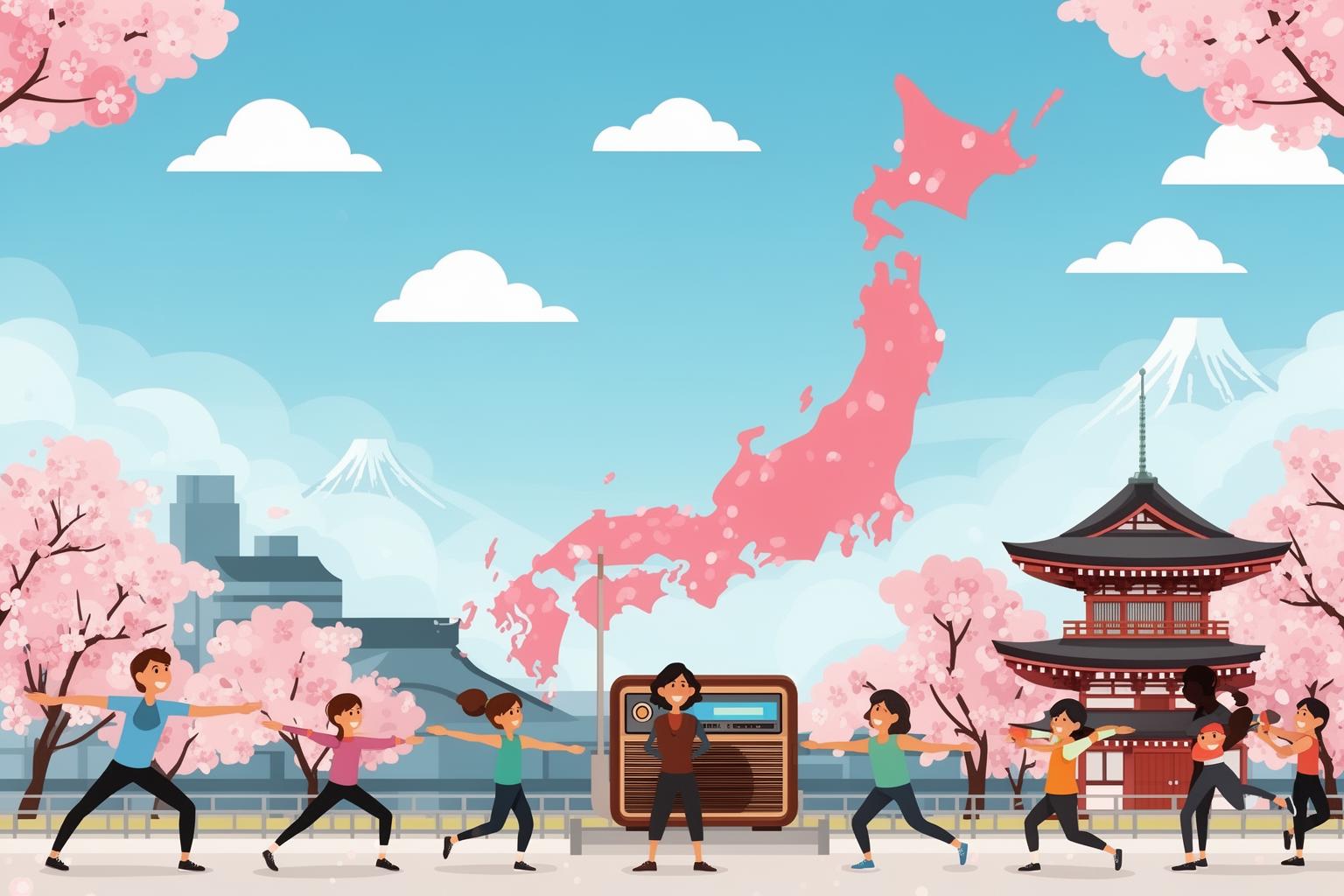
As Japan has evolved into a highly modernized, globalized society, one might assume that a quaint, collectivist practice like Radio Taiso would fade away. In some respects, its influence has diminished. Yet, it continues to show remarkable resilience, adapting its role to meet the demands of contemporary life.
In Parks, Schools, and Factories
Radio Taiso is no longer ubiquitous, but it remains present in specific, significant areas of Japanese daily life. The most prominent participants are the elderly. For many retirees, the morning gathering in the park forms the foundation of their daily routine. It provides gentle exercise, helps alleviate the aches of aging, but most importantly, serves as a social anchor. It offers an opportunity to greet neighbors, share news, and combat the loneliness that often comes with old age. The routine gives them a reason to leave the house every day.
In the workplace, its use is more selective. While a sleek Tokyo tech startup is unlikely to begin the day with synchronized stretches, many traditional manufacturing companies, construction firms, and some municipal offices still maintain the practice. Here, it functions both as a practical warm-up to prevent injuries and as a team-building activity. Moving together, even for just three minutes, is thought to promote a sense of unity and shared purpose before work begins.
In schools, Radio Taiso remains a staple, especially as the customary warm-up for the annual undōkai, or sports day. As the entire student body moves in unison to the familiar piano tune, it acts as a strong symbol of school spirit and collective effort.
A Quiet Persistence in a Changing World
Despite its ongoing presence, Radio Taiso is no longer the universal phenomenon it once was. In sprawling, anonymous megacities like Tokyo, the summer stamp card tradition has become less common. Many younger Japanese associate it with their grandparents or a more conformist Showa-era past to which they feel distant. Individual pursuits such as jogging, yoga, or gym workouts have often replaced the collective morning routine.
Still, Radio Taiso refuses to vanish. Its survival speaks to its ingenious design. It requires no fees, special equipment, or athletic skill. It represents the lowest barrier to communal wellness imaginable. In an aging society facing social isolation, its role as a community hub is more important than ever. For a culture that values consistency and incremental improvement—the philosophy of kaizen—a small, daily habit of self-care is perfectly fitting.
Ultimately, Radio Taiso endures because it is more than exercise. It is a form of moving meditation, a shared physical language connecting millions. It is the sound of a Japanese morning. That simple piano melody carries the weight of history—imperial ambition, post-war rebuilding, and the steady, quiet rhythm of daily life. Watching a group move together is not a sign of mindless conformity, but a moment of community sharing a simple, healthy ritual. It is history you can feel in your muscles, a three-minute link to the heartbeat of Japan itself.