I remember the first time I truly felt like an outsider in Japan. It wasn’t when I butchered the language or struggled with chopsticks. It was in a sterile, beige bank branch, trying to open a simple savings account. I’d filled out stacks of paperwork, presented my passport and residence card, and felt a surge of competent-adult pride. Then came the final step. The teller slid a form across the counter, pointed to a small circle at the bottom, and said with a polite but firm smile, “Here, please affix your seal.”
I stared at her, then at the empty circle. “My… seal?” I offered my pen. “I can sign it.” She shook her head, the smile unwavering. A signature, she explained, wouldn’t do. I needed a hanko. A what? A stamp. A personal, registered stamp with my name on it. Without one, I was, in the eyes of the Japanese banking system, a ghost. I had no verifiable identity. I couldn’t open an account, rent an apartment, or even get a cell phone plan. My carefully practiced signature, the unique flourish I’d used to sign everything from birthday cards to legal documents my entire life, was worthless.
That moment is a rite of passage for many foreigners living in Japan. It’s the first brush with a system that seems both ancient and inscrutably bureaucratic. In a country that builds bullet trains and humanoid robots, why is daily life still governed by a tiny, ink-stained cylinder of wood or plastic? It feels like a contradiction, a relic from a bygone era. But to dismiss the hanko as a mere rubber stamp is to miss the point entirely. It’s not an outdated signature. It’s a key that unlocks the cultural logic of Japan itself—a story of power, identity, and a deeply ingrained concept of trust. Understanding the hanko isn’t just about navigating bureaucracy; it’s about understanding Japan.
This unique interplay of tradition and power also hints at the enduring impact of Japan’s subtle authority figures, as revealed by the intriguing role of kuromaku in shaping everyday governance.
A Signature in Miniature: What Exactly Is a Hanko?
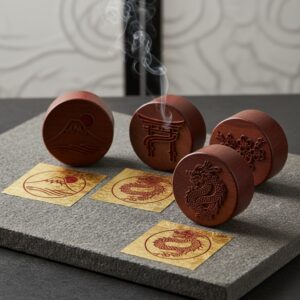
Before exploring the reasons why, it’s useful to first understand what a hanko is. A hanko, also known as an inkan, is a personal seal. At its most basic, it’s a small, cylindrical object, typically between the size of a lipstick and a chapstick, with a name carved into one end. The material can range from cheap, mass-produced plastic to hand-carved boxwood, durable titanium, or historically, water buffalo horn and ivory. This carved end is pressed into a thick, vermilion ink paste called shuniku—a substance with a consistency somewhere between clay and wax, often kept in a small, ornate case. The resulting impression on paper is a perfect red circle containing the characters of a name.
However, not all hanko are the same. In fact, a person usually owns a set of three, each serving a different purpose and level of authority, forming a kind of personal identity toolkit.
The Holy Trinity of Hanko: Jitsuin, Ginkoin, Mitomein
Think of this as a hierarchy of identity. At the top sits the king—the one seal to rule them all.
This is the jitsuin, or “registered seal.” It is your official, legally recognized identity in stamp form. You can have only one. To make it official, you take your custom-carved hanko to your local municipal office, where they register its unique impression in their records. From that point forward, that specific stamp, together with its official registration certificate (inkan tōroku shōmeisho), serves as the legal equivalent of a notarized signature. The jitsuin is reserved for life’s most significant transactions: buying property, purchasing a car, taking out a major loan, signing a will, or incorporating a business. It’s kept securely and brought out only for moments of great importance. Using it is a deliberate and serious act.
Next is the ginkoin, or “bank seal.” As the name suggests, this hanko is registered with your financial institutions. When you open a bank account, you register your ginkoin. From then on, any major transaction—like a large withdrawal, setting up an automatic transfer, or closing an account—requires stamping a form with that exact seal. It’s the key to your financial life. While a bank might allow you to use an ATM card and PIN for everyday transactions, the ginkoin is the definitive proof of identity for anything substantial. You don’t carry this seal with you; it stays at home, separate from your bank book.
Lastly, there is the mitomein, the “recognition seal.” This is your everyday tool. It’s an unregistered, informal stamp used to acknowledge receipt of items. Signing for a package from Amazon? You’ll use your mitomein. Circulating an internal memo at work? Everyone stamps it with their mitomein. It’s equivalent to scribbling your initials. These seals are often mass-produced with common surnames and can be purchased for a few dollars at any stationery store. The security lies not in the seal’s uniqueness but in the simple act of acknowledgment it represents.
This tiered system—official, financial, and casual—offers the first insight that the hanko is more than just a stamp. It’s a sophisticated, analog method for calibrating identity and responsibility.
A Stamp Through Time: The Hanko’s Journey into Japanese Life
So where did this practice originate? The hanko is not indigenous to Japan. Like many fundamental aspects of its culture, including its writing system and Buddhism, the concept of the seal was introduced from the Asian mainland. Its history is a captivating tale of how a symbol of absolute authority was gradually adopted, transformed, and eventually democratized.
An Imperial Import
The earliest known seal in Japan dates back to 57 AD. It is a solid gold hanko discovered in the 18th century, believed to have been a gift from the Emperor of China’s Han Dynasty to an envoy from a small Japanese kingdom. The inscription reads, “King of Na of Wa, Vassal to Han.” For the centuries that followed, seals remained the exclusive privilege of the highest echelons of society: the Emperor and his most powerful court nobles. The seal was not a mark of personal identity but a symbol of imperial authority. When the Emperor’s seal was stamped on a document, it was not merely a verification—it was the law, imbued with divine significance.
The Samurai’s Seal of Approval
As imperial power declined and feudal Japan arose, authority shifted to the warrior class. From around the 12th century, samurai lords and shoguns began adopting the practice to validate their commands and land grants. They created their own stylized signatures carved into seals, known as kaō. This was a major development. The use of seals expanded beyond a single, central ruler to regional warlords who held actual power. Owning and using a seal became synonymous with being part of the ruling elite. It was a symbol of having land, vassals, and the authority to command them. Yet, for the vast majority of the population—the farmers, merchants, and artisans—the hanko remained as distant and irrelevant as the politics of the shogun’s court.
From Warrior Class to Working Class
The true revolution, and the reason the hanko remains on your desk today, occurred during the Meiji Restoration in the late 19th century. After centuries of feudal rule and isolation, Japan’s new leaders undertook a radical, comprehensive modernization of the country. They needed to establish a modern nation-state with a centralized government, a national legal system, and a strong economy. To achieve this, they first needed to identify their citizens.
In 1873, the Meiji government enacted a law that was both simple and socially transformative. It required all citizens to have a registered family name and to use a registered seal—a jitsuin—for all legal and official transactions. This was a brilliant piece of social engineering. In one sweep, the government created a national identification system. The hanko, once an elite symbol, was now mandatory for everyone. It became the cornerstone of modern Japanese bureaucracy, the foundation of contracts, property rights, and civil registration.
This is the crucial ‘aha!’ moment. The hanko is not just a quaint tradition that lingered into modern times. It was the very engine of modernization. It enabled the government to build a functional, nationwide system of personal identification and legal verification from scratch. Its continued use is not a sign of Japan’s stubbornness toward change; it is proof of its central role in shaping the Japan we know today.
More Than a Mark: The Cultural Weight of the Red Circle
Understanding the history of the hanko reveals its bureaucratic origins, yet it doesn’t entirely explain why it holds such profound cultural significance. Why does the physical action of pressing a seal carry more weight than simply signing a name? The answer lies in the cultural values the hanko represents: responsibility, trust, and a concrete connection to identity.
The Embodiment of Responsibility
A signature can be quickly scribbled, messy, and inconsistent. In contrast, using a hanko is a deliberate and mindful act. You take the seal from its case, carefully press it into the thick red shuniku paste for an even coat, check the orientation to ensure the characters face upwards, and then place it precisely within the designated circle on the document before pressing down with firm, steady pressure. It is a small ritual.
This physical action carries significant psychological weight. In Japanese culture, stamping your hanko (hankō o osu) is a tangible expression of your intention and a formal acceptance of responsibility. The clear, consistent imprint signals that your decision is equally clear and final. It marks a moment of commitment, captured in red ink. This is why many Japanese people say they feel the seriousness of a contract more deeply when pressing their seal than by simply signing. The hanko turns an abstract agreement into a concrete deed.
A Circle of Trust, Not a Line of Defense
Another key difference between a hanko and a Western signature is security. The primary safeguard of a signature is its complexity and uniqueness, making it difficult to forge. The hanko, however, is based on a very different principle. While a custom-carved jitsuin is unique, the everyday mitomein is often mass-produced. For example, my neighbor Tanaka-san can walk into any 100-yen store and purchase a hanko bearing his name that looks just like his colleague’s. So where does the security come from?
It stems not from the seal itself but from the high-trust society in which it is used. The system is not designed to be foolproof against determined forgery; rather, it operates on an assumption of honesty. Using another person’s hanko without permission is an unthinkable breach of trust, a form of identity theft with severe legal and social repercussions. The security of the hanko is rooted in this social contract. It works because society collectively agrees to its trustworthiness. While Western signatures anticipate fraud and aim to guard against it, the hanko system presumes integrity. The jitsuin, on the other hand, adds an institutional layer of verification with an official certificate, creating a two-factor system: the physical seal you possess and the government’s official record.
Craftsmanship and Personal Identity
Beyond its practical purpose, the hanko is often a beautiful and deeply personal object. A high-quality seal is hand-carved by a master craftsman, an inshōkokuinshi, who spends years perfecting the art of engraving intricate characters in ancient scripts like tenshotai (seal script) onto a small surface. The choice of material, font, and character balance all contribute to a miniature work of art uniquely yours.
For many, a hanko is more than just a tool; it is a physical embodiment of their name and family heritage. It is often presented as a gift when a young person comes of age, symbolizing their entrance into adulthood. A finely crafted seal can be handed down through generations, serving as a tangible link to ancestors. In a culture that highly values the family name, the hanko acts as a personal emblem—a common person’s coat of arms.
The Seal in the Digital Age: An Analog Tool in a Modern World
Despite its long history and cultural significance, the hanko faces an undeniable challenge in the 21st century. Its dependence on physical presence and paper documents is a significant obstacle in an increasingly digital world. This tension came to a head during the COVID-19 pandemic, sparking a nationwide discussion about the future of the seal.
The “Hanko Problem” and the Drive for Digitalization
When Japan promoted remote work to prevent the spread of the virus, a uniquely Japanese issue surfaced: employees couldn’t fully work from home because they had to physically visit the office just to stamp documents. This phenomenon of “hanko shussha” (coming to the office to stamp) became a symbol of Japan’s difficulty in modernizing its office culture. The reliance on paper-based workflows, with everything requiring a series of red seals for approval, was exposed as a major inefficiency.
This led the Japanese government, particularly under administrative reform minister Taro Kono, to launch a high-profile campaign for datsu-hanko—“escaping the hanko.” The objective was to remove the need for personal seals on thousands of government administrative forms and to strongly encourage private companies to do the same. It was a direct challenge to a centuries-old pillar of Japanese bureaucracy.
Resistance, Adaptation, and the “Digital Hanko”
The transition has not been straightforward. Opposition arises not only from a love of tradition but also from the sheer inertia of a system built around the hanko for over 150 years. Entire corporate workflows, legal precedents, and security protocols rely on it. Simply abolishing it requires a fundamental overhaul of how business and government function.
In response, a hybrid solution has appeared: the digital hanko. These are electronic stamps that can be affixed to digital documents. They are more than just image files; they are typically linked to a user’s identity and include cryptographic security features such as timestamps to verify when a document was “stamped” and to ensure it has not been altered since. This represents a classic Japanese approach: rather than completely replacing the old system, it adapts a familiar form to new technology. It is a skeuomorphic solution that seeks to provide the visual confirmation and procedural feel of a traditional hanko in a paperless environment.
The Enduring Role of the Physical Seal
Despite this digital push, reports of the hanko’s demise are greatly exaggerated. While the casual mitomein is gradually being replaced by digital alternatives for routine office tasks, the most important seals—the jitsuin and ginkoin—remain firmly entrenched in the physical world. For life’s most significant events, there is a strong cultural and psychological attachment to the ritual of using a physical seal.
Can you imagine closing on your first home with a click? Or registering your marriage with an electronic signature? For many in Japan, these moments require a certain gravity, a ceremony that a digital action cannot replicate. The physical act of retrieving your registered seal, preparing the ink, and making that indelible red mark provides a sense of finality and importance that underscores the weight of the commitment being made. It is a ritual that confirms the significance of the moment.
Your Own Piece of Japan: Getting and Using a Hanko

For any foreigner planning to live in Japan long-term, obtaining a hanko is not just a charming cultural ritual; it’s a practical necessity. The process is surprisingly simple and provides an intriguing insight into this unique craft.
Where to Get One
Hanko shops (hanko-ya) can be found in nearly every town or shopping arcade. For a basic, machine-carved mitomein, you can even visit a key-cutting kiosk or a large stationery store and have one made within an hour. However, for a ginkoin or jitsuin, it’s best to seek out a specialized craftsman. There, you can select from a wide variety of materials and consult with the owner on the ideal font and layout for your name. The experience is both personal and rewarding.
The Foreigner’s Hanko
What name should you put on it? You have several options. The most common choice is to have your last name written in katakana, the phonetic script used for foreign words. You can also use romaji (the Roman alphabet), which is perfectly acceptable for official registration, provided that the name on the seal exactly matches the one on your official residence card. Some adventurous foreigners even collaborate with a carver to create ateji—kanji characters selected for their phonetic similarity to approximate their name.
Hanko Etiquette 101
Using a hanko comes with its own set of unwritten rules. You must stamp it upright, never upside down or at an angle, as a sloppy impression can be perceived as careless or even disrespectful. Perhaps the most intriguing aspect of hanko etiquette is found in the corporate world: the ojigi hanko, or “bowing seal.” In a typical ringi-sho (a document circulated for approval), junior employees stamp their seals perfectly upright. As the document moves up the chain of command, each successive manager stamps their seal slightly tilted to the left, as if it is “bowing” to the seals of their superiors. The CEO’s seal at the top is perfectly upright and centered. It’s a striking, visual expression of the corporate hierarchy, all conveyed through the subtle angle of a red stamp.
The Final Impression: Why the Hanko Endures
My initial frustration at the bank all those years ago eventually transformed into fascination. The hanko is not a barrier to modern life; rather, it serves as a gateway into the Japanese mindset. It unveils a culture that finds significance in ritual, places great importance on responsibility, and has built its modern society on a foundation of collective trust.
It has persisted not because Japan is trapped in the past, but because the hanko has successfully evolved from a symbol of imperial authority to a democratic instrument of personal identity. It became deeply embedded in the very fabric of the modern state. And today, even as its role is being questioned and adapted for a digital future, it maintains its power in the moments that matter most.
The small red circle is more than just a signature. It is an affirmation. It represents a physical act of commitment in a world that is becoming increasingly fleeting. It is a tangible connection to one’s name and one’s word. Ultimately, the story of the hanko is the story of how Japan balances tradition and modernity—not by discarding the old for the new, but by discovering new ways to carry the weight of the past forward.