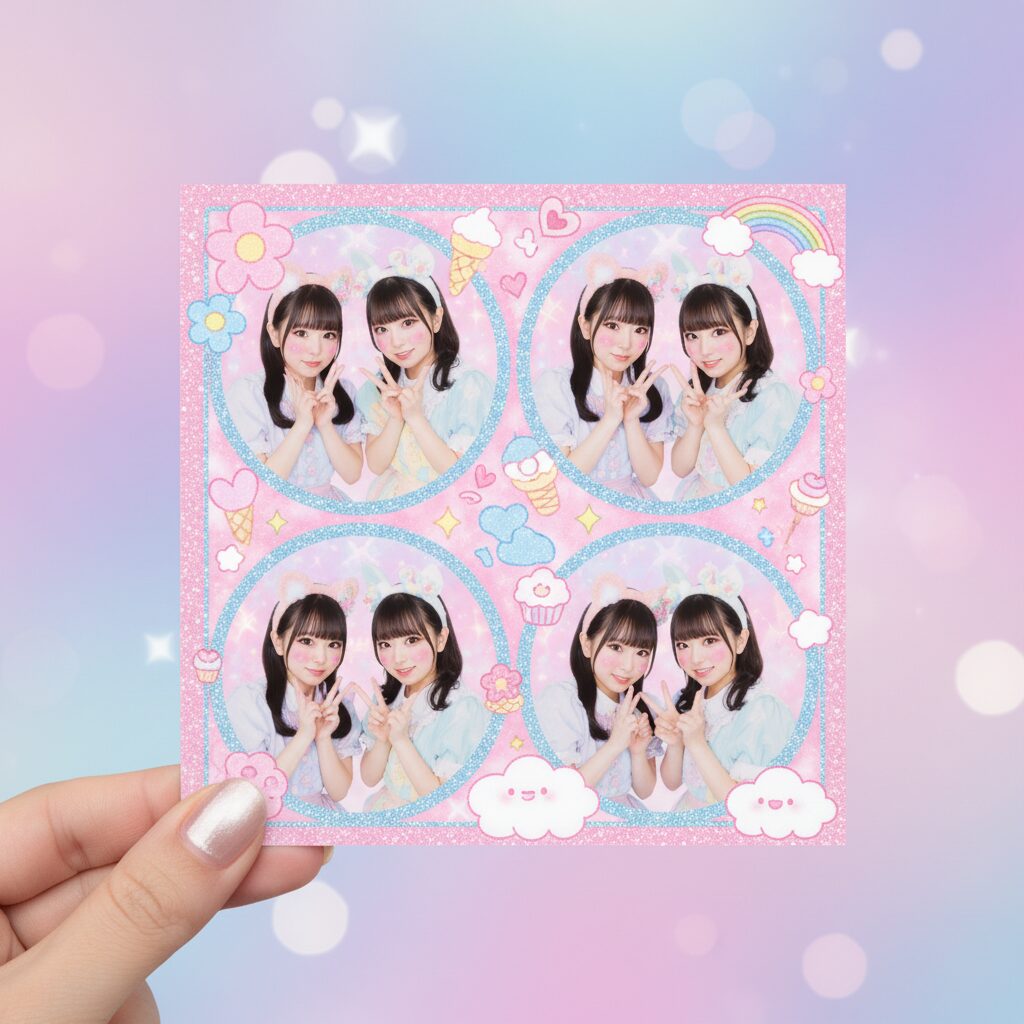
Before you ever swiped right on an Instagram filter, before Snapchat gave you puppy ears, and long before TikTok face-tuned you into an alternate reality, there was a little box in a Japanese arcade that did it all first. It was loud, it was cramped, and it printed your face on a sheet of tiny stickers. It was called Purikura, and it wasn’t just a photo booth. It was a social ritual, a technological oracle, and the machine that engineered the modern ‘kawaii’ face. To understand Purikura is to understand the aesthetic DNA of our filtered world, born not in Silicon Valley, but in the neon-drenched game centers of 1990s Japan.
At its core, Purikura—a portmanteau of Purinto Kurabu (Print Club)—is a photo sticker booth. But calling it that is like calling a Michelin-starred restaurant a place that serves food. It misses the point entirely. These booths weren’t just about capturing a moment; they were about curating it. They were designed, from the very beginning, to make you look ‘better’ than you do in real life. Specifically, they were designed to make you look cuter. The machines offered a potent, almost magical promise: step inside as yourself, and emerge as an idealized, wide-eyed, flawless-skinned version of you, immortalized on a glossy sticker sheet you could share with your friends. It was a fantasy factory, and for a generation of young Japanese women, it became the visual language of their youth.
This isn’t just a story about vintage tech. It’s about the birth of a subculture built around a very specific kind of self-representation. It’s about a physical space that created a digital aesthetic, and a social currency traded not in likes and shares, but in painstakingly cut-out squares of vinyl. Forget what you think you know about photo booths. We’re about to step behind the curtain into a world of digital graffiti, prescribed poses, and the relentless, joyful pursuit of cute.
For readers intrigued by the cultural impact of these digital innovations, exploring the high-tech evolution of Purikura offers an even deeper look into this enduring Japanese aesthetic trend.
A Brief History of the Face Machine
The story of Purikura starts in the mid-1990s, a lively period for Japanese youth culture. Although the economy had passed its bubble peak, it still supported a world of consumerism and entertainment. Arcades, or ‘game centers’ as they are called in Japan, were bustling social hubs, filled with the sounds of fighting games and UFO catchers. This environment was the breeding ground for the photo sticker phenomenon. In 1995, two companies, Atlus and Sega, independently introduced the first machines. It was Atlus’s machine, named “Print Club,” that gave its name to the entire genre.
At first, the concept was straightforward: take a photo with a friend, select a decorative frame, and print it as a sheet of small stickers. While the idea wasn’t entirely new, its execution perfectly suited the target audience: joshi kōsei, or high school girls. They were the trendsetters, drivers of coolness, and they embraced Purikura with remarkable enthusiasm. Suddenly, these booths appeared everywhere, with lines winding out of arcades as girls queued for their turn.
The true brilliance, however, wasn’t just in the sticker format. It was in the interactivity. Early machines were simple but quickly advanced. Developers realized the excitement wasn’t only about the photo, but about the process. The technology started incorporating features that let users actively alter their own images. This marked a vital breakthrough. It changed Purikura from a passive photo-taking device into an active tool for self-expression. The competition for the cutest, most flattering results had begun, along with the establishment of a distinct digital aesthetic.
Engineering the ‘Kawaii’ Ideal: The Anatomy of a Purikura Edit
What a modern smartphone filter achieves with a single tap, Purikura accomplished through a series of specialized, often extreme, digital enhancements. These weren’t subtle tweaks; they were intentional, powerful changes crafted to shape the user’s appearance toward a shared cultural ideal of ‘kawaii’ (cuteness). Understanding these key features is like peering into the source code of the modern selfie.
The Eyes Have It (`Deka-me`)
The most striking and iconic Purikura feature is undoubtedly the deka-me or “big eyes” effect. Long before anime filters became popular on social media, these machines digitally enlarged and reshaped users’ eyes. The software would detect the eyes and expand them, often making them rounder and more doe-eyed. The effect could be surprising, but that was exactly the intention. It was a direct reference to manga and anime aesthetics, where characters are distinguished by their large, expressive eyes. This wasn’t about looking like an enhanced version of yourself; it was about resembling a character, a stylized ideal. It instantly conveyed youth, innocence, and a distinct style of Japanese cuteness. The technology grew so advanced that users could often adjust the enlargement’s intensity and even add digital reflections or ‘sparkles’ to the pupils for a livelier look.
Flawless Skin and Sculpted Chins (`Bihada` Effect)
Another cornerstone of the Purikura makeover is the bihada or “beautiful skin” effect. Japanese beauty standards emphasize clear, smooth, and radiant skin. Purikura software catered to this by applying a heavy smoothing algorithm that erased blemishes, pores, and texture, resulting in a porcelain-doll-like complexion. But it didn’t stop at skin. The machines also included facial sculpting tools. Jawlines were softened, and chins sharpened into a delicate ‘V’ shape, a feature borrowed from idealized 2D characters. Essentially, it was digital plastic surgery completed in 30 seconds inside an arcade. This set a benchmark that digital avatars should be flawlessly smooth and perfectly sculpted—an aesthetic that apps like Meitu and FaceTune later capitalized on globally.
Legs for Days
While facial modifications took center stage, full-body shots featured their own type of digital magic. For years, Purikura machines have offered a feature that subtly (or sometimes overtly) lengthens the user’s legs. When groups of friends posed for full-body pictures, the software would stretch the lower half of the image, making everyone look taller and more slender. This catered to a different ideal—that of the fashion model. It added another layer of fantasy, allowing teenagers to temporarily embody the long-limbed proportions seen in their favorite magazines. It was a complete head-to-toe makeover.
The Decoration Phase (`Rakugaki`)
After the camera flashes and the software completes its transformative work, the second act of the Purikura experience begins: rakugaki, or doodling. Once photos are taken, users move to an external editing station where, against a ticking clock, they use touchscreens and styluses to unleash a flood of creative customization on their images. This is where photos truly become personalized keepsakes. They add text—the date, their names, inside jokes, declarations of “BFF.” They fill the background (and often themselves) with a dense collage of digital stamps: hearts, stars, ribbons, crowns, animals. Users can draw freely, apply digital makeup like blush and lipstick, and even change their hair color. The rakugaki phase is a hectic, collaborative, and joyful process. It transforms a simple photo into a vivid time capsule, a vibrant memento of a particular day with specific people.
More Than a Photo: The Purikura Ritual
To view Purikura solely as a piece of technology is to overlook its cultural essence. The ‘vibe’ of Purikura stems from the rituals that accompany it—a social performance with its own set of rules, spaces, and outcomes. It was, and continues to be, an activity, a destination, and a vital element of female friendship in Japan.
A Shared Secret Space
The physical design of a Purikura booth is crucial to its purpose. It is a small, enclosed area, almost always closed off by a curtain. When you and your friends step inside and draw the curtain, you enter a private world. Outside lies the noisy, public chaos of the arcade; inside is an intimate stage just for you. This privacy is essential. It establishes a safe space for silliness, vulnerability, and experimentation. You can try out poses, make silly faces, and adjust your hair without worry. The machine’s lively, cheerful voice guides the process, creating a feeling of a shared, directed experience. For a few moments, the booth transforms into a secret clubhouse, a temporary refuge where the sole aim is to have fun and capture a perfect, shared memory.
The Currency of Friendship
The end result of a Purikura session is a single sheet of stickers. And this sheet is almost never for just one person. The next part of the ritual involves finding a spot to sit and using the small scissors conveniently attached to the machine to carefully cut up the sticker sheet. The photos are then divided and exchanged among the group. This act of sharing is essential. A Purikura sticker is a token of affection, a tangible proof that says, “We spent this time together. We are friends.” These stickers would then be placed everywhere. They adorned the backs of flip phones, inside school notebooks, on pencil cases, and were collected in special sticker albums called purichō. A well-decorated purichō served as a visual diary of your social life, a tribute to your friendships.
Posing is a Language
If you pass by a group of young women taking a Purikura photo, you’ll notice the poses are far from random. There is a deeply rooted visual vocabulary of Purikura poses that has developed over the decades. The ever-present peace sign (piisu), usually held near the cheek, is a classic. Then there are various hand-over-face gestures: the “toothache” pose (hand cupping the jaw to make the face look smaller), fingers forming a heart shape, or the more recent chun-piisu (a heart made with thumb and forefinger). These poses are not spontaneous—they are learned and repeated. The machines themselves encourage this by displaying examples of popular poses on screen, effectively teaching users how to perform for the camera in the preferred ‘cute’ manner. This standardized posing fostered a sense of shared culture and visual identity among its users.
The Evolution and Legacy: From Sticker Books to Smartphones
The rise of the smartphone camera, equipped with its own array of editing apps and filters, seemed destined to be the end of Purikura. Why spend 500 yen on something you can now do for free on your phone? Yet, although the industry has surely contracted since its heyday, Purikura has endured. It survived by doubling down on its unique qualities and embracing a continually intensifying race of digital enhancements.
The Arms Race of Augmentation
To remain relevant, Purikura makers had to provide features that free phone apps couldn’t match. This led to a new generation of machines boasting hyper-advanced capabilities. Skin smoothing became impeccably flawless, eye enlargement far more dramatic, and facial sculpting incredibly precise. New options emerged, like applying startlingly realistic digital makeup, changing hair color and style, or even adjusting lighting to mimic a professional photo shoot. Often, the results verge from ‘cute’ into the uncanny valley, producing images where the subjects are barely recognizable. However, for devoted users, this extreme level of transformation is the main draw—it offers a fantasy that even the best Instagram filter can’t fully replicate.
The Analog Allure in a Digital World
Perhaps the most important reason Purikura has lasted is its physical aspect. In a time when our photos exist as fleeting data in the cloud, a Purikura sticker is a tangible keepsake. You can hold it, trade it, and stick it on something you own. The entire process—going to the arcade with friends, squeezing into the booth, laughing as you try to strike poses on time, frantically decorating the pictures—is an event in itself. It is an experience, not just a means to an end. People want more than the photo; they want the memory of creating it. This shared, real-world interaction is something a solitary selfie session simply can’t replace.
The Purikura Diaspora: How Japan’s Cute-Tech Went Global
Although the booths themselves might not be found on every street corner worldwide, the aesthetic and technological concepts pioneered by Purikura have become universal. Every time you use a beauty filter on Instagram, a face-slimming tool on TikTok, or a skin-smoothing app like Snow or Meitu, you are engaging with Purikura’s legacy. It served as the cultural and technological training ground for the selfie generation. It normalized the notion that our digital selves don’t need to be faithful representations of reality. Instead, they can—and arguably should—be curated, enhanced, and idealized versions. Purikura taught millions how to perform for a digital lens and equipped them with the tools to perfect that performance, laying the foundation for the filtered world we live in today.
Finding Your Filter: The Modern Purikura Experience
For those unfamiliar, entering a modern Purikura corner can be an intense sensory adventure. Usually located on a dedicated floor in large game centers like Taito Station or Round1, you’ll encounter a dazzling collection of enormous, brightly lit machines, each playing its own J-pop soundtrack and promising a distinctive aesthetic experience.
The first hurdle is selecting your machine. Signs promote various ‘styles’ or ‘looks.’ One may provide a more ‘natural’ and soft finish, another a ‘cool’ and glamorous model-like appearance, and a third a ‘girly’ and extra-sparkly effect. The differences are often subtle, but they hold great significance for enthusiasts.
After inserting your 400 or 500 yen, the process moves quickly. You step inside as a cheerful digital voice guides you. A screen previews your image and often suggests poses. Then, the countdown starts. Flash. Reposition. Flash. You typically take six to eight photos in quick succession, a frantic yet enjoyable race to capture the perfect shot. Next, you proceed to the rakugaki station, where the pressure mounts—a timer, usually set for two or three minutes, counts down as you and your friend decorate your selected photos. When time runs out, the machine processes your creation and, moments later, dispenses a warm, glossy sheet of stickers from a front slot. The final step is locating the nearby counter with tiny scissors, where the essential ritual of cutting and sharing unfolds.
This process has remained strikingly consistent for over twenty years. It’s a bit of 90s nostalgia energized by 21st-century technology. Purikura isn’t just a photo booth; it’s a time capsule, a fantasy machine, and a powerful force for social bonding. It’s the original face-tune, the analog predecessor of the digital face we present to the world. And it achieved all this not through a solitary tap on a glass screen, but through laughter, collaboration, and friendship, all gathered together behind a thin fabric curtain.