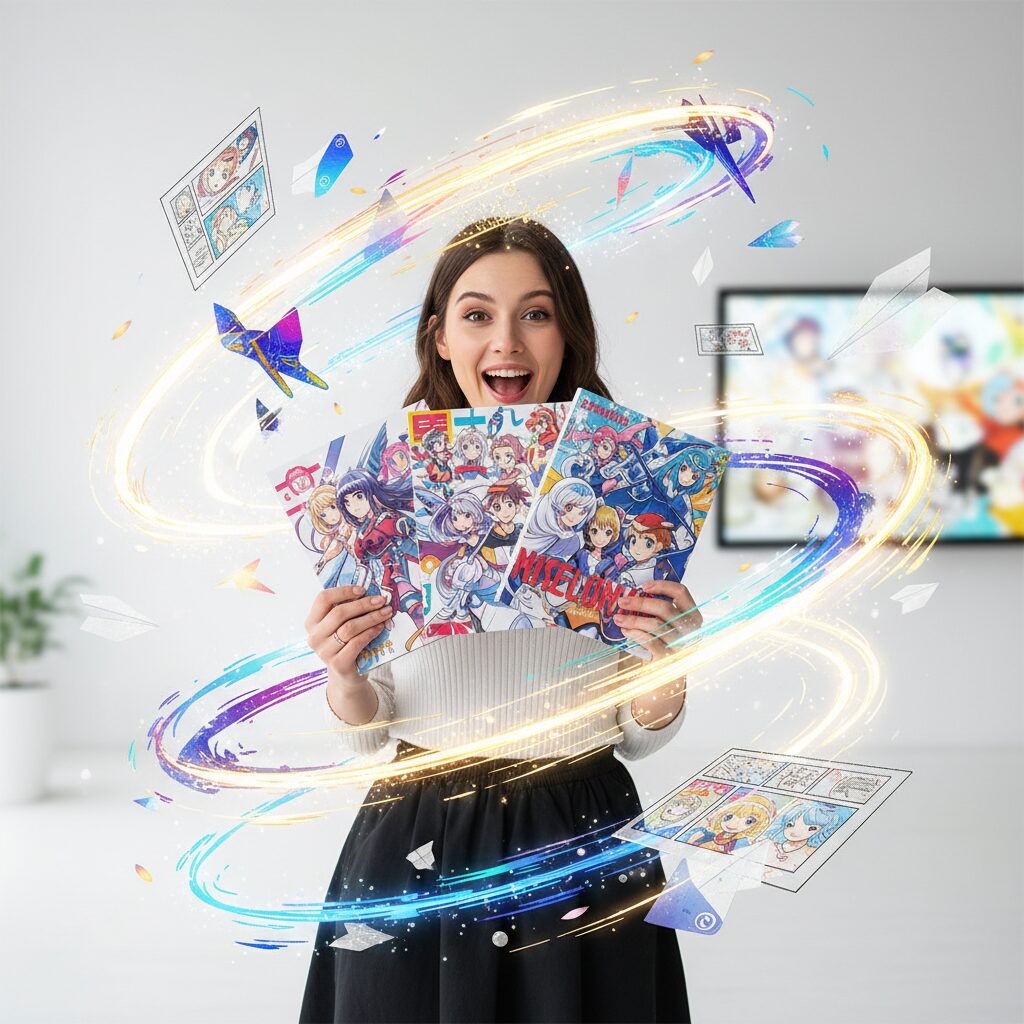
You think you know how manga and anime are made. The image is a familiar one, broadcast in countless documentaries and behind-the-scenes features: the solitary, brilliant creator, the mangaka, hunched over a drawing table under a halo of lamplight, battling deadlines to bring their singular vision to life. It’s a compelling story of individual genius. And it’s mostly a myth. Or, at least, it’s only a tiny fraction of the truth.
The real engine of Japan’s creative culture—the sprawling, chaotic, and unbelievably productive force that fuels its pop culture dominance—doesn’t operate under the bright lights of a publisher’s office. It thrives in the crowded halls of convention centers, in small printing shops, and on countless digital art tablets in anonymous apartments across the country. It’s a world known as dōjinshi.
At its simplest, the word translates to “self-published work.” But that definition is criminally insufficient. It fails to capture the sheer scale and importance of a cultural phenomenon that is, simultaneously, a massive fan-fiction scene, a talent incubator for the professional industry, an experimental laboratory for new genres, and a vital community for millions. Dōjinshi are not just quirky side projects or amateur knock-offs. They are the secret R&D department, the unacknowledged farm league, and the cultural pressure valve for the entire Japanese creative ecosystem. To understand dōjinshi is to understand the invisible logic that makes Japanese pop culture so relentlessly innovative and responsive. It’s the story of how a nation of passionate fans became the co-authors of the very culture they love.
This creative underground vibe is echoed in Japan’s unexpected embrace of playful innovation, as seen in the lasting influence of analog purikura’s playful technology, which continues to reshape the nation’s pop culture landscape.
Beyond the Fan-Fiction Label: What Dōjinshi Actually Is
Before we can explore its influence, we must first address some common Western misconceptions. The closest parallel might be the online fan-fiction and fan-art communities, but this comparison quickly falls apart under closer examination. Dōjinshi culture is older, more organized, and firmly rooted in physical media and face-to-face interaction. It’s not merely about writing stories; it involves creating, printing, and selling a tangible artifact.
A World of “Same People”
The term itself provides the first insight. Dōjinshi (同人誌) consists of three characters: dō (同), meaning “same” or “similar”; jin (人), meaning “person”; and shi (誌), meaning “publication.” A dōjinshi is a publication produced by dōjin—people of the same mindset, individuals who share a common interest. From its very name, the focus is on community, not just individual fandom.
This is more than just a linguistic point. It shapes the entire subculture. A dōjinshi creator is part of a sākuru (サークル), or “circle,” a term borrowed from school clubs that refers to a small, collaborative group, even if composed of just one person. They are not “authors” in the professional sense; rather, they are members of a community of practice. This subtle difference is key. It distinguishes the activity from a purely commercial endeavor and places it within a passionate, shared pursuit. It signals that everyone involved—from the creator behind the table to the fan buying the book—is part of the same community, bonded by their love for a specific series, character, or trope.
The Spectrum of Creation: From Parody to Original Work
The dōjinshi world is extensive and includes several distinct types of work. The best-known, and the one often defining it in the eyes of outsiders, is what’s referred to in Japan as niji sōsaku (二次創作), or “secondary creation.”
This category covers parody and fan works. It involves using characters, settings, and worlds from established manga, anime, video games, or even live-action shows to create new stories. Here you’ll find “what if” scenarios the original narrative never explored. What if two rival male characters actually had romantic feelings for each other? What would a stoic character’s life at home be like? What happens to the cast after the final chapter? Niji sōsaku is a vast, collective dialogue with the source material—a way for fans to deconstruct, analyze, and ultimately reshape the narratives they cherish in their own way.
However, it’s mistaken to think this defines all dōjinshi. There is an equally lively, though less internationally recognized, scene for ichiji sōsaku (一次創作), or “primary creation.” These are entirely original works. Creators invent their own characters, construct their own worlds, and tell their own stories, completely independent of existing franchises. For these creators, the dōjinshi scene is not a sandbox to play in other people’s worlds but a platform to launch their own visions, bypassing traditional publishing gatekeepers. They build their audience organically, selling original manga, art books, and novels directly to fans.
Lastly, there is a smaller but intellectually significant category of dōjinshi focused on criticism and analysis, known as hyōron (評論). These are dense, text-heavy zines offering in-depth explorations of specific series, character types, or industry trends. They serve as media theory fanzines, where passionate fans produce scholarship-level critiques and analyses that often exceed what is found in mainstream publications. This aspect of the dōjinshi world reflects the serious, intellectual dedication fans bring to their hobbies.
The Cauldron of Creativity: Comiket and the Dōjinshi Ecosystem
To truly comprehend the scale and vitality of the dōjinshi world, one must understand its core: the Comic Market, or “Comiket.” Held twice annually in the expansive halls of Tokyo Big Sight convention center, Comiket is unlike a Western comic convention. There are no dazzling Hollywood panels, no celebrity autograph opportunities, and no giant corporate booths dominating the space. At its essence, it is a marketplace. It stands as the largest dōjinshi sales event in the world, a temporary city devoted to the buying and selling of self-published works.
A Twice-Yearly Pilgrimage to Tokyo Big Sight
The numbers are astonishing. Over three to four days, Comiket draws more than half a million visitors. Tens of thousands of dōjinshi circles set up tables, with creators seated behind piles of their freshly printed books. The event is so vast that it has developed its own unique culture, rhythms, and unwritten rules.
The atmosphere is charged with focused, almost reverential energy. Long, orderly lines coil around the building hours before the doors open. Inside, the halls are a dense sea of people, as attendees navigate the maze of tables with practiced skill, clutching maps and wish lists. The air carries the scent of paper and ink. Despite the crowding, there is a deep sense of shared purpose and mutual respect. For many, this is a pilgrimage, a sacred space where the boundary between creator and consumer fades.
The Unspoken Rules of the Game
This entire ecosystem operates within a legally and socially intriguing “gray zone.” Technically, producing and selling works based on copyrighted characters counts as copyright infringement. In practice, official rights holders largely tolerate it. This tolerance is not due to lax enforcement but stems from a delicate, unspoken agreement between the professional industry and the fan community.
Publishers and studios recognize that the dōjinshi scene acts as a vast, self-sustaining marketing engine. It keeps fan engagement high during the long intervals between new anime seasons or manga volumes. It enables deeper exploration of a series’ universe, which in turn strengthens the connection between fans and the franchise. A thriving dōjinshi scene for a particular series signals a healthy, passionate fanbase.
In exchange, the dōjinshi community self-regulates. Circles limit their print runs, typically producing just enough to sell at the event. They avoid presenting their work as official merchandise. Their scale complements rather than competes with the official products. It’s a symbiotic relationship: the dōjinshi scene depends on mainstream source material, while the mainstream industry quietly benefits from the free promotion and intense fan loyalty generated by the dōjinshi community.
More Than Just a Market: The “Circle” and the Community
The most important transaction at Comiket goes beyond financial exchange. It is social. When a fan approaches a table, they often purchase the dōjinshi directly from the creator’s hands. There may be a brief, sometimes shy conversation—a compliment on the artwork, a shared expression of love for the characters. That small moment of human connection is the lifeblood of the whole system.
It turns consuming into participation and support. You’re not simply buying a product; you are directly affirming a fellow fan’s passion and dedication. This direct link between creator and audience is something the mainstream industry can only aspire to. It fosters a powerful feedback loop, where creators deeply understand what resonates with their audience, and fans feel personally invested in the creator’s success.
The Talent Pipeline: From Dōjinshi Circle to Professional Mangaka
If the dōjinshi scene were solely about fan works, it would still be a captivating subculture. However, its true significance lies in its role as the most important talent incubator for Japan’s professional creative industries. The journey from a small table at Comiket to a serialized manga in a major magazine is a well-established route.
A Portfolio in Public
Creating dōjinshi serves as a highly effective, self-guided apprenticeship in becoming a mangaka. Running a circle requires creators to handle everything themselves. They must write the story, draw the panels, ink the lines, tone the pages, design the cover, format the book for printing, manage the finances, and promote their work. Through trial and error, they learn which stories resonate with audiences, which art styles attract attention, and how to meet self-imposed deadlines to have their books ready for events.
Every dōjinshi they produce becomes a public piece of their portfolio. It demonstrates not only their drawing skills but also their ability to complete a project and create something others are willing to buy. Editors from major manga magazines are known to roam the floors of Comiket in search of new talent. They seek not just skilled artists, but creators who already understand the production process and have proven they can connect with an audience.
Case Studies in Stardom: The CLAMP Phenomenon and Beyond
The list of professional creators who began in dōjinshi reads like a who’s who of the manga and anime world. One of the most iconic examples is CLAMP, the all-female artist collective behind huge hits like Cardcaptor Sakura, Magic Knight Rayearth, and xxxHolic. Starting as a dōjinshi circle in the 1980s, they created parody works of popular series. Their high-quality art and engaging storytelling quickly won a large following within the dōjinshi scene, eventually drawing professional publishers’ attention.
They are by no means alone. Kouta Hirano, creator of Hellsing, was once a prolific dōjinshi artist. Huke, the artist responsible for the character designs in Steins;Gate, rose to prominence through the dōjinshi community. Many popular artists who create works based on the expansive Touhou Project video game franchise have also transitioned to professional careers. The pattern is evident: dōjinshi serves as the proving ground. It’s where raw talent is shaped into professional skill. Success in the dōjinshi world signals to the industry that a creator possesses not only artistic talent but also the discipline and audience-building expertise needed for professional success.
The Cultural Pressure Valve: Exploring Themes the Mainstream Won’t Touch
Beyond nurturing talent, the dōjinshi world fulfills another vital role: it acts as a laboratory for cultural and narrative experimentation. Operating outside the formal frameworks of the commercial industry, it is free from the restrictions imposed by advertisers, editorial demands, and the need to appeal to the widest possible audience. This liberty enables the dōjinshi community to explore niches, ideas, and relationships that mainstream media often avoids due to risk aversion.
The Freedom of the Gray Zone
The same legal gray area that permits dōjinshi to exist also grants it a shield of creative freedom. Creators do not have to pitch their ideas to editors or seek committee approval. If they have a story to tell—no matter how niche or unusual—they can simply bring it to life. This fosters an extraordinary diversity of content. The dōjinshi scene is where you find deep emotional explorations of minor characters, intricate alternate-universe scenarios, and ultra-specific genre mashups that would never survive a corporate boardroom.
This is especially true for adult-oriented content. While the professional manga industry does produce mature works, the dōjinshi scene offers a far more detailed and unfiltered exploration of adult themes and relationships, free from censorship or the pressure to conform to mainstream preferences.
Deconstructing and Rebuilding Narratives
Dōjinshi serves as the world’s largest focus group and narrative workshop. It’s where the subtext of mainstream works becomes explicit. This is most evident in the culture of “shipping”—the act of pairing characters in romantic relationships. Dōjinshi overwhelmingly explores these relationships, especially same-sex pairings that are only subtly hinted at in the original works.
The entire Boys’ Love (BL) and Girls’ Love (GL) genres, now commercially significant categories, largely originated and developed within the dōjinshi scene. Female creators used dōjinshi to delve into romantic and erotic stories between male characters from popular shōnen manga, creating a space focused on emotional intimacy and complex relationships. This fan-driven movement revealed a vast, untapped market that the professional industry has since begun to serve.
A Space for Unfiltered Expression
Ultimately, dōjinshi offers creators a platform to tell the stories they want to see, rather than those a corporation believes will sell. It’s a place to “fix” unsatisfying endings, to highlight beloved but marginalized characters, or to venture into darker, more psychologically intricate narratives. Ideas and tropes are put to the test in this environment. When a particular character pairing, story concept, or aesthetic becomes popular in the dōjinshi world, it sends a strong signal to the mainstream industry. The creative innovations emerging from this fertile ground of fan passion are often later adopted, sanitized, and repackaged for a mass audience.
Why It Matters Beyond the Otaku Sphere
It’s easy to write off dōjinshi as a niche interest limited to a committed subculture. However, doing so overlooks its fundamental role in Japan’s influence on global culture. The vitality within this community extends outward, influencing the very products celebrated and sold worldwide.
Fueling the “Cool Japan” Engine
The manga, anime, and games at the forefront of the “Cool Japan” brand are not created in isolation. They represent the polished tip of a vast iceberg of creative activity. The professional industry sustains its rapid production pace and high quality precisely by drawing from the abundant talent, ideas, and passion nurtured within the dōjinshi world. Without this self-perpetuating ecosystem of amateur creation, the professional sector would be slower, less diverse, and far less aligned with the desires of its most devoted fans.
Each time an assistant on a hit manga is hired based on their dōjinshi portfolio, or a new anime succeeds by embracing a character dynamic popularized by fans, the contribution of this “amateur” sphere becomes evident.
A Model of Participatory Culture
Long before Western scholars discussed “remix culture” and “participatory media” in the digital age, Japan had already established a vibrant, physically grounded version of it. The dōjinshi scene exemplifies a culture where the boundary between producer and consumer is not just blurred but erased. Consumption is not a passive experience; it is the foundation for creation. Loving a story involves more than buying the next volume; it means deconstructing that story and reimagining it in new ways. It’s a culture of active, creative participation.
So next time you watch an anime or read a manga that feels fresh, bold, or perfectly attuned to fans’ desires, remember the unseen engine behind it. It hums in the bustling halls of Tokyo Big Sight, powered by the passion of hundreds of thousands of creators who don’t wait for permission to share their stories. They simply make them, for themselves and for one another. In doing so, they quietly, consistently, and powerfully shape the future of the creative world we all enjoy.