You’ve probably seen the boxes, stacked high in the electronics shops of Akihabara or tucked away in the hobby section of a department store. They’re vibrant, covered in dynamic illustrations of giant robots locked in dramatic space combat. Inside, sealed in clear plastic, are grids of colorful parts, a cryptic instruction manual, and a sheet of tiny stickers. To the uninitiated, it looks like a complicated children’s toy. A Lego set for teenagers, perhaps. It’s a box of plastic, destined to become a static plastic figure on a shelf. This is the common perception of Gunpla—Gundam plastic models—and it’s profoundly, fundamentally wrong.
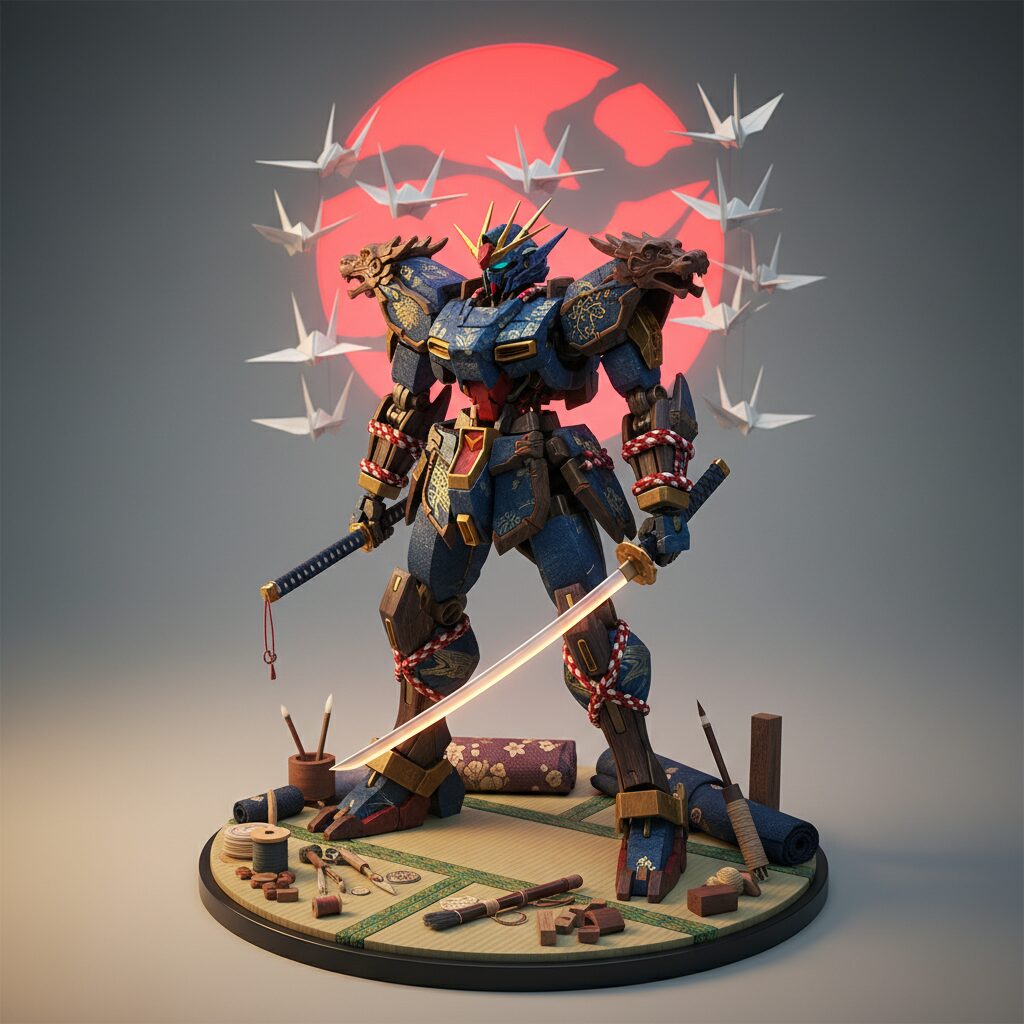
To dismiss Gunpla as just a toy is to miss one of the most vibrant and accessible expressions of modern Japanese craftsmanship hiding in plain sight. It’s to mistake a perfectly crafted set of chisels and a prime block of wood for a finished sculpture. The box doesn’t contain a product; it contains potential. The act of building a Gundam model, from a simple snap-build to a museum-quality custom piece, is a deep dive into the very principles that have defined Japanese artisanship for centuries: patience, precision, a reverence for tools, and the meditative pursuit of perfection. This isn’t just about assembling a robot. It’s about participating in a culture of meticulous creation, a quiet rebellion against the disposable, a personal journey from consumer to creator. It’s where the spirit of the ancient swordsmith is reborn on a quiet hobby desk, armed with a pair of nippers and a tiny pot of paint.
The meticulous transformation of Gunpla parallels the way bubble-era Tokyo nights continue to echo Japan’s timeless blend of tradition and modern innovation.
The Anatomy of a Plastic Prayer

Opening a Gunpla box, you won’t immediately see the familiar form of a robot. Instead, you’re met with a collection of plastic trays called “runners.” These flat frames, each marked with a letter, hold individual parts that extend like leaves from a branch. Every piece—a tiny thruster nozzle, a section of armor, a finger joint—is linked to the runner by a small plastic nub known as a “gate.” The first thing that strikes you is the astonishing precision of it all. The engineering is awe-inspiring. Parts designed to form intricate, multi-layered joints are molded with such fine tolerances that they later snap together with a satisfying, firm click, holding their position securely without the need for glue.
The instruction manual is a wordless diagram, a universal language of arrows, numbers, and symbols. It doesn’t narrate a story; it guides you through a ritual. This initial interaction is key to grasping the Gunpla ethos. The manufacturer, Bandai, has executed their role with near-supernatural expertise. They have crafted, engineered, and molded an impeccable canvas. The rest is left to you. The runners are not merely plastic; they are the raw material. The manual is more than a guide; it is the first step in a lengthy apprenticeship. The builder’s journey starts here, with the awareness that the quality of the final model depends not on what was in the box, but on the skill, patience, and care the builder chooses to apply.
This marks the first major departure from the Western idea of a model kit. While many traditional kits involve battling ill-fitting parts, flashing, and unclear instructions, a modern Gunpla kit is a collaboration. Bandai offers a flawless foundation, removing frustrating obstacles and letting the builder concentrate fully on the art of finishing. The challenge isn’t in making it fit; it’s in making it perfect.
From Snap-Fit to Shokunin
The journey of a Gunpla builder is a gradual process of skill development, similar to any traditional craft. It consists of distinct phases, each requiring greater patience and revealing deeper levels of artistry. Nearly no one begins with a masterpiece; they begin with a simple snap.
The First Cut is the Deepest
The most basic Gunpla building method is known as a “straight build” or “snap-build.” It demands just the most essential tools: a pair of side cutters, often referred to as nippers, and occasionally a hobby knife. The procedure is straightforward: identify the part number in the manual, find it on the runner, and cut it free. The aim is to remove the piece from the runner as cleanly as possible. This is the first exercise in precision. Cutting too close can damage the part, while cutting too far leaves a noticeable plastic nub that must be carefully trimmed. Even at this basic level, builders learn to feel the plastic, appreciate a sharp blade, and develop a steady hand.
Putting the parts together is a tactile delight. The pieces snap together firmly. Joints articulate, armor plates shift, and gradually, from a flat assortment of shapes, a three-dimensional figure takes shape. For beginners, this moment feels magical. For experienced builders, however, it represents only a rough outline. The base is set, but the essence remains missing.
The Art of the Invisible
The next crucial step toward true mastery is perfecting the finish. This starts with an almost obsessive focus on nub removal. The small leftover gates, where the piece was attached to the runner, are the adversaries of a clean build. Serious builders use increasingly fine sanding sticks, sponges, or files to smooth these areas until they blend seamlessly with the surrounding plastic. This slow, repetitive, and meditative task demands patience.
Why such fixation on tiny marks invisible to most? Because the builder sees them. It’s the same drive that leads a cabinetmaker to sand areas inside drawers that are never visible or a chef to arrange a garnish with tweezers. It represents a commitment to perfection for its own sake. The effort is not about impressing observers but about honoring the craft and the material. This phase prioritizes patience above all. An hour can be spent sanding and polishing a single armor plate, striving for an imperceptible smoothness. Through these quiet, repetitive actions, the mind calms, and the builder attains a state of flow—a deep, focused concentration emblematic of artisanship.
Drawing Life into the Lines
Even once assembled and perfectly smooth, a model can look flat and toy-like. The next stage in the builder’s progress is panel lining. Most Gunpla kits feature fine, recessed lines indicating armor panels, vents, and mechanical details. By applying a very thin wash of black, gray, or brown ink or paint into these grooves and cleaning up the excess, the builder introduces shadow and depth. Suddenly, the model comes to life, gaining a sense of scale and complexity.
This simple technique is transformative—it’s akin to an artist using ink to sharpen a pencil sketch’s lines. It requires subtlety; the goal is not bold, obvious lines but delicate shadows that trick the eye into perceiving more detail than is present. Selecting the right color—black for strong contrast on white parts, gray for a softer effect, brown to imply grime or rust—is the builder’s first genuine aesthetic choice. This step moves the builder beyond mere instruction following and toward creative interpretation. A panel-lined model no longer appears just snapped together. It looks built.
The Altar of the Hobby Desk

Step into the workspace of a committed Gunpla builder, and it won’t resemble a child’s playroom. Instead, you’ll find a craftsman’s bench. The area is typically compact, meticulously organized, and stocked with specialized tools that reflect a profound dedication to the hobby. This is the modern dōjō, a place of practice and discipline.
Basic nippers and a hobby knife are accompanied by a wide array of other instruments. There are glass files that cost more than the model kits themselves, capable of shaving plastic with surgical precision. There are scribing tools with tungsten carbide tips designed for carving new, custom panel lines into the plastic. Miniature pin vises for drilling tiny holes are present as well. Dozens of bottles of paint, thinners, and primers fill the space. An airbrush, with its compressor softly humming, stands ready to apply perfectly even layers of color.
This collection of tools is far from mere decoration; each serves a distinct purpose in achieving a superior finish. The builder becomes familiar with their properties, limitations, and maintenance. Much like a calligrapher cherishes their brushes or a chef their knives, a Gunpla builder understands that the quality of their work is closely tied to the care and quality of their tools. The hobby desk transforms into a personal altar to the craft, a place where the chaotic outside world dissolves, leaving only the focused task at hand.
Beyond the Manual: The Builder’s Soul
The true artistry of Gunpla emerges when builders go beyond the instruction manual. Once they have mastered the basics of assembly and finishing, they start to view the kit not as a fixed blueprint but as a canvas for their own creative expression and storytelling. This is where the builder’s personal spirit is embedded into the mass-produced plastic.
A Language of Decals and Top Coats
Most high-grade Gunpla kits include extensive sheets of decals. These range from simple stickers to dry-transfer decals rubbed onto the surface, and the most delicate of all, water-slide decals. These are ultra-thin markings printed on special paper that, when soaked in water, slide off the backing and onto the model. Applying a tiny warning label, no larger than a grain of rice, onto the curved surface of a shoulder armor piece without tearing or wrinkling requires extraordinary patience and skill. Yet builders often spend hours placing hundreds of these tiny details across a single model. Why? Because these elements create a convincing sense of scale and realism. They elevate the model from simply depicting a giant robot to becoming a miniature, lifelike replica.
After completion of assembly, sanding, painting, and decaling, one crucial final step remains: the top coat. A clear finish—matte, semi-gloss, or gloss—is sprayed over the entire model. This seals the decals, protects the paint, and, most importantly, unifies the overall finish. A matte coat absorbs light, giving the model a realistic, military-hardware appearance while hiding minor surface flaws. A gloss coat makes it gleam like a brand-new sports car. This last choice defines the model’s personality and serves as the builder’s ultimate statement on the piece.
Weathering and Storytelling
Perhaps the most expressive aspect of Gunpla artistry is weathering—the technique of making the model appear used, worn, and battle-scarred. Builders employ a wide variety of methods to convey a story. They might use a fine-tipped brush with dark gray paint to create tiny chips along armor edges, simulating paint scraped off during combat. Powders and washes might be applied to add rust streaks, oil stains dripping from joints, or mud splattered on the feet and legs, reflecting a specific environment.
One builder may envision their Gundam fighting in a desert, applying dusty, sand-colored pigments. Another might picture it operating in a humid jungle, adding moss effects and moisture stains. This is pure narrative. The builder becomes a director, with the model as their actor. They are not merely building a robot but creating a character with a backstory. A perfectly painted, pristine Gundam showcases technical skill, whereas a masterfully weathered Gundam becomes a work of art that evokes emotion and tells a story without words.
The Path of Customization
At the highest levels of the hobby, builders abandon instructions completely. They practice “kitbashing,” mixing parts from various kits to craft a wholly unique design. They may combine legs from one model, the torso from another, and the backpack from a third, designing a custom machine born from their imagination. Epoxy putty is used to sculpt new shapes, and a scriber carves intricate panel lines into blank surfaces, adding detail where none existed before. This represents the Gunpla grandmaster’s approach. It demands a deep understanding of mechanical design, an artist’s eye for proportion and form, and the technical skill to realize a singular vision. Here, the builder transcends craft to become a designer and sculptor.
The Silent Community and the Meditative Flow

So, who is involved in this? The Gunpla community is an extensive and varied global network, yet the act of building remains deeply solitary. For many, it serves as a form of active meditation. In an era of constant digital distractions, the focused attention needed to sand a tiny piece of plastic or place a microscopic decal acts as a powerful remedy. For hours, the mind becomes quiet, centered on a concrete, physical task. The satisfaction derives not from instant gratification, but from the slow, steady progress of a long-term project. It is a calm space where skill, patience, and creativity come together.
However, this solitary practice exists within a lively and supportive community. Online forums, social media groups, and YouTube channels abound with builders of all skill levels sharing their creations, offering advice, and developing new techniques. There is a strong sense of shared knowledge, much like a modern-day guild. A beginner can seek recommendations for the best nippers, and a master might reveal their secret technique for a perfect rust effect. This culture of mutual respect and knowledge exchange is key to the hobby’s vitality. There are even international competitions, such as the Gunpla Builders World Cup, where top builders worldwide gather to have their creations judged, pushing the limits of what can be achieved with a box of plastic.
The Plastic Paradox: Mass Production Meets Individual Artistry
Here lies the brilliant solution to a modern paradox: how can something mass-produced on an industrial scale also serve as a medium for deeply personal craftsmanship? Gunpla provides this answer. Bandai, equipped with multi-million-dollar steel molds and advanced injection-molding technology, is the master smith. They craft the “sword”—the kit—with a level of precision unmatched by any individual. In a way, the kit is a perfect blade blank.
However, a blank is not a finished weapon. The individual builder acts as the polisher, the sharpener, the artisan who fashions the hilt and wrapping. Their role is to transform this perfect, sterile, mass-produced object and infuse it with a soul. The craft lies not in making the parts but in the finishing. It involves the patient removal of every flaw, the careful placement of every decal, and the artistic selection of each paint chip and rust stain. Every completed Gunpla, even those built from the identical kit, is one of a kind. Each reflects its builder’s skill, patience, imagination, and story.
For this reason, Gunpla is more than just a toy. It is a modern embodiment of the shokunin damashii, the artisan spirit. It democratizes craftsmanship, offering the values of patience, precision, and the pursuit of perfection to anyone with a hobby knife and a passion to create. In a world of passive consumption, building Gunpla stands as an active declaration: a choice to slow down, concentrate, hone a skill over time, and craft something beautiful and uniquely yours with nothing but your own two hands. It is the quiet, meticulous art of transforming plastic into soul.