I once watched a friend’s grandmother peel an apple. It was a quiet, mesmerizing ritual. She didn’t just hack away at the skin; she used a small, sharp knife to spiral it off in one long, unbroken ribbon. When she was done, she didn’t toss it into the compost bin. She laid it carefully on a small bamboo tray to be dried for tea. The core and seeds were set aside, destined for a homemade vinegar. Every single part of that apple was given a purpose. When I expressed my admiration, she just smiled and murmured a single word: “Mottainai.”
If you’ve spent any time in Japan, you’ve heard it. A mother might say it to a child who hasn’t finished their rice. A friend might sigh it when you mention you bought a book you’ll never read. The most common English translation is “what a waste,” but this phrase is a pale, flimsy shadow of the original. It captures the result, but none of the feeling. It’s like describing a symphony as “a collection of sounds.”
Mottainai (もったいない) isn’t just an observation; it’s a visceral, emotional reaction. It’s a gut-level pang of regret at the squandering of potential. It’s the feeling you get when you see something of value—be it food, time, energy, talent, or even an opportunity—being used improperly or not at all. It is a philosophy, a spiritual caution, and a deeply ingrained cultural reflex that shapes Japanese society in countless ways, from the dinner table to the art gallery. To understand mottainai is to understand one of the fundamental pillars of the Japanese mindset, an unspoken rule that dictates that everything, from a grain of rice to a human life, possesses an intrinsic value that is a sin to disrespect.
This deep respect for every part of an apple mirrors the quiet power found in the precise unspoken silence in a Japanese dojo, where every measured pause transcends ordinary routine.
The Anatomy of a Feeling: What Is Mottainai, Really?
Before exploring how mottainai manifests in everyday life, we first need to analyze the feeling itself. It is a complex blend of emotional and philosophical elements, one that defies simple explanation and uncovers the deeper spiritual currents beneath the surface of modern Japan.
More Than Just ‘Wasteful’
The term is a compound. Mottainai is thought to derive from the Buddhist word mottai, which refers to the intrinsic substance or essence of things. The suffix nai is a straightforward negation. At its heart, mottainai signifies a state where the essential character of something has been lost or denied. It expresses regret for the violation of an object’s or resource’s true nature.
This explains why its use is so wide-ranging. It naturally applies to physical waste. Leaving the lights on in an empty room is mottainai. Discarding perfectly good leftovers is also mottainai. But the concept extends far beyond tangible waste, reaching into the intangible aspects of life. If a gifted artist friend quits painting to accept a dull office job, you might sigh and say, “Your talent… it’s mottainai.” If you spend just one day in Kyoto and choose to stay in your hotel rather than visit the temples, that’s a textbook case of mottainai. It is a missed chance and a squandered opportunity for experience. This feeling makes no distinction between a forgotten carrot in the fridge and an abandoned dream. Both signify a failure to honor potential, which is the root of the regret.
The Spirit in the Object
This deep respect for potential is closely tied to Japan’s indigenous spiritual tradition, Shintoism. Shinto is an animistic religion; it does not draw a strict line between animate and inanimate, sacred and profane. It holds that kami—gods, spirits, or divine essences—can inhabit anything and everything. A majestic old tree, a uniquely shaped stone, a river, and even human-made tools may all contain a form of spirit.
This worldview, cultivated over centuries, has fostered a cultural habit of treating objects with a reverence that may seem unusual to outsiders. A chef’s knives, a calligrapher’s brushes, a carpenter’s tools—these are not merely implements; they are collaborators in creation, imbued with a spirit born from their purpose and the care of their owner. This is why ceremonies such as hari-kuyō (針供養) exist, where broken sewing needles are taken to shrines to be thanked for their service before being laid to rest in a soft block of tofu. It is an expression of gratitude.
Seen through this lens, throwing something away carelessly is more than mere waste—it is disrespect. You are not simply discarding a physical object; you are disregarding the resources from which it was made, the labor of its creator, and the item’s inherent mottai, or essence. The feeling of mottainai is the guilt that stems from this act of disrespect. It is a spiritual recoil, a quiet recognition that you have failed to be a responsible caretaker of the things entrusted to you.
Forged in Scarcity, Polished by Aesthetics: The Roots of a Mindset
This spiritual foundation was forged through centuries of harsh, practical realities. The mottainai mindset did not originate in a tranquil temple; it was shaped in the crucible of necessity. Japan’s unique geography and history created ideal conditions for this philosophy to evolve into more than just a virtue—it became an essential survival strategy.
The Lessons of an Island Nation
Take a look at a map. Japan is a mountainous, resource-scarce archipelago, historically isolated and constantly vulnerable to the forces of nature. Typhoons, earthquakes, tsunamis, and volcanoes are not distant threats; they are recurrent chapters in the nation’s story. For much of its history, Japan had to make do with limited resources. There was no vast frontier to colonize or boundless reserves of lumber or ore to exploit. Every resource was finite and invaluable.
This reality culminated during the Edo period (1603-1868), when the ruling shogunate imposed a near-total isolation policy known as sakoku. For over two centuries, Japan was a closed economy. Nothing was imported, and nothing was exported. This isolation compelled the formation of one of the world’s earliest true circular economies. Waste was not tolerated; it was turned into a resource. A worn-out cotton kimono, for example, would undergo a long process of reuse. Initially, it might be re-dyed and transformed into a child’s garment. After the child outgrew it, the fabric would be repurposed into cushion covers or floor mats. Once those became worn, they were stitched into diapers or cleaning rags (zōkin). When the rags had frayed to threads, they would finally be burned, and the ashes collected to fertilize the next cotton crop. Nothing went to waste. This was not a quaint tradition; it was the engine of the economy.
The Post-War Scars
If the Edo period laid the groundwork for mottainai, the aftermath of World War II embedded it deeply into the modern psyche. The nation lay in ruins. Cities were firebombed, the economy had collapsed, and food was desperately scarce. The generation that lived through those years and rebuilt the country from devastation endured a level of poverty and deprivation almost unimaginable today. For them, mottainai was not merely a philosophy; it was a harsh daily reality. Every grain of rice was cherished. Every scrap of metal was valuable. Discarding anything was an unthinkable act of wastefulness.
This generation includes my friend’s grandmother. Their habits—reusing plastic bags, saving tiny bits of soap, carefully tending small vegetable gardens—are living remnants of that era. They are the high priestesses of mottainai, whose influence has flowed down through the generations. Even as Japan rose to become an economic superpower, renowned for its technology and consumer culture, the shadow of scarcity endured. The memory of hunger is a powerful teacher, and its lessons remain deeply ingrained.
Mottainai in Modern Motion: How It Shapes Life Today
So how does a philosophy rooted in Shinto spirits and post-war scarcity express itself in hyper-modern, 21st-century Japan? It can be found everywhere, often in subtle, nearly invisible forms. It appears in dining rituals, the celebration of repair, and even in the puzzling contradictions of contemporary consumer life.
At the Dinner Table
The most frequent encounter with the spirit of mottainai happens during a meal. The Japanese approach to food is imbued with a gratitude that goes far beyond a simple “bon appétit.” The custom of saying itadakimasu before eating is a prime example. Often translated as “I humbly receive,” it embodies much more. It expresses thanks to everyone and everything involved in the meal: the farmers, the fishermen, the cooks, and most importantly, the life of the plant or animal given up.
With this mindset, leaving food uneaten is a profound act of disrespect. It negates that entire chain of effort and sacrifice. That’s why children are taught from an early age to finish every grain of rice in their bowl. A common tale tells them that leaving rice behind will make them go blind. While it’s a simple scare tactic, it reflects the deep belief in the preciousness of each grain. This ethos extends to the kitchen, where traditional Japanese cooking (washoku) is a masterclass in using whole ingredients. A daikon radish is used from leafy green top to fibrous root tip. The peel might go into a stir-fry, the main part grated or simmered, and the greens added to miso soup. Fish is treated with the same reverence; after fillets are taken for sashimi or grilling, the head and bones are simmered for hours to create a rich, savory broth (dashi). This isn’t a trendy “nose-to-tail” culinary trend; it’s been the standard for centuries.
The Art of Repair and Reuse
Beyond the kitchen, mottainai has inspired distinctly Japanese aesthetics that celebrate, rather than hide, the act of mending and preservation.
The most renowned example is kintsugi (金継ぎ), the art of repairing broken pottery. When a beloved ceramic bowl or plate breaks, it is never discarded. Instead, the fragments are carefully rejoined with a special lacquer mixed with powdered gold, silver, or platinum. The philosophy is not to conceal the damage but to highlight it. The shimmering gold seams become part of the object’s story, a tribute to its endurance. The breakage and repair are seen as moments that enhance the object’s beauty and value, not diminish it. Kintsugi perfectly embodies mottainai: what is broken is not waste but an opportunity to create a new, more intriguing form of beauty.
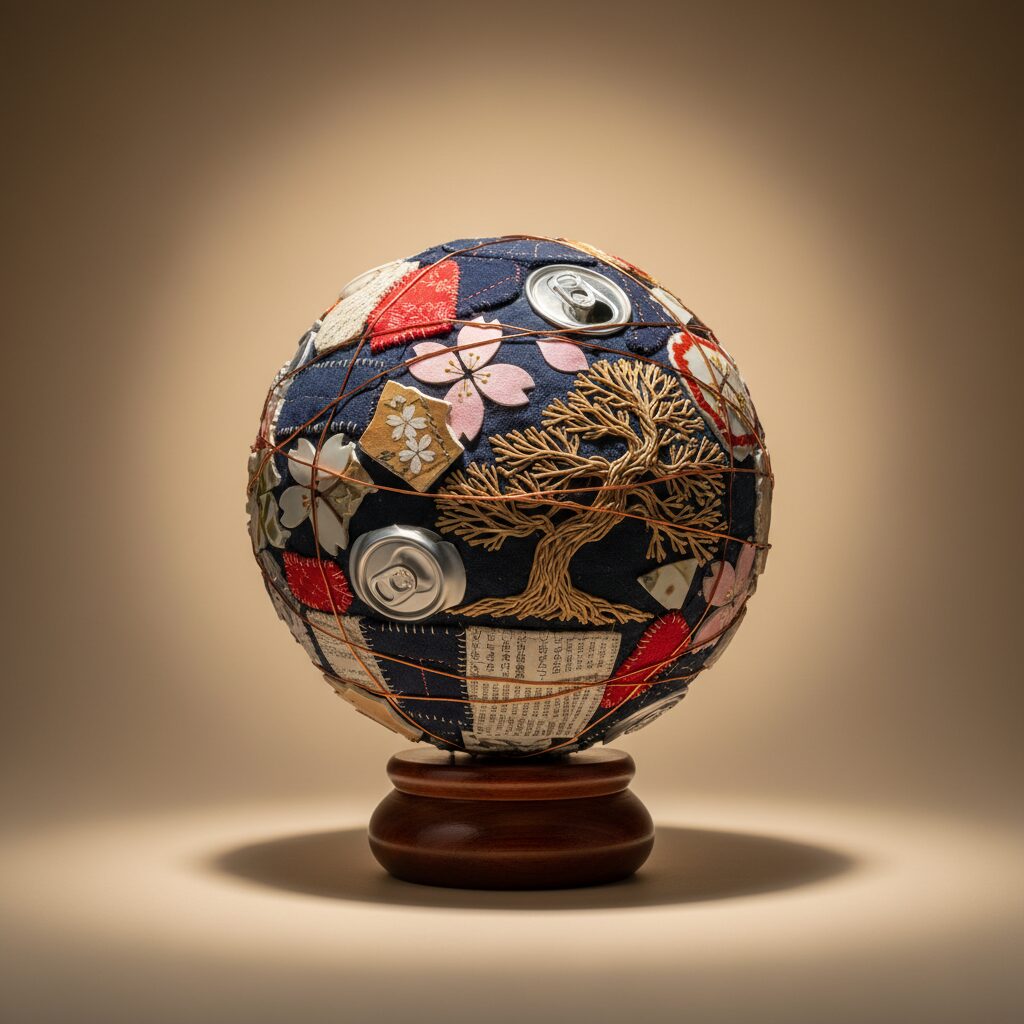
A simpler, more rustic counterpart to kintsugi is boro (ぼろ). The term means “tattered” or “ragged,” referring to the practice of patching clothing and textiles with layers of fabric. Originating from the necessity of rural, pre-industrial Japan, where cotton was precious, peasant families painstakingly mended garments and bedding with scraps of indigo-dyed hemp. Over generations, these items turned into collages of textures and blue hues, chronicling a family’s history and determination to make things last. What once marked poverty has been reassessed in modern times as an extraordinary example of folk art and sustainable design.
The Paradox of Modern Consumption
At this point, we must confront the elephant in the room. How can a culture so devoted to mottainai also be the culture known for elaborate, multi-layered packaging, convenience stores filled with single-use plastics, and an endless cycle of consumer fads? This is the central contradiction of contemporary Japan.
The paradox is real but not baffling. The love of intricate packaging arises from a different but equally strong cultural value: a reverence for presentation and hygiene. A gift is not merely about the object inside; giving is a ritual, and the wrapping plays a vital role in showing respect to the recipient. Similarly, the emphasis on cleanliness and separating items is a deeply ingrained social norm. This often directly conflicts with mottainai principles, creating a form of cultural cognitive dissonance.
Moreover, a clear generational gap exists. The post-war generation, for whom mottainai was a matter of survival, is gradually disappearing. Younger generations, raised amid unprecedented affluence and convenience, lack the same visceral bond with scarcity. For many, the allure of a 24/7 convenience store lifestyle outweighs the quiet admonishments of their grandmother’s ghost. Yet, the concept is not dead. It is simply evolving, shifting from a focus on material possessions to things like time, data, and personal potential.
The Global Echo of a Local Idea: Mottainai’s New Meaning
In recent years, this profoundly Japanese concept has unexpectedly gained new life on the global stage, repurposed as a powerful slogan for the modern environmental movement. It has proven to be a compelling and valuable idea for a world struggling with the repercussions of its own throwaway culture.
From Grandma’s Kitchen to Global Summits
The individual most responsible for this worldwide leap was the late Kenyan environmentalist and Nobel Peace Prize laureate, Wangari Maathai. She came across the term mottainai at a United Nations conference and was immediately captivated by its depth. She believed that the conventional environmental slogan “Reduce, Reuse, Recycle” was too clinical and mechanistic. Mottainai, she maintained, encompassed these three principles but added an essential fourth dimension: Respect.
Maathai promoted mottainai as a more holistic and emotionally meaningful way to consider our planet’s finite resources. It wasn’t merely about sorting your trash correctly; it was about fostering a spirit of gratitude and respect for the environment from the outset. Her endorsement of the term provided it with an international platform, and it is now widely used by environmental organizations to express a deeper, philosophical approach to sustainability.
More Than a Buzzword
In a world overwhelmed with eco-friendly branding and greenwashing, mottainai offers something genuinely authentic. It reminds us that sustainable living is not a recent innovation; it is ancient wisdom that many cultures, compelled by necessity, have long embraced. It shifts the focus from a guilt-based sense of duty to a more uplifting feeling of appreciation.
Embracing a mottainai mindset is not about self-denial or leading a bleak, austere life. On the contrary, it is about finding greater joy and meaning in what you already possess. It is the satisfaction of repairing something broken, the simple pleasure of a meal where nothing was wasted, the beauty discovered in an object that proudly bears the marks of its age and history. It is the quiet pride that comes from being a responsible steward of your small corner of the world.
Ultimately, mottainai is the voice of our conscience mourning lost potential. It is the pang felt when you scrape leftovers into the bin. It is the regret over the book you purchased but never read, the language you began to learn but abandoned, the beautiful day you squandered indoors. It is a feeling found in every culture, a universal human sorrow at the sight of waste. Japan just happened to give it the perfect name.