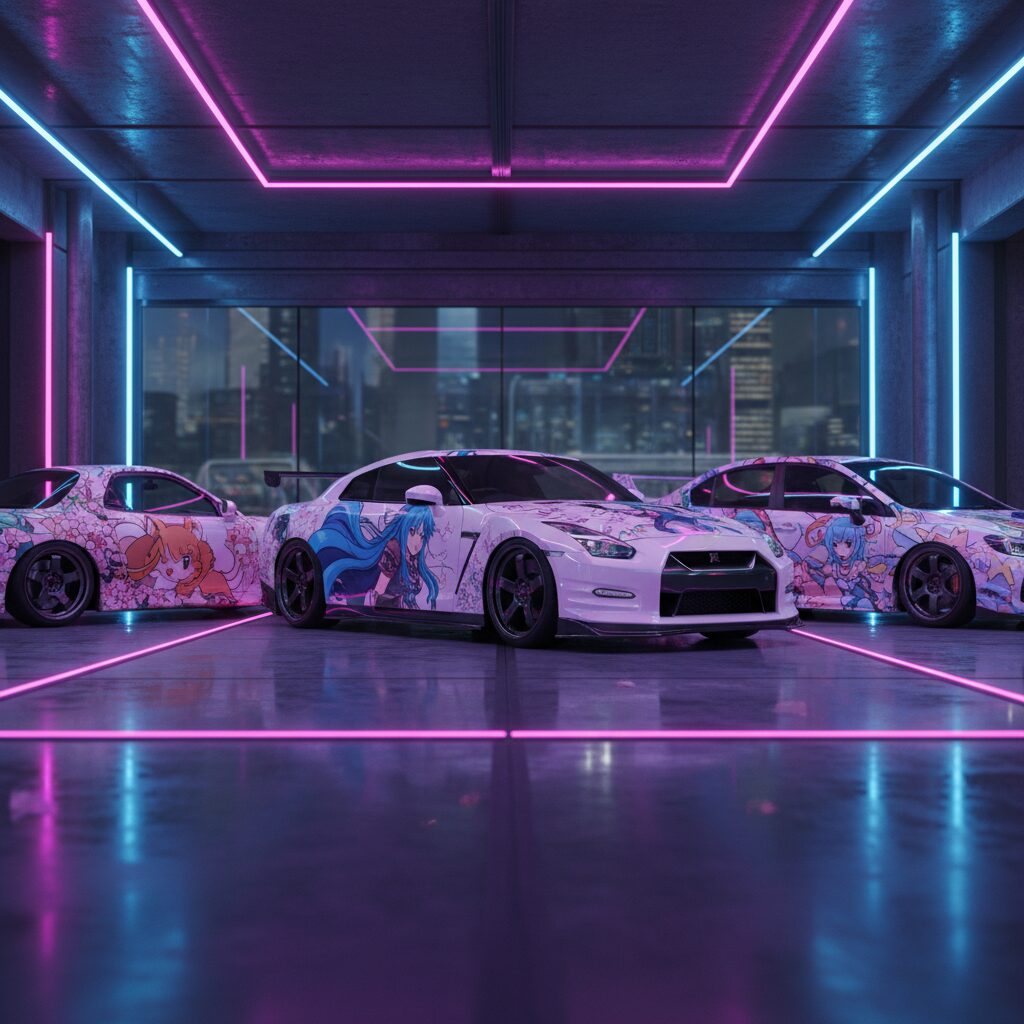
Imagine you’re driving down a quiet street in a Tokyo suburb. You see the usual assortment of sensible family vans and compact kei cars. Then, something catches your eye. It’s a sleek, modified sports coupe, but it’s not the roaring engine or the custom wheels that make you stare. It’s the car’s entire surface. Plastered across the hood, doors, and rear is a massive, vibrant illustration of a wide-eyed anime girl with electric blue hair, frozen mid-action in some fantastical battle. The car is a moving mural, a rolling declaration of love for a fictional character. You’ve just witnessed an itasha.
Welcome to one of Japan’s most visible, misunderstood, and fascinating subcultures. The word itasha (痛車) is a portmanteau of itai (痛い), meaning painful, and sha (車), meaning car. The name itself is a masterclass in Japanese self-deprecation. It’s a preemptive strike, an admission that plastering your vehicle with your favorite 2D character might be a bit cringeworthy, a little “painful” to look at for the uninitiated. But for the owners and the community that surrounds them, this pain is the entire point. It’s a badge of honor worn with a wry smile. This isn’t just about sticking a few decals on a bumper; it’s about transforming a mass-produced machine into a deeply personal, unapologetically obsessive work of art. It’s where the high-octane world of car modification collides head-on with the passionate, often insular universe of otaku fandom. To understand itasha, you have to look beyond the vinyl and see the statement being made: this is who I am, and this is what I love, broadcast for the entire world to see.
This vibrant subculture of automotive self-expression also echoes the passion of dōjinshi creativity, revealing an unseen layer of Japan’s innovative spirit.
The Anatomy of an Obsession
At first glance, an itasha might appear straightforward: a car adorned with anime characters. However, dismissing it as merely that overlooks the intricate layers of creativity, technical skill, and personal expression that define its culture. There is a distinct hierarchy of dedication, evident in the complexity and quality of the vehicle’s transformation.
More Than a Sticker
The simplest entry into the itasha scene involves basic decals or stickers, often referred to as “sticker bombing.” An owner might feature a single, carefully chosen image of their favorite character on a window or side panel. This represents the shallow end of the spectrum—a subtle way to show affiliation without a major financial or aesthetic commitment. It’s a nod to the culture rather than full immersion.
Authentic itasha begin where the decals form part of a larger, cohesive design. This typically involves large-format printed vinyl sheets, carefully applied to the car’s body panels. A common method is to use the hood as the primary canvas or dedicate each side of the car to different characters or scenes from the same series. The design process is crucial. Owners often invest countless hours, frequently collaborating with professional designers, to create layouts that complement their car’s unique lines and curves. The artwork isn’t simply pasted on; it’s integrated. A character’s pose might align with the sweep of a fender, or their flowing hair may enhance the car’s motion. The objective is harmony between machine and art.
The Full Wrap: The Pinnacle of Dedication
The most devoted and financially committed owners choose a full wrap. The entire vehicle, bumper to bumper, is enveloped in a custom-designed vinyl livery. This represents itasha at its highest form. The car transforms into a singular, unified work of art. These wraps are intricate, multi-layered endeavors demanding exceptional skill to apply flawlessly—every seam must be perfect, every contour covered without bubbles or wrinkles. The designers behind these wraps are true artists, able to turn a Toyota Supra or Nissan Silvia into a moving tribute to series like Hatsune Miku, Love Live!, or Fate/Stay Night.
Yet customization seldom ends with the exterior. True enthusiasts carry the theme inside. Custom seat covers embroidered with character logos, steering wheels in thematic colors, gear shifts replaced with novelty items from the series, and even dashboard panels hydro-dipped or wrapped in matching patterns. The interior transforms into a private sanctuary, a fandom cockpit complementing the public display outside. Some even modify their sound systems to play voice lines or theme songs from the anime whenever the doors open. Every detail is an expression opportunity.
The Choice of Canvas: Car and Character
Selecting both the base vehicle and character is a deeply personal decision. While itasha can be seen on nearly any car, from tiny kei cars to family minivans, Japanese sports cars from the 90s and 2000s—the iconic JDM (Japanese Domestic Market) legends—remain the favored canvases. Models like the Nissan Silvia, Toyota Chaser, Mazda RX-7, and Subaru Impreza are perennial favorites. Their aggressive styling and ties to performance and tuning culture provide a dynamic backdrop for artwork.
The character choice holds even greater significance. Often, the character selected is the owner’s oshi (推し) or waifu / husbando—a term for their favorite character with whom they share a deep, personal connection. This is not merely about appreciating the art style; it’s devotion to the character’s personality, story, and world. The car becomes a mobile shrine, a public testament to this affection. The entire process of selecting the art, designing the layout, and applying it to the car serves as a modern ritual of fandom.
From a Painful Joke to a Cultural Force
The story of itasha mirrors the journey of otaku culture itself: evolving from the shadowy corners of Akihabara to the brilliant lights of international exhibition halls. This subculture didn’t emerge suddenly; it developed through the merging of Japan’s vibrant car modification scene and the surge of anime and gaming popularity in the late 20th century.
The Digital Dawn
The origins of itasha date back to the 1980s, when enthusiasts adorned their cars with stickers of favorite brands or racing teams. However, the modern iteration began to take shape in the early 2000s. The advent of the internet and digital design software enabled fans to create and share high-quality character artwork more easily. Simultaneously, improvements in vinyl printing technology allowed for large-format, weather-resistant graphics to become more accessible and affordable. Previously, such decorations required expensive and permanent custom airbrush paint jobs, but vinyl wraps provided a non-permanent, high-impact alternative.
Early adopters were typically devoted otaku based in locations such as Akihabara in Tokyo or Nipponbashi in Osaka—individuals deeply immersed in both car tuning and anime fandom, two worlds that appeared quite distinct. The first itasha were often met with bewilderment and ridicule, even within their own communities. Car enthusiasts viewed them as frivolous, while some anime fans considered them overly ostentatious. Initially, the “painful” label was less of an ironic badge and more a literal reflection of public reaction.
Racing into the Mainstream
A turning point for the subculture came from an unexpected source: professional motorsports. In the mid-to-late 2000s, racing teams in Japan’s renowned Super GT series began using anime-themed liveries as sponsorship. The most notable example is the Goodsmile Racing team, which has showcased cars featuring the virtual idol Hatsune Miku since 2008. These were not merely fan creations; they were professionally designed, high-performance race cars competing at the pinnacle of domestic motorsport.
This shift had a significant impact. It conferred a sense of legitimacy and coolness to the itasha concept. If a championship-level race car could be covered in anime characters, perhaps the idea wasn’t so unusual after all. This bridged the divide between the underground subculture and a broader mainstream audience, motivating many fans to create their own itasha. Events like Comiket, Japan’s largest comic convention, began allocating large sections of their parking lots to itasha displays, making them major attractions.
Today, the itasha scene is firmly established. Specialized shops focus on designing and applying itasha wraps, national conventions and competitions are held, and an active online community shares creations and techniques. While it remains a niche interest, it is no longer hidden in the shadows—it has become a recognized and surprisingly durable pillar of contemporary Japanese subculture.
The Psychology of the Public Shrine
To truly understand itasha, one must ask the fundamental question: why? Why would someone spend thousands of dollars and countless hours transforming their car into a mobile billboard for a cartoon character, especially within a society that often values subtlety and conformity? The answer lies in a complex mix of identity, community, and the rebellious joy of turning a private passion into a public statement.
A Shield of Self-Awareness
The term itasha is crucial. By calling their own creations “painful,” owners neutralize criticism before it can even arise. It’s a form of cultural jujutsu. Labeling it as embarrassing or cringey is unnecessary; the owner is already in on the joke. This self-awareness acts as a protective shield. It converts potential shame into a bold declaration. It says, “I understand exactly how this looks to you, and I don’t care. My love for this character and art form matters more than your judgment.” This ironic detachment enables a genuine and heartfelt expression of fandom. It’s a distinctly Japanese way of addressing potentially awkward social situations by openly acknowledging the awkwardness.
Finding Your Tribe in Traffic
In a busy, often impersonal urban setting, an itasha is a strong signal. It serves as a beacon for like-minded people. For the owner, driving an itasha is a way of saying, “I belong to this group.” Another fan spotting the car on the street or in a parking area feels an immediate sense of connection and recognition. It’s a visual handshake that breaks through social barriers.
This is most apparent at gatherings and meet-ups that form the community’s core. In these spaces, the car becomes a conversation starter and a physical symbol of shared interest. Owners swap stories about their favorite series, compliment one another’s designs, and exchange tips on vinyl application and upkeep. The car is the ticket to a community offering acceptance and understanding—a stark contrast to the judgment they might encounter from the wider public. For many, the social bond formed through this unique hobby is as meaningful as the car itself.
Rebelling Through Fandom
Japanese society, though evolving, still prioritizes the group over the individual and maintaining a public face (tatemae) that may differ from one’s private feelings (honne). Within this context, the itasha is a radical gesture. It takes the honne—a deep, personal, and often nerdy passion usually kept private—and puts it on dazzling public display. It is an act of defiance against societal pressure to conform.
It’s a way of claiming public space for a private identity. The car becomes a personal bubble, a piece of property moving through the shared world. By decorating it so boldly, the owner asserts their individuality in one of the most visible ways possible. It stands in stark contrast to the quiet conformity of a commuter train. This is not simply a matter of liking anime; it’s about the freedom to express that love openly, loudly, and on one’s own terms.
The Itasha Community: Parks and Recreation
The itasha subculture flourishes not in isolation but through community. These cars are designed to be admired, and their owners are enthusiastic about sharing their passion. This social aspect becomes most apparent at dedicated meet-ups, which range from casual gatherings in parking lots to large, officially sanctioned events.
Hallowed Ground: The Parking Area Meets
Some of the most iconic spots for car enthusiasts in Japan are the huge Parking Areas (PAs) along the country’s expressways. Locations like Daikoku PA near Yokohama and Umihotaru PA on the Tokyo Bay Aqua-Line hold legendary status in car culture. On weekend nights, these spaces turn into impromptu car shows, featuring hundreds of vehicles of every imaginable style. Among the tuned drift cars and roaring supercars, a lively group of itasha is always present.
The atmosphere here is both relaxed and respectful. Owners park their cars, often with hoods raised to display engine modifications or interior lights on to highlight themed cabins. Visitors wander through the rows, snapping photos and chatting with the owners. There’s a quiet appreciation for the time, money, and effort invested in each vehicle. It is a place where intricate design details are admired, and the choice of a niche character from an obscure visual novel is acknowledged and celebrated. These meets serve as the community’s lifeblood, where friendships are made and inspiration sparked.
The Main Stage: Conventions and Shows
Beyond the casual PA meets, itasha play a prominent role at larger events. Major car shows like the Tokyo Auto Salon now feature dedicated sections for itasha, placing them on par with more traditional car modifications. However, the true spiritual homes of itasha are otaku-centric conventions.
The parking lots of events like Comiket in Tokyo become spectacles on their own, hosting hundreds, sometimes thousands, of itasha. These gatherings represent the pinnacle of the scene, showcasing the latest trends, the most ambitious designs, and a remarkable variety of cars and series. Some events even hold competitions, with judges awarding prizes for best design, best craftsmanship, and most creative concept. For a devoted owner, gaining recognition at one of these major events is the ultimate accolade.
The Cost of Devotion
This level of involvement comes at a considerable cost. It’s a hobby demanding significant financial commitment, emphasizing that this is a serious endeavor rather than a passing interest. The price for a full, professionally designed and applied vinyl wrap can easily range from $3,000 to $10,000 USD, depending on the design’s complexity and the vehicle’s size. This cost does not include the base car itself, any performance or aesthetic upgrades, or interior customizations. Maintaining the wrap also requires care, as vinyl can be damaged by sun exposure and weather over time. Being an itasha owner is an investment, signaling that fandom is a central aspect of one’s life—something worthy of substantial dedication and resources.
A Rolling Contradiction

Ultimately, the itasha represents a beautiful contradiction. It is a subculture that is both self-deprecating and fiercely proud. It is highly individualistic while also deeply dependent on a sense of community. It takes a disposable aspect of modern pop culture—an anime character—and honors it with the reverence and artistry typically reserved for classical art. It merges the mechanical, performance-focused realm of car tuning with the emotional, narrative-rich world of otaku fandom.
To encounter an itasha is to witness a story. It is the story of a fan’s devotion, an artist’s craft, and a community’s ability to define what is cool, beautiful, and “painful” on their own terms. These cars are more than mere transportation; they serve as canvases for a vibrant, mobile, and unapologetically nerdy art movement. They stand as a declaration that, even in a world dominated by mass production and social norms, there is always space for passionate, painful, and glorious individuality.