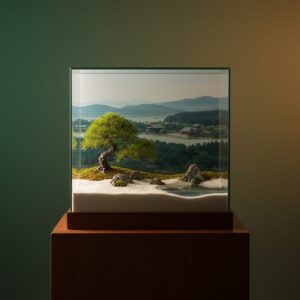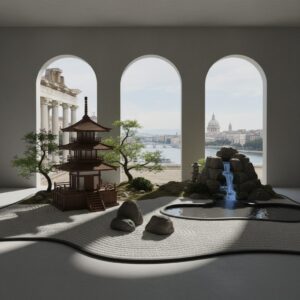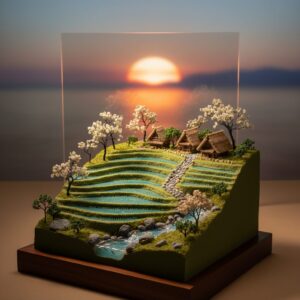
Stand in a great Japanese garden—one of the masterworks in Kyoto, perhaps—and you’ll feel an almost unnerving sense of completeness. Every rock seems placed by gravity itself, every plant pruned to its essential form. The raked gravel flows like water, and the moss carpets the ground with the quiet patience of centuries. It’s a world in miniature, a perfected landscape that calms the mind and stills the soul. But the most profound element, the one that elevates the garden from a beautiful enclosure to a work of genius, might not be inside the garden at all.
Look closer. Notice how the dark wood of the temple veranda creates a perfect frame. Through that frame, beyond the meticulously clipped azalea bushes and the still pond, a mountain rises in the distance, its silhouette tracing a gentle curve against the sky. That mountain isn’t part of the temple grounds. The monks don’t own it. They don’t tend to it. Yet, it is undeniably the garden’s final, most breathtaking feature. This is the art of shakkei, or “borrowed scenery.”
Shakkei is the quintessentially Japanese design principle of incorporating distant landscapes into the composition of a garden. It is the conscious act of “borrowing” a view—a faraway mountain, a neighboring pagoda, a stand of forest, even the ocean—and making it an integral part of the garden’s design. This isn’t just about having a nice view. It’s a sophisticated and deeply philosophical technique that dissolves the boundaries between the finite, human-made space of the garden and the infinite, untamed wilderness beyond. It’s a design choice that speaks volumes about the Japanese relationship with nature, space, and the very idea of possession. To understand shakkei is to understand that the ultimate Japanese garden often finds its completion far beyond its own walls.
This ingenious approach to fusing human design with nature is explored further in how Japanese gardens seamlessly borrow nature.
The Philosophy Behind the Frame
The concept of borrowing scenery goes far beyond being a mere aesthetic technique to make a small space appear larger. It represents a worldview expressed through landscape design. At its essence, shakkei is a gentle challenge to the notions of containment and ownership. Traditionally, in the West, a garden has symbolized control over nature—a plot of land tamed, organized, and enclosed by walls or hedges, clearly separated from the wild outside. The garden was seen as a human domain, demonstrating our capacity to dominate the natural world.
Shakkei offers a profoundly different perspective. The designer who “borrows” Mount Hiei for their garden does not claim it as their own. Instead, they recognize its beauty as a universal gift, something to be admired and harmonized with, rather than possessed. This reflects a deeply rooted cultural view, shaped by Shinto and Buddhist philosophies, which regard humanity not as separate from or superior to nature, but as an integral part of it. In this light, the garden wall acts less as a barrier and more as a permeable membrane through which the wider world flows. The human-made (the garden) and the natural (the borrowed vista) are not opposing forces; they engage in a dialogue, complementing each other within a single, harmonious composition.
This dialogue is vibrant and constantly evolving. The borrowed landscape is not a fixed image. Clouds drift over the distant mountain’s surface, the seasons change the borrowed forest’s hues from spring’s fresh greens to autumn’s fiery reds, and mist may obscure the view at one moment only to unveil it with striking clarity the next. By welcoming this dynamic, uncontrollable element into the garden, the designer embraces the principle of wabi-sabi—valuing beauty found in imperfection and impermanence. The garden is never truly “complete” because its most vital element is the living, breathing world itself. This acknowledgment of transience imparts a profound sense of peace to these gardens. They do not resist time; they flow with it.
The Techniques of Borrowing
While the philosophy emphasizes harmony and acceptance, the practice of shakkei is far from passive. It is an art form that demands great intentionality and technical skill, requiring a masterful eye for composition, perspective, and illusion. A successful borrowed scenery garden offers a carefully planned experience, guiding the viewer’s gaze and creating a seamless visual journey from the immediate foreground to the distant horizon.
Framing the View
The most essential technique is creating a frame. Borrowed scenery is rarely showcased as a broad, open panorama. Instead, it is unveiled through a carefully constructed aperture that focuses attention and heightens the view’s impact. This frame may be architectural, such as the pillars and eaves of a veranda, or a window within a tea house, transforming the landscape into a living painting—an effect known as madomado (window view). Viewed from the darker interior, the sunlit world outside acquires an almost supernatural vibrancy and depth.
Frames can also be natural. A gap between two carefully pruned pine trees, an opening in a dense hedge, or the low arch of a garden gate all serve to direct the eye. By controlling what the viewer sees, the designer isolates the most desirable element of the distant landscape, filtering out distractions and presenting a perfectly composed scene. This act of framing conveys deliberate artistry, making clear that the inclusion of the distant view is no random happenstance.
The Middle Ground as Connector
A successful shakkei composition requires more than just foreground and background. The critical, and often most challenging, component is the middle ground—the garden itself. This area acts as a visual bridge, linking the viewer’s immediate surroundings with the borrowed scenery on the horizon. Without a convincing middle ground, the distant view can seem disconnected, resembling a picture hung on a wall rather than a natural extension of the landscape.
Designers use various strategies to establish this connection. Trees or shrubs within the garden may echo the shapes or textures of the distant forest. A low, rolling hedge might be sculpted to mimic the silhouette of the mountains beyond. Stones in a rock garden can be arranged to suggest a miniature mountain range that leads the eye toward the real one. Water features, like ponds, are particularly effective, reflecting the sky and creating a sense of vast continuity between the garden and the world beyond. The goal is to foster a visual flow, an uninterrupted transition that blurs the boundary between the garden and the borrowed landscape.
Hiding and Revealing
Paradoxically, one of the most compelling techniques in shakkei is to hide the very scenery one wishes to borrow. This is the concept of miegakure, or “hide and reveal.” Instead of showing the entire stunning view immediately at the entrance, the designer creates a path—such as a stroll garden, or kaiyū-shiki teien—that reveals and conceals the borrowed landscape incrementally. A visitor might glimpse a distant pagoda fleetingly through a bamboo screen, only to have it vanish as the path curves. A few steps farther, the view reappears, larger and more dramatic, framed perfectly by a maple tree.
This technique builds anticipation and fosters a sense of discovery. It transforms garden viewing from a passive act into a narrative experience. The viewer becomes an active participant, with their movement through the space uncovering the landscape’s secrets piece by piece. By controlling the rhythm of concealment and revelation, the designer amplifies the emotional impact of the final, fully revealed view, making it feel earned and all the more magnificent.
Masterpieces of Borrowed Scenery
To truly understand the power of shakkei, one must observe the gardens where this principle has been finely honed. These spaces are more than just beautiful; they serve as living examples of a deep artistic and philosophical vision.
Entsu-ji Temple, Kyoto
Nestled in northern Kyoto, Entsu-ji is a small temple that presents one of the purest and most striking instances of shakkei. The garden itself is minimalist: a moss bed, a few rocks, and some low, clipped hedges. Visitors sit on the veranda of the main hall, gazing outward. The temple’s wooden pillars serve as vertical frames, while the hedges in the foreground are carefully trimmed to echo the undulating silhouette of Mount Hiei in the distance. The connection is so direct and deliberate that the mountain feels less like a backdrop and more like the garden’s primary rock feature. There is hardly any middle ground; the garden flows directly from the temple’s edge to the remote peak, creating a breathtaking and contemplative composition.
Shugakuin Imperial Villa, Kyoto
If Entsu-ji is a succinct poem, Shugakuin is an epic novel. This expansive villa, constructed in the 17th century, is a masterpiece of large-scale shakkei. It is a stroll garden, meant to be experienced by walking through its Upper, Middle, and Lower Villas. The most dramatic use of borrowed scenery is at the Upper Villa. From the Rinun-tei teahouse, perched on a hillside, the view is spectacular. Below, a large man-made pond extends, its shores dotted with islands and bridges. But beyond the pond, the garden’s borders seem to disappear. The carefully tended landscape blends seamlessly with the surrounding rice paddies, forests, and the entire mountain range encircling Kyoto. The designer did not simply borrow a single mountain; they borrowed the whole Kyoto basin, making the imperial grounds feel as vast as nature itself.
Adachi Museum of Art, Shimane Prefecture
A more contemporary yet equally impressive example is the Adachi Museum of Art. Here, the concept of shakkei is highlighted by treating the gardens as “living Japanese paintings.” The museum’s founder, Adachi Zenko, believed the garden was an extension of the art collection. Visitors experience the gardens not by walking through them but by gazing out from large windows inside the museum. In one famous view, a window is designed to resemble a hanging scroll (kakejiku), perfectly framing a scene of a white gravel river, manicured pines, and a waterfall, with the natural mountains in the distance forming the painting’s backdrop. It is a stunning fusion of art, architecture, and landscape design, where the borrowed scenery becomes the final, living brushstroke on a masterpiece that evolves with every season.
More Than Just a Pretty View: Shakkei in the Modern World
In an era marked by rapid urbanization and shrinking private spaces, the principles of shakkei feel more relevant than ever. Although few people today have the luxury of borrowing a mountain, the underlying philosophy provides a valuable lesson for modern life and design. At its core, the art of shakkei is an art of context.
Urban architects and designers now apply a form of contemporary shakkei. In a densely populated city like Tokyo, a strategically placed window in an apartment building might not frame a mountain but could capture a single, beautiful cherry tree in a neighbor’s yard, a distant iconic skyscraper, or simply an uncluttered patch of sky. By doing so, it “borrows” a sense of beauty and space from the surrounding urban environment, making a small living area feel more connected and expansive. It serves as a reminder that even in the most crowded places, one can cultivate tranquility by thoughtfully shaping one’s relationship with the outside world.
Ultimately, shakkei is more than a technique for gardeners and architects—it is a mindset. It involves looking beyond your own fences, both literal and metaphorical. It encourages an appreciation for beauty you do not own, a harmony between your small world and the larger one it inhabits, and an acknowledgment that the most meaningful view often recognizes a reality greater than yourself. It is the simple yet profound understanding that by thoughtfully framing the world, we can invite its infinite beauty to become part of our own lives.