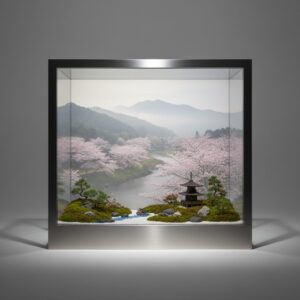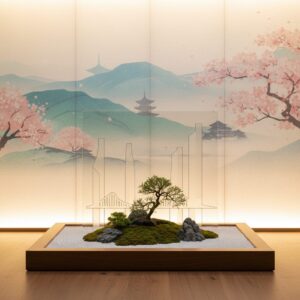
Stand in a truly great Japanese garden, and you might feel a peculiar sense of scale. You’re in a meticulously controlled space—every rock placed with intention, every plant pruned to an ideal form. Yet, the world feels vast, expansive, almost infinite. You look past a perfectly raked bed of gravel and a stone lantern, and your eyes are drawn over a clipped hedge to a distant mountain, its slopes hazy in the afternoon light. That mountain isn’t on the garden’s property deed. The temple doesn’t own it. But in that moment, it is unequivocally the most important part of the garden. The garden has claimed it, not through ownership, but through a far more elegant act: borrowing.
This is the essence of shakkei, or 借景. The characters translate literally to “borrowed scenery.” It’s one of the most fundamental and profound concepts in Japanese landscape design, yet it’s often misunderstood as simply “having a nice view.” It’s so much more than that. Shakkei is not a passive appreciation of a backdrop; it is the active, intentional incorporation of a distant landscape into the immediate composition of the garden. It is a design philosophy that dissolves boundaries, making a small, finite space feel connected to the vast, uncontrollable world beyond its walls. To understand shakkei is to understand a core aspect of the Japanese relationship with space, nature, and the subtle art of framing perception itself.
This seamless interplay between cultivated design and the vast world beyond invites readers to explore an ingenious perspective on borrowed scenery that transcends traditional boundaries.
The Illusion of a Boundaryless World
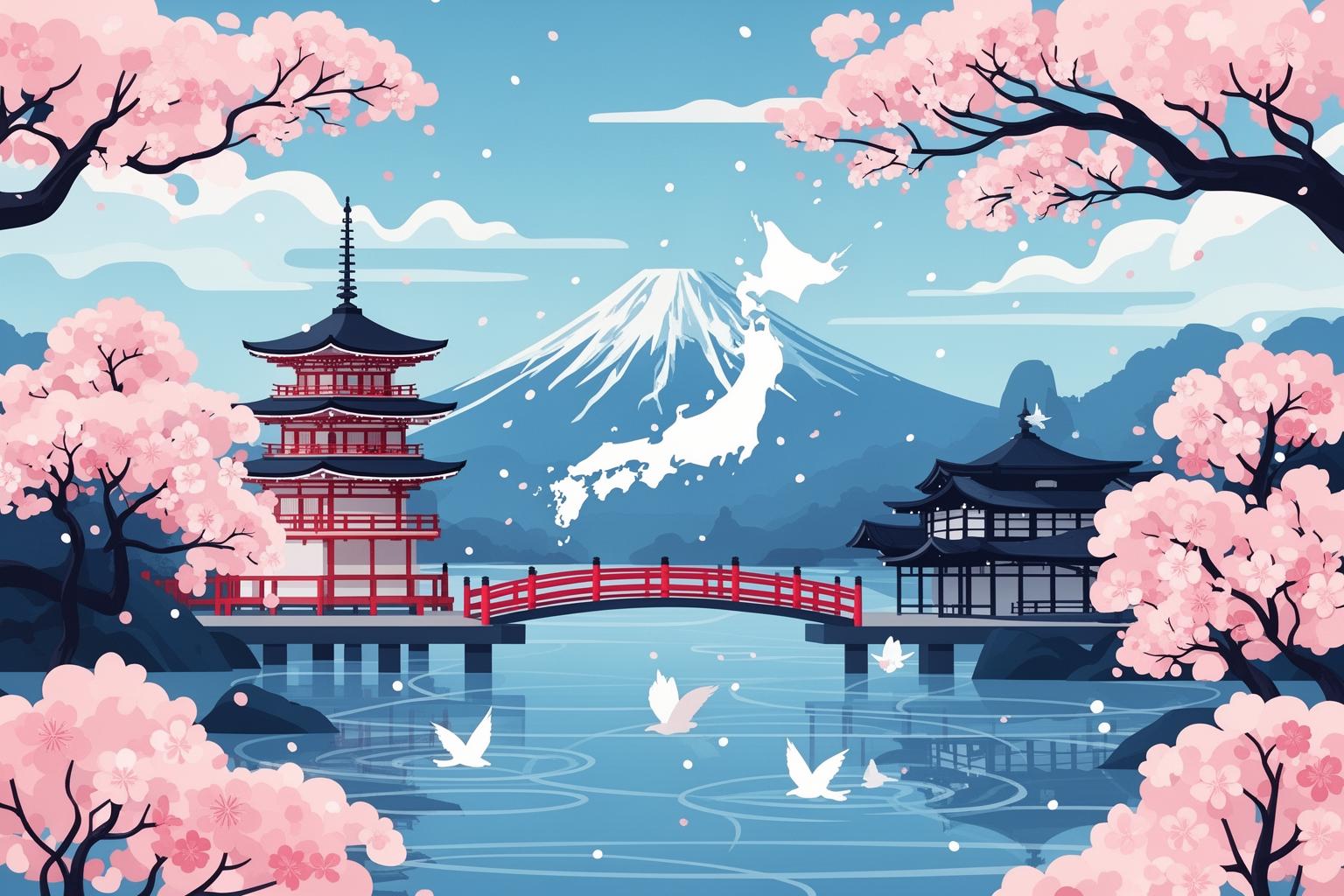
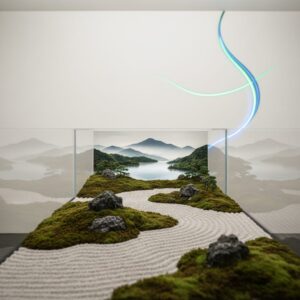
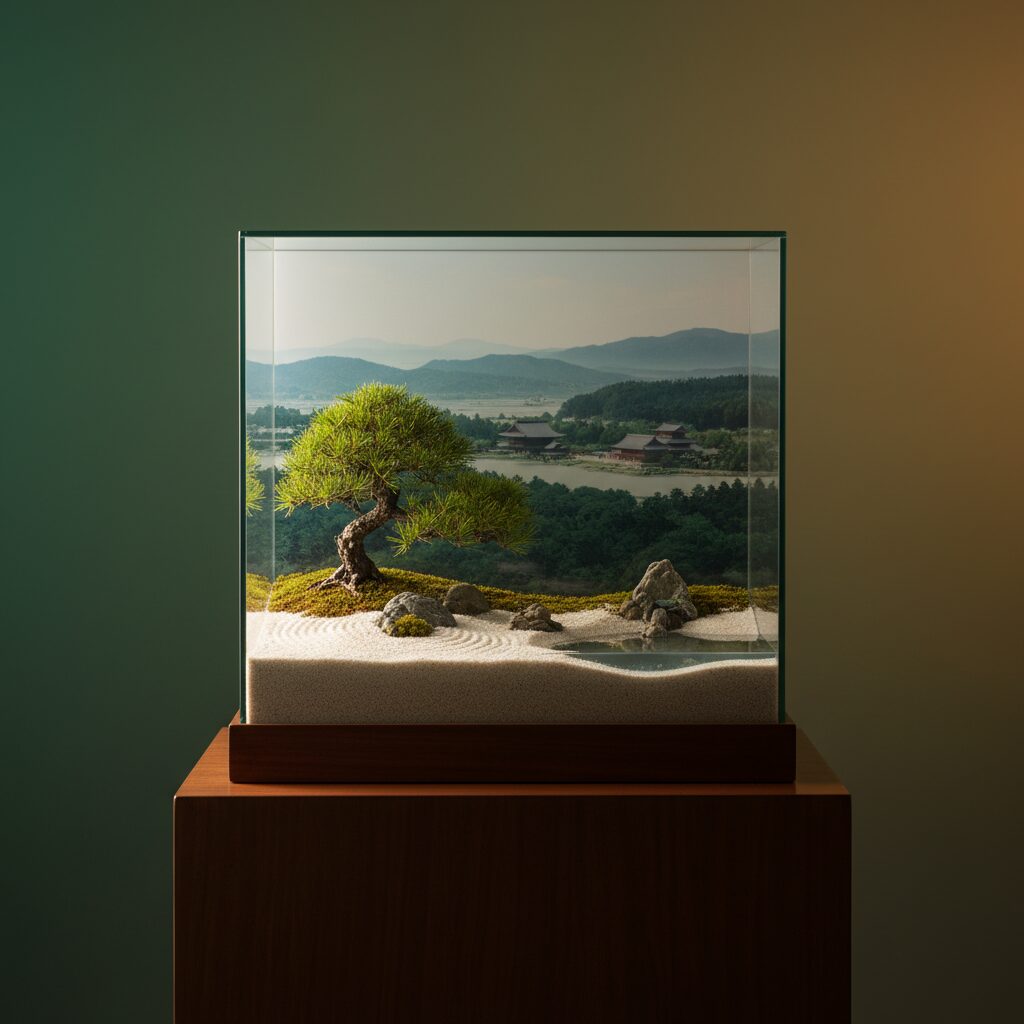
At its core, shakkei is a brilliant illusion. It involves forming a visual and psychological link between three distinct layers: the foreground (the garden itself), the middle ground (the framing elements), and the background (the borrowed scenery). The brilliance lies in how the middle ground is carefully crafted to seamlessly unite the foreground with the background, making them appear as one continuous landscape.
The “frame” is crucial. This is not simply about placing a garden in a picturesque location. A designer might use a low, trimmed hedge of azaleas to conceal the visual clutter of the town in the valley below, while keeping the view of the mountains beyond perfectly clear. The hedge acts like a man-made cloud bank, editing reality to create a more harmonious composition. The overhanging eaves of a teahouse roof, a thoughtfully positioned grove of bamboo, or the pillars of a temple veranda can all function as a proscenium arch, showcasing the natural drama beyond.
Think of it as a live-action landscape painting. The garden designer is the artist, but instead of paints and canvas, they employ rocks, plants, and architectural features. The distant mountain, the neighbor’s forest, or even a far-off pagoda becomes the subject of the artwork. The garden itself—its ponds, paths, and lanterns—is the detailed foreground that provides depth and context to the entire scene. It anchors the viewer, offering a human scale from which to admire the grandeur of the borrowed element.
This technique creates a striking dynamic tension. You are simultaneously aware of the intimate, controlled space you inhabit and the wild, untamed nature far beyond. The garden acts as a bridge between these two realms. It does not attempt to mimic the mountain; instead, it honors it by framing it. It does not seek to own the scenery; it respectfully borrows its beauty for a time. This borrowing implies a temporary relationship based on respect rather than control. The mountain will remain long after the garden is gone, but for this moment, they collaborate to create a scene of profound beauty.
A Frame for the Mind: The Psychology of Shakkei
Why go through all this effort? Because shakkei is more than just a visual technique; it is also a psychological one. It aims to evoke a particular mindset, one that reveals much about the cultural perspective that created it. In the West, a traditional formal garden, such as those at Versailles, typically symbolizes human mastery over nature. It imposes geometric order on the landscape, serving as a statement of power and dominance. In contrast, a garden featuring shakkei does the opposite. It acknowledges its own smallness in relation to the larger world and, in doing so, broadens its spiritual and aesthetic boundaries.
This concept aligns seamlessly with other fundamental Japanese aesthetic principles. Take ma (間), the idea of negative space. Ma posits that the empty space between objects holds as much importance as the objects themselves. In a garden employing shakkei, the sky above the mid-ground hedge and below the distant mountain represents a vast expanse of ma. The garden does not attempt to fill this void; instead, it uses the borrowed scenery to give that emptiness shape, significance, and scale. The emptiness becomes an essential, active component of the composition.
Likewise, shakkei resonates with the philosophy of wabi-sabi (侘寂), which values imperfection, impermanence, and rustic simplicity. Borrowed scenery exemplifies this perfectly. It lies completely beyond the gardener’s control. Clouds drift over the mountain’s face, the seasons shift the distant forest’s colors from vibrant green to fiery red to stark white, and rain may obscure the view altogether. By incorporating this scenery, the garden embraces transient, uncontrollable beauty. It accepts that perfection is not about static control but about a harmonious relationship with an ever-changing world. Every visit to the garden is unique, as the borrowed element never appears the same twice.
Ultimately, shakkei’s purpose is to transform the viewer’s perspective. It lifts you out of immediate concerns and connects you to something larger and more enduring. It physically embodies a worldview that sees humanity not as separate from nature but as a small part of a vast, interconnected whole. The boundary between the ‘inside’ (the human-made garden) and the ‘outside’ (the natural world) is deliberately and beautifully blurred.
The Four Methods of Borrowing
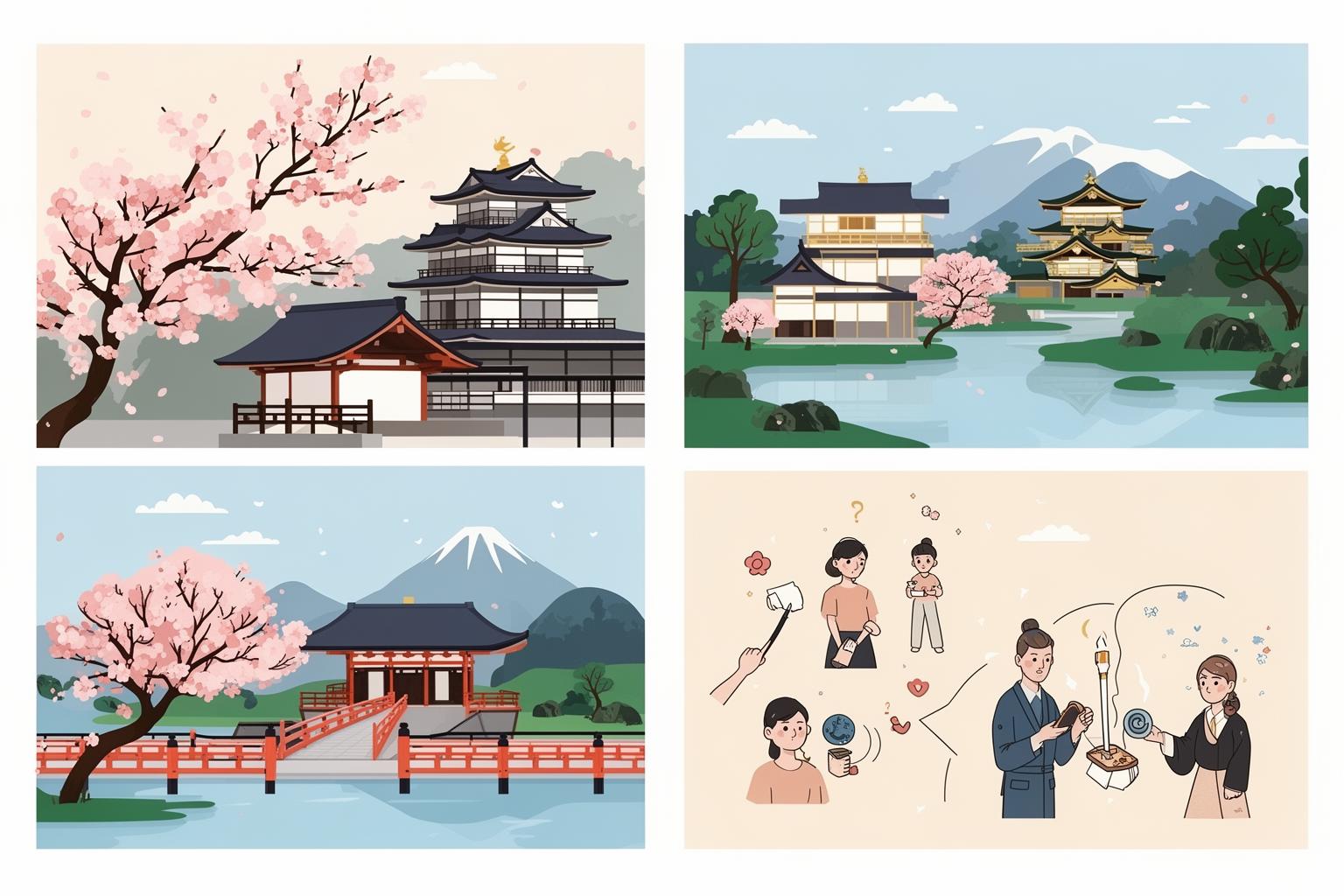
Japanese garden theory is nothing if not intricate. Over centuries, scholars and designers have classified shakkei into four primary types, based on the direction and proximity of the borrowed element. Understanding these categories enhances appreciation of the technique’s subtlety and diversity.
Enshaku (遠借): Distant Borrowing
This is the classic form of shakkei that most people envision. It involves incorporating a famous mountain, a line of hills, or another significant, large-scale natural feature into the garden’s view. The essential aspect is the great distance involved, which imparts a sense of grandeur and epic scale. The middle ground becomes especially important here, as it must effectively conceal the intervening space (potentially filled with buildings, roads, or unsightly modern elements) to create the illusion of a seamless transition. When executed well, the effect is stunning, making a garden of just a few acres feel as vast as the surrounding landscape.
Rinshaku (隣借): Adjacent Borrowing
More intimate and subtle, rinshaku involves borrowing elements from a neighboring property. This might be a beautiful grove of trees within an adjacent temple compound, the elegant tiled roof of a nearby building, or even a striking rock formation just beyond the wall. This form of shakkei requires cooperation and a shared aesthetic sensibility between neighbors. It’s a charming concept in dense urban settings like Kyoto, where it recognizes that beauty need not be privately owned to be appreciated. A wall might be lowered, or a bamboo fence selectively thinned, to allow a ‘glimpse’ of the neighbor’s maple tree, which is then framed by a stone lantern in one’s own garden.
Gyōshaku (仰借): Upward Borrowing
This borrowing technique directs the viewer’s gaze upward. Instead of a distant mountain, the borrowed element could be the sky, drifting clouds, or the canopy of very tall trees located just outside the garden’s boundaries. A small, enclosed courtyard garden might be designed entirely around framing a section of sky. The changing light, the movement of clouds, and the stars at night become the garden’s main dynamic feature. It’s a method for creating a sense of openness and expansiveness even within a confined space.
Fushaku (俯借): Downward Borrowing
Less common but equally impactful, fushaku entails borrowing a view from below. This might involve situating a pavilion on a hillside to overlook a winding river valley, or more subtly, designing a pond to capture the reflection of the sky or overhanging trees. The reflection becomes a borrowed element—a fleeting, shimmering version of the world above. This adds layers of reality and illusion to the garden experience, encouraging contemplation about what is real and what is merely a reflection.
Seeing Shakkei in Practice: Where to Experience It
While the theory is intriguing, shakkei is an art form that must be experienced firsthand to be truly understood. Several gardens in Japan are regarded as exceptional masterpieces of this technique.
Shugaku-in Imperial Villa, Kyoto
Arguably the grandest and most renowned example of shakkei in Japan. Situated in the northeastern hills of Kyoto, Shugaku-in consists of three distinct gardens spread across a vast estate. The highlight is the Upper Villa. After following a winding path, you reach a pavilion perched high on a hill, where a panoramic view unfolds before you. Below lies a large, man-made pond called Yokuryu-chi, featuring islands and bridges. Beyond the pond, the garden’s boundary seems to fade completely into the surrounding forests and, further beyond, the majestic Higashiyama and Kitayama mountain ranges. The design expertly conceals the city in the valley, crafting an idealized, pristine landscape that feels endlessly expansive.
Tenryu-ji Temple, Kyoto
The Sogenchi Teien (Cloud-Dragon Garden) at Tenryu-ji in Arashiyama is one of the oldest surviving gardens of its type and a classic example of distant borrowing. The garden itself, with its central pond and carefully arranged rock formations, is a masterpiece. However, its true brilliance lies in how it seamlessly incorporates the forested slopes of Mount Arashiyama and Kameyama as an integral part of the background. The curve of the pond’s shoreline mirrors the undulating lines of the hills. The deep green of the distant forest serves as the final backdrop for the entire scene. The boundary is so fluid that it feels as if the temple grounds extend all the way to the mountain peaks.
Adachi Museum of Art, Shimane Prefecture
A modern marvel, the gardens of the Adachi Museum are frequently ranked among the best in Japan, and deservedly so. Here, shakkei is executed with meticulous precision. The museum building itself features enormous picture windows that act as literal frames for the garden views. The “Living Hanging Scroll” is a tall, narrow window that perfectly frames a waterfall and landscape outside, resembling a classical ink painting. The gardens are immaculately maintained and designed to blend seamlessly with the natural, untamed mountains beyond. The boundary between the pruned pines within and the wild forests outside is almost indistinguishable. It is perhaps the most deliberate and self-aware application of shakkei, a breathtaking fusion of art and nature.
Beyond the Garden Wall: Shakkei as a Modern Mindset
Shakkei is often thought of as a historical technique tied to feudal lords and Zen monks. However, its underlying philosophy is more relevant today than ever before. It presents a compelling counter-narrative to our modern habit of isolating ourselves, controlling our surroundings, and sharply dividing what is ‘mine’ from what is not.
Take a look at contemporary Japanese architecture, and you will notice the spirit of shakkei everywhere. An urban home might include a large, floor-to-ceiling window not to showcase the interior, but to incorporate the view of a single cherry tree in a small nearby park. A city apartment balcony might be designed not for furniture, but to frame a particular view of the distant skyline, bringing the city’s life into the private space. It’s a way to discover and curate beauty even in the most crowded settings.
On a deeper level, shakkei can be understood as a way of living. It involves finding value in what you don’t own. It means recognizing your connection to the broader world and accepting that your personal space is permeable, always shaped by the larger environment. You can ‘borrow’ the beauty of a sunset from your office window, the sound of rain from a nearby forest, or the energy of a bustling street from a cafe seat. It’s an act of selective attention, framing the world to bring a sense of connection and peace, without the need to possess or control it.
So next time you look out a window, take a moment to pause. Don’t just see what’s outside. Notice the frame. Observe what is included and what is left out. Pay attention to the relationship between the near and the far. You might realize you’re not just looking out at the world, but borrowing a piece of its beauty, creating a temporary, personal garden for your mind. That is the lasting, quiet power of shakkei.