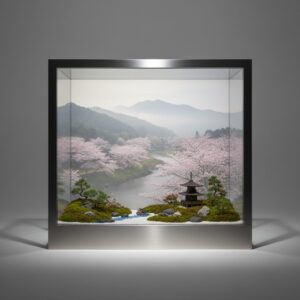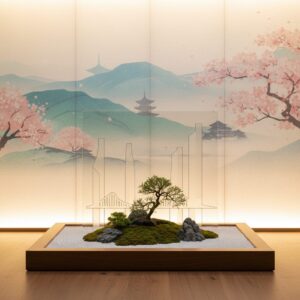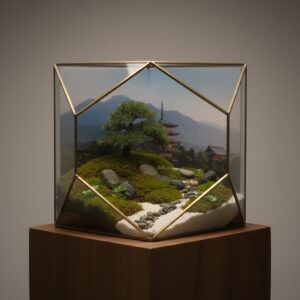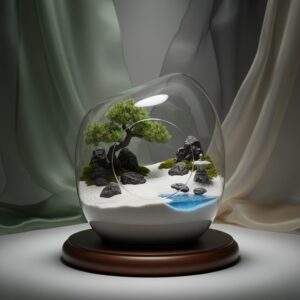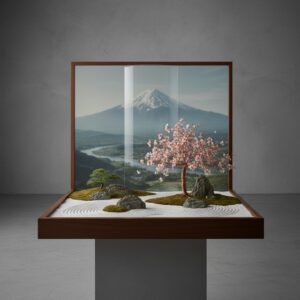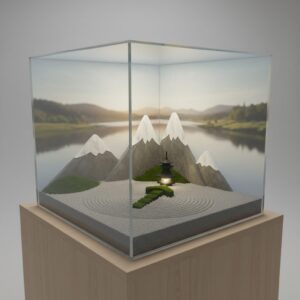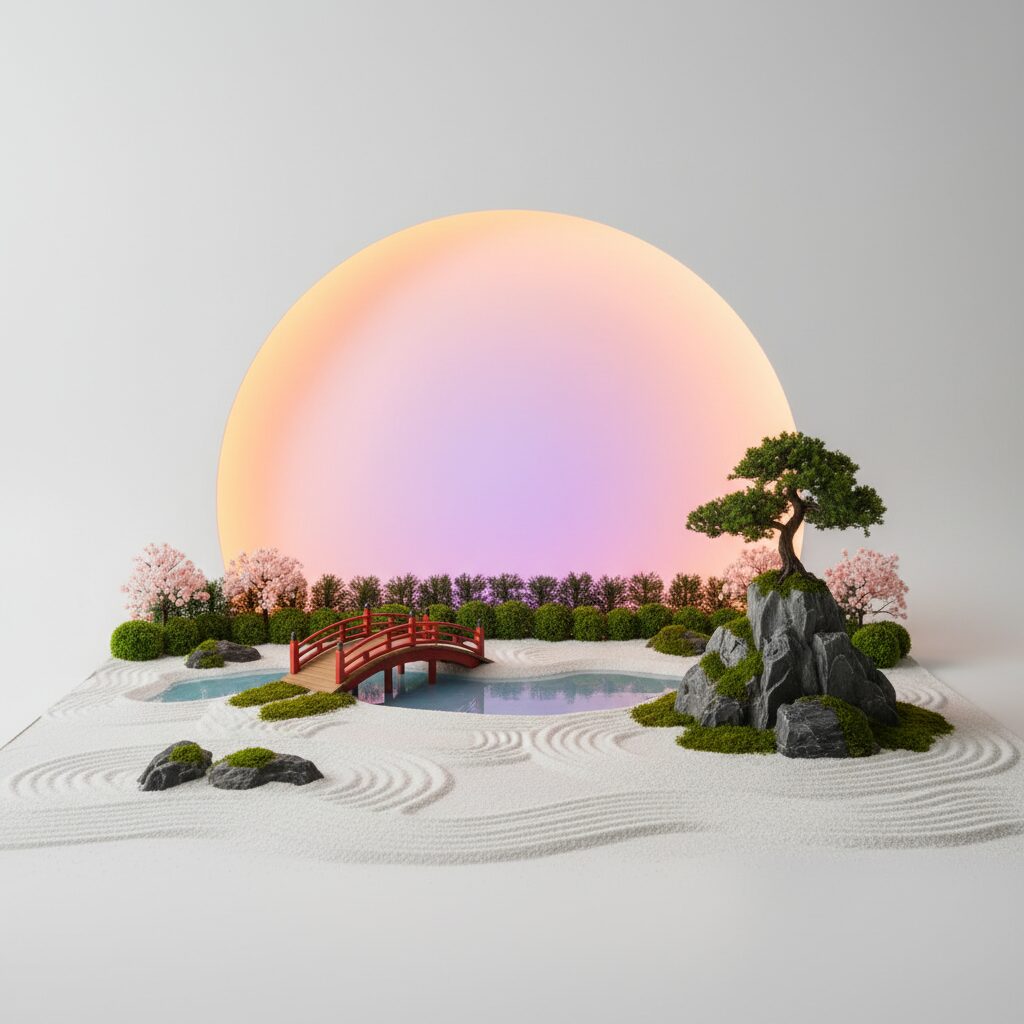
You’re standing in a Japanese garden, maybe in Kyoto. It’s perfect. Every rock seems placed by a divine hand, moss carpets the ground in fifty shades of green, and a stone lantern sits with quiet dignity beside a placid pond. The space feels meticulously controlled, a miniature world sealed off from the chaos outside. But then you look up, past the carefully clipped azalea bushes and the elegant black pine, and your eyes land on the soft, blue-grey silhouette of a distant mountain. Suddenly, the garden doesn’t feel small at all. It feels boundless. The garden wall, which you thought was the boundary, has somehow dissolved. That mountain, miles away, feels like it’s part of the composition. It feels like it belongs right here.
What you’re experiencing is not an accident. It’s a deliberate, sophisticated design principle known as shakkei, or “borrowed scenery.” This is one of the most profound concepts in Japanese landscape architecture, a technique that elevates a garden from a mere collection of plants into a conversation with the world beyond its borders. It’s the art of intentionally incorporating a distant landscape—a mountain, a forest, the sea, even the roof of a neighboring temple—into the garden’s own design, making it a vital part of the overall aesthetic. This isn’t just about having a nice view; it’s about blurring the line between the created and the existing, the private and the public, the finite and the infinite. It’s a philosophy that reveals a deep-seated Japanese perspective on nature, space, and humanity’s place within it. So, let’s unpack how and why these gardens reach beyond their own fences to pull the horizon into their embrace.
This interplay between the meticulously crafted space and the vast natural backdrop also invites us to rethink where the intimate garden experience meets the sacred threshold that bridges human design with nature’s expanse.
What is Shakkei, Really? Beyond the Postcard Definition
At its core, shakkei is an act of inclusion. The garden designer recognizes that they cannot create anything grander than a mountain range or an expansive forest. So, rather than trying to compete with or block it out, they choose to incorporate it. But this borrowing is much more deliberate and artistic than merely refraining from building a tall wall. It involves curation, framing, and a delicate interplay between the foreground, middle ground, and background.
The Art of Framing
Borrowed scenery loses its effect if the view is just a broad, unstructured panorama. The essence of shakkei lies in how the view is framed. The designer uses elements within the garden as a natural picture frame, guiding the viewer’s gaze and heightening the impact of the distant object. A carefully placed gap between two maple trees might perfectly frame a distant pagoda. The curved roof of a teahouse might dip just low enough to reveal a specific mountain peak. A window in a study, called a mado, can be designed not only to let in light but also to capture the distant landscape as a living painting.
This framing is vital. It conveys a sense of purpose and control. The designer is essentially inviting the viewer to say, “Look here. Notice this particular relationship between my garden and that mountain.” It separates the borrowed element from its broader context, making it feel more special and intimately connected to the garden space you’re in. Without the frame, it’s merely a view. With the frame, it transforms into a composed work of art.
The Middle Ground is Key
A common misconception about shakkei is that it focuses solely on the distant view. In truth, the success of the technique depends entirely on the “middle ground”—the garden itself. The elements inside the garden—the ponds, rocks, trees, and lanterns—must be designed to connect with and complement the borrowed scenery. They act as a visual bridge, leading the eye from the immediate foreground to the distant background.
For instance, a garden designer might arrange a cluster of jagged rocks in the foreground that subtly mirrors the shape of the faraway mountain range. The flowing shape of a clipped hedge might echo the contour of a remote hill. The color of certain flowers might be selected to harmonize with the seasonal hues of the borrowed forest. This thoughtful composition of the middle ground smooths the transition, tricking the eye into seeing the garden as extending beyond the wall, flowing naturally and continuously toward the horizon. Without a well-designed, complementary middle ground, the distant scenery would feel detached and isolated, like a picture hung on a wall rather than an integral part of the environment.
The Philosophical Roots: A Shared East Asian Heritage
This sophisticated design approach didn’t emerge spontaneously. The concept of integrating a garden with the broader world is deeply rooted in East Asian philosophy, drawing from both Chinese Taoist traditions and Japan’s native Shinto beliefs. Understanding these origins is essential to appreciating why shakkei is more than merely an aesthetic choice.
Taoist Echoes and Chinese Origins
The idea of borrowing scenery clearly originates from classical Chinese garden design. The 17th-century Chinese garden manual, Yuanye (園冶), thoroughly explains the principles of jiè jǐng (the Chinese term for shakkei). Chinese scholars and officials, profoundly influenced by Taoism, aimed to create gardens that reflected the natural world on a smaller scale. A fundamental Taoist principle is living in harmony with the Tao, the fundamental, flowing order of the universe. A garden completely enclosed by high walls, in a way, defies this flow by creating an artificial barrier between the human and natural worlds.
In contrast, a garden that borrows scenery expresses humility and harmony. The designer recognizes that the most powerful elements of nature cannot be created or owned. By incorporating a distant mountain, they do not conquer it but enter into a respectful dialogue with it. This reflects the Taoist ideal of wu wei (無為), often translated as “effortless action” or “non-doing.” The designer attains a grand effect not through forceful effort, but through clever, respectful alignment with existing natural forces. This philosophy then traveled to Japan, where it found fertile soil to grow.
Shinto and the Spirit of Place
The Taoist reverence for nature found a perfect echo in Japan’s indigenous Shinto beliefs. In Shinto, the natural world is inhabited by kami, divine spirits or gods dwelling in extraordinary natural features—majestic mountains, ancient trees, powerful waterfalls, and striking rock formations. A prominent mountain on the horizon was not just a scenic landmark but the home of a powerful kami.
From this viewpoint, shakkei gains a profound spiritual significance. When a garden at the base of a mountain “borrows” that peak for its view, it does more than add an attractive backdrop. It invites the presence and power of the mountain’s kami into the garden. The garden transforms into a sacred space, a link between the human realm and the divine. Gazing upon the borrowed mountain from within the garden becomes an act of reverence, a quiet recognition of the sacred energies permeating the land. This endows the practice of shakkei with a distinctively Japanese spiritual weight, turning landscape design into an act of devotion.
The Four Categories of Borrowed Scenery
Over centuries, Japanese garden designers have refined and categorized the art of shakkei into four primary types. These classifications highlight the subtlety and deliberate intention behind the practice, illustrating that borrowing scenery is a flexible technique adapted to various environments and desired effects.
Enshaku (遠借) – Distant Borrowing
This is the traditional and most striking form of shakkei. It involves incorporating a major landscape feature far in the distance, typically a mountain or a range of hills. This technique is commonly seen in grand stroll gardens of villas and temples, where the entire design focuses on capturing a famous peak. The result is an impression of vastness and grandeur, making the garden feel as expansive as the landscape it borrows. Shugaku-in Imperial Villa in Kyoto, with its magnificent borrowing of Mount Hiei, serves as a classic example. The garden and the mountain merge into a single, sweeping vista.
Rinshaku (隣借) – Adjacent Borrowing
Not all borrowing occurs on a grand scale. Rinshaku involves borrowing from one’s immediate surroundings. This could mean incorporating a beautiful grove of trees on a neighboring property, the elegant tiled roof of an adjacent temple, or even a striking wall. This type of shakkei reflects a communal and layered sense of space, especially in dense urban settings like Kyoto. It implies that beauty need not be confined by property boundaries. Rather than erecting a high fence to block neighbors, the designer strategically opens a view, creating a shared aesthetic environment. It’s a gracious and artistic way of saying, “Your beautiful trees enhance my garden, so I will borrow them.”
Gyōshaku (仰借) – Upward Borrowing
At times, the most captivating scenery is directly above. Gyōshaku involves designing a garden that draws the viewer’s gaze upward. This might entail framing a view of the sky through a dense canopy of trees, incorporating the passing clouds into the garden’s dynamic composition. It may also emphasize the height of towering cryptomeria trees within or just beyond the garden’s boundary. This technique is often employed in smaller, enclosed gardens, such as the courtyards (tsuboniwa) of urban homes, where horizontal views are limited. By borrowing the sky, the designer creates a sense of openness and vertical space, preventing the garden from feeling confined.
Fushaku (俯借) – Downward Borrowing
As the counterpart to upward borrowing, fushaku directs the gaze downwards from a higher vantage point. A building or veranda positioned on a slope might be designed to borrow the view of a pond, stream, or carefully arranged rock garden below. The viewer looks down into the borrowed scenery. This creates a feeling of tranquil contemplation and prospect, offering a commanding yet peaceful outlook over the landscape. It is a subtler form of shakkei, focusing on the beauty at one’s feet rather than on the distant horizon.
Shakkei in Practice: Seeing is Believing
To fully grasp the power of borrowed scenery, it’s helpful to examine several masterworks where this principle is prominently showcased. These gardens are not merely beautiful spaces; they serve as living demonstrations of a profound design philosophy.
Tenryu-ji Temple, Kyoto
The Sogenchi Teien (Sogen Pond Garden) at Tenryu-ji, a World Heritage site in Arashiyama, exemplifies shakkei brilliantly. Designed in the 14th century by the celebrated Zen monk Muso Soseki, the pond and its arrangement of rocks and pines in the foreground are striking on their own. However, the garden’s true brilliance lies in how it seamlessly incorporates the hills of Arashiyama and Kameyama in the background. The gentle mountain slopes, adorned with a mix of cherry trees and maples that change with the seasons, seem to rise directly from the pond’s far shore. The garden’s physical boundary is entirely obscured, making the mountains appear as the garden’s final, grandest rock arrangement.
Murin-an Villa, Kyoto
Constructed during the Meiji era, Murin-an offers a more modern, naturalistic interpretation of shakkei. Though relatively small and subtle, the garden features a lush lawn—a rarity at that time—and a gentle stream that meanders through it. Yet the entire garden is carefully oriented to borrow the view of the verdant Higashiyama mountains in the distance. Designer Ogawa Jihei VII cleverly used a dense forest as the backdrop, concealing the city that lies between the villa and the mountains. This creates the illusion of a continuous, uninterrupted natural landscape stretching from the garden’s lawn all the way to the mountain peaks. It evokes a sense of a private, rustic retreat, despite being located within a vibrant part of the city.
Adachi Museum of Art, Shimane
Arguably the most renowned modern example of shakkei is the garden at the Adachi Museum of Art. Here, the concept is taken to its most deliberate and refined expression. The museum’s founder, Adachi Zenko, regarded the garden itself as a work of art—a “living Japanese painting.” The gardens are not meant to be wandered through; instead, they are viewed from inside the museum through expansive picture windows. These windows serve as literal frames. From one viewpoint, you might see a composition of white gravel and meticulously pruned pines that perfectly frame a distant, man-made waterfall. From another, the rolling hills and mountains become the backdrop of a flawlessly composed scene. This is shakkei as pure visual art, where the line between landscape architecture and painting is completely blurred.
More Than a View: The Cultural Statement of Shakkei
Ultimately, the technique of borrowed scenery is more than just a clever method to make a garden appear larger. It is a tangible expression of a cultural worldview. It conveys a message about the relationship between humanity and nature, control and acceptance, and the very essence of boundaries.
The Illusion of Control, the Reality of Harmony
Shakkei represents a fascinating paradox. On one side, it is an exceptional act of control. The designer carefully calculates angles, trims trees, and positions rocks to create a perfect, curated view, leaving nothing to chance. On the other side, it is a profound act of surrender. The designer acknowledges that the most magnificent element of their composition—the mountain—is entirely beyond their control. They cannot move it, alter its color, or prevent the clouds from covering it. They must accept it and work with it. This duality reflects a broader cultural mindset: one can create order and beauty within one’s own limited sphere, but this must always be done in harmony with the larger, uncontrollable forces of nature.
Blurring Boundaries: Uchi-Soto and the Permeable Wall
The practice of shakkei directly challenges the notion of rigid boundaries, a concept deeply examined in Japanese culture through the dichotomy of uchi-soto (inside/outside). Uchi represents the private, controlled inner world of the home or group, while soto refers to the public, external world. A typical wall or fence sharply divides these two realms. But a garden employing shakkei makes this boundary permeable. The garden becomes a liminal space, a bridge that belongs to the uchi yet actively invites the soto in. It suggests that the inside and outside are not fundamentally separate, but part of a continuous, flowing reality.
The Ephemeral and the Eternal
A garden is a place of constant transformation. Moss grows, flowers bloom and fade, leaves turn fiery red and then fall. It celebrates the transient, ephemeral beauty captured by the term mono no aware. However, the borrowed scenery often symbolizes the eternal and unchanging. A mountain has stood for millennia and will continue to stand for millennia more. By uniting these two elements, shakkei offers a profound meditation on time. It sets the fleeting beauty of the seasons against a backdrop of permanence, reminding the viewer that our transient world exists within a much larger, enduring cosmos. The garden becomes a place to reflect on both the beauty of the moment and the vastness of eternity.
So, the next time you find yourself in a Japanese garden, let your eyes wander. Look for the deliberate framing, the careful composition of the middle ground, and the way the space draws the world into itself. Look beyond the wall, past the fence. You may discover that the true garden doesn’t end where the moss stops, but extends all the way to the distant, borrowed horizon.