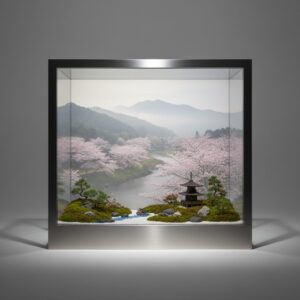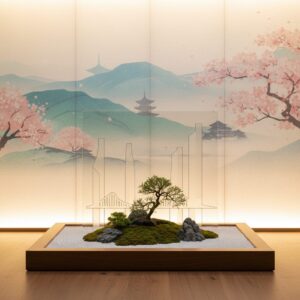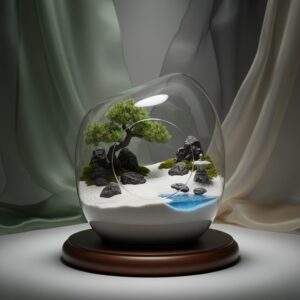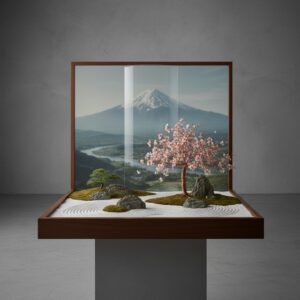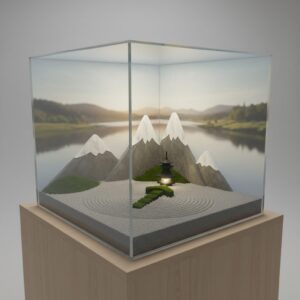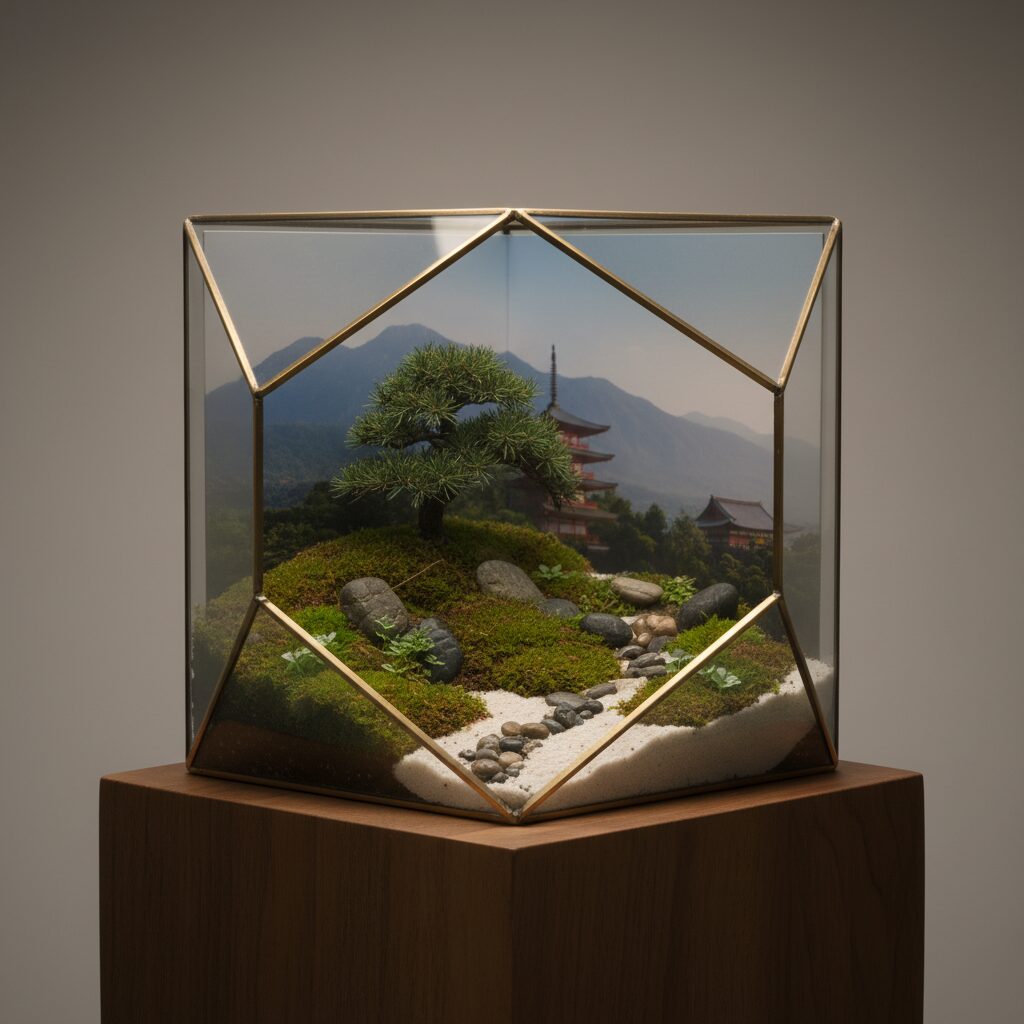
Stand in a great Japanese garden, truly stand there and feel the space, and you’ll notice something strange. It feels bigger than it is. The garden seems to breathe, to expand beyond its mossy walls and raked gravel. Your eyes are drawn from a carefully placed stone lantern in the foreground, across a pond, past a manicured pine, and then… up, to the purple silhouette of a mountain miles away. That mountain, though it lies on land the garden’s owner will never possess, feels like it’s part of the design. It’s not an accident. It’s the entire point.
This is the art of shakkei (借景), one of the most profound and defining principles of Japanese landscape architecture. The word itself is a perfect key to the concept. It’s composed of two characters: shaku (借), meaning to borrow or to rent, and kei (景), meaning scenery or landscape. Borrowed scenery. It’s the radical idea that a garden’s true canvas doesn’t end at its physical boundary. Instead, it deliberately incorporates elements from the wider world—distant mountains, neighboring forests, the roof of a nearby temple, even the sky and clouds—into its own composition. This isn’t just about having a nice view. It’s an act of visual and philosophical appropriation, a technique that frames the world outside and claims it as a vital component of the intimate space within. It’s a design principle that turns a finite plot of land into a portal to the infinite.
This broader notion of space encourages us to look beyond the immediate garden to discover a deeper narrative, as revealed in the art of seeing, where Japanese gardens subtly communicate their timeless stories.
The Philosophy Behind the Frame: More Than Just a Pretty View
To comprehend shakkei, you need to shift your perspective on what a garden is. In many Western traditions, a garden represents a statement of control. It is a space carved out from the wild, where nature is tamed, organized, and made to conform to a human vision of beauty. Hedges are squared, flowerbeds are symmetrical, and a clear wall or fence declares, “Here, human dominion begins, and the wilderness ends.” Shakkei suggests the opposite. It proposes that the most beautiful garden is one that recognizes its smallness and attains grandeur by harmonizing with the untamable world beyond.
This reflects a deep-rooted cultural viewpoint in Japan regarding the relationship between humanity and nature. The aim isn’t conquest; it’s integration. A garden that employs shakkei doesn’t attempt to rival the majesty of a distant mountain. Instead, it reveres it. The garden becomes a foreground, a viewing platform crafted solely to showcase that mountain at its most striking. This act of borrowing expresses humility. It acknowledges that the greatest beauty is often what we cannot possess or control, but only appreciate and frame.
This concept is also closely connected to other fundamental Japanese aesthetic principles. Consider ma (間), the idea of negative space. In a painting or a musical piece, it is the silence between notes or the unpainted section of a scroll that gives the work its power. In a garden, the borrowed scenery represents the ultimate expression of ma. The garden itself—the rocks, the trees, the water—is the foreground, the tangible form. The vast space between the garden’s edge and the borrowed mountain is the ma, a charged emptiness that links the two and creates a profound sense of depth and scale. The design is as much about what isn’t present as what is.
Moreover, shakkei embraces the Buddhist notion of impermanence. A garden’s internal elements can be carefully controlled, but the borrowed scenery remains wild and ever-changing. The borrowed mountain may be cloaked in mist one morning and sharply outlined against a clear sky the next. Its summer greens will shift to autumn reds, then be covered by a blanket of winter snow. The cherry blossoms in a nearby grove, borrowed for one magnificent week each spring, will inevitably fall. By connecting the garden to this uncontrollable, transient beauty, the designer ensures the garden is never static. It is alive, evolving not only day by day but moment by moment, reminding the observer of the fleeting nature of all things.
The Architect’s Toolkit: Techniques of Deception and Delight
Creating a successful shakkei garden is much more intricate than merely placing a garden in front of a beautiful view. It requires a refined set of techniques aimed at manipulating perspective, directing the eye, and seamlessly merging the artificial with the natural. It is a form of gentle, elegant trickery.
Framing the View
The most essential technique is framing. The view must be thoughtfully curated. A designer doesn’t simply present the mountain; they reveal it through a carefully crafted lens. This might be architectural, such as the round window (marumado) of a tea house that transforms the landscape outside into a living scroll painting. It can also be the dark wooden posts of a temple veranda that serve as vertical borders, or the graceful curve of a gate that unveils the scenery as you pass through. Framing may also be natural. A pair of strategically planted pine trees can create a living frame, with branches artfully pruned to guide the gaze toward the distant peak. This act of framing directs the viewer’s attention to a specific point, isolating the most beautiful feature of the background and elevating it to the level of art.
The Middle Ground Connection
One of the most subtle yet vital elements is establishing a convincing middle ground. Without it, the transition from the garden (foreground) to the borrowed scenery (background) may feel abrupt and disconnected. The middle ground serves as a visual bridge, linking the two realms. A classic approach is to plant a row of trimmed shrubs or trees at a middle distance. Their shapes might be pruned to mimic the contours of the distant mountain range, creating a visual harmony that connects the near and far. A white gravel path might guide the eye out of the garden and appear to merge with a distant waterfall. This middle layer acts as the glue of shakkei, making the borrowed scenery feel less like a backdrop and more like a natural extension of the garden itself.
Concealment and Revelation
Exceptional shakkei gardens rarely disclose their masterpiece all at once. They apply a principle known as miegakure (見え隠れ), or “hide and reveal.” As you walk along a winding path, a tall stone wall or dense bamboo thicket might completely block the borrowed view. Your attention focuses on immediate details—the texture of moss on a stone, the sound of water in a basin. Then, as you turn a corner, the view suddenly and dramatically emerges. This creates a sensation of journey and discovery. The act of concealing the view makes its eventual revelation more impactful and surprising, transforming the experience from a static observation into a dynamic narrative that unfolds as you move through the space.
The Four Classical Types of Shakkei
Japanese garden theorists have traditionally classified shakkei into four distinct types based on the direction and distance of the borrowed elements. Understanding these categories reveals the subtlety and diversity within this single principle.
Enshaku (遠借): Distant Borrowing
This is the classic form of shakkei, the one that most readily comes to mind. It entails incorporating a large, distant natural feature, typically a famous or beautifully shaped mountain. The emphasis here is on scale. The garden takes advantage of the vast size and constant presence of the mountain to convey a sense of grandeur and timelessness that cannot be achieved within the garden’s own boundaries. The mountain serves as the garden’s anchor in the broader landscape.
Rinshaku (隣借): Adjacent Borrowing
Not all borrowed scenery is far away. Rinshaku involves borrowing from the immediate surroundings. This might include a grove of trees in a nearby park, the elegant roofline of a neighboring temple, or even a wall that offers an appealing texture or color. In densely populated urban areas like Kyoto, rinshaku provides a particularly ingenious solution. It depends on an unspoken community understanding, where the beauty of one property extends to enhance the next. This is a very local, intimate form of borrowing.
Gyōshaku (仰借): Upward Borrowing
This form of shakkei directs the viewer’s gaze upward. It incorporates elements above the garden, such as the sky, the moon, or distinctive cloud formations. It may also include the canopy of exceptionally tall trees overhanging the garden. In a small, enclosed courtyard garden, gyōshaku can serve as the main method to create a feeling of openness and prevent a sense of confinement. By framing a section of sky, the garden connects itself to the vastness above.
Fushaku (俯借): Downward Borrowing
As the counterpart to upward borrowing, fushaku involves looking downward. This is often employed in gardens situated on hillsides or cliffs, where the design integrates views of a valley, lake, or sea below. It can also be done on a smaller scale by using a pond or water basin to reflect the sky or overhanging trees, effectively borrowing these elements into the water’s surface. This technique adds depth and complexity, creating a garden within the garden.
Iconic Examples: Where to See Shakkei in Action
To truly understand the power of shakkei, you need to see it firsthand. While photographs can suggest its effect, it is the experience of standing within these spaces that unveils the brilliance of the design.
Shugaku-in Imperial Villa, Kyoto
Widely regarded as the apex of shakkei design, Shugaku-in is an expansive villa located in the northeastern hills of Kyoto. Its upper garden, especially, exemplifies distant borrowing. From the veranda of a pavilion perched high on a hill, you gaze out over a large pond. The pond’s edge and the carefully manicured landscape provide the foreground and middle ground. Yet, the true focus is the sweeping view of the Kyoto basin and the gentle, rolling mountains that frame the city. The entire garden serves as a magnificent stage crafted solely to showcase the landscape beyond. The scale is awe-inspiring, and the boundary between garden and world disappears entirely.
Tenryu-ji Temple, Arashiyama, Kyoto
Situated in the lively Arashiyama district, the Sogenchi Teien (Cloud-Dragon Garden) at Tenryu-ji is one of the oldest and most renowned examples. The garden centers around a large pond, adorned with strategically placed rocks and pines along its shore. However, the backdrop steals the show: the lush and seasonally dramatic Arashiyama mountains. They rise directly behind the pond, integrated so seamlessly that they seem intentionally placed by the garden designer. There is almost no distinct middle ground; the forest on the mountain appears to begin where the temple grounds end, a flawless combination of distant and adjacent borrowing.
Entsu-ji Temple, Kyoto
For a more subtle and intimate encounter, Entsu-ji offers a revelation. This small temple in northern Kyoto features a simple dry landscape garden of raked gravel and moss-covered stones. The view is framed from a darkened temple hall, looking out between wooden pillars that perfectly enclose the scene. The garden borrows the trunks of tall Japanese cedar trees from nearby properties and, in the distance, the unmistakable silhouette of Mount Hiei. It is a quiet, contemplative, and remarkably precise use of shakkei, where every element—from the pillars to the borrowed mountain—is in flawless harmony.
Adachi Museum of Art, Shimane Prefecture
While the prior examples are historical, the Adachi Museum demonstrates that shakkei remains a living art form. Consistently acclaimed as the best garden in Japan, it is a modern marvel of perfection. The museum building itself incorporates massive picture windows often described as “living paintings.” Through these glass panes, you can see a series of immaculate gardens—a dry landscape garden, a white gravel and pine garden, and a moss garden. These gardens have been meticulously crafted to blend seamlessly with the natural mountains and forests behind them. The pruning is so precise that the lines of the manicured shrubs flow directly into the contours of the distant landscape. This shakkei is so flawless it almost feels surreal, dissolving the boundary between human-crafted garden and divine nature.
Shakkei in the Modern World: An Enduring Legacy
In an era of relentless urbanization, the art of shakkei faces existential challenges. A view meticulously preserved for centuries can be erased overnight by the construction of a new apartment building. The borrowed scenery, by its very nature, lies beyond the garden owner’s control, making this vulnerability more pronounced than ever. Many historic gardens in Kyoto now engage in legal battles to protect their “borrowed” views from modern development.
Nevertheless, the philosophy of shakkei endures, its influence extending far beyond traditional garden walls. It is reflected in modern Japanese architecture, which often features large windows, the seamless blending of indoor and outdoor spaces with elements like engawa (verandas), and the minimalist framing of a single, striking natural element—a courtyard tree, a patch of sky, a city view. The essence of shakkei is spatial awareness. It encourages us to look beyond our immediate surroundings and see their connection to the wider world. It teaches that by mindfully engaging with our environment, by framing and appreciating what lies beyond our control, we can make our own spaces feel infinitely larger and more beautiful.