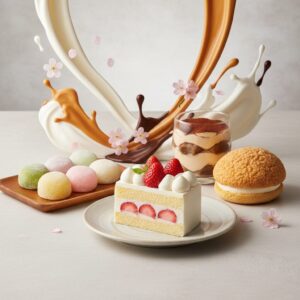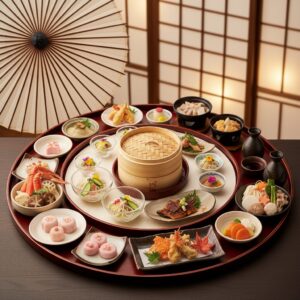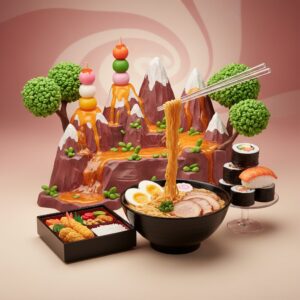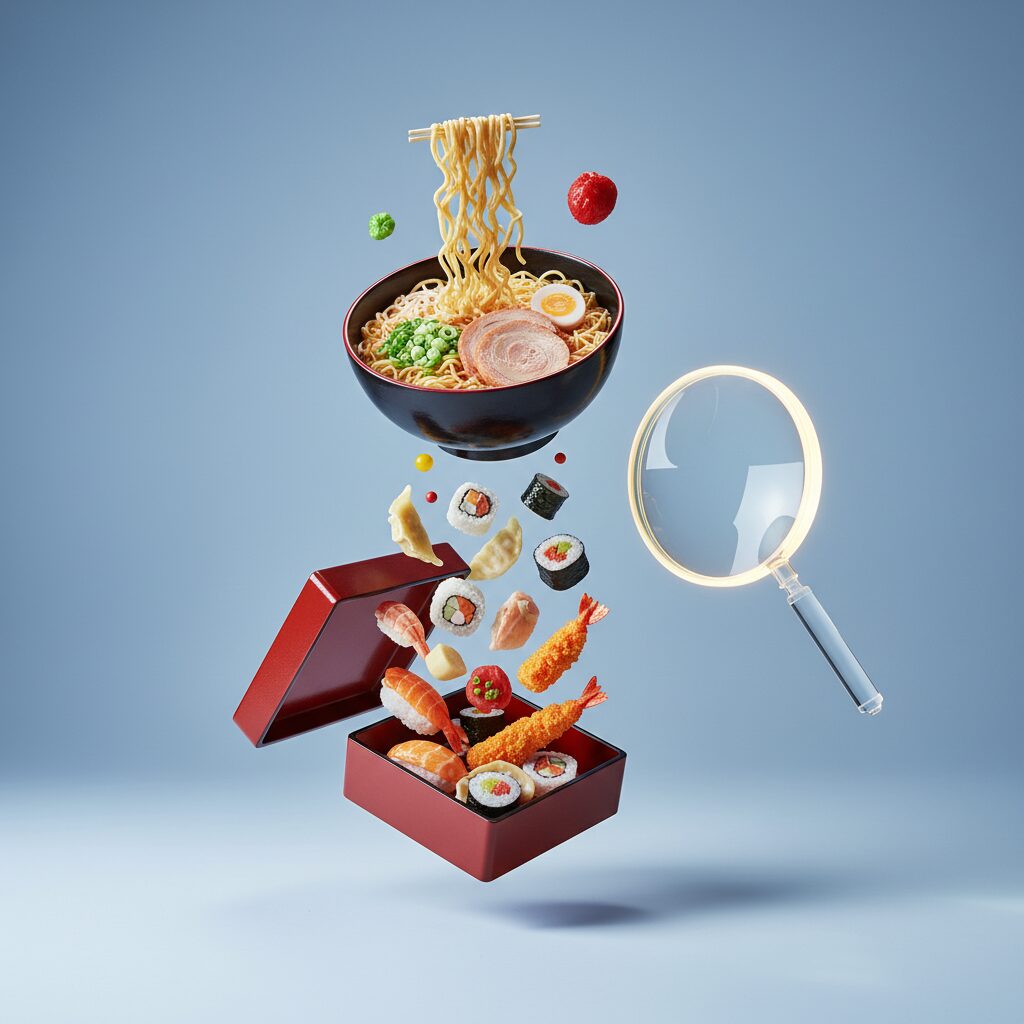
Walk down almost any commercial street in Japan, and you’ll encounter them. Sitting patiently in glass cases outside restaurants, they are beacons of culinary possibility. A perfect bowl of ramen, its broth gleaming under the lights, noodles suspended mid-lift by a pair of floating chopsticks. A glistening slice of tuna sushi, so fresh it seems to defy its own static nature. A katsu curry, the sauce frozen in a perfect, glossy cascade over a breaded pork cutlet. This is the world of shokuhin sampuru, the hyper-realistic food models that are as much a part of Japan’s dining landscape as vending machines and convenience stores. To a first-time visitor, it can feel like a charming, if slightly baffling, quirk. Why go to such extraordinary lengths to create inedible replicas of every single item on the menu? Is it just elaborate, old-fashioned advertising? The truth, as is so often the case in Japan, is far more layered. These models are not mere decorations; they are a fundamental part of the dining ritual, a sophisticated visual language designed to communicate, reassure, and entice. They are a silent, tireless salesman, a cultural contract between the restaurant and the diner, and a testament to a uniquely Japanese obsession with craftsmanship and managing expectations. To understand sampuru is to understand something essential about how Japan approaches food, service, and communication itself.
This intricate dance between visual allure and consumer confidence is further unpacked in discussions on hyper-realistic food samples as trust builders, which reveal how these detailed replicas subtly encourage a sense of reliability before the meal even begins.
The Birth of an Industry: A Solution for a Changing Nation
Like many of Japan’s most iconic modern innovations, the food model emerged during a period of significant social and cultural change. It wasn’t an invention seeking a purpose but rather a refined solution to a distinct set of challenges faced by a nation rapidly opening itself to the world.
The Department Store Dilemma
Imagine Japan in the early 20th century—the Taisho and early Showa eras. The country was undergoing a whirlwind of modernization and Westernization. Cities expanded, bringing with them a new temple of commerce: the department store, or depato. These grand, multi-level buildings were more than mere shopping venues; they served as destinations for a new urban middle class, offering a glimpse of a sophisticated, modern lifestyle. A prominent feature of these stores was the expansive dining hall, often located in the basement (depachika) or on upper floors. Here, the public encountered a range of exotic, unfamiliar dishes. Foods like katsuretsu (cutlet), omu-raisu (omelet with rice), and spaghetti were exciting but perplexing to a population used to rice, fish, and pickles. How do you describe beef stew to someone whose culinary experience does not include it? A written menu, displaying foreign names in katakana, was often more confusing than helpful. Restaurant owners and department store managers faced a significant challenge: how to clarify these new foods and encourage a hesitant public to try them. Early efforts to use real food in display cases failed disastrously; the food spoiled quickly under the lights, attracted flies, and became unappetizing within hours. The need for a permanent, flawless, and persuasive representation of the menu was evident.
Takizo Iwasaki and the Accidental Omelet
The answer came from an unexpected source in the countryside. Takizo Iwasaki, from Gujo Hachiman in Gifu Prefecture, was experimenting with wax for educational models. The now-legendary story goes that one night, working late, he noticed how molten wax dripping into a bucket of water solidified into delicate, ruffled shapes resembling flower petals. Inspired, he applied this principle to food. His first creation was a replica of his wife’s cooking: a fluffy omelet covered in bright red ketchup. The story says the model was so realistic it completely fooled her when he placed it on the table. In 1932, Iwasaki opened his first factory in Osaka, marking the birth of the shokuhin sampuru industry. His wax models were exactly what the growing restaurant scene required. They were durable, lifelike, and most importantly, offered a visual certainty. Customers could see the exact size, shape, and composition of a dish before ordering. This was revolutionary. It eliminated the fear of the unknown and replaced it with the reassurance of clarity. Iwasaki’s invention didn’t just promote food; it fostered confidence. In doing so, it helped pave the way for the widespread acceptance of Western and other foreign cuisines throughout Japan.
More Than Just Plastic: The Unspoken Language of Sampuru
While sampuru originally served as a practical marketing tool, their purpose has expanded and deepened over the decades. They have become an integral part of the cultural language surrounding dining out in Japan, fulfilling several vital roles that extend well beyond mere advertisement.
The Visual Menu: Bridging Language Barriers
For any non-Japanese visitor traveling across the country, the importance of sampuru becomes immediately clear. Confronted with a menu full of indecipherable kanji, the display case acts as a lifeline. It turns what could be a stressful experience into a straightforward, universal interaction. You don’t need to know the term for tempura soba; simply pointing suffices. This “point-and-order” approach is an extremely efficient form of non-verbal communication. It enables foreigners to navigate Japan’s culinary scene with ease and confidence, making the culture more welcoming. In a country that can sometimes feel insular, sampuru silently convey the message, “You don’t have to speak our language to enjoy our food.” This role has become even more significant with the growth of international tourism, making these models essential tools for eateries in popular areas.
Managing Expectations: The Promise of Consistency
To fully appreciate the significance of sampuru, it’s important to understand the cultural notion of anshin (安心). This term roughly translates to peace of mind, reassurance, or a feeling of security. It is a highly valued state in Japan, and businesses strive to provide it to their customers. The food model is a potent carrier of anshin. It serves as a visual contract. The model displayed is not an idealized version of the dish; it is a guarantee of what you will receive. The size of the shrimp, the number of pickles, the precise arrangement of toppings—everything will be faithfully replicated on your plate. This removes the risk of disappointment, the uneasy feeling of ordering something that doesn’t match its description. In Western dining, menu descriptions can be elaborate and somewhat vague, leaving room for the chef’s interpretation. In Japan, such ambiguity often causes anxiety. The sampuru eliminates that uncertainty completely. It creates a clear, mutual understanding between chef and customer, ensuring a smooth, predictable, and satisfying dining experience.
The Art of the Teishoku: Visualizing the Complete Meal
Shokuhin sampuru truly excel when used to present a teishoku (定食), or set meal. A staple of casual dining in Japan, a teishoku is a complete and balanced meal typically composed of a main dish (such as grilled fish or pork tonkatsu), a bowl of rice, miso soup, and one or two small side dishes like pickles (tsukemono) or a small portion of vegetables (kobachi). Displaying this full set as a model allows customers to evaluate the meal as a whole. They can quickly gauge portion sizes, the variety of flavors and textures, and the overall value. It’s not just about seeing the main course—it’s about grasping the entire culinary experience on offer. The visual balance of the set—the colors, the arrangement of bowls and plates—also enhances its appeal, reflecting the Japanese aesthetic focus on harmony and presentation. A sampuru for a teishoku doesn’t simply show food; it embodies a philosophy of dining.
The Craftsmanship Behind the Curtain: From Wax to Vinyl Chloride
The creation of shokuhin sampuru is not a matter of mass production. It is a highly skilled craft—an industrial art that combines meticulous technique with a profound understanding of food. The workshops producing these models remain secretive, often safeguarding their methods as trade secrets handed down from master to apprentice over many years.
A Secretive Art Form
Originally, all sampuru were crafted from wax. Though visually effective, wax had major limitations: it was fragile, faded under sunlight, and melted or deformed in heat, making it unsuitable for sunny restaurant windows. The industry transformed in the 1970s with the advent of liquid vinyl chloride. This durable and versatile plastic enabled a level of realism and longevity that was previously unattainable. The process is painstaking. It starts with the restaurant providing a perfectly prepared dish to the sampuru workshop. The artisans then carefully dismantle it and create silicone molds of each individual component—every slice of green onion, every grain of rice, every piece of meat. Liquid plastic, tinted with paints to match the base color, is poured into these molds and heated in an oven until it hardens. The true artistry, however, emerges after the pieces are taken from the molds. The components are assembled and meticulously hand-painted, requiring both a painter’s eye and a sculptor’s skill.
The Quest for Shizuru
A central concept in sampuru making is shizuru (シズル). The term originates from the English word “sizzle,” referring to the intangible quality of “deliciousness” that makes food look appetizing. It encompasses the visual cues that stimulate the senses and provoke cravings. Artisans excel at creating shizuru. Using airbrushes and fine-tipped brushes, they add subtle color gradations to produce perfect char marks on grilled eel or the golden crust on fried prawns. They have invented myriad techniques to replicate textures and temperatures. For example, a frosty beer mug is rendered by applying a matte coating and then dripping clear resin down the side to imitate condensation. A glossy finish on raw fish is achieved with a layer of clear urethane. The melting, delicate appearance of cheese on a pizza is crafted by carefully heating and skillfully stretching the plastic. It is this relentless pursuit of shizuru that elevates sampuru from mere replicas to true works of art that evoke an instinctive, visceral response.
The Molds of Reality
At the heart of this artistry lies the mold-making process. The commitment to realism is absolute. When a workshop is commissioned to create a model of a specific restaurant’s signature ramen, they do not rely on photographs. Instead, the restaurant sends a complete, perfectly prepared bowl. The artisans meticulously deconstruct it, creating unique molds for that restaurant’s exact type of noodle, that particular slice of chashu pork, that specific narutomaki fish cake. This guarantees the model is an exact one-to-one representation, not a generic approximation. This procedure is repeated for every dish. The result is a vast library of thousands of molds—a comprehensive archive of Japan’s culinary heritage captured in silicone. This dedication to precision is why the model in the window serves as such a reliable promise of the meal to come.
The Modern Sampuru: Evolving in a Digital Age
In an age dominated by Instagram, high-resolution food photography, and digital menus on tablets, one might think that physical food models are relics destined for obsolescence. Yet, shokuhin sampuru endure and have even discovered new life and audiences in the 21st century.
Beyond the Restaurant Window
Though their main role remains in restaurant displays, the art of sampuru has expanded in fresh and playful ways. The remarkable realism and pop-art charm of these items have made them popular souvenirs. Today, you can find sampuru fashioned as keychains, phone cases, USB drives, magnets, and even hair accessories. A hyper-realistic shrimp tempura keychain is uniquely Japanese kitsch, celebrating the country’s distinct aesthetic sensibilities. Moreover, the craft itself has become a tourist draw. In places like Kappabashi Kitchen Town in Tokyo, or Gujo Hachiman, the birthplace of the industry, workshops now offer hands-on classes where visitors can create their own wax tempura or lettuce. This has transformed an industrial art once kept secret into an interactive cultural experience, allowing a new generation to appreciate the skill involved.
The Enduring Power of the Physical
Ultimately, sampuru persist because they provide something a digital image cannot. A photo on a screen is flat, transient, and exists in a different realm. A food model is a tangible, three-dimensional object that shares the same physical space as the viewer. You can walk around it, view it from various angles, and admire its texture and volume in a way a photo can’t offer. It creates an immediate, visceral bond. There is a honesty and solidity to a physical model that fosters trust. It reflects a culture that still deeply values craftsmanship, presentation, and clarity. The sampuru is a holdover from an analog era, but its purpose—to communicate clearly and inspire trust—is timeless. So next time you stand before a Japanese restaurant, captivated by a window full of glistening plastic food, pause to appreciate what you’re truly seeing. It’s not merely a menu. It’s a piece of history, a work of art, and a silent conversation between chef and customer—a beautiful, tangible promise of the delicious meal awaiting inside.