Walk down almost any commercial street in Japan, from a bustling Tokyo shotengai to a quiet side alley in Kyoto, and you’ll eventually encounter them. Display cases, brilliantly lit, sit outside restaurants, showcasing a perfect, glistening array of the menu. There’s the ramen, its broth frozen in a state of perpetual shimmer, the noodles suspended mid-lift by a pair of floating chopsticks. There’s the tonkatsu, its panko crust a masterpiece of texture, each golden-brown crumb seemingly placed by hand. A tall glass of beer sits beside it, beaded with condensation that will never, ever drip.
Your first reaction is probably a double-take. Is it real? The detail is so staggering, so absurdly precise, that for a split second your brain can’t quite process it. This isn’t just a plastic model; it’s a perfect, three-dimensional photograph of a meal at its most delicious moment. This is the world of shokuhin sanpuru (食品サンプル), or food samples, a uniquely Japanese phenomenon that goes far beyond simple decoration.
It’s easy to dismiss them as a quirky novelty, a fun bit of visual flair. But that would be missing the point entirely. These plastic meals are not just marketing gimmicks; they are a fundamental pillar of Japanese customer service. They are a silent contract, a visual promise, and a masterclass in building trust by eliminating every possible ounce of uncertainty for a potential diner. They answer the questions you have before you even think to ask them, all without a single word being spoken. Understanding why these samples are so astonishingly realistic is to understand something deep about the Japanese approach to commerce, communication, and the psychology of putting a customer at ease.
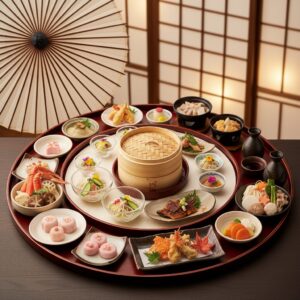
The meticulous care in crafting these samples mirrors the elegance of kaiseki culinary storytelling, offering a glimpse into Japan’s rich gastronomic narrative.
The Silent Salesman: A Promise on a Plate
Imagine you’re a tourist, jet-lagged and overwhelmed, staring at a menu entirely in a language you cannot read. Or perhaps you’re a local, simply in a rush and wanting to make a quick, confident lunch decision. In both cases, the menu itself can be a barrier. Words are abstract. “Grilled fish set meal” sounds fine, but what kind of fish is it? How is it prepared? What sides accompany it? How large is the portion?
This is the problem the shokuhin sanpuru solves with remarkable elegance. It embodies the ultimate principle of “what you see is what you get.” The display case outside the restaurant functions as a three-dimensional, full-color menu that needs no translation. It communicates everything instantly.
You don’t just see a model of ramen; you see that specific restaurant’s ramen. You observe the exact thickness of the chashu pork, the precise creaminess of the egg yolk, the number of nori sheets, the scattering of green onions. You gauge the portion size down to the last noodle. The sample is not an idealized version of the dish; it is, with astonishing accuracy, a direct replica of the meal you will receive if you walk inside and order it. This isn’t just advertising; it’s a carefully crafted preview.
This practice of showing rather than telling is deeply embedded in Japanese customer service. It’s about anticipating the customer’s concerns. The restaurant essentially says, “Here is our promise to you, rendered in plastic. This is the quality, this is the quantity. There will be no surprises, no disappointment.” This assurance builds immediate trust. A restaurant willing to invest substantial money—and these samples are not inexpensive—into such an honest representation of their food signals its confidence and pride in its product. The realism is not merely for display; it forms the foundation of the transaction.
The Craftsmanship Behind the Curtain
The nearly supernatural realism of food samples is no accident. It results from a century of artistic and technical refinement, a craft perfected with the same dedication a chef brings to preparing actual food. The industry forms a fascinating world of its own, merging artistry with meticulous, almost scientific, precision.
This all began during the early Showa period, in the 1920s. As Western-style dishes such as omurice (omelet rice) and croquettes gained popularity in department store cafeterias, customers often didn’t know what they were ordering. Takizo Iwasaki, often regarded as the father of the industry, is credited with inventing the modern food sample. Legend has it that after observing wax dripping in water, he was struck by inspiration. He crafted an impressively realistic wax model of his wife’s omurice, complete with a shiny ketchup drizzle. It was so convincing that even she was fooled. He established his company in his hometown of Gujo Hachiman in Gifu Prefecture, which remains the undisputed center of food sample production in Japan to this day.
At first, samples were made from paraffin wax, which was fragile and melted easily under the hot lights of display cases. Nowadays, artisans primarily use durable synthetic resins such as vinyl chloride and silicone. The process remains extremely labor-intensive and bespoke. It starts with the restaurant supplying the artisan with a freshly cooked dish. The craftsmen then create silicone molds of every single element—each cucumber slice, every piece of tempura shrimp, and every grain of rice.
The Art of Deception
Creating the molds is only the beginning. The true magic lies in the coloring and assembly, almost always done by hand. Artisans employ airbrushes and fine-tipped paintbrushes to capture the subtle gradients of a perfectly grilled steak or the translucent sheen of raw tuna. They have developed a repertoire of secret techniques to replicate specific textures. For example, to mimic the frothy head of a glass of beer, they may use a gelatinous material. The crisp, airy texture of tempura batter is often recreated by carefully manipulating melted vinyl resin in water.
Every detail is carefully considered. The way sauce seeps into rice, the slight char on a grilled eel, the delicate placement of a garnish—all are meticulously reproduced. This is not mass production. It is a highly skilled craft where artisans, many training for years, become specialists in particular food types. There are masters of ramen, sushi experts, and virtuosos of Italian pasta. Their commitment to realism reflects the Japanese cultural emphasis on shokunin (artisan) spirit—the relentless pursuit of perfection in one’s craft. The care they invest in the plastic model mirrors the care the chef puts into the actual dish.
Reading the Code: The Unspoken Language of Sanpuru
Once you begin to grasp the purpose behind food samples, you start to notice the subtle language they convey. They communicate information that goes well beyond merely identifying a dish.
First and foremost is portion size, a crucial detail that menus often overlook. The sample completely removes this uncertainty. You know precisely how much food you’re getting for your money, which is a key factor in making your decision. It sets expectations clearly, avoiding the common disappointment of ordering a dish that appears generous on the menu but arrives sparse on the plate.
Moreover, the presentation of the sample tells a story about the restaurant itself. A meticulously, almost surgically, arranged set meal in a polished display case suggests a more formal, precise establishment. A sample with a more rustic and hearty appearance might indicate a casual, family-run shokudo (diner). The display serves as an extension of the restaurant’s identity.
This entire system is designed to provide anshin (安心)—a fundamental Japanese concept roughly meaning peace of mind, reassurance, or a sense of security. Japanese society is, in many respects, organized to minimize unpleasant surprises and social friction. From train schedules timed to the second to meticulously detailed instructions for everything, there is a deep cultural emphasis on clarity and predictability. The shokuhin sanpuru perfectly embodies this. It offers the customer the anshin of knowing exactly what they are committing to. In a country where the customer experience (omotenashi) is paramount, eliminating anxiety is one of the highest forms of service.
Beyond the Restaurant Window: The Evolution of an Art Form

While their main role remains in front of restaurants, the art of shokuhin sanpuru has grown into a cherished part of Japan’s visual and pop culture. Their novelty and remarkable craftsmanship have turned them into objects of fascination all on their own.
In tourist areas and specialty shops, you can now discover an astonishing array of food sample-themed merchandise. These include hyper-realistic gyoza-shaped keychains, phone cases resembling plates of spaghetti, USB drives disguised as sushi, and detailed magnets that are miniature replicas of the full-sized displays. Such items have become popular souvenirs, offering a quirky and uniquely Japanese keepsake for travelers.
Additionally, the industry has become more accessible to the public. In places like Gujo Hachiman or Tokyo’s Kappabashi Kitchen Town, several studios provide workshops where you can try making your own samples. These hands-on sessions, where you craft an impressively realistic piece of tempura or a bowl of shaved ice from colored wax and resin, have become highly popular among both Japanese and foreign visitors. They offer a direct appreciation of the skill involved and help demystify the process behind these everyday art pieces.
This cultural diffusion shows how deeply the aesthetic of food samples has embedded itself in the national consciousness. It is no longer simply a B2B product for restaurants; it has become a celebrated art form, a tangible cultural item that people want to own, engage with, and even create themselves.
The Psychology of Certainty
Ultimately, the profound realism of Japanese food samples is not about deception, but quite the opposite: absolute, uncompromising honesty. It serves as a communication tool designed to build a bridge of trust between the business and the customer by fostering a shared, clear understanding.
In the West, menu language often relies on evocative, abstract, and sometimes misleading descriptions. Terms like “artisanal,” “farm-fresh,” and “sun-kissed” are employed to create an appealing image in the diner’s mind, but these images leave much room for interpretation—and potential disappointment. The Japanese approach, embodied by the sanpuru, eliminates this ambiguity. It substitutes flowery language with concrete evidence.
This commitment to clarity reflects a form of omotenashi, the renowned Japanese concept of hospitality. True omotenashi goes beyond politeness; it involves anticipating others’ needs, concerns, and possible anxieties, and addressing them proactively. A restaurant with a perfect display case has already answered your questions: What is it? What’s in it? How big is it? Is it worth the price?—all before you even step inside.
So, the next time you find yourself gazing into one of those glowing cases, captivated by a gleaming plastic bowl of noodles or a flawless slice of cake, pause for a moment. You aren’t merely looking at clever marketing. You are witnessing a promise, a work of art, and a profound cultural statement. You are observing a system based on a simple but powerful idea: the best way to earn a customer’s trust is to show them, with perfect clarity and impeccable craftsmanship, exactly what you have to offer.