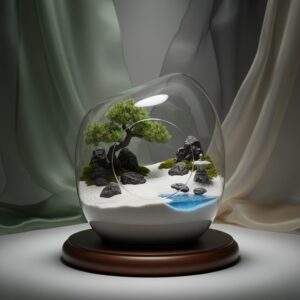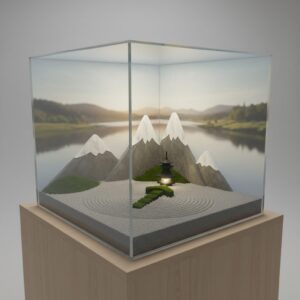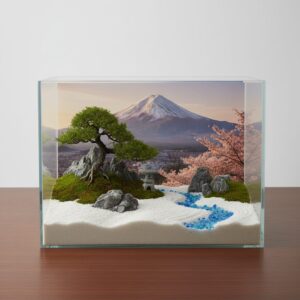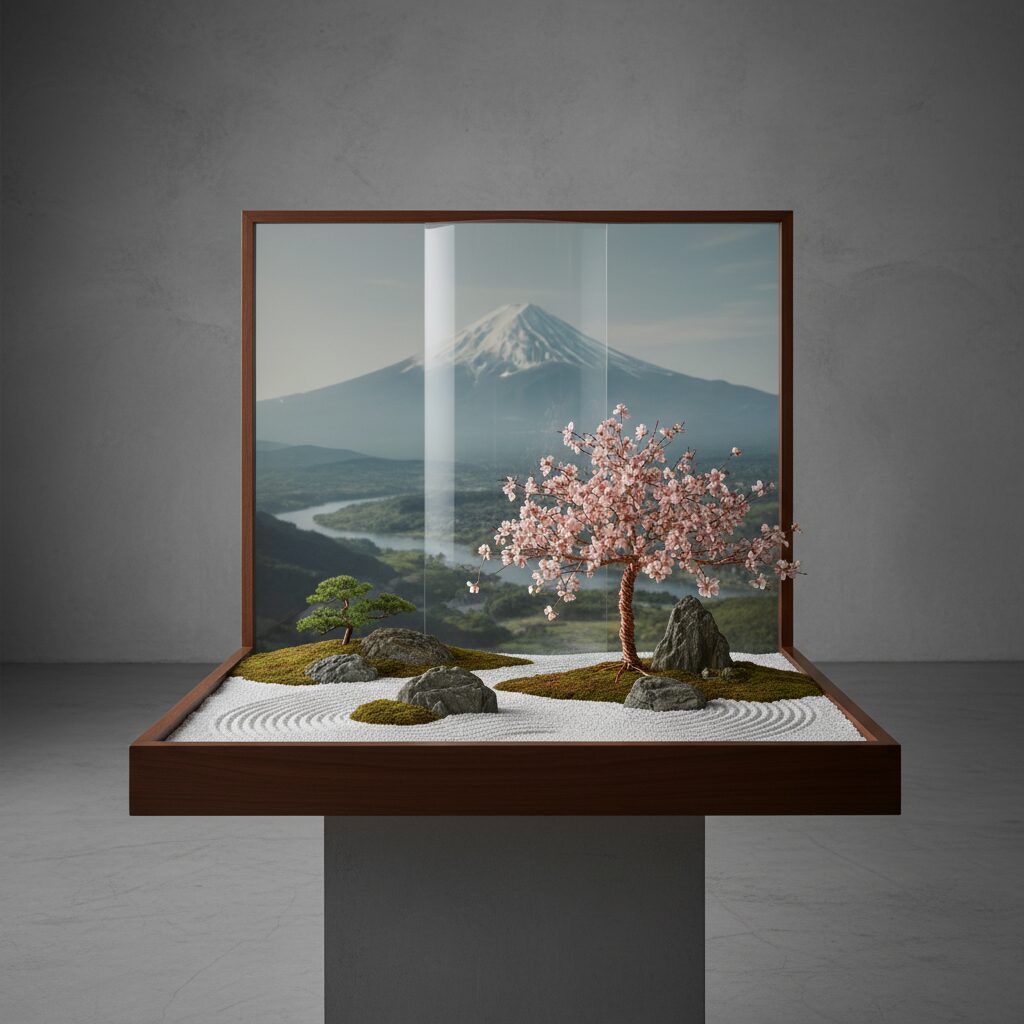
Walk into a classic Western garden—Versailles, for instance—and you know exactly what you’re looking at. It’s a declaration of human will. Symmetrical paths, geometric flowerbeds, fountains engineered to defy gravity. It is a space conquered, controlled, and meticulously arranged for our viewing pleasure. The boundary walls are absolute; they define the beginning and the end of the masterpiece. The garden is the picture. Now, I want you to hold that idea in your mind, and then let’s travel to a small, moss-covered temple on the edge of Kyoto. You step onto a wooden veranda, worn smooth by centuries of stockinged feet. Before you lies a simple garden of raked gravel and a few carefully placed stones. It’s beautiful, serene. But as you sit, your gaze is pulled past the low, unassuming wall. Your eyes drift over the treetops of the intervening forest and settle on the majestic, hazy silhouette of a distant mountain. Suddenly, that mountain is no longer just a backdrop. It’s the focal point, the anchor of the entire composition. The garden at your feet is not the masterpiece; it is merely the frame. The true masterpiece is the world beyond. You’ve just experienced shakkei.
Shakkei, often translated as “borrowed scenery,” is one of the most profound and essential concepts in Japanese landscape design, yet its name is deceptively simple. Borrowing implies a temporary loan, something to be returned. But shakkei is less about taking and more about acknowledging, incorporating, and seamlessly integrating the surrounding landscape into the garden’s design. It’s an act of profound humility. The garden designer admits that they cannot create anything more beautiful than nature itself. Instead of trying to compete with it, they choose to collaborate. They are not creating a self-contained world but are instead curating a specific view of the larger world that already exists. This single principle is the key to unlocking the soul of the Japanese garden. It explains why the most vital elements are often found beyond its physical borders, and why the garden itself is often an exercise in elegant restraint. It’s a radical shift in perspective that transforms a simple plot of land into a bridge between the human and the natural, the finite and the infinite.
This intertwining of nature and design invites reflection on how ancient legal blueprints once shaped Kyoto’s distinctive architectural legacy.
The Art of the Unseen Hand
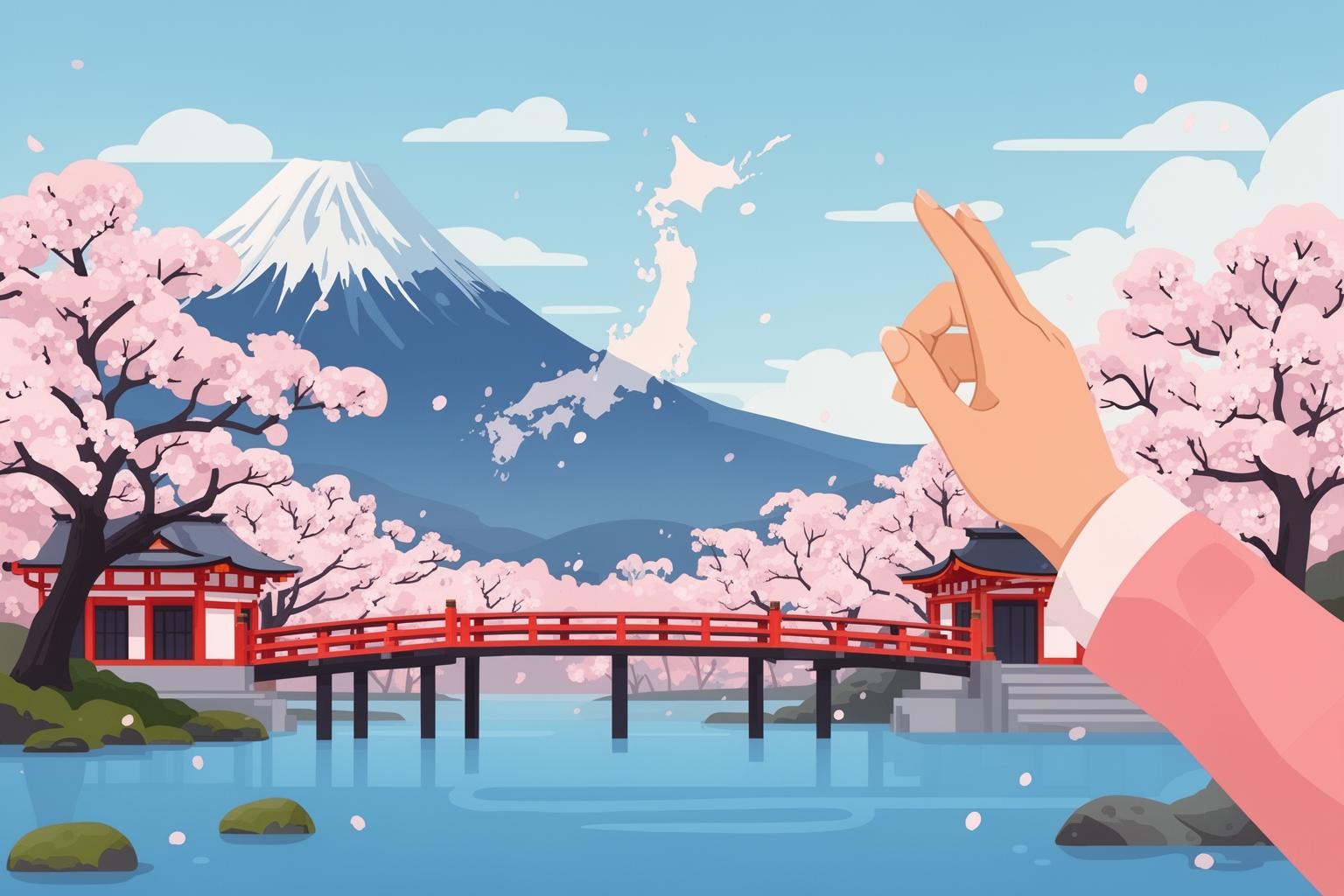
To grasp shakkei, you first need to unlearn the notion that a garden is defined by what you add to it. Shakkei focuses primarily on what you omit and how you frame what already exists. The garden becomes a carefully crafted lens. This explains why architecture and garden design are inseparable in Japan. A circular window (marumado) in a teahouse doesn’t merely let in light; it isolates a perfect view of a single maple branch, transforming it into a living painting that shifts with the seasons. The dark, polished floorboards of a temple veranda act as a mirror, capturing the reflection of the sky and clouds, effectively borrowing the heavens and bringing them down to earth. The pillars and eaves of a building serve as a proscenium arch, guiding the viewer’s gaze toward the intended “borrowed” view.
This is an active, deliberate act. The designer functions as an editor of reality, employing techniques like miegakure, or “hide and reveal.” A strategically planted bamboo grove might block a neighboring pagoda, only for it to emerge dramatically as you turn a corner along the garden path. A low fence may be built not to keep things out but to obscure the uninspiring middle ground—a road, some houses—so the viewer’s eye leaps from the garden’s foreground directly to the distant, borrowed mountain peak. This creates a powerful, often illusionary, sense of connection and scale. The mountain feels integrated into the garden because the cluttered, intervening details have been artfully removed.
The effect is a subtle manipulation of perception. The designer fashions a composition that appears entirely natural, almost accidental, but is actually the product of meticulous planning and foresight spanning generations. They had to envision not only how the garden would look when finished but how the trees they planted would grow to frame the view thirty, fifty, or even a hundred years hence. It is an art of patience, deep time, and an ego surrendered to a greater purpose: to amplify the beauty of the world beyond the wall.
Four Walls of the Wider World
While the concept feels fluid and philosophical, classical Japanese garden theory categorizes shakkei into four primary types. Understanding these categories enhances appreciation for the varying scales and subtleties of this design principle. Each type borrows from a distinct part of the environment, highlighting the breadth of this worldview.
Enshaku (Distant Borrowing)
This is the most striking and familiar form of shakkei. Enshaku involves integrating large, distant natural features into the garden’s layout. A prime example is borrowing a mountain, such as Mount Hiei, which serves as the celebrated backdrop for gardens at temples like Entsu-ji and the Shugaku-in Imperial Villa in Kyoto. The mountain acts as the centerpiece. The garden itself—the raked sand, the pruned azalea bushes, the stone lanterns—plays a supporting role, carefully arranged to honor the distant peak. The skill in enshaku is to create a seamless visual transition. The contours of the garden’s hills may echo the shape of the mountain range, and the foliage colors might complement the hues of the far-off forest. The designer strives to convince the eye that no boundary exists between garden and mountain, that one blends into the other in an unbroken panorama. When executed well, it evokes a stunning sense of vastness, making a small garden appear infinitely expansive.
Rinshaku (Adjacent Borrowing)
Not all borrowing occurs on a grand scale. Rinshaku is the practice of incorporating elements from the immediate surroundings, right next door. This might include the woods of a neighboring shrine, the elegant roofline of an adjacent temple, or even a striking tree in a neighbor’s yard. In dense urban settings like Kyoto, rinshaku proved a practical and ingenious solution. Instead of erecting a high wall to block neighbors, one could build a lower, permeable fence or screen that frames a view of their beautiful cherry tree, effectively making it part of the garden’s seasonal display. This represents communal aesthetics, relying on a shared understanding that the beauty of one space can extend and enhance another. It quietly challenges the idea of absolute private property, proposing instead a landscape of shared beauty. It acknowledges that a garden does not exist in isolation but is part of the larger fabric of its neighborhood.
Gyōshaku (Upward Borrowing)
This is perhaps the most delicate and poetic form of shakkei. Gyōshaku means borrowing from the sky above. This includes the ever-shifting clouds, the deep blue sky, the moon, and the stars. A tranquil pond in a garden is rarely just water; it serves as a canvas for gyōshaku. Its calm surface reflects the sky perfectly, bringing the cosmos into the intimate garden space. Garden design might intentionally leave open patches in the tree canopy to create “windows” framing the sky. The garden experience then becomes linked to the time of day and weather. A cloudy day offers soft, diffused light, while a clear night transforms the pond into a starry expanse. This type of borrowing highlights impermanence, as the garden is never identical twice because its “borrowed” ceiling is always changing. It invites the viewer to be present and cherish the fleeting beauty of the moment.
Fushaku (Downward Borrowing)
As the name implies, fushaku is the counterpart to upward borrowing; it involves borrowing from below. This can be literal, such as incorporating the view of a river or stream flowing beneath the garden’s elevation. A veranda might extend over a small ravine, making the sound and sight of flowing water an integral part of the garden experience. More subtly, it can involve visually incorporating elements on the ground plane outside the garden’s official bounds. For example, a garden on a hillside might use a low hedge to connect the raked gravel within the garden to a field of wildflowers blooming on the slope below. Though the field is not part of the garden, it has been “borrowed” to add color, texture, and a sense of harmony with the natural landscape. Like all forms of shakkei, fushaku dissolves boundaries and views the garden as a point of connection rather than separation.
The Philosophy of the Open Gate
Ultimately, shakkei is more than just an aesthetic technique; it embodies a worldview expressed through soil, stone, and water. It sharply contrasts with the mentality that seeks to dominate and control nature. To borrow scenery is to acknowledge that you are part of a greater whole, not its ruler. It is an act of environmental and spiritual humility. It implies that true beauty lies not in what we can create anew, but in our ability to recognize and cherish the beauty that already exists around us.
This philosophy is deeply rooted in Zen Buddhism and Daoist thought, which emphasize harmony with nature and the interconnectedness of all beings. A garden designed with shakkei transforms into a space for meditation, a means to shift one’s perspective. It encourages you to look beyond your immediate surroundings—the small, enclosed space you inhabit—and connect with the vast, enduring presence of mountains, the sky, and the seasons. It serves as a tangible reminder of your place in the universe.
In today’s world, filled with both literal and metaphorical walls, the lesson of shakkei feels more vital than ever. We spend so much time shaping our own little boxes—our digital identities, our personal spaces—trying to shut out the chaos beyond. The principle of the borrowed view offers a different approach. It suggests that profound beauty and peace lie in opening the gates, in dissolving the boundaries between what is “mine” and what simply “is.” It invites us to see our lives not as isolated pictures, but as frames through which we can view and appreciate the magnificent, uncontrollable, and ever-changing world outside. The next time you find yourself in a Japanese garden, by all means, admire the moss and stones. But then, lift your eyes. Look beyond the wall. The true spectacle is just beginning.