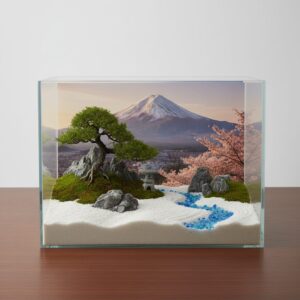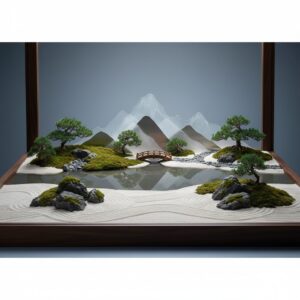
Stand in a great Japanese garden, and you’ll notice a strange paradox. The space feels meticulously controlled, every rock and plant placed with intention. Yet, it also feels boundless, as if it stretches to the horizon. This isn’t an accident; it’s the result of a design philosophy that is both profoundly clever and deeply spiritual. The technique is called shakkei (借景), or ‘borrowed scenery,’ and it is the art of dissolving boundaries. It’s the quiet genius that makes a finite plot of land feel infinite by pulling the wider, untamed world into its very composition. Instead of building walls to keep the world out, the garden architect invites it in, turning a distant mountain, a neighboring forest, or even a castle keep into a dramatic backdrop that becomes the garden’s most magnificent feature. Understanding shakkei isn’t just about learning a landscaping term; it’s about grasping a fundamental aspect of the Japanese worldview—the belief that we are not separate from nature, but a small, interconnected part of it. This principle moves beyond simple aesthetics to become a statement about humanity’s place in the universe.
Embracing the union of meticulous design and boundless nature, these gardens reveal how traditional Japanese aesthetics capitalize on shakkei techniques to blur the lines between human creation and the natural world.
Beyond the Garden Wall: The Philosophy of Borrowing
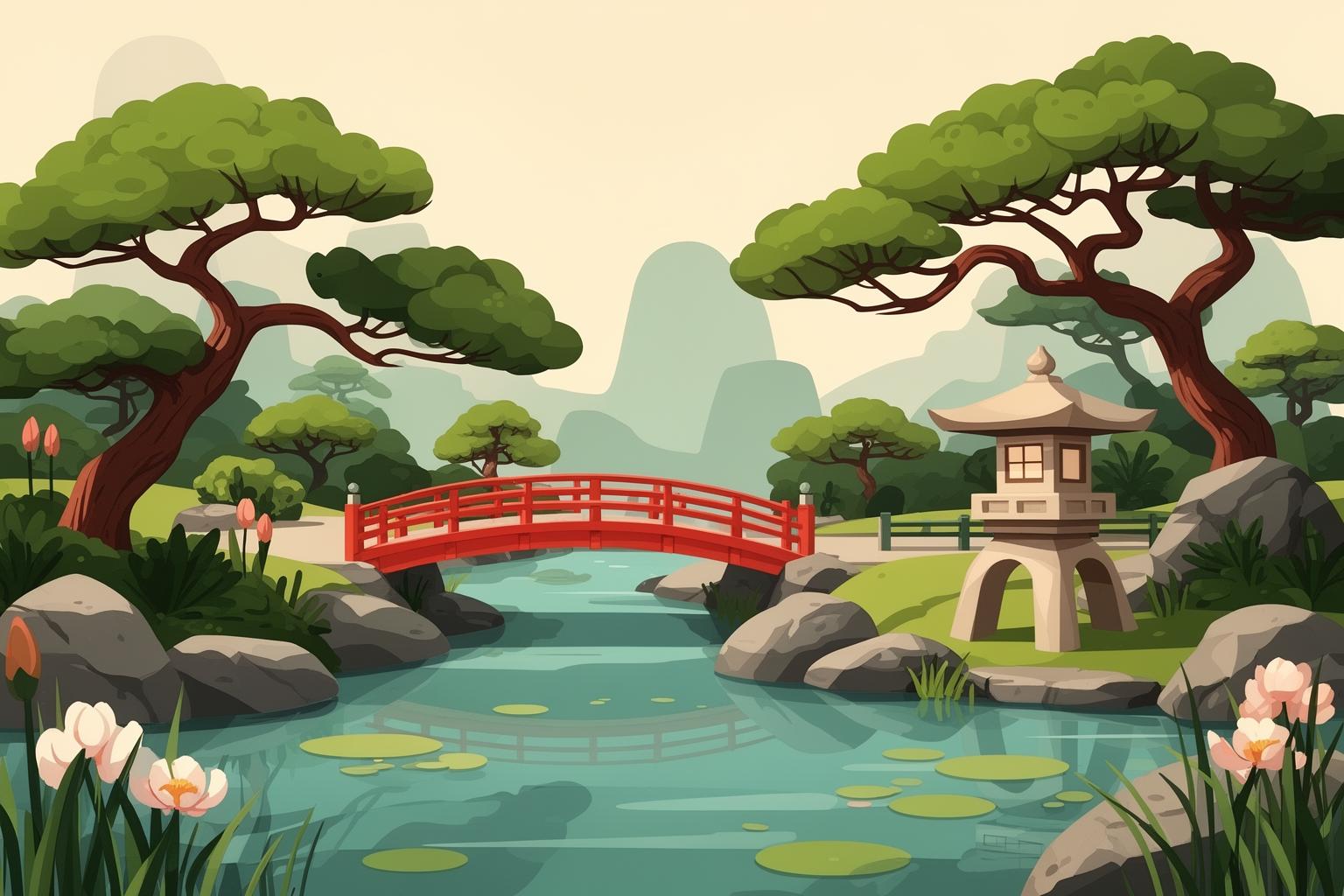
The core concept of shakkei stands in stark contrast to many Western landscape design traditions. Consider the formal gardens of Versailles in France, which showcase human mastery over nature. Symmetry is enforced, hedges are shaped into geometric patterns, and the entire landscape is controlled by a strict, mathematical order. There is a distinct, unmistakable boundary where the cultivated garden ends and the wild begins. This design expresses power, signifying that humanity can create an order more perfect than nature’s own.
Shakkei follows the opposite approach: cooperation rather than domination. The garden designer using shakkei starts with humility, recognizing that the most breathtaking feature is not one they can construct or plant but one that already exists beyond the property line. Their purpose is not to create a self-contained paradise but to skillfully frame and harmonize with the grandeur of the natural world. This philosophy is deeply tied to Japan’s native Shinto beliefs, which perceive divinity (kami) in natural elements such as mountains, ancient trees, and waterfalls. A distant mountain is not merely a beautiful sight; it can hold sacred significance. Incorporating it into the garden is an act of respect, bringing that sacredness into a human-scale environment.
This also aligns with a Buddhist view of interconnectedness. From this perspective, drawing a clear boundary between the ‘garden’ and the ‘mountain’ is an artificial division. Both belong to the same continuous reality. Shakkei physically embodies this concept. The garden becomes a microcosm, a thoughtfully arranged foreground that guides your gaze toward the macrocosm beyond. The wall or hedge at the garden’s edge no longer acts as a barrier but serves as a transitional feature, softening the distinction between what is owned and what is beyond ownership, between the crafted and the wild. It conveys that true beauty arises not in isolation but within its broader context.
The Techniques of Deception: How the Eye is Tricked
Achieving seamless integration involves much more than simply having a pleasant view. Shakkei is an intricate art form that depends on precise techniques to manipulate perspective and deceive the eye into perceiving a single, unified landscape. The designer functions like a film director, carefully guiding what the viewer observes and how they perceive it.
Framing the View
One of the most important techniques is framing. The ‘borrowed’ scenery is rarely displayed in full. Instead, it is revealed selectively through carefully crafted frames. This could be the wooden posts of a temple veranda, a window in a tea house (enmado, or ‘picture window’), a strategically placed gap in a row of trees, or the arch of a rustic gate. This framing serves two functions. First, it directs the viewer’s focus, elevating the distant landscape from a mere background to a deliberate focal point. The frame signals, “Look here. This is significant.” Second, it enables the designer to curate the view. An unattractive modern building or a jumble of power lines can be conveniently concealed behind a tree branch or the edge of a wall, while the perfect, timeless peak of a mountain is displayed in the clear space. It is a curated reality, presenting an idealized version of the world outside.
The Middle Ground as Connector
Perhaps the most subtle and vital component of successful shakkei is managing the middle ground (chūkei). Without a smooth transition, the borrowed scenery can feel disjointed, like a poster hung on a wall behind the garden. The designer must visually connect the foreground (the garden itself) with the background (the distant mountain or forest). This is often accomplished with elements that bridge the visual gap. A cluster of trees in the middle distance might be planted to mimic the texture and color of the distant forest, creating the illusion of a continuous treeline. A stone wall or clipped hedge might conceal the ‘seam’—the road, fence, or valley—that actually separates the garden from the borrowed view. A pond in the foreground may reflect the sky, forming a visual plane that links the viewer’s immediate surroundings with the vastness beyond. This masterful use of the middle ground is what makes the illusion truly seamless, convincing the brain to perceive a continuous, receding space.
Miniature and Metaphor
Another layer of sophistication is added through miniaturization and metaphor. Elements within the garden are often designed to echo the forms of the borrowed scenery. A large, carefully selected rock in the foreground might have a silhouette that mirrors the peak of the distant mountain. A cluster of smaller stones might symbolize foothills. A raked area of white gravel in a dry landscape garden (karesansui) might represent the ocean beyond a borrowed coastal forest. This technique, known as mitate (seeing one thing as another), creates a powerful sense of resonance and scale. The garden becomes a miniature, symbolic version of the larger landscape, reinforcing the connection and making the integration feel not only visual—a trick of the eye—but deeply conceptual and intentional.
Masterpieces of Borrowed Scenery: Where to See It in Action
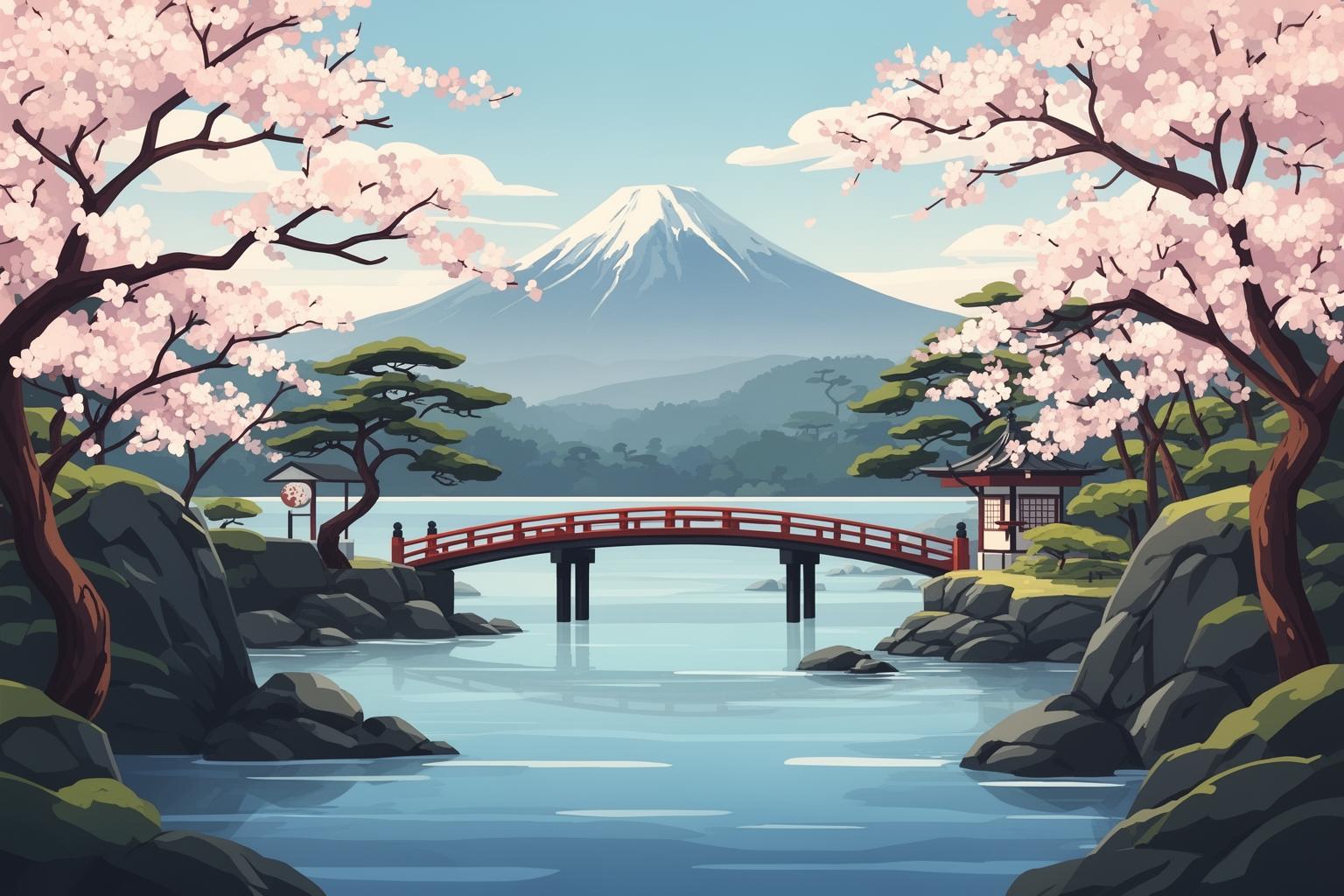
While the principles of shakkei can be seen in gardens both large and small throughout Japan, several renowned locations display the technique in its most stunning form.
Tenryū-ji Temple, Arashiyama, Kyoto
Often regarded as one of the most flawless examples of shakkei, the Sogenchi Teien (Sogen Pond Garden) at Tenryū-ji exemplifies harmonious collaboration with nature. Designed in the 14th century by the Zen master Musō Soseki, the garden features a large pond in the foreground, surrounded by carefully arranged rocks and meticulously pruned pines. However, the garden’s true brilliance lies in its backdrop: the verdant, forested slopes of Mount Arashiyama and Kameyama. There is no clear dividing line; the trees at the pond’s edge appear to blend seamlessly into the forest blanketing the mountainsides. The hills don’t feel like they are behind the garden; rather, they seem to be part of it, rising directly from the pond’s opposite shore. As the seasons shift, the dominant feature of the garden transforms with them—from the delicate pinks of spring cherry blossoms to the fiery reds of autumn maples, all mirrored in the pond’s calm surface.
Shugaku-in Imperial Villa, Kyoto
While Tenryū-ji demonstrates an intimate form of shakkei, Shugaku-in Imperial Villa presents it on a grand, panoramic scale. Constructed in the 17th century for Emperor Go-Mizunoo, this expansive estate includes three villas positioned at different levels on a hillside in northern Kyoto. The design emphasizes movement and discovery. As you move through the lower and middle gardens, framed glimpses of the surrounding scenery appear. The ultimate experience is reached at the Upper Villa, where a large pond opens up before you. From this vantage point, the view expands dramatically. The designers used massive, clipped hedges to shield the nearby village and rice paddies, creating a seamless vista that incorporates the surrounding mountains and even parts of Kyoto’s city skyline. It is less a single framed scene and more of an immersive, 180-degree experience of unity with the entire basin.
Adachi Museum of Art, Shimane Prefecture
For a contemporary take on shakkei, few places rival the beauty of the Adachi Museum of Art. Although the museum itself was established in 1970, its gardens are widely regarded as some of the finest in Japan. The founder, Adachi Zenko, believed the garden should be perceived as a living Japanese painting. And that is exactly how visitors experience it. The gardens are not intended to be wandered through; rather, they are viewed from inside the museum through large glass panes that act as literal picture frames. The meticulously maintained landscape of white sand, raked gravel, moss, and expertly trimmed pines blends flawlessly with the distant natural mountains. The museum staff famously go to great lengths to preserve this illusion, even climbing the “borrowed” mountains to ensure their pristine condition. This is shakkei at its most refined and perfected—a seamless fusion of art, architecture, and nature.
More Than a Pretty View: Shakkei’s Cultural Resonance
Ultimately, the lasting power of shakkei lies in what it reveals about the culture that created it. It is a tangible expression of a worldview that prioritizes harmony over dominance and integration over isolation. It represents the aesthetic concept of wabi-sabi—an appreciation for natural imperfection and transience. The borrowed scenery is never fixed. It continuously changes with the light, the weather, and the seasons. A cloud may drift across the mountain’s face; mist might rise from the forest after rain; snow may dust the distant peaks. Thus, the garden is never truly finished, nor perfect in a static sense. Its beauty is alive, dynamic, and shaped by forces far beyond the gardener’s control. This acceptance of change and impermanence lies at the heart of Japanese thought.
Moreover, shakkei is the ultimate embodiment of ma (間), the concept of negative space. In Japanese aesthetics, empty space—the pause in music, the unpainted silk in a scroll, the silence between words—is as significant as the object or sound itself. In a garden using shakkei, the ‘empty’ space between the foreground and the distant mountain creates the sense of depth, scale, and longing. It is this void that links the present moment within the garden to the timeless landscape beyond.
So, the next time you find yourself in a Japanese garden, look beyond the perfectly raked sand and carefully placed lanterns. Observe the edges. Notice how the garden doesn’t simply stop, but extends outward and draws the world into its embrace. You’re witnessing more than just a clever design technique. You are experiencing a profound philosophical statement about living in harmony with the world, expressed through moss, stone, and borrowed mountains. The true genius of a Japanese garden is not merely what is planted within its walls, but its ability to convince you that no walls exist at all.