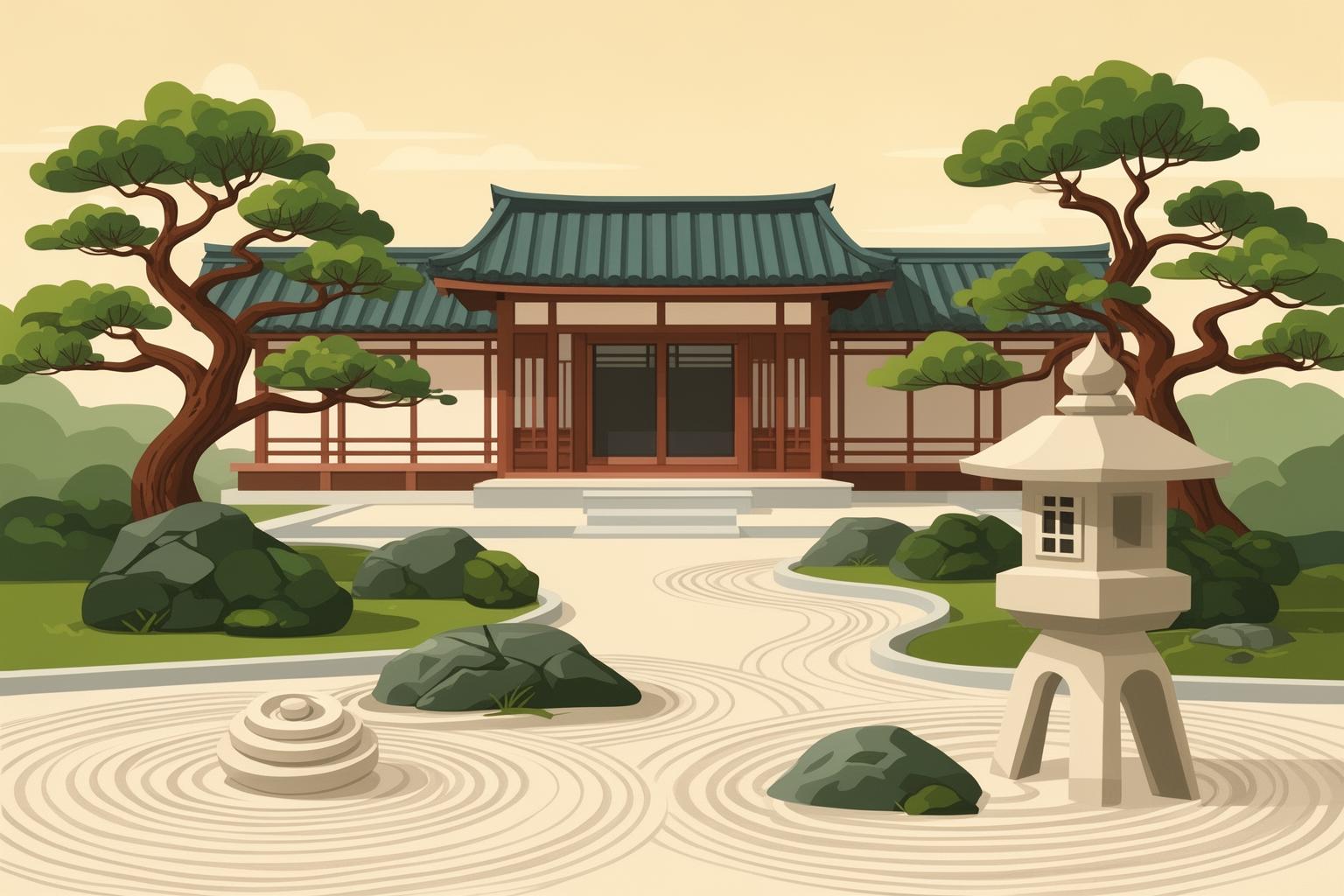
You’ve seen the image, I’m sure. A walled courtyard, not of grass and flowers, but of immaculately raked white gravel. A few formidable, moss-flecked rocks emerge from this static sea, placed with an intention that feels both random and perfect. There are no cascading waterfalls, no vibrant blossoms, no chirping birds. There is only stone, sand, and a profound, unnerving silence. This is the Japanese dry landscape garden, the karesansui.
Most people look at a Zen garden and see one of two things: either a serene, minimalist piece of landscape art, or a bafflingly empty space. A gravel pit with some nice rocks. The question that hangs in the quiet air is always the same: What am I supposed to be looking at? And more importantly, how can this stark, abstract arrangement possibly claim to represent the immense, chaotic, and vibrant power of nature? Why does it feel so full when it’s so empty?
This isn’t about horticulture. It’s about philosophy made visible. A Zen garden isn’t a miniature copy of a landscape; it’s a blueprint of the universe. It’s a spiritual tool, a meditation device disguised as a courtyard. Answering why it uses mere rocks and sand to channel nature’s power requires us to step outside the Western idea of a garden as a place of additive beauty—more flowers, more colors, more life—and into a world where the greatest truths are revealed by taking things away. This is about the art of absence, and the profound ‘aha!’ moment comes when you stop looking at the garden and start participating in it with your mind.
In a comparable journey toward inner calm, the minimalist philosophy of Zen gardens echoes in forest bathing, where nature’s gentle touch nurtures the spirit.
Beyond the Rake: What Karesansui Actually Is
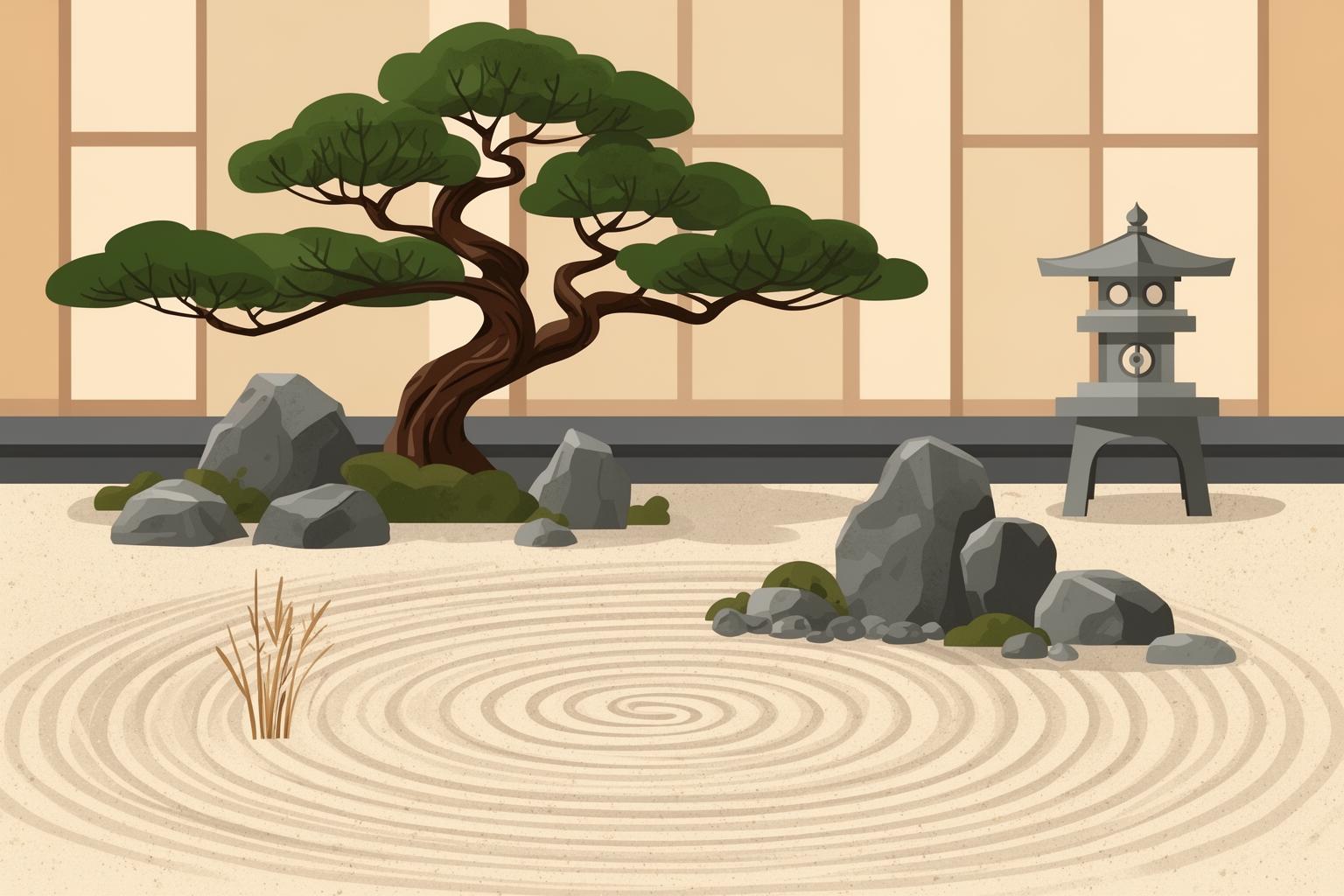
First, let’s clarify what we’re discussing. The term karesansui (枯山水) literally means “dry mountain water.” The phrase itself is a paradox, a deliberate contradiction that unlocks its significance. It describes a garden that evokes mountains and water without using a single drop of actual water.
Its fundamental elements are strikingly simple. There are rocks (ishi), which form the garden’s framework and main structural features. There is sand or, more commonly, fine gravel (shirakawa-suna), selected for its pale hue and texture. Occasionally, a touch of living greenery, usually moss (koke), clings to the rocks, hinting at the passage of time and resilience of life. The most essential component, however, is what is absent: flowing water.
In a karesansui garden, the raked gravel is the water. The carefully carved lines in the sand, made by a monk’s rake, serve more than decoration. They symbolize, abstractly, water in all its forms. Straight lines might suggest the calm surface of a quiet bay. Swirling patterns around a rock evoke the ripples caused by a stone dropped into a pond. Undulating, parallel waves can represent the vast, unending swell of the open ocean. The gravel acts as a canvas on which the concept of water is painted. It captures the essence of water—its movement, its patterns, its interplay with land—without containing the actual substance.
The rocks become the solid contrasts to this fluid void. They are rarely random boulders but are carefully chosen for shape, color, and texture, arranged to suggest islands, mountains rising from the sea, or even specific mythological figures. A tall, jagged stone might represent Mount Horai, a legendary island of the Immortals in Chinese mythology. A cluster of stones could depict a mother tiger leading her cubs across a river, a classic Zen metaphor. These are not merely rocks in a sandbox; they are performers on a stage, frozen in an eternal drama.
It is also important to recognize that these gardens are not designed for walking through. You don’t stroll along a path. A karesansui is meant to be viewed from a fixed, single vantage point, typically the veranda (engawa) of a nearby temple building, like a painting or scroll. You are the observer, and the garden is the object of contemplation. This static viewpoint encourages you to engage with it as a whole composition, a unified, singular thought.
The Art of Absence: Finding the Universe in Emptiness
To grasp why this reductionist approach is so powerful, you must understand the philosophical engine behind it: Zen Buddhism. Zen thought is deeply focused on perceiving reality as it truly is, free from the illusions and noise created by our own minds. Karesansui gardens embody this pursuit physically, grounded in several key aesthetic and philosophical principles.
Ma (間): The Power of Negative Space
The central concept is ma, often translated as “negative space,” but it encompasses much more. Ma is the interval, the gap, the pause, the space between things that gives them form and meaning. In Western art, attention tends to focus on the object—the sculpture, the painting’s subject. In Japanese aesthetics, the empty space surrounding the object is equally important, if not more so. It’s the silence between notes that creates music. It’s the unpainted silk that empowers a brushstroke.
In a Zen garden, the broad stretch of raked sand—the ma—is not empty; it is full of potential. It’s the void from which all existence arises. The rocks provide a focal point and a sense of scale, but the garden’s profound peace and expansiveness come from the sand. This empty space invites your mind to enter, wander, and fill in the gaps. By presenting a highly abstracted landscape, the garden compels you to engage your imagination to complete it. You see rocks and raked gravel, and your mind, prompted by these evocative symbols, conjures an image of a pine-clad island amid a misty sea. It becomes a co-creative interaction between the designer and the observer.
Yugen (幽玄): Suggestion Over Statement
Flowing from this is the notion of yugen, a concept signifying profound, mysterious, and subtle grace. It values suggestion rather than explicit declaration. A garden attempting to perfectly replicate a mountain range literally would be perceived as obvious and shallow, leaving nothing to the imagination. Yugen is about hinting at a deeper reality without fully revealing it. A karesansui garden doesn’t depict an ocean; instead, it shows lines in sand and a rock, evoking the feeling of an ocean—its vastness and timelessness—more powerfully than any photograph could. The mystery is what captivates you. The quintessential example is the garden at Ryōan-ji in Kyoto, where fifteen rocks are positioned so that from any viewpoint on the veranda, at least one is always hidden. The garden teaches that you can never perceive all of reality at once; some aspect is always concealed, leaving space for mystery and contemplation.
This is the moment of insight. The garden isn’t a diorama; it’s a trigger. It is meant to bypass your logical, literal mind and communicate directly with your intuition and imagination. The emptiness isn’t an absence; it is the presence of all things, existing in potential.
A Mind in a Raked-Sand Box: The Garden as a Meditation Tool
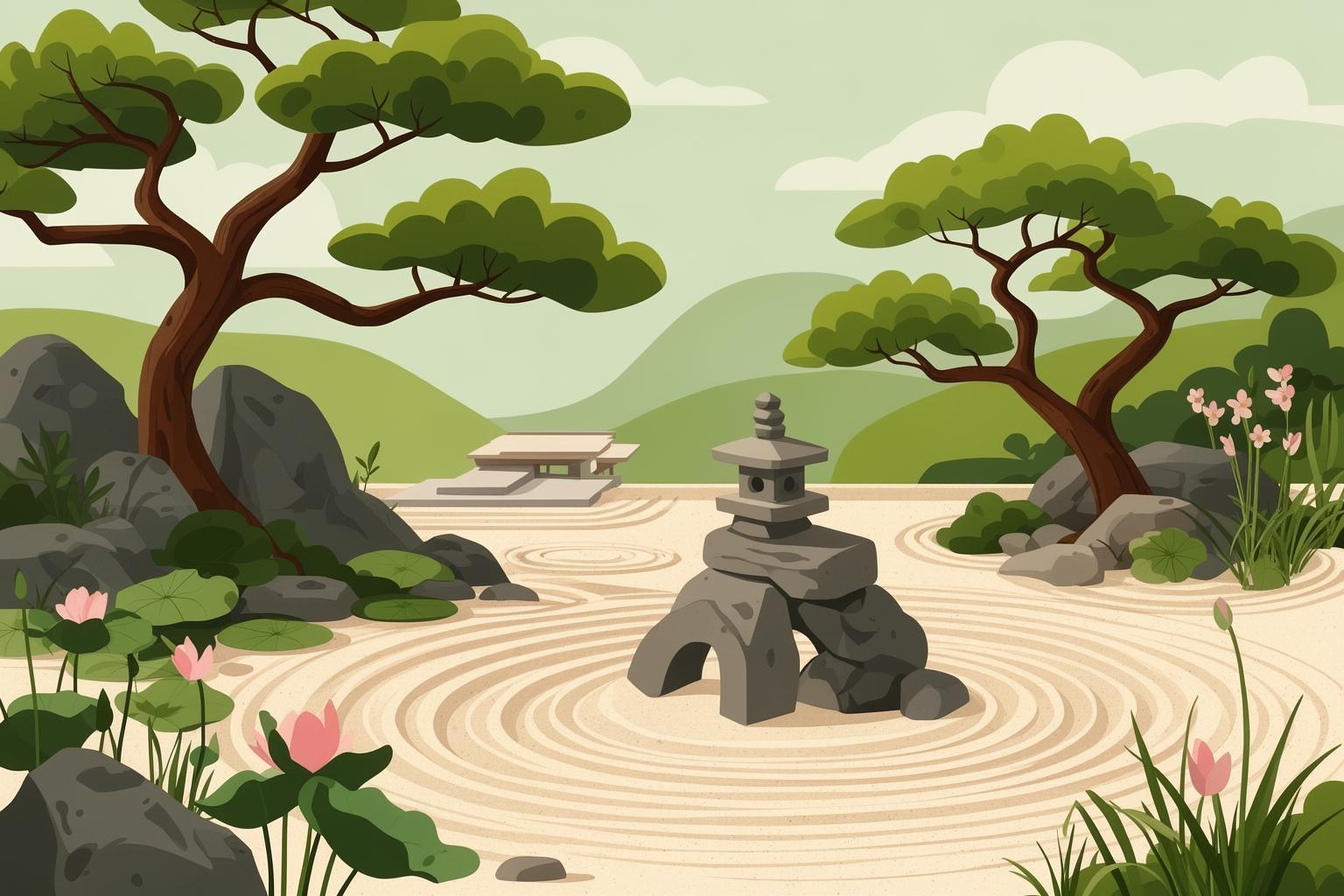
These gardens were not initially designed for tourists or art critics. They were created by and for Zen monks as an essential part of their spiritual training. The garden serves as a dōjō—a place of the way, a training hall for the mind.
Its purpose is twofold. First, there is the physical practice involved in its creation and upkeep. The act of raking the sand, called samu, is a form of active meditation. It demands intense concentration, physical control, and a state of mindful awareness. Every movement must be precise and intentional. A single misplaced footstep or a trembling hand can ruin the pattern, requiring the monk to begin again. This process clears the mind of distracting thoughts, focusing attention entirely on the present moment—the feel of the rake, the sound of the gravel, the rhythm of the body. The resulting pattern serves as a physical record of a state of deep concentration.
Second, for the observer, the garden functions as a visual kōan. A kōan is a paradoxical question or statement used in Zen practice to exhaust the analytical mind and provoke a moment of enlightenment or intuitive insight. Classic kōans include “What is the sound of one hand clapping?” The garden acts as a silent, visual kōan. It asks: How can this be a landscape without plants or water? How can this static arrangement represent the constant flux of nature? How can this small, enclosed space contain the entire universe?
Your rational mind can’t solve these puzzles. It tries, naturally. It analyzes the composition, counts the rocks, and traces the lines in the sand. But ultimately, if you spend enough time with it, the analytical mind surrenders. And in that moment of release, a different kind of perception arises. You stop trying to figure it out and simply experience it. The internal dialogue quiets down. You notice how the light shifts on the surface of the rocks, the subtle textures of the sand, the sense of stillness. The garden becomes a mirror for your own mind. If your mind is chaotic, the garden will seem sterile and dull. If your mind is calm, the garden reveals its infinite depth.
Reading the Rocks: Symbolism and Composition
Although the overall impression is one of intuitive feeling, the design of a karesansui is far from random. It is grounded in centuries of aesthetic principles, many of which are borrowed from Chinese landscape ink painting (sumi-e). The arrangement of rocks follows strict compositional rules intended to produce balance, rhythm, and depth.
Rock groupings are frequently arranged in asymmetrical triads, symbolizing the Buddhist trinity, or in clusters of five, seven, or nine. The numbers themselves matter less than the dynamic tension and harmony formed among the stones. A composition might include a tall, vertical rock symbolizing a mountain, a low, flat rock representing the earth, and a rounded stone positioned between them, creating an overall balance. These groupings direct the viewer’s gaze throughout the composition, crafting a visual journey across the imagined sea.
The selection of rocks is critical. The garden designer would spend months, or even years, searching for stones with the right character (ki). They sought rocks that conveyed a particular energy—some being aggressive and dynamic, others calm and passive. Their weathered surfaces and subtle hues were essential expressions of wabi-sabi, the Japanese aesthetic that finds beauty in imperfection, impermanence, and simplicity. These stones were not viewed as lifeless objects but as living entities, imbued with the spirit of the mountains from which they originated.
Moreover, these gardens are experts in illusion. They often use techniques of forced perspective to make a small space appear vast. Rocks placed in the “foreground” are larger, while those in the “background” are smaller and set slightly lower, generating the illusion of a deep, receding landscape within a shallow courtyard. This manipulation of scale plays with perception, further blurring the boundary between the physical space and the imaginary world it conjures.
Not Just a Pretty Courtyard: The Legacy of Karesansui
The philosophy of the dry landscape garden reaches far beyond the confines of temple grounds. Its principles—minimalism, the significance of negative space, and the elegance of natural, unembellished materials—are central to Japanese aesthetics and have deeply influenced modern design across the globe.
When you encounter the work of an architect such as Tadao Ando, with his stark use of raw concrete, dramatic voids, and the play of light and shadow, you are witnessing the essence of karesansui. When you appreciate the simplicity of Japanese interior design, where a single flower in a vase can define an entire room, you are experiencing the power of ma. This design philosophy recognizes that what is omitted is just as crucial as what is included.
It stands in sharp contrast to the traditional Western garden ideal, exemplified by the formal gardens of Versailles or the lush, overflowing English cottage garden. These celebrate human dominance over nature, with abundance, symmetry, and vivid color. The karesansui offers a profoundly different kind of beauty—a beauty of subtraction, austerity, and intellectual and spiritual reflection. It doesn’t aim to overwhelm the senses with excess stimuli. Rather, it seeks to calm them, creating a space of profound tranquility where one can contemplate the fundamental nature of existence.
The true power of the Zen garden lies in giving you nothing, and in doing so, offering you everything. By reducing nature to its most essential elements—stone as solidity, sand as fluidity, emptiness as potential—it invites the viewer to perceive beyond the surface. It does not depict a specific landscape; instead, it symbolizes the core principles that govern all landscapes. It is a diagram of the cosmic forces within a universe held in perfect, silent balance. To understand it, all you need to do is sit quietly and let the rocks and sand speak.