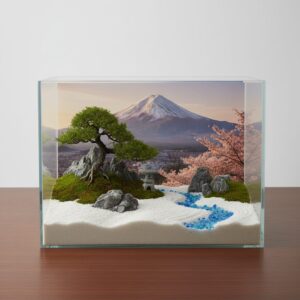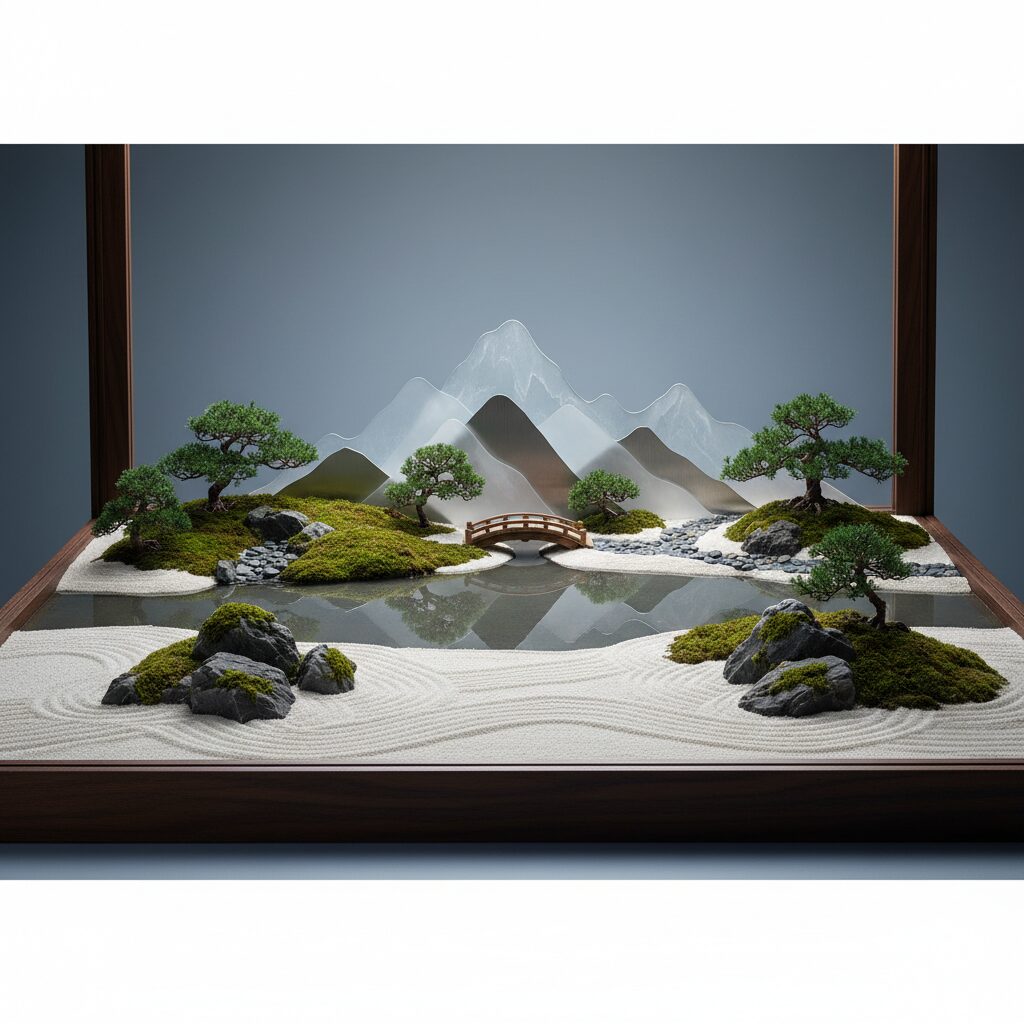
You’ve probably felt it before, even if you didn’t have a name for it. You’re sitting in a room, looking out a perfectly placed window, and the view of the mountain range in the distance feels like it’s part of the room’s decor. Or maybe you’ve been in a backyard where the neighbor’s magnificent, ancient tree seems to stand guard over your own little patch of green. For that moment, the boundary of the property line dissolves, and your space feels grander, more connected to the world beyond. This sensation—of deliberately pulling the outside world into your own curated space—is the essence of a centuries-old Japanese design principle called shakkei.
Literally translated, shakkei (借景) means “borrowed scenery.” It’s one of the most sophisticated and powerful concepts in Japanese landscape architecture. This isn’t just about having a room with a view; it’s the conscious, artistic act of incorporating a distant landscape into the composition of a garden. The mountain, the forest, the sea, or even the roof of a neighboring temple is not just a backdrop; it becomes a central, living element of the garden itself. It’s an art form that fundamentally challenges the Western notion of a garden as a contained, enclosed space, a human-tamed paradise walled off from the wilderness. Instead, shakkei proposes a different relationship: one of partnership, where the human hand works to frame and honor the grandeur of nature, not to conquer or exclude it. This concept is a window into a particular Japanese, and broader East Asian, worldview—one that sees humanity not as the center of the universe, but as a thoughtful participant within it.
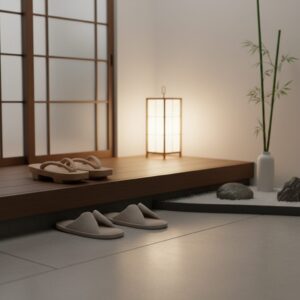
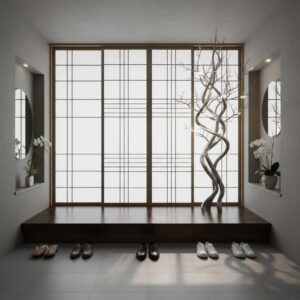
The artful use of natural vistas in shakkei finds a conceptual parallel in the design of the Japanese genkan as a cultural boundary, which redefines everyday spaces with a touch of tradition and subtle elegance.
The Art of the Frame: How Shakkei Works
At first glance, a garden designed with shakkei might appear deceptively simple. You see the garden before you and a mountain in the distance. However, this effect is no mere coincidence. It is a carefully crafted illusion, a sleight of hand achieved through soil, stone, and plants. The effectiveness of shakkei depends on the skillful manipulation of foreground, middle ground, and background to create a seamless visual flow.
The “Middle Ground” as Connector
The true brilliance of shakkei is found not in the garden itself or the distant view, but in the space between them. This middle ground is designed to trick the eye into linking the two distinct areas. Without a thoughtfully arranged middle ground, the distant mountain simply appears as a faraway peak. With it, the mountain becomes the dramatic climax of the garden. This middle ground might be a physical barrier such as a low, trimmed hedge, a tile-capped wall, or a row of trees. By carefully concealing the chaotic, unrefined space between the garden’s boundary and the borrowed scenery—things like roads, buildings, or power lines—the designer effectively shortens the perceived distance. The hedge masks the visual distractions so your eye naturally leaps from the garden’s edge to the distant summit, merging them into one unified image.
Framing the View
Architecture plays a vital role in the art of shakkei. The view is almost always intended to be appreciated from a specific vantage point, frequently from inside a building. A veranda (engawa), a shoji screen drawn aside, or a circular window (marumado) serves as a purposeful frame. This is much like a painter structuring a landscape on canvas. The frame guides the viewer’s gaze, focusing attention and heightening the scene’s impact. It signals, “Look here. This is the composition I have crafted for you.” The dark wood of a pillar or the clean line of a roof eave can make the green of the distant hills appear even more vivid. By controlling the frame, the garden designer shapes not only the space but also the experience of viewing it.
Hide and Reveal
Excellent shakkei gardens seldom present the entire view all at once. The principle of miegakure, or “hide and reveal,” often comes into play. A strategically placed maple tree may allow only fleeting glimpses of the borrowed mountain as you stroll along a path. The full panorama is unveiled only upon reaching the main viewing platform of the temple’s main hall. This creates a sense of anticipation and discovery. The partial concealment adds depth and intrigue, making the ultimate reveal even more striking. It’s a dynamic experience that transforms the viewer from a passive onlooker into an engaged participant in the landscape.
A Philosophical Blueprint: What Shakkei Says About Culture
To grasp shakkei is to grasp a profound aspect of the Japanese cultural mindset concerning nature, ownership, and space. It goes beyond being a mere design technique; it embodies a philosophical worldview deeply shaped by Zen Buddhism and Taoism.
Beyond Ownership
In a world where property boundaries dominate, shakkei presents a radical idea: you don’t have to own something to incorporate it into your life and home. The monks of Entsu-ji temple in Kyoto do not possess Mount Hiei, yet the mountain remains the undeniable heart of their garden. This represents appropriation without possession. It reflects the belief that the great beauties of nature belong to everyone, a universal commons. The garden designer “borrows” the mountain with the understanding that it cannot be owned, only admired. This humble stance acknowledges that the most magnificent elements of a landscape often lie beyond human control. It quietly challenges the notion that value is dependent on ownership.
Humanity’s Place in Nature
The iconic Western garden, especially from the French formal tradition, emphasizes control—nature rationalized, geometrized, and shaped to human will. In contrast, shakkei expresses the opposite impulse. It is an act of respect. The garden does not impose on the landscape but instead creates a thoughtfully crafted link to it. The key element—the borrowed scenery—is the one the designer did not create. This establishes a hierarchy where nature maintains its power and grandeur, and the human role is to craft a space worthy of contemplation. This perfectly aligns with Zen and Taoist principles, which stress harmony with the natural flow of the universe (Tao) and acknowledge a reality far greater than the individual self. The garden becomes a place for meditation, a space to connect with the vast, untamed world beyond its boundaries.
The Illusion of Infinity
Japan’s limited space has influenced its architecture and design for centuries. Shakkei offers an ingenious response to this constraint. By visually incorporating a distant, expansive landscape, a small, enclosed garden can feel limitless. The technique plays with scale, creating an illusion of depth and vastness that transcends the actual dimensions of the property. This manipulation of perception is a common theme across many Japanese arts. It links to the aesthetic concept of ma (間), the powerful emptiness or negative space between objects. In shakkei, the sky, mist, and the unseen valley between garden and mountain are integral parts of the composition. The garden’s true size becomes psychological, not physical, bridging the finite space of human creation with the infinite expanse of the natural world.
The Four Views of Shakkei: Types of Borrowed Scenery
Japanese garden theory is profoundly systematic. Over the centuries, scholars and garden masters have classified shakkei into four distinct types based on the direction and scale of the borrowed scenery. Understanding these categories enhances appreciation for the subtlety and intention behind each design.
Enshaku (Distant Borrowing)
This is the most renowned and striking form of shakkei. Enshaku involves incorporating a major natural feature on the horizon, such as a famous mountain or a vast body of water. The well-known use of Mount Hiei in several Kyoto gardens serves as a classic example. This type of borrowing imparts a sense of grandeur and epic scale. The garden becomes a foreground to a majestic natural masterpiece, connecting the intimate human space with the sublime forces of the region’s geology and geography.
Rinshaku (Adjacent Borrowing)
Borrowing does not always occur on a grand scale. Rinshaku refers to borrowing from the immediate surroundings. This might include a grove of trees in a nearby park, the elegant roofline of a neighboring temple, or even a wall from the property next door. This approach fosters a sense of community and shared space, softening the divisions between properties. It is a more intimate, localized form of shakkei that deepens the connection with the surrounding environment. In densely populated urban areas, this might simply involve framing the view of a neighbor’s cherry tree so that its blossoms in spring seem part of your own garden.
Gyōshaku (Upward Borrowing)
This may be the most poetic and fleeting type of shakkei. Gyōshaku borrows from the sky above. The borrowed element could be the moon, a distinctive cloud formation, or the flight path of birds. Gardens are designed to lift the viewer’s gaze upward, often using tall, slender elements such as bamboo or stone lanterns to direct attention. The emphasis here is on capturing the transient and ever-changing beauty of the heavens. It serves as a reminder of time and impermanence, incorporating a constantly shifting canvas.
Fushaku (Downward Borrowing)
Fushaku is the rarest and most subtle form of borrowed scenery. It involves borrowing views from below the garden’s main sightline. A common example is using a pond or basin of water to reflect the sky, mountains, or trees. The reflection becomes the borrowed element—a shimmering, inverted world contained within the garden. This technique introduces a layer of complexity and contemplation, inviting viewers to look downward in order to perceive what lies above.
Experiencing Shakkei Today: Where to See It in Action
While the principles of shakkei can be observed in gardens both large and small throughout Japan, several iconic sites stand out as masterful examples of this art form. Experiencing them firsthand reveals the true power of this design philosophy.
The Imperial Classic: Shugaku-in Imperial Villa, Kyoto
Constructed in the 17th century for Emperor Go-Mizunoo, Shugaku-in represents shakkei on an impressive imperial scale. Consisting of upper, middle, and lower villas spread across a hillside in northern Kyoto, the estate skillfully incorporates the surrounding hills and distant mountains into its overall design. From the upper villa’s Jugetsu-kan (Lakeside Pavilion), the view over Yokuryu-chi Pond appears to blend seamlessly with the natural landscape. The designers even dammed a river to form the pond, illustrating their willingness to undertake large-scale earthworks to achieve perfect harmony. The surrounding rice paddies, still cultivated by local farmers, contribute to the borrowed view, linking the refined imperial world with the everyday life of the countryside.
The Living Painting: Adachi Museum of Art, Shimane
One of the most renowned modern examples of shakkei can be found in the garden at the Adachi Museum of Art. It has been acclaimed as the best garden in Japan for over two decades, and for good reason. The museum’s founder, Adachi Zenko, regarded the garden itself as a work of art—a “living Japanese painting.” The museum’s windows are designed to frame the scenes outside perfectly. The garden is meticulously maintained to blend seamlessly with the natural mountains behind it. Staff even venture into the hills to prune trees and preserve the backdrop in ideal condition. This is a hyper-real, almost surreal interpretation of the shakkei principle, where the boundary between nature and art is deliberately and completely blurred.
Zen Simplicity: Tenryu-ji Temple, Arashiyama, Kyoto
Recognized as a UNESCO World Heritage site, the Sogenchi Teien (Sogen Pond Garden) at Tenryu-ji is among the oldest extant examples of shakkei. Designed by the celebrated garden creator Muso Soseki in the 14th century, the garden masterfully incorporates the mountains of Arashiyama, including Kameyama and Arashiyama itself, into its layout. The pond in the foreground, the rocks symbolizing Buddhist cosmology, the wooded middle ground, and the iconic mountains in the distance all harmonize perfectly. It serves as a textbook example of how a Zen garden can foster a contemplative space that feels both enclosed and connected to the vastness of nature.
Urban Ingenuity
The essence of shakkei is not limited to grand temples or imperial estates. It is a living concept that adapts to its surroundings. In modern Tokyo, a landscape architect might design a small rooftop garden that frames the Tokyo Skytree, borrowing a symbol of modernity rather than a mountain. A tiny residential garden (tsuboniwa) might include a small opening in its fence to borrow the greenery of a nearby public park. This adaptability demonstrates that shakkei is not merely a historical custom but a timeless approach to creating beauty and a sense of spaciousness, regardless of limitations.
Ultimately, shakkei is more than just a technique for making gardens appear larger or more attractive. It embodies a worldview expressed through soil and stone. It teaches a way of seeing that extends beyond fences and property lines to find connection. It invites us to view our own small, crafted worlds not as separate from the greater whole, but as integral parts of it. In an era marked by division and enclosure, the art of borrowed scenery serves as a powerful reminder that sometimes, the most beautiful things are those we do not own, but simply possess the wisdom to embrace.