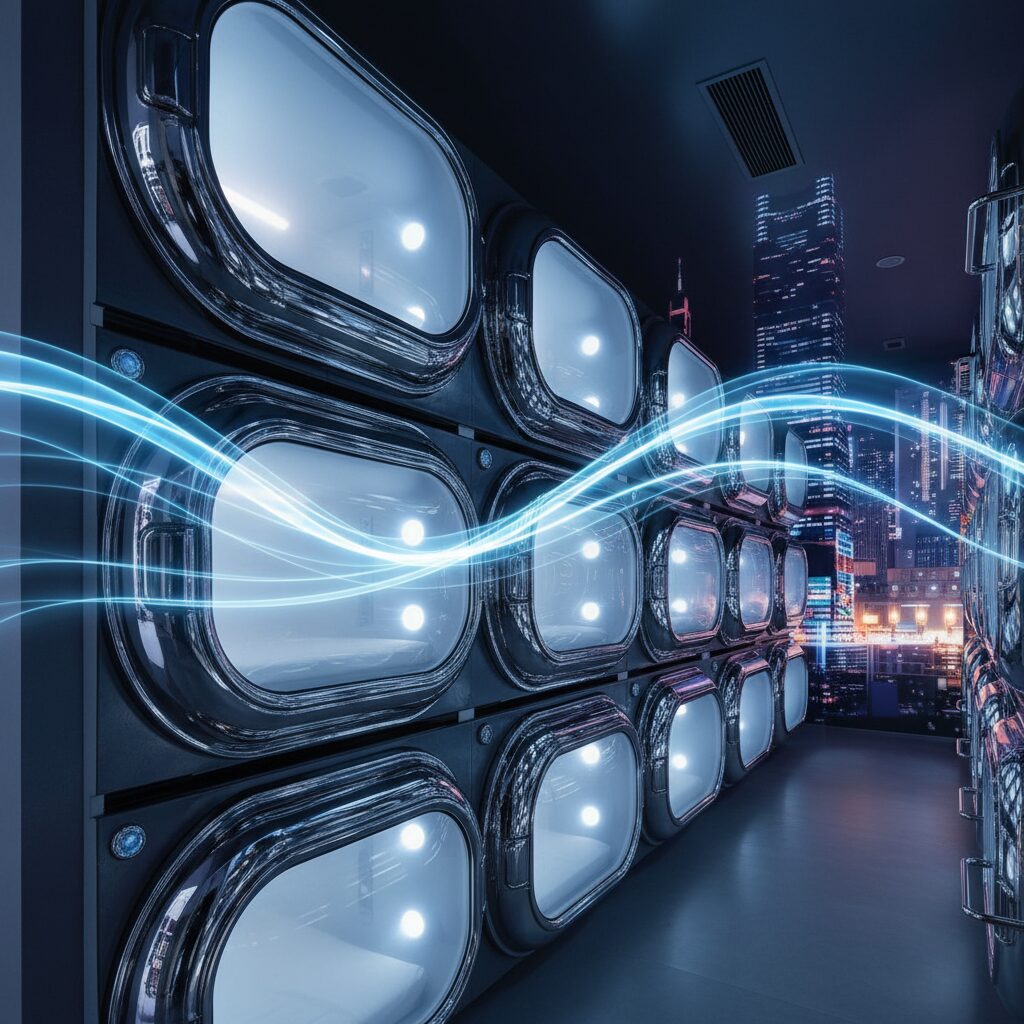
When most people outside of Japan picture a capsule hotel, their mind usually lands somewhere between a sci-fi movie set and a human beehive. It’s an image of sterile white pods stacked floor to ceiling, each containing a person cocooned for the night. The concept feels futuristic, clinical, and maybe a little dystopian. It’s become a visual shorthand for a certain kind of Japanese efficiency, often misunderstood as a quirky budget option for tourists or a sign of cramped urban living. And while it does serve those functions today, that’s not the whole story. It’s not even the interesting part of the story.
To really understand the capsule hotel, you have to look past the novelty of its design and ask a more fundamental question: why would a society invent such a thing? What specific problem did sleeping in a drawer solve? The answer isn’t about saving space or catering to backpackers. The capsule hotel is a physical artifact of a specific moment in time, a perfect, almost poetic solution to the immense pressures of Japan’s 1980s economic boom. It was conceived not for tourists, but for a very particular tribe: the Japanese salaryman, the corporate foot soldier of the Bubble Economy. To get the capsule hotel, you first have to get him, and the world that demanded he give everything, including his commute home.
This exploration of Japan’s rapid urban transformation also sheds light on how the visual narratives of danchi culture capture the ambiance of a bygone economic boom.
The Economic Miracle and its Human Cost
To grasp the 1980s in Japan is to grasp a nation riding high on its own achievements. The post-war recovery had transformed into a full-fledged economic superpower. The term “Bubble Economy,” or baburu keizai, characterizes this era of wildly inflated stock and real estate markets. Tales from this time now seem like legends: Tokyo’s Imperial Palace grounds were said to be worth more than all the real estate in California; companies were snapping up foreign landmarks like Rockefeller Center; executives indulged in champagne and hailed taxis with ¥10,000 bills. Japan Inc. wasn’t just competing globally; it felt like it was dominating.
Yet, this economic miracle was driven by a distinct kind of human energy. Central to it was the salaryman, the white-collar office worker. He was more than just an employee; he was a corporate soldier, committed to his company through a system of lifetime employment. In return for this security, the company demanded near-complete loyalty. The office was not merely a place to work from nine to five. It was the heart of your social and professional life. Your identity was tied to your company name and your rank within it.
This loyalty was expressed in time. Long hours were not just frequent; they were the standard expectation. Leaving the office before your boss was considered rude. Staying late, often without a clear reason other than to be visible, was a quiet display of dedication. The boundary between work and personal life disappeared entirely. This relentless pace became so widespread that it spawned a new vocabulary, including the chilling term karoshi—death from overwork. This intense, high-pressure environment was precisely the challenge that the capsule hotel would ultimately address.
The Unspoken Rules of the Corporate Warrior
The salaryman’s day didn’t conclude when he finally packed up his briefcase. In fact, some of the most critical work took place after official hours. This was governed by a set of unwritten rules as strict as any corporate policy.
The Ritual of Nommunication
One of the most essential rituals was the after-work drinking session. This was more than just a casual beer with colleagues; it was a strategic institution so important it even had its own portmanteau: nommunication (from nomu, to drink, and communication). These gatherings, often held several nights a week, were where the real work of building relationships occurred. In a culture that values group harmony and indirect communication, the sake-fueled atmosphere of an izakaya allowed for relaxation of the rigid office hierarchy. It was in this setting that frustrations were aired, trust was established, and genuine consensus was reached away from the formal stiffness of the meeting room.
Refusing an invitation from your boss was unthinkable. It wasn’t merely skipping a social event; it was seen as lacking team spirit, a rejection of the company family. So, you went. You drank, you listened, you bonded. And the hours passed. One drink became two, one izakaya led to another for a second round (nijikai), and sometimes even a third (sanjikai).
The Tyranny of the Last Train
While the salaryman worked in the bustling city centers of Tokyo or Osaka, he often lived far beyond their limits. The dream of home ownership pushed families out to sprawling suburban prefectures like Chiba, Saitama, or Kanagawa. This meant commutes were punishingly long—one or even two hours each way.
This geographic reality imposed a nightly deadline: the shuden, or last train. Japan’s famously punctual train system is impressive, but it isn’t 24/7. Between midnight and 1 AM, the lines cease operation. Missing that last train was a common, almost unavoidable, outcome of the work-hard, drink-hard culture. After a long night of nommunication, a salaryman would often find himself rushing through a station, only to watch the red taillights of his final ride home fade into the darkness. He was stranded.
The Problem in Search of a Solution
Picture the scene: it’s 1 AM in Shinjuku. You’re drained after a twelve-hour workday followed by a three-hour drinking session. Your head is spinning. Your home is two hours away by train, but the trains have stopped running. What do you do?
Your choices are limited and far from ideal. You could take a taxi, but the fare for a long suburban ride would be astronomical—eating up a significant portion of a day’s or even a week’s wages. It’s an emergency option, not a regular solution.
You might look for a standard business hotel. But that’s expensive and feels like overkill. You don’t need a king-sized bed, a desk, and a private bathroom for just five hours of sleep. All you want is a flat surface and a quiet place to close your eyes before being back at the office by 9 AM.
The other alternatives are less attractive. You could try to sleep in a 24-hour manga cafe or an all-night diner, slouched in a chair. Or you might go to a public sauna, where a common room with reclining chairs might be available. These options are cheap but not professional. You’d arrive at work the next day crumpled, unrested, and smelling of smoke. This isn’t a sustainable routine for a committed corporate worker.
This was the recurring dilemma faced by tens of thousands of men every night. The system demanded they stay late, but offered no practical way to get home and rest afterward. There was a glaring gap in urban infrastructure—a need for something cheaper than a hotel, more comfortable than a chair, and more professional than a sauna.
Enter the Capsule: Architecture as a System
The solution emerged in 1979 in Osaka. Designed by the visionary architect Kisho Kurokawa, the Capsule Inn Osaka was the first of its kind worldwide. Kurokawa was a prominent figure in an architectural movement known as Metabolism, which saw cities as living, organic systems. The Metabolists envisioned buildings that were flexible, adaptable, and made up of prefabricated, replaceable parts—like cells in a body. The capsule represented the ultimate manifestation of this philosophy.
Kurokawa didn’t design a small room; he created a purpose-built sleeping pod. The capsule eliminated every non-essential feature of a traditional hotel room. There was no space to walk, no window, no desk, no closet, and no en-suite bathroom. It was reduced to its fundamental function: a private, enclosed space with a bed. Inside, you had only the bare essentials: a light, an alarm clock, perhaps a small television, and a curtain or screen for privacy. It was pure, distilled utility.
All other functions were delegated to communal areas. Personal belongings were stored in lockers. Hygiene was managed in a large Japanese-style public bath, or sento, a crucial element that offered both cleaning facilities and ritual relaxation. There might be a lounge with vending machines and a TV, and perhaps a small restaurant. This smart division of functions allowed for remarkable density. By stacking the individual sleep capsules, a building could accommodate a large number of guests in a prime downtown location, making the nightly rate extremely affordable.
More Than a Bed, It Was a Social Reset Button
Here lies the true genius of the capsule hotel. It was more than just an inexpensive place to sleep; it was a carefully designed piece of social engineering that addressed several issues simultaneously. It served as an acceptable social outlet for the pressures of the salaryman’s life.
For the worker, it provided a guilt-free spot to rest. Staying at a capsule hotel conveyed an unspoken message: “I worked tirelessly for the company, fulfilled my social duties by drinking with my team, and now I can’t even make it home.” In a culture that valued visible effort, it became a subtle badge of honor, a mark of dedication. It was a valid excuse.
Moreover, it acted as an essential buffer between professional and domestic life. Coming home drunk at 2 AM risked disturbing your wife and children, fumbling in the dark, and facing potential disapproval. The capsule hotel offered a “social reset.” You could sober up, relax in the communal bath, and emerge refreshed. Most capsule hotels even provided a clean white shirt, razor, and toothbrush. You could return to the office the next morning looking sharp and presentable, as if the previous night’s fatigue and excess never occurred. It helped preserve harmony, or wa, at both work and home.
The communal bath was more than just a functional shower. It was a culturally significant space for relaxation and mental cleansing. For a man who had spent the day in a strict hierarchy and the evening in obligatory socializing, the quiet, anonymous steam of the bath was a moment of release and purification—a final ritual before recharging for the next day.
The Capsule Today: From Salaryman Sanctuary to Global Curiosity
The economic bubble burst spectacularly in the early 1990s, bringing with it a gradual shift in the excesses of the 1980s work culture. Lifetime employment ceased to be a guarantee, and the tradition of mandatory, all-night drinking sessions diminished. The original clientele of the capsule hotel—the stranded salaryman—is no longer as abundant as it once was.
Yet, the capsule hotel has not only endured but flourished. It evolved. The core idea of offering an affordable, safe, and private sleeping space in a prime urban location proved to have broad appeal. Capsule hotels became a popular choice for budget travelers from across the globe, young Japanese individuals needing accommodation after late-night concerts, or workers on tight budgets looking to save on rent.
In recent years, the capsule has undergone another transformation. A new generation of “luxury” or “designer” capsules has arrived, shifting the concept from merely functional to an aesthetic experience. Modern examples, like the 9h (nine hours) chain, emphasize sleek minimalist design, high-quality bedding, and premium amenities. These cater to a generation that values both efficiency and style. Female-only floors and even entire female-only capsule hotels have also become common, making the experience accessible to a wider audience.
Despite their increasing sophistication, their essence remains rooted in that intense, high-pressure period of Japanese history. The next time you see a photo of those neatly stacked pods, look past the futuristic design. See a monument to a bygone era. See a clever solution to an impossible challenge. The capsule hotel is more than just a bed in a box; it is a quiet narrative of a nation at work, a tribute to the salarymen who powered an economic miracle—one exhausting day and one missed train at a time.