Walk into a home almost anywhere in the Western world, and the entry is a casual affair. You might kick off your shoes if they’re muddy, hang a coat on a hook, and drop your keys in a bowl. The transition from the public street to the private home is a soft fade, a matter of a few steps. In Japan, however, that transition is a hard stop. It’s a deliberate, ritualized sequence that takes place in a highly specific, purpose-built space: the `genkan`.
For first-time visitors, the `genkan` can be a source of mild anxiety. You arrive at the door, see the host’s shoes neatly pointing outward on a lower level, and a sudden wave of procedural uncertainty hits. Where do I step? What do I do with my own shoes? Do I put on those slippers? Why are my feet suddenly the most important and complicated part of my body? It’s easy to dismiss this as just a quaint custom about keeping floors clean. But that’s like saying a handshake is just about checking for hidden weapons. The truth is far more profound. The `genkan` isn’t just an entryway; it’s a physical border, a symbolic airlock between the outside world and the inner sanctuary of the home. It’s where the public realm ends and the private realm begins, and crossing it correctly is a fundamental expression of social and cultural literacy in Japan. Understanding this small patch of real estate is one of the quickest ways to grasp the deeper operating system of Japanese society, from its concepts of purity to its strict social divisions. It’s a space loaded with meaning, a daily ritual that says everything about how this culture defines home, safety, and respect.
Gaining further insight into how the genkan delineates the public from the private in Japanese culture can be deepened by exploring its role as the very soul of the home.
The Anatomy of a Threshold: What Makes a Genkan a Genkan?
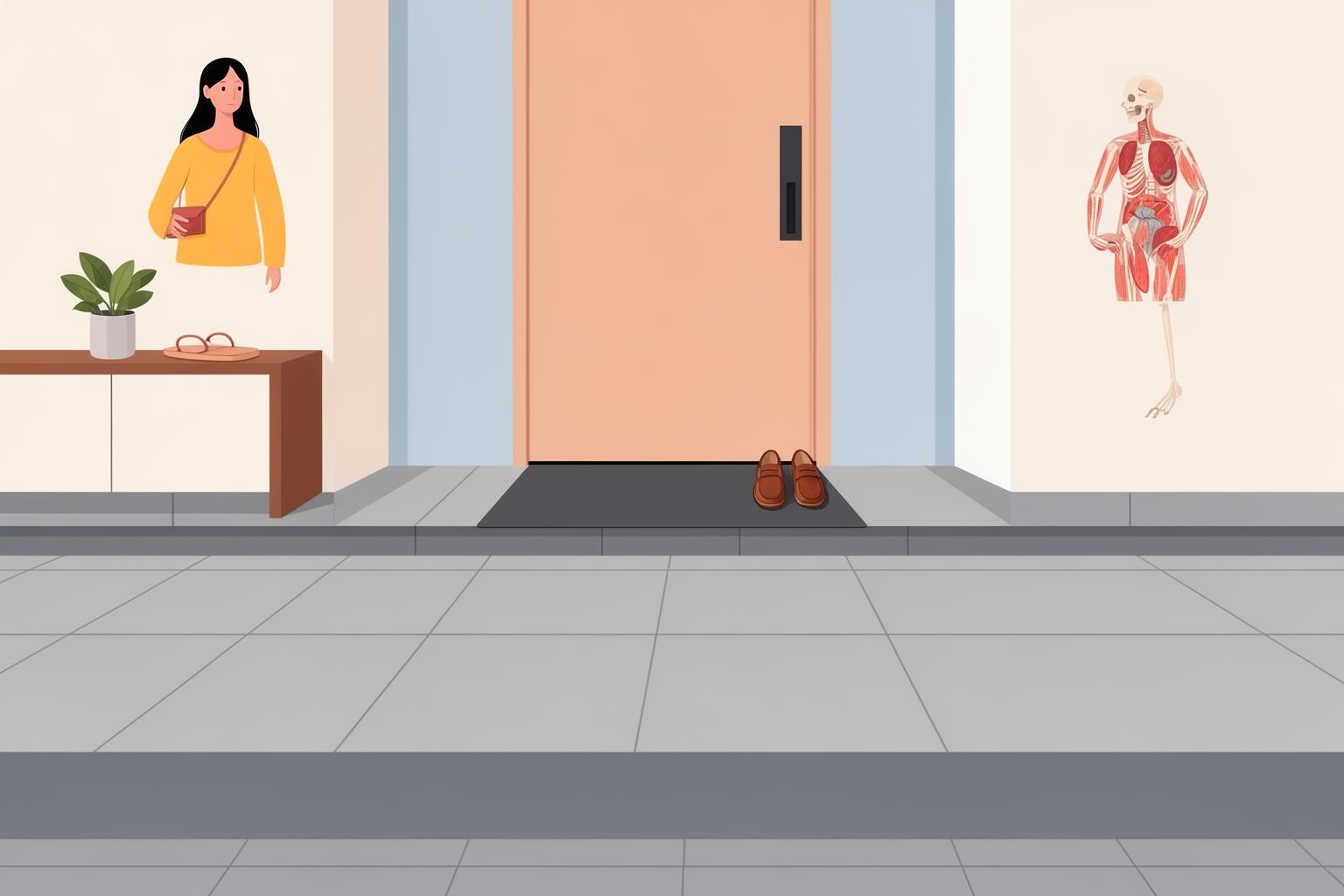
At first glance, a `genkan` appears simple. It’s the space immediately inside the front door. However, its design is intentional; every feature holds a specific practical and symbolic purpose. It is an architectural element as standardized and essential in a Japanese home as the kitchen or bathroom. Unlike a Western foyer or mudroom, which tend to be flexible spaces, the `genkan` is defined by a distinct and uncompromising architectural feature.
The Step (`Agarigamachi`)
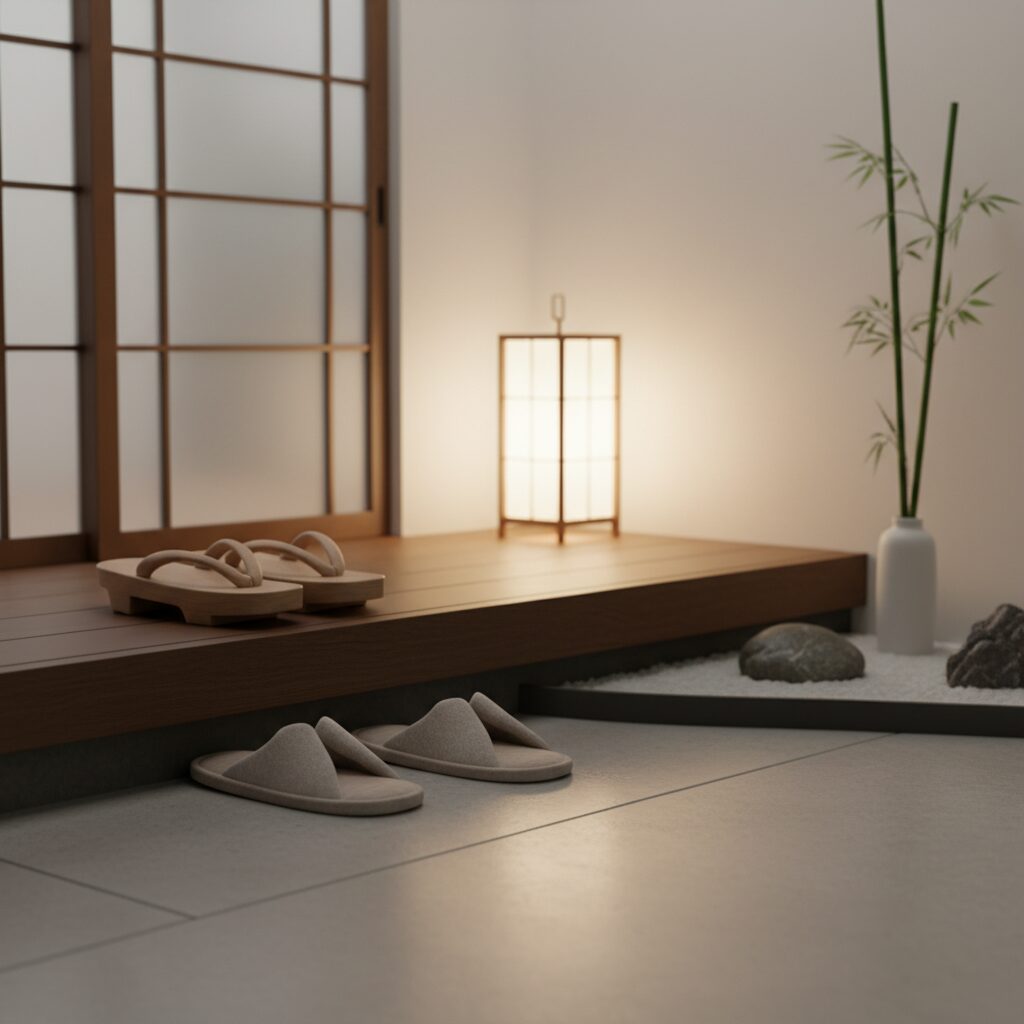
The most crucial element of the `genkan` is the `agarigamachi`, the raised step that separates the entry area from the rest of the house. This is not merely a decorative threshold; it is a literal elevation change, usually between 5 and 15 centimeters (2 to 6 inches), though in older homes it can be much taller. This step creates two distinct zones. You enter onto the lower level, and to enter the home proper, you must step up. This physical act of ascending is essential, marking a transition between two types of space. Once you have stepped up, your feet should never touch the lower area again, and under no circumstances should your shoes touch the upper floor. The `agarigamachi` represents a clear boundary, a border you cross every time you come home.
The Ground Floor (`Tataki`)
The lower level of the `genkan` is called the `tataki`. The term originally referred to a mixture of packed earth, lime, and water used to form a hard, durable floor. Today, it is usually finished with concrete, tile, or stone—materials that are sturdy, water-resistant, and easy to clean. Although technically inside the house, this is the “outside” zone. It acts as a decontamination area for the outside world. This is where you remove your shoes, allowing all dirt, dust, rain, and snow from the street to settle. The `tataki` is designed to contain this mess, preventing it from being tracked into the clean interior. It also serves as a temporary holding place for other outdoor items: umbrellas drying in a stand, a child’s tricycle, a folded stroller, or packages from deliveries. It functions as the home’s buffer, absorbing the initial impact of the outdoors.
The Shoe Cabinet (`Getabako`)
Dominating the `genkan` in nearly every Japanese home is the `getabako`, or shoe cabinet. Its name literally means “`geta` box,” referring to the traditional wooden clogs. This is not a small, inconspicuous shoe rack hidden in a closet; it is often a substantial piece of furniture, a built-in closet that commands the entryway. Its presence highlights the importance of the shoe-removal ritual. Japanese people have different shoes for various occasions: work shoes, school shoes, casual sneakers, formal shoes for events, and more. A family of four can easily accumulate a dozen pairs used regularly. The `getabako` provides an orderly, designated spot for all of them. A messy pile of shoes cluttering the `tataki` is seen as unsightly and disrespectful, implying a disorganized household and lack of care. The `getabako` maintains the boundary between outside and inside, keeping it neat, organized, and clear, reflecting the cultural emphasis on order and cleanliness.
More Than Just Dirt: The Symbolic Meaning of the Inside/Outside Divide
If the `genkan` were solely about hygiene, doormats and shoe racks would be enough. However, its strict design and the unwavering rituals linked to it reveal a much deeper cultural logic. The division of spaces is not merely physical; it is deeply symbolic, rooted in ancient beliefs about purity and a fundamental social concept that shapes Japanese life.
Purity and Pollution (`Kiyome` and `Kegare`)
To fully grasp the meaning of the `genkan`, one must understand the native Shinto concepts of purity (`kiyome` or `sei`) and impurity (`kegare`). In Shinto belief, the outside world is not only physically dirty but also carries a form of spiritual or metaphysical pollution. `Kegare` is not sin in the Western sense; rather, it is a condition of defilement or contamination caused by contact with death, illness, and the general chaos of public life. By contrast, the home is a sacred, purified space—a sanctuary from the `kegare` of the outside. Removing your shoes in the `genkan` is therefore a ritual of purification. You are shedding the pollution of the outside world before crossing the threshold into the clean, protected space of the home. This act cleanses both your feet and your spirit. The same principle is evident at any Shinto shrine, where visitors perform a purification ritual called `temizu`, washing their hands and rinsing their mouths with water from a basin before approaching the main hall. The `genkan` serves as a domestic `temizuya`, a place where the profane is cleansed before entering the sacred.
`Uchi-Soto`: The Social Boundary
The `genkan` also represents the most powerful physical expression of `uchi-soto`, one of the key concepts for understanding Japanese social dynamics. `Uchi` (内) means “inside” and refers to your in-group: your family, company, or team. Within the `uchi` group, communication tends to be more direct, informal, and intimate. `Soto` (外) means “outside” and refers to everyone else—strangers, clients, people from other companies. Interactions in the `soto` realm are governed by formality, politeness (`keigo`), and a greater emotional distance. The `genkan` is the literal boundary between your private `uchi` world and the public `soto` world. When you invite someone to cross the `agarigamachi` and step into your home, you are admitting them into your inner circle. It’s a significant gesture of inclusion. Conversely, many interactions intentionally take place only in the `genkan`. A delivery driver, salesperson, or neighbor dropping something off will often complete their entire transaction on the `tataki`. They engage with the household without formally entering the `uchi` space. This is not considered rude; rather, it is a mutual understanding and respect for the boundary. They belong to the `soto` world, and the task at hand does not require entry into the private `uchi` sphere. This makes the `genkan` a vital social stage where the terms of a relationship are subtly negotiated and affirmed.
The Genkan in Action: Mastering the Everyday Rituals
Grasping the theory is one thing; smoothly performing the choreography of the `genkan` is quite another. For Japanese people, these actions are instinctive, learned from early childhood. For outsiders, it might seem like an awkward dance, but the steps become straightforward once you understand the reasoning.
The Art of Entry
The correct way to enter a Japanese home is a graceful process designed for both efficiency and respect. First, you open the door and step onto the `tataki`. Then, importantly, you turn to face the door you just came through. Bending down, you remove your shoes. By facing the door, you can easily place them on the `tataki` with toes pointing outward, ready for a quick exit later. Finally, you step up backward or sideways onto the raised floor, ensuring your socks or bare feet do not touch the lower, “unclean” `tataki`. Positioning your shoes with the toes pointing out is a small yet meaningful act of thoughtfulness (`omoiyari`). As a guest, the host may turn your shoes around for you as a gesture of hospitality, but doing it yourself reflects good manners. It indicates that you do not intend to be a burden and have already prepared for your departure.
The Guest Slipper Protocol
Once inside the home, you will often see a neat row of slippers (`surippa`) waiting for you. You should put these on immediately. While walking around in just your socks is sometimes tolerated—especially in very modern homes or among close friends—wearing slippers is generally considered polite. It provides an added layer of separation from the floor. This slipper etiquette includes another level of complexity: the toilet slippers. Many homes have a separate pair of slippers, often plastic and clearly labeled `TOILET`, placed just inside the bathroom. The rule is strict: you leave your house slippers outside the bathroom door, step into the toilet slippers, use the toilet, and then switch back when you leave. The bathroom is seen as a distinct zone of potential impurity within the home, and its slippers must never be worn elsewhere. Forgetting to switch back and accidentally walking into the living room with the toilet slippers is a common and deeply embarrassing social faux pas—a rite of passage for many foreigners living in Japan.
When Rules Get Bent: Modern Adaptations
Naturally, Japan is not a static society. Architecture and lifestyles evolve. In many modern, space-limited city apartments, the `genkan` may be tiny—a small tiled area barely large enough for one person to stand on, with a minimal `agarigamachi` that is little more than a slight step. Yet, no matter the size, the function and ritual remain intact. The boundary persists and is still respected. Additionally, responding to an aging population, some newer homes are designed to be “barrier-free” (`bariafurii`), removing the step for accessibility. In these cases, the boundary is marked by a change in flooring material—such as a transition from tile to wood. Though the physical step may be gone, the psychological boundary remains. The cultural expectation to remove one’s shoes at that point continues to be strongly upheld.
Beyond the Home: Where Else You’ll Find a Genkan Mentality
Once you understand the logic behind the `genkan`, you begin to notice it everywhere. The concept of shedding the outside world before entering a new, distinct space is reflected in numerous aspects of Japanese society.
Schools and Workplaces
From their first day of kindergarten, Japanese children learn the `genkan` routine at school. Every school features a large `genkan` at the entrance, lined with rows of `getabako` (shoe lockers). Students arrive, take off their outdoor shoes, place them in their assigned locker, and change into a pair of indoor shoes (`uwabaki`) worn only inside the school building. This system not only keeps the floors exceptionally clean but also instills the `uchi-soto` discipline from an early age. The school is considered an `uchi` environment, distinct from the `soto` world outside. Some traditional companies, doctor’s offices, and clinics similarly require staff and visitors to remove their shoes and wear slippers, reinforcing the notion that the workspace is a controlled, internal environment.
Temples, Shrines, and Ryokan
Entering a sacred or respected space nearly always involves this transition. At Buddhist temples, you must remove your shoes before stepping up into the main halls where the deities reside. This is an act of humility and respect. The same applies at traditional inns, or `ryokan`. Upon arrival, you leave your street shoes in the main `genkan`. You will be given slippers to wear in the hallways, but when you enter your private room with its delicate `tatami` straw mat flooring, you must remove even the slippers. `Tatami` is regarded as a pure, almost sacred surface, meant only for socks or bare feet. This creates nested layers of `uchi-soto`: the `ryokan` itself is an `uchi` space separate from the outside world, and your private room is an even more intimate `uchi` space within it.
Restaurants and Even Fitting Rooms
This practice extends to many other public places. Traditional Japanese restaurants, particularly those with `tatami` rooms (`zashiki`), have a `genkan` where guests leave their shoes, often storing them in small lockers. Even in modern environments, the mentality remains. For example, when trying on clothes at a Uniqlo or other retailer, you will often find a small, raised platform inside the fitting room. You are expected to remove your shoes and step up onto this platform before trying on pants or skirts. The reasoning is simple: it keeps the garments from touching the dirty floor where many shoes have been. It’s a miniature, temporary `genkan` serving the purposes of commerce and cleanliness.
What the Genkan Tells Us About Japan
The `genkan` is much more than just an architectural feature. It serves as a piece of cultural hardware, a physical system that enforces the social norms of Japanese life every day. It stands as a constant, tangible symbol of the boundary between public and private, chaos and order, impurity and purity. Its rituals uphold a profound respect for cleanliness that transcends simple hygiene and enters the spiritual domain. It functions as the training ground for `uchi-soto`, guiding individuals from childhood on how to navigate the essential social divisions shaping their world.
In today’s fast-paced, globalized society, the `genkan` demands a moment of pause. It acts as a mandatory punctuation mark at both the start and end of each day. During that brief act of unlacing shoes and crossing the threshold, you consciously shift between worlds. This small, yet powerful ritual anchors you in a sense of place and propriety. To grasp the significance of the `genkan` is to realize that in Japan, the manner in which you enter a room holds as much importance as what happens within it. It is a key that reveals a deeper understanding of how space, ritual, and social relationships are seamlessly woven into one elegant fabric.