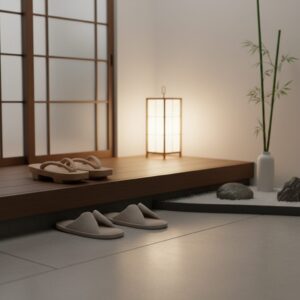
You know how when you step into a Japanese home, there’s that immediate sense of transition? That pause, that sunken space just inside the door where shoes come off and the outside world is left behind. You asked me why that small area, the genkan, feels so much more significant than just a foyer or a mudroom. It’s a great question, because you’ve put your finger on something that isn’t just about architecture—it’s a key to understanding a fundamental aspect of Japanese culture. The genkan isn’t merely a place to store shoes; it’s a physical border, a ceremonial stage, and a psychological airlock between the public and the private. In a culture that places immense value on boundaries and cleanliness, this humble entryway is arguably the most important space in the entire home.
Forget the living room or the kitchen for a moment. The genkan is where the essence of the home is defined and protected. It’s the literal and figurative line between the outer world, with all its chaos and grime, and the inner sanctuary of the family. To understand the genkan is to understand the deep cultural distinction between uchi (inside) and soto (outside), a concept that governs everything from language to social relationships. This small, sunken floor is where that abstract social code becomes concrete. It’s a space of transformation, where you shed your public self along with your shoes and become ready to enter the private realm. Let’s break down why this simple architectural feature carries so much weight.
For a deeper understanding of how a Japanese genkan guards the boundary between the outer world and the inner sanctuary, consider exploring its dynamic cultural role further.
The Sacred Boundary: Uchi and Soto Made Manifest
At the core of the genkan’s significance lies the Japanese concept of uchi-soto (内 Soto 外). This is not merely a simple division of ‘inside’ and ‘outside’; rather, it is a nuanced social framework that defines one’s relationships with groups and individuals. Uchi denotes your inner circle—family, close colleagues, or your company. It is a realm of intimacy, informality, and trust. Conversely, soto encompasses everyone and everything else: the outside world, strangers, and other companies. It is governed by formality, politeness, and a measure of separation.
This social distinction is deeply embedded in Japanese society, influencing everything from the language used (humble forms for your own group, honorifics for others) to the way business is conducted. The genkan serves as the physical embodiment of this crucial social boundary. It marks the exact point where the soto world ends and the uchi world begins.
Standing on the lower level of the genkan, known as the tataki—often made of stone, tile, or concrete—you remain technically in the soto realm. Though inside the building and protected from the elements, you have not yet been admitted into the private uchi space of the home. This is why delivery persons or neighbors dropping off small items often complete their transactions entirely within the genkan without stepping up into the living area. They are acknowledging and respecting that boundary, present but not intrusive.
Stepping up from the tataki onto the raised floor of the home is a deeply symbolic act. It physically crosses a threshold, symbolizing your acceptance into the inner circle. By removing your shoes, you are both literally and figuratively leaving behind dirt, impurities, and concerns of the outside world. This cleansing occurs before entering the home’s sanctuary. The change in elevation, even if only a few inches, creates a powerful psychological shift—moving from a public space into a private one, which may alter your behavior, mindset, and even posture. Thus, the genkan is not a passive area but an active zone of transition that enforces one of the most fundamental principles of Japanese social life.
The Ritual of Arrival and Departure
As a transitional space, interactions in the genkan involve a set of deeply ingrained rituals that go beyond mere politeness; they demonstrate respect for the home and its occupants. Observing these small ceremonies signals your understanding and appreciation of the space’s cultural significance.
First and foremost is the removal of shoes. This is absolute. Wearing outside shoes on the raised floor of a Japanese home is never acceptable—it would be akin to walking across someone’s bed in muddy boots, a profound disrespect. The etiquette is to slip off your shoes while standing on the tataki, then step up onto the raised floor in socks or bare feet. Guests are often provided with house slippers for comfort.
But the ritual continues. After removing your shoes, you are expected to turn them to face the door. This small act embodies omoiyari—consideration for others. It indicates that you are mindful of your eventual departure, making it easier to put your shoes back on without turning your back on your hosts. This subtle but meaningful detail communicates respect and attentiveness to the flow within the space.
This is also the moment for formal greetings. Upon entering someone’s home, you announce your arrival with “Ojama shimasu,” which translates literally to “I am going to be a bother” or “I am intruding.” It is a humble acknowledgment of entering their private domain. When returning home, family members call out “Tadaima” (“I’m home”), to which those inside respond “Okaeri” or “Okaerinasai” (“Welcome back”). These phrases go beyond greetings; they are verbal affirmations of crossing the threshold, reinforcing the passage from the soto world back into the uchi sanctuary.
More Than a Mudroom: Design and Practicality
While the genkan is steeped in symbolic meaning, it also stands as a brilliant example of practical design that harmoniously integrates philosophy with functionality. Every component serves a purpose, enhancing the household’s overall cleanliness, organization, and social etiquette.
The most notable feature is typically the getabako (下駄箱), or shoe cabinet. The term derives from geta, traditional wooden clogs, and hako, meaning box. This is far from a random pile of shoes by the door; it’s a dedicated piece of furniture, often beautifully crafted, that keeps the entryway neat and orderly. The size and contents of the getabako reveal much about the family living there—the number of members, their ages, and their activities. It quietly reflects the life within.
Materials chosen for the genkan are purposeful as well. As noted, the lower tataki area is usually finished with a hard, durable, and easy-to-clean surface like tile, stone, or polished concrete. This “dirty” zone is designed to endure the elements brought in from outside and can be swept or washed down without harming the more delicate interior flooring such as wood or tatami mats. The visual and tactile contrast between the hard, cool tataki and the warm, soft interior floor provides an unmistakable and intuitive boundary. No sign is needed to indicate where shoes should be removed; the architecture itself conveys the rule.
A Buffer for Social Interactions
The genkan’s function as a liminal space also extends to serving as a social buffer. It creates a gradient of interaction, offering a neutral space where not every visitor must be fully welcomed inside the home. In the West, if a courier delivers a package, you might open the door to have them wait on the front porch, or invite them into the hallway. In Japan, the genkan perfectly fills this role.
Interactions occur inside the house, sheltered from the weather but outside the private living areas. This enables a polite yet clear boundary to be maintained. Whether it’s a brief chat with a neighbor, accepting a delivery, or paying a service person, it all takes place comfortably on the tataki. This avoids the awkwardness of leaving someone outside or inviting a near stranger into the heart of the home for a quick exchange. It’s a cleverly designed social filter that allows residents to manage the degree of access they grant to outsiders.
The Historical Roots of a Modern Necessity
The genkan as we recognize it today wasn’t always a common feature in every Japanese household. Its origins date back to the entryways of Zen temples and the grand residences of samurai during the Kamakura period (1185–1333). In these settings, the entrance served as a formal space meant to separate the sacred from the profane, or the formal, public life of a warrior from his private, domestic one. It was a place for visitors to wait, for rituals to take place, and for the clear acknowledgment of status differences within a feudal society.
For centuries, this type of formal entryway was a luxury reserved for the elite. The homes of commoners, farmers, and merchants often featured simple packed-earth floors (doma) that functioned as a combined entryway, kitchen, and workshop. There wasn’t a distinct architectural separation between inside and outside as we see today.
It was only after the Meiji Restoration in 1868, when Japan began to modernize and Western architectural ideas blended with traditional ones, that the genkan gradually became more common in ordinary homes. The pursuit of better hygiene, privacy, and a more organized domestic life drove its widespread adoption. By the mid-20th century, especially during the post-war housing boom, the sunken genkan became standardized. It turned into an essential element of the modern Japanese home, found in everything from large suburban houses to tiny one-room city apartments.
Even in the smallest urban living spaces, where every inch matters, developers almost always include a genkan. It might be only a tiny, six-inch drop in floor level, but that small step is non-negotiable. Its presence reflects how deeply ingrained the cultural importance of this boundary is. Constructing a Japanese home without a genkan would result in a space that feels fundamentally incomplete and culturally dissonant.
The Genkan Today: Adapting to the Future
While the core principles of the genkan remain intact, its form and function continue to adapt alongside modern Japanese lifestyles. Architects and designers are continually rethinking this traditional space to suit contemporary needs, demonstrating its impressive versatility.
In many new homes, the traditional getabako is being replaced by a shu-zu kuro-ku, or “shoe closet.” This is essentially a small walk-in closet adjacent to the genkan, offering much more storage space not only for shoes but also for strollers, golf bags, coats, and other outdoor items. This keeps the main entryway clean and minimalist while accommodating the growing number of possessions typical of modern life.
Design aesthetics have also evolved. While classic genkan were often enclosed and dimly lit, many contemporary designs feature open-concept entryways filled with natural light, blurring the boundary with the main living area while still preserving the essential level change. Some designs include built-in benches for comfort, particularly benefiting an aging population by making the process of removing and putting on shoes easier.
Following the global pandemic, the genkan has gained renewed significance as a sanitation zone. A rising trend is the addition of small sinks within the genkan, allowing family members and guests to wash their hands immediately upon entering the home, before touching anything else. This modern adaptation perfectly aligns with the genkan’s original purpose: to shield the inner sanctuary from outside contaminants, whether dirt or viruses.
Ultimately, the genkan is much more than just an entryway. It is a powerful symbol, a practical tool, and a small space where some of the most important aspects of Japanese culture are enacted daily. It’s a place that teaches respect for boundaries, fosters mindfulness, and smooths the transition between our public and private selves. So, the next time you step into a Japanese home and pause at that sunken threshold, take a moment to appreciate it. You’re not simply in a hallway; you’re standing in the soul of the house.