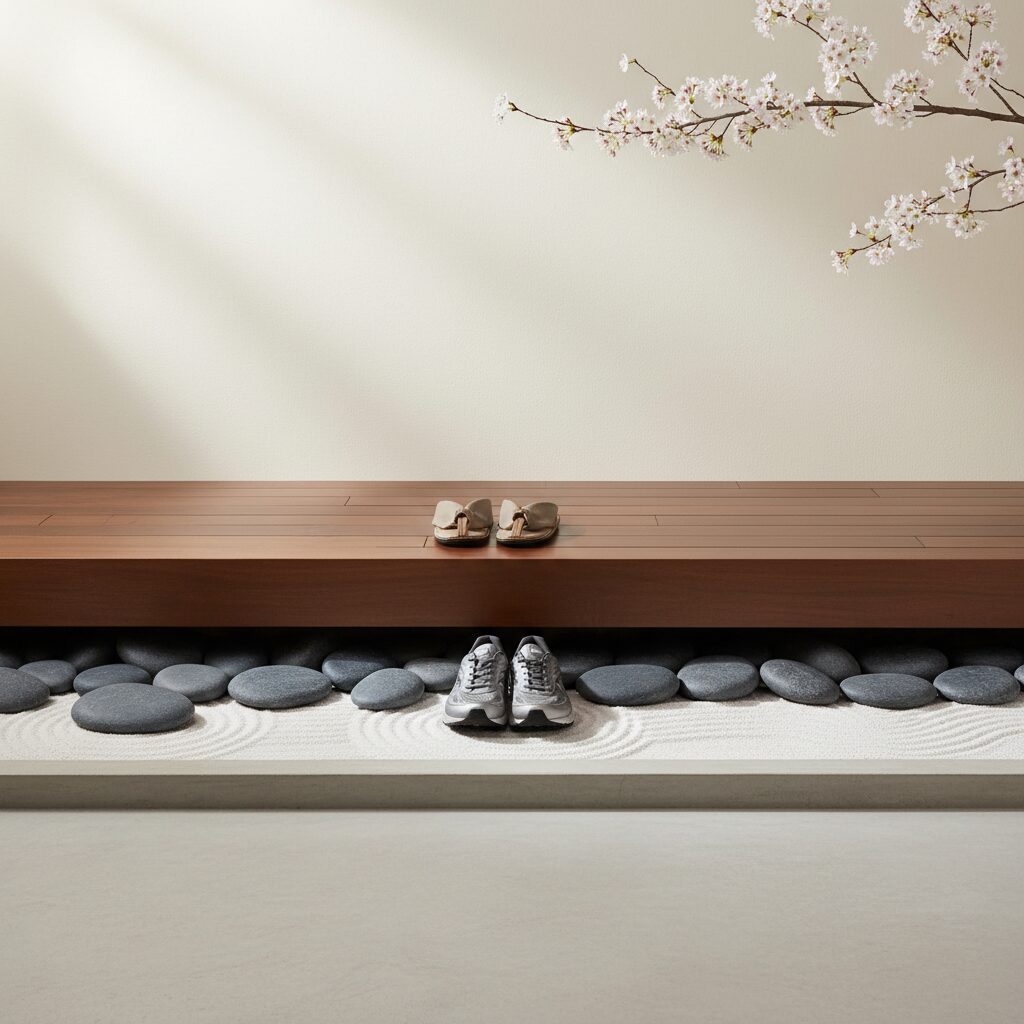
Before I lived in Japan, I never gave much thought to an entryway. It was just the bit of floor inside the front door. It’s where you’d find a crumpled takeaway menu, a stray dog lead, a pair of boots you meant to clean last autumn, and a doormat bearing some vaguely witty slogan that stopped being witty the third time you saw it. An entryway was a functional, forgettable space—a glorified landing pad for keys and mail. A place you passed through without a second thought on your way to the real parts of the house.
Then I came to Japan, and I encountered the genkan. My first time was at a friend’s apartment in a quiet Tokyo suburb. I pushed open the heavy steel door and stopped. I wasn’t in the living room, or even a hallway. I was in a small, distinct, and clearly important space. It was a step down from the rest of the apartment, floored in cool grey tile, and to the side stood a tall, slender wooden cabinet. My friend, seeing my hesitation, smiled, slipped off her own loafers with a practiced grace, and stepped up onto the gleaming wooden floor of the main hallway. She gestured for me to do the same. In that moment, I understood that I wasn’t just taking my shoes off. I was participating in a ritual. I was crossing a border.
The Japanese genkan is not a foyer, a vestibule, or a mudroom. It is an airlock. It is a deliberate, meticulously designed transitional zone that physically and psychologically separates the outer world from the inner sanctum of the home. It’s the first and most fundamental lesson in Japanese spatial logic, and understanding its unspoken rules is the key to grasping the deep cultural distinction between the public self and the private self. This small patch of real estate by the front door is, in many ways, one of the most significant rooms in the entire country.
Beyond its role as a liminal space, the genkan invites us to explore how Japan also transforms communal areas, as seen in the transformative nature of sentō architecture.
The Anatomy of a Threshold
To grasp the genkan’s significance, you first need to understand its physical structure. Unlike a Western entryway, which generally flows seamlessly from the home’s main flooring, the genkan is marked by a distinct and deliberate change in elevation. This architectural detail is central to its function, creating a visible and tangible boundary that governs all behavior within the space.
The Step of Importance: The Agarigamachi
The key feature is the step. The lower section, the area you enter first from outside, is called the tataki (叩き). This part is treated as an extension of the outdoors, even though it lies inside the house. It’s usually surfaced with durable, easy-to-clean materials like tile, stone, or polished concrete. This area serves as the designated spot for shoes, umbrellas still wet from rain, and any items carrying dirt and disorder from outside. Essentially, the tataki acts as a quarantine zone for grime.
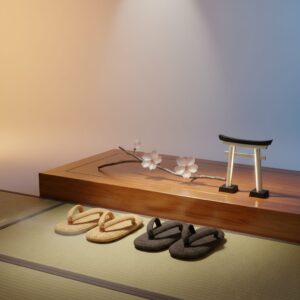
From the tataki, you must step up to access the main living area. This raised threshold, typically wooden, is called the agarigamachi (上がり框). Its height can range from just an inch in a compact modern apartment to a foot or more in older, traditional houses. Regardless of its size, its significance is absolute. The agarigamachi marks the line. It is the sacred boundary. Crossing it means officially entering the home, a private, purified space. The soles of outdoor shoes must never, under any circumstance, touch the floor beyond the agarigamachi. This isn’t a mere suggestion—it’s a fundamental rule of domestic life, as deeply ingrained as locking the door at night.
This straightforward architectural element creates an immediate and unmistakable division. There is no ambiguity about where the outside ends and the inside begins. The physical act of stepping up reinforces the transition subconsciously. You are leaving the soto (outside) and entering the uchi (inside), and your body performs the action that acknowledges this change.
The Gatekeeper: The Getabako
Every genkan, whether large or comically small, includes a designated area for shoes known as the getabako (下駄箱), or shoe box. Traditionally, this cabinet held wooden clogs (geta), which is the origin of its name, but today it stores a family’s collection of sneakers, loafers, work shoes, and sandals. It serves as more than just storage; it enforces the genkan’s primary rule.
The getabako upholds the principle that shoes belong only in the genkan, nowhere else in the home. By providing a designated, enclosed space, it keeps the visual and physical clutter of the outside contained. A well-kept getabako is a quiet badge of pride, reflecting an orderly household. In many homes, the top of the getabako functions as a small altar to domestic life. You’ll often find a vase with a single seasonal flower, a framed family photo, or a small decorative item alongside a dish for keys and personal seals (hanko). It’s both the first thing you see upon entering and the last thing you notice when leaving—a small, curated display of welcome and order.
The presence and prominence of the getabako send a clear message: shoes aren’t merely dirty; they are symbols of the public world. They have no place in the private domain. Their journey ends here, at the threshold, where they are neatly stored until needed again to face the outside world.
The Unspoken Choreography
The physical design of the genkan dictates a precise and elegant sequence of movements. For Japanese people, this routine is instinctive, learned early in childhood, and performed without conscious thought. For outsiders, mastering this choreography is the initial step toward cultural fluency. It’s a subtle dance of arrival and departure, guided by principles of cleanliness, respect, and efficiency.
The Art of Arrival
Entering a Japanese home is not a single, thoughtless act but a series of deliberate steps. First, you open the front door and step onto the tataki. Before doing anything else, you close the door behind you. Leaving the door open is considered rude and insecure, momentarily breaking the barrier between the home and the street. With the door shut, you are now fully within the transitional space of the genkan.
Next comes the crucial movement. You turn to face the door you just entered through. You remove your shoes and place them neatly together on the tataki. Then, in socks or bare feet, you step up sideways or backwards onto the raised floor of the agarigamachi. The key is never to let the soles of your feet—even when wearing socks—touch the “unclean” tataki. Once inside, you crouch down and turn your shoes so their toes point toward the door. This simple gesture holds great significance. It shows that you are thinking ahead to your departure, making it as smooth and effortless as possible. It marks you as a considerate guest, not an intruder who has barged in.
The Guest’s Gambit
For visitors, this ritual takes on even greater importance. When arriving at someone’s home, they will greet you in the genkan. After removing your shoes and stepping onto the clean floor, your host will almost certainly offer you a pair of guest slippers (raikyaku-suripa). These act as an indoor uniform, providing another layer of separation between you and the pristine floors of the home. It is polite to accept and wear them.
An interesting exception occurs with tatami rooms. If you are led from the main hallway into a tatami-matted room, you are expected to remove the slippers before stepping onto the woven straw. Tatami is a delicate, respected material, and one walks on it only in socks or bare feet. This creates an additional layer of transition, another boundary within the home that demands acknowledgment and respect.
The host may say something like, “douzo, sono mama de,” meaning “please, leave your shoes as they are.” This reflects Japanese polite modesty (enryo). A culturally aware guest understands to disregard this and perform the shoe-turning ritual anyway. Leaving your shoes in disarray, pointing into the house, would subtly signal poor manners, implying you don’t intend to depart gracefully.
The Tools of Transition
The genkan often includes several essential items that support this smooth choreography. A long-handled shoehorn (kutsubera) is common, enabling people to put on shoes without sitting down or struggling. An umbrella stand (kasatate) is also vital, providing a place for wet umbrellas to drip on the tataki floor without dampening the rest of the house. In homes with elderly residents, a small, sturdy stool is often placed near the agarigamachi to aid in removing and putting on shoes.
These objects are not mere decorations; they are practical tools that honor the importance of the transition. They exist to make the ritual of crossing the threshold as seamless and dignified as possible for everyone, from small children to grandparents.
A Space Between Worlds: Uchi-Soto
To truly comprehend the genkan, you must look beyond just the architecture and etiquette. It is essential to grasp the foundational cultural concept it represents: uchi-soto (内 Soto). This principle shapes Japanese social relationships and worldview, with the genkan serving as its most powerful physical symbol.
Defining Uchi (Inside) and Soto (Outside)
Uchi signifies the “inside” group—family, close colleagues, and one’s inner circle. It is a realm of intimacy, informality, and trust. In contrast, soto denotes the “outside” world—strangers, other companies, and society at large. Interactions within the soto sphere are more formal, distant, and governed by different social rules. The Japanese language itself shifts depending on whether you are addressing someone from uchi or soto, requiring varying degrees of politeness and humility.
The home represents the ultimate uchi space—a sanctuary and private domain where the family can be themselves, free from the demands of the public world. Thus, the genkan is not simply an entrance but a boundary checkpoint between these two distinct social realms. Standing on the tataki means you remain in soto territory. Salespeople, delivery workers, and postal carriers conduct their transactions from this lower level, never assuming they may cross the agarigamachi unless invited. Being welcomed inside signifies a profound gesture of trust and inclusion, marking your passage from the soto world into the uchi circle.
The Psychology of Purity
The genkan ritual also reflects deep-rooted cultural beliefs about purity and pollution, stemming from Shinto and Buddhist traditions. The outside world, soto, is not only socially distant but also a source of metaphorical and literal impurity (kegare). This concept goes beyond physical dirt or germs to encompass a broader sense of disorder and spiritual contamination. The home, the uchi space, must be preserved as a place of purity and order (kiyome).
Removing shoes is thus a powerful act of purification. It involves shedding the dust, grime, and symbolic burden of the outside world before entering the clean, orderly sanctuary of the home. This rationale explains the strictness of the shoe-removal rule and its extension to many other places in Japan. Students change from outdoor shoes to indoor slippers (uwabaki) at school. Shoes are removed when entering temples, traditional inns (ryokan), certain restaurants, and some medical offices and clinics. Any setting regarded as clean, protected, or intimate demands the removal of outdoor footwear. The genkan at home is simply the first and most intimate expression of this widespread cultural principle.
The Modern Genkan: Adaptation and Endurance
Not every genkan in Japan is a spacious, elegant entryway reminiscent of a classic film. In a country where space is the ultimate luxury, especially in urban areas, the modern genkan has evolved. Yet, remarkably, its essential principles remain unchanged. Though its size may have diminished, its function and symbolism remain as powerful as ever.
The Apartment Genkan: A Tiny Territory
In a typical contemporary apartment, the genkan might measure no more than a square meter. The tataki could be just a small patch of linoleum or tile, and the agarigamachi a barely noticeable lip of wood or metal, perhaps only an inch high. The getabako might be a narrow, tall cabinet that cleverly maximizes vertical space, with shoes stored on diagonal shelves.
Despite its small size, the boundary is absolute. The ritual is still executed with the same care. The physical constraints of the space often make the ritual even more intricate—a well-practiced dance of turning, stepping, and arranging within a confined area. The fact that this boundary is so fervently maintained, even when it occupies such a tiny footprint, highlights its immense cultural significance. It is a non-negotiable feature of domestic architecture, a minimum requirement for a space to be considered a proper Japanese home.
When the Rules Get Bent
Naturally, modern life challenges this ancient system. The genkan can become a site of domestic negotiation. Where should the baby stroller go? It has wheels that have been outside, so it technically belongs on the tataki. But it’s bulky and clogs the limited space. Should it be cleaned and brought inside? Or should it stay just outside the front door, in the shared apartment hallway? Similar debates arise over bicycles, sports equipment, and large deliveries.
The most common and striking cultural misstep a foreigner can make is to enter a home with their shoes on. The reaction this provokes is usually not anger, but a stunned, almost disbelieving silence, followed by a gentle but urgent, “Ah, ah, shoes, please!” It is so fundamentally wrong that many Japanese people are momentarily unsure how to respond. It is comparable to walking into a Western living room and putting muddy feet up on the white sofa. It’s a violation of the most basic house rule.
Beyond the Welcome Mat

The genkan is far more than just a place to leave your shoes. It serves as a cultural classroom, a training ground for understanding the Japanese worldview. It teaches that boundaries deserve respect, that there is a proper way to step between different realms, and that the transition itself deserves attention and care.
It embodies the separation between the public persona one must uphold in society and the relaxed, authentic self within the sanctuary of home. Each time you return, you are not merely passing through a door; you are consciously shedding the outside world, both literally and figuratively, to enter a space of peace and purity. The brief moments spent performing this quiet ritual of arrival act as a buffer, providing a moment for mental and physical realignment.
Once you understand the deep, unspoken logic of the genkan, its presence becomes visible everywhere in Japan. You notice it in the formal openings and closings of business meetings, in the meticulous wrapping of gifts, and in the polite distance maintained during conversations. This is a culture that appreciates the importance of a proper threshold. And it all begins right there, on that small patch of tiled floor, with the simple yet profound act of removing your shoes.