You’ve finally found it. Tucked down a narrow side street, marked only by a steamed-up window and a short, dark blue curtain, or noren, hanging over the door. The moment you duck inside, the world outside vanishes, replaced by a humid, fragrant embrace. The air is thick with the scent of long-simmered pork bone, toasted sesame, and sharp scallions. You hear the rhythmic slosh of noodles being strained, the percussive clatter of spoons against ceramic, and the low hum of conversation punctuated by hearty slurps. This is it—an authentic Japanese ramen-ya. Your senses are overloaded, your stomach is rumbling, and you’re ready for a transcendent bowl of noodles.
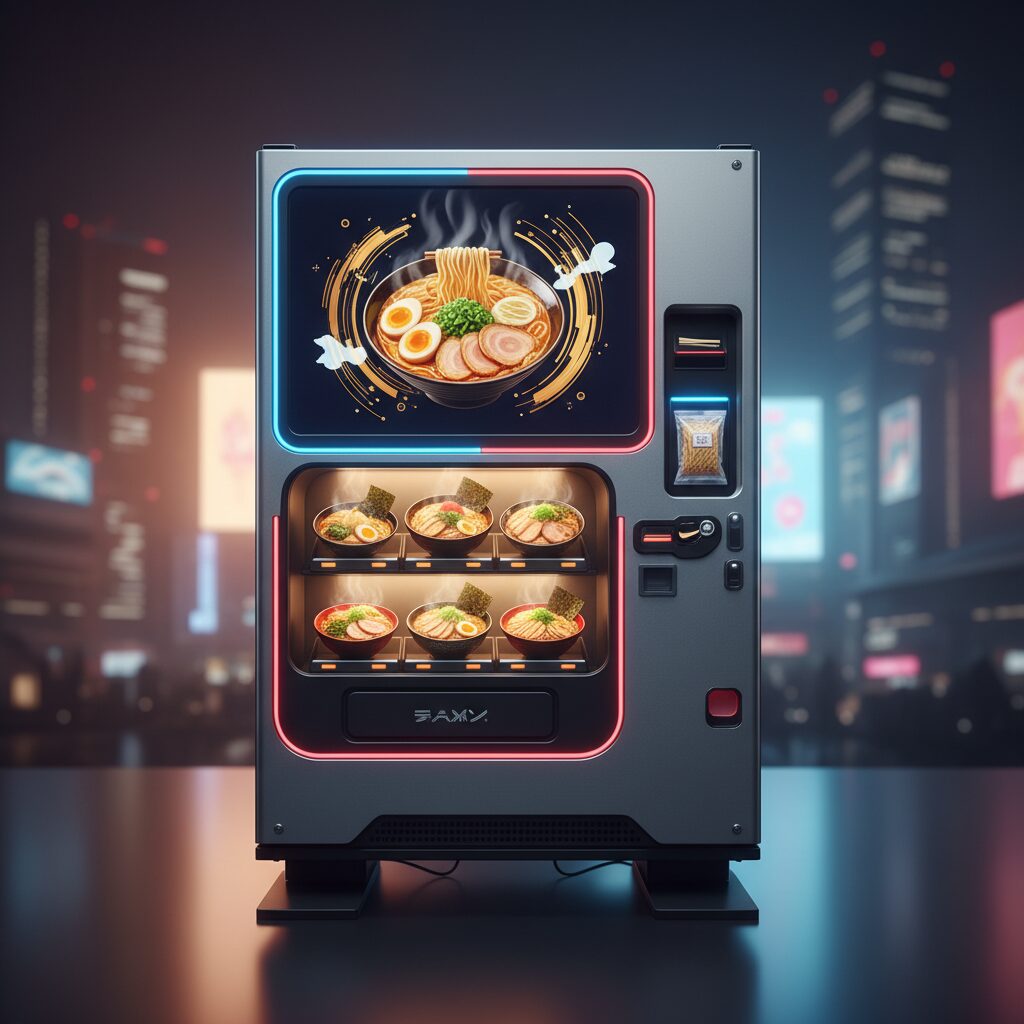
But before you can even find a seat at the worn wooden counter, you’re confronted by an unexpected gatekeeper. It’s not a smiling host or a hurried waiter. It’s a machine. A brightly lit, slightly imposing vending machine covered in a grid of buttons, each adorned with cryptic Japanese characters and a small, often faded, photograph. This is the shokkenki (食券機), or more commonly, the shokken machine—the ticket vendor.
For the uninitiated, it can feel like the first boss in a video game you weren’t prepared for. You stand there, a little bewildered, trying to decipher the options while a queue of seasoned locals forms patiently behind you. It feels… impersonal. Cold, even. In a world that increasingly prizes artisanal, hands-on experiences, why would a craft-focused establishment put a soulless automaton between you and the master chef just a few feet away? Is this just about cutting labor costs? Is it some quirky obsession with automation?
The answer, like so many things in Japan, is far more nuanced and deeply considered. That machine is not a barrier; it’s a meticulously designed instrument. It’s not there to replace human interaction but to purify it. It is the silent conductor of the ramen shop symphony, a tool engineered to orchestrate a perfectly efficient, focused, and uniquely Japanese dining ritual. To understand the shokken machine is to understand the very philosophy that elevates a simple bowl of noodle soup into an art form.
For those curious about the ritual preceding a meal, discovering the essence of itadakimasu can further illuminate how every element of Japanese dining is intertwined with tradition.
The Transactional Firewall: Money, Purity, and Focus
At its core, the shokken machine functions as a firewall, deliberately and clearly separating the realms of commerce and craft. This division is both practical and deeply philosophical, reflecting fundamental Japanese values of cleanliness, efficiency, and respect for the artisan.
A Matter of Clean Hands
First, consider the practical reality of a ramen kitchen. It’s a hot, steamy, and often greasy environment. The chef, the taisho, moves with constant energy. One moment, their hands are plunging a wire basket of fresh noodles into boiling water; the next, they are carefully arranging slices of rich chashu pork, handling oily bamboo shoots, and ladling thick, simmering broth. The last thing those hands should come into contact with is money. Currency is notoriously dirty, having passed through many hands and carrying countless germs. In a culture that highly values cleanliness and hygiene, it’s unthinkable for a chef to handle cash and then immediately return to preparing food. The shokken machine elegantly addresses this issue. Customers handle the money—they insert bills and coins, press buttons, and receive a small paper ticket. This ticket is the only item that bridges the customer’s world and the chef’s. It’s a clean, simple, and hygienic means of transferring information, ensuring that the hands crafting your meal remain pure and wholly devoted to that task.
The Psychology of Pre-Payment
Beyond hygiene, the machine fundamentally changes the psychology of dining. By requiring payment upfront, it settles the entire financial transaction before the meal begins. Think about a typical restaurant experience elsewhere: you eat and enjoy your meal, then come the slightly awkward steps of flagging down a server, waiting for the bill, checking it, and fumbling with cash or a card. The final moments of the meal are occupied by logistics and commerce. The shokken machine eliminates all that. Once you hand over your ticket, the transaction is complete. There’s no waiting for a bill or making payment afterward. The meal is freed from its monetary aspect. This pre-payment liberates both customer and staff. The chef can focus completely on cooking, and you can focus entirely on eating. It transforms the experience from a commercial exchange into a pure act of consumption and enjoyment. You are there simply to savor the best ramen the chef can create. Period.
Eliminating “Choice Paralysis” at the Counter
Moreover, the machine streamlines ordering by requiring a choice before you occupy valuable counter space. In a tiny, ten-seat ramen-ya, every second and inch of space matters. The shokken system prevents customers from sitting down and spending five minutes studying the menu, asking questions, and delaying the service flow. The decision is made while standing, often while waiting in line. You examine the buttons, make your selection, and by the time you sit, you are ready. You present your ticket, and the well-oiled kitchen springs into action. This may seem a small detail, but in a country that prizes efficiency and smooth, harmonious flow (nagare), it represents critical social engineering. It respects the time of both the chef and other patrons, ensuring the rapid turnover these small shops rely on to survive.
The Orchestra of Efficiency: How the Shokken Conducts the Kitchen
If the machine serves as a firewall, it is also like a conductor’s baton, guiding the intricate orchestra of a bustling ramen kitchen. The simple paper ticket it issues is a potent tool for communication and workflow management, ensuring speed, accuracy, and a seamless journey from order to bowl.
The Universal Language of Tickets
Picture a crowded ramen shop during the lunch rush: the hiss of burners, the bubbling broth, the murmur of customers—it’s a noisy and hectic scene. In such an environment, verbal orders are risky. Was that “extra noodles” or “extra nori”? Did the customer want spicy miso or regular miso? Mishearing an order results in wasted ingredients, unhappy customers, and a disrupted kitchen rhythm. The ticket removes all uncertainty. It is a clear, concise, and tangible instruction. The chef glances at the ticket and immediately understands: Tonkotsu ramen, firm noodles (katame), with an extra seasoned egg (ajitama). There is no margin for error. In shops with multiple staff members, the ticket system becomes even more essential. One person can take the ticket and start the noodle timer while the chef readies the broth and toppings. It’s a standardized, non-verbal language that everyone in the kitchen comprehends perfectly, enabling a level of coordination impossible with spoken orders alone.
Sequencing the Noodle Dance
The physical tickets themselves become vital to the workflow. As customers hand them over, the chef arranges them on the counter in the order received. This forms a visual queue—a tangible timeline of the upcoming work. The chef can see at a glance: “I have three shio ramen, then a tsukemen, then a shoyu with extra pork.” This allows efficient batching of tasks. If several orders for the same ramen arrive, they can prepare their base simultaneously. They can coordinate the exact timing needed for each unique dish. Tsukemen (dipping noodles) requires a different preparation and serving style than standard soup ramen. The lineup of tickets on the counter is the chef’s sheet music, enabling them to orchestrate the complex dance of noodle boiling, broth ladling, and topping placement with precision and finesse.
Managing the Human Flow
The shokken system also extends its organizational prowess to customers. It functions as a gatekeeper and pacing mechanism. In popular shops, a line often forms outside the door. The protocol is to wait until you’re near the front, then enter, purchase your ticket from the machine, and return to your spot in line. This small step achieves several goals. First, it confirms your commitment—you’re no longer just browsing; you’ve bought your meal and become a confirmed patron. Second, it provides staff with an exact count of pending orders. They know precisely how many bowls to prepare and can manage ingredient stock accordingly. Finally, it ensures a smooth transition from waiting outside to sitting inside. When a seat opens, the next person in line with a ticket simply walks in, sits down, and hands it over. The process has already begun—no delay, no fuss. It’s a system designed to move people through with maximum efficiency and minimal friction.
A Social Contract Written on a Paper Slip
The influence of the shokken machine goes beyond simply improving efficiency and enters the realm of social dynamics. It creates a clear, unspoken social contract among the customer, the chef, and the other patrons, fostering an environment that is both uniquely focused and egalitarian.
The Democratization of the Counter
In a shokken-based ramen shop, everyone is treated equally. There is no preferential treatment for regulars, nor any benefit to being louder or more demanding. Your place in line is determined solely by when you purchased your ticket, and your order is fulfilled according to when you hand it to the chef. The machine acts as an impartial arbitrator, indifferent to whether you are a tourist or a local, a salaryman or a student. This system creates a notably democratic and level playing field. The emphasis is entirely on the ramen, not on social status or connections. Everyone arrives for the same reason and follows the same process, fostering a shared sense of purpose and quiet respect within the intimate space.
Permission to Focus: The Solo Diner’s Sanctuary
This is perhaps one of the shokken machine’s most remarkable social functions. For many in Japan, ramen is a deeply personal and often solitary experience—a quick, satisfying meal grabbed alone at lunch or on the way home from work. The machine is a gift to the solo diner (ohitorisama). It eliminates the need for potentially awkward social interactions: no small talk with a cashier or explanations to a server. The entire process requires minimal verbal communication. You interact with the machine, hand over a ticket, then are free to retreat into your own world. You can watch the chef’s mesmerizing movements, focus solely on the flavors and textures of your bowl, or simply zone out after a long day. The machine offers permission to be alone, silent, and fully absorbed in the sensory experience of the meal, creating a sanctuary where the only relationship that matters is between you and your bowl of ramen.
Setting Expectations: You Get What You Paid For
The ticket is more than just an order; it serves as a binding contract. It signifies a clear and final agreement. The buttons on the machine explicitly indicate what you are purchasing: Ramen, 900 yen. Extra Pork, 200 yen. There are no hidden fees, no service charges, and no confusion about the final bill. This clarity and transparency are reassuring, eliminating any potential transactional anxiety. You know exactly what you’re getting and what it costs. In return, the expectation is that you will eat your meal with focus and vacate your seat within a reasonable time for the next person waiting. This simple, elegant contract underpins the entire experience, ensuring fairness and predictability for everyone involved.
The Evolution of a Simple Idea
While the shokken machine seems like a timeless fixture in the ramen world, it is actually a product of a distinct historical period and has continually evolved. Its roots trace back to Japan’s post-war push for efficiency and automation, and its contemporary versions mirror the shifting tastes and technologies of the 21st century.
From Post-War Necessity to Modern Customization
Ticket vending machines initially appeared in Japan not in restaurants but at train stations during the 1920s. However, their widespread use in eateries emerged after the war. As Japan rebuilt and modernized rapidly, there was a nationwide focus on efficiency, labor-saving technology, and automation. Vending machines for drinks, cigarettes, and snacks became ubiquitous. Small, family-run restaurants, including ramen shops, recognized their potential. A shokken machine could replace a dedicated cashier, freeing a family member to assist in the kitchen. It was a practical solution born from the desire to streamline operations and boost output in a rapidly growing economy. What started as a necessity soon became a perfect philosophical match for the fast-paced, high-turnover world of ramen.
The Modern Shokken: Touch Screens and Infinite Choice
Today, the bulky, analog machines of the past are often replaced by sleek, digital touch-screen interfaces. These modern shokkenki offer a higher level of sophistication. They display high-resolution photos of every dish, making them much more accessible for tourists and locals alike. Many provide multiple language options, completely breaking down communication barriers. Most importantly, they enable an incredible range of customization. The simple ticket has transformed into a detailed spec sheet for your ideal bowl. You can specify the firmness of your noodles—katame (firm), futsuu (normal), or yawarakame (soft). You can select the broth’s richness—kotteri (rich) or assari (light). You can control the amount of garlic, green onion, or spicy paste. The machine records your precise preferences and transmits them flawlessly to the kitchen, ensuring a bespoke bowl of ramen made exactly to your liking.
Is Something Lost? The Human Touch vs. The Perfect System
Naturally, one might argue that this relentless drive for efficiency comes at a cost. Does the machine diminish the dining experience’s human warmth? Is something precious lost when you interact with a screen instead of a person? It’s a legitimate question. For those who value friendly service and a personal connection with restaurant staff, the shokken system might feel impersonal. But that misses the point. The system isn’t designed to eliminate the human touch; it’s meant to redirect it. The warmth and humanity aren’t found in the transaction but in the craft. By automating the routine, the machine allows the chef to devote all their energy, skill, and soul (kokoro) to the bowl. The human touch remains—in the perfectly balanced broth simmered for twelve hours, the meticulously sliced scallions, and the gentle placement of the egg atop the noodles. The shokken machine safeguards the chef’s focus, and in doing so, it elevates their artistry.
Reading the Machine: What the Buttons Tell You About the Shop
For newcomers, the grid of buttons can seem intimidating, but it follows its own logic and grammar. Learning to interpret the machine is the first step toward becoming a true ramen connoisseur. The arrangement of the buttons is intentional; it reflects the chef’s priorities and pride.
The Prime Real Estate: Top-Left is Best
Throughout Japan, there is a widespread convention in the layout of shokken machines. The most important button, usually for the shop’s signature dish, is almost always positioned in the top-left corner. This represents the ramen they are most proud of, the bowl that defines their identity. It’s their ichiban osusume (number one recommendation). If you’re ever unsure what to order, pressing the top-left button is your safest and often most rewarding choice. This simple guideline will lead you to the heart and soul of any ramen-ya.
Decoding the Rows and Columns
Typically, the main ramen dishes are arranged in the top rows. The first row might feature the shop’s primary style (e.g., Tonkotsu), with variations such as extra toppings (additional chashu, egg, seaweed) on the same row or the one just beneath. Different broth types, like Miso or Shio, are often placed on their own rows. Below the main dishes, side orders like gyoza, fried rice, or plain white rice usually appear. The bottom rows tend to be reserved for drinks—beer, highballs, and soft drinks. Understanding this general hierarchy allows you to navigate the machine with greater confidence, even if you can’t read a single Japanese character.
The Sold-Out Sticker and the Handwritten Special
Finally, pay attention to the small details on the machine’s surface. A small red light or a paper sticker bearing the characters 売り切れ (urikire) indicates the item is sold out. This often signifies quality—the chef prepares a limited amount each day, and when it’s gone, it’s gone. Conversely, you might spot a handwritten sign taped to the machine announcing a seasonal special (kisetsu gentei) not listed on the regular menu. These often represent the most interesting and creative dishes offered by the chef. Such subtle analog cues remind us that behind the automated interface lies a dynamic, living kitchen responding to seasonal changes and daily ingredient availability.
So the next time you enter a ramen shop and are confronted with that wall of buttons, don’t see it as a barrier. See it for what it truly is: a gateway. It is the first step in a carefully choreographed ritual designed to eliminate every distraction, inefficiency, and impurity, leaving only what matters most. It’s the silent conductor ensuring the entire experience—from the moment you arrive to your final, satisfying slurp—is executed with flawless precision. It enables the chef to be a true artisan and lets you be a pure participant in their craft. The shokken machine is not the opposite of a great food experience; in the world of Japanese ramen, it is the secret ingredient that makes it possible.