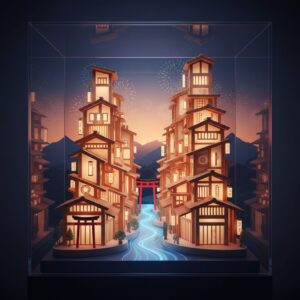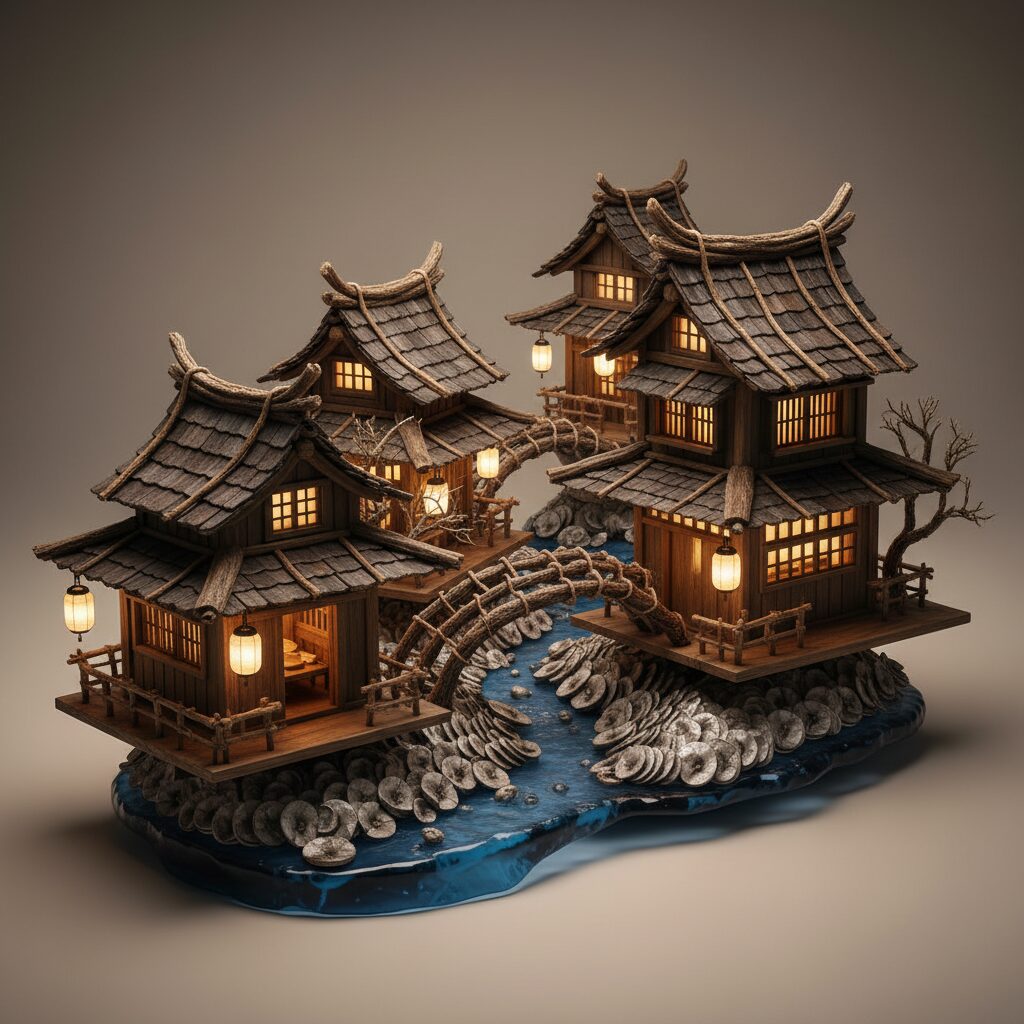
Walk through the historic districts of Kyoto, like Gion or Nishijin, and you’ll notice a curious architectural pattern. The street is lined with homes and shops whose facades are remarkably narrow, some barely wider than a large car. They present a modest, almost secretive face to the world, with dark timber lattices and deep eaves. You might peek through a cloth curtain, or noren, and see a small shop interior, but the true scale of the building remains a mystery. It feels like you’re only seeing the first few pages of a very long book.
These structures are known colloquially as unagi no nedoko, or “eel’s beds.” The name is brilliantly descriptive. Just like an eel, these townhouses, called machiya, are long, thin, and burrow deep into the city block. It’s a design that seems, at first glance, to be an inefficient use of land, a response to overcrowding. But the truth is far more clever and speaks volumes about the intersection of commerce, culture, and governance in feudal Japan. This unique architectural footprint wasn’t born from a simple lack of space; it was a brilliant and pragmatic piece of design jujutsu, a direct response to a centuries-old tax law that inadvertently shaped the very look and feel of Japan’s ancient capital.
This intricate urban design, with its hidden courts and narrow facades, subtly mirrors the notion of borrowed scenery, where external views seamlessly enhance the architectural narrative.
The Logic of the Layout: A Tax on Appearance
To understand the eel’s bed, you need to look back to the Edo period (1603-1868), an era of relative peace and flourishing commerce under the Tokugawa shogunate. As cities like Kyoto grew with merchants, artisans, and samurai, the government required a reliable method to evaluate property taxes. Rather than taxing based on total area—a complex and intrusive task—they came up with a simpler, more elegant approach: the maguchi-zei, or frontage tax.
The reasoning was simple: the wider your property’s frontage (maguchi) on the main street, the higher your tax. The street-facing width was viewed as an indicator of commercial potential and social standing. A broad storefront implied a thriving business, better customer access, and thus, a richer source for tax revenue. The system was straightforward to measure and enforce—an official could just walk down the street with a measuring rope.
This single policy triggered a lasting impact on urban planning. For the astute merchant class, the chonin, the strategy became clear: reduce your taxable frontage without compromising the space needed for your business and home. Since taxes were based on width, they simply built deeper rather than wider. This led to the distinctive unagi no nedoko layout, with lots sometimes only five or six meters wide but stretching fifty meters or more back from the street. It was a perfectly legal and clever workaround—a quiet, architectural form of resistance to the tax collector’s reach.
A Journey Through an Eel’s Bed
The resulting interior space exemplifies efficiency, progressing linearly from public to private areas, unfolding room by room. Walking through a traditional machiya is like traveling through the life of the family that lived there, where work, family, and nature were seamlessly integrated into one continuous space.
The Public Face: The Mise-no-ma
The journey begins at the front of the house in the mise-no-ma, or shop space. This area, accessible directly from the street, was often a simple earthen floor (doma) serving as a workshop or retail storefront. Here, a weaver might set up his loom, a kimono maker display her fabrics, or a sake merchant arrange his barrels. The front of the house typically featured koshi, wooden lattice screens that offered privacy while allowing light and air to pass through, enabling the occupants to view the street without being fully exposed. This room represented the family’s public face, a commercial zone where the outside world was welcomed—but only to a certain extent.
The Inner Sanctum: Living and Working Spaces
Moving further inside past the shop, you step up from the earthen floor into the raised, tatami-matted living quarters. This transition marks a clear boundary, leaving the commercial world behind and entering the home. Unlike Western houses, traditional machiya often have no dedicated hallways. Instead, rooms flow into one another, divided by painted sliding screens (fusuma) or paper shoji screens. This layout allows flexible use of space; rooms can be combined for large gatherings or separated for privacy. Typically, there is a central living area (ima) and smaller rooms for sleeping or tea. This fluid design was crucial for maximizing the narrow floor plan, ensuring no space was wasted on mere passage.
The Breath of Life: The Tsuboniwa
Perhaps the most enchanting and vital feature of the unagi no nedoko is the tsuboniwa, a small, enclosed courtyard garden. In a long, narrow house pressed tightly between neighbors, light and ventilation would otherwise be nearly impossible to achieve in the center of the structure. The tsuboniwa serves as the lungs and heart of the house. These are not expansive gardens but carefully crafted miniature landscapes, often featuring a stone lantern, a water basin (tsukubai), some moss, and a single maple or bamboo plant. They provide windows to nature, capturing the changing seasons, the sound of rain, and the interplay of light and shadow. The tsuboniwa offers a vital connection to the natural world, a serene focus that brings beauty and calm deep inside the urban home. Often, a machiya includes more than one of these courtyards, creating pockets of light and air throughout its considerable length.
The Back of the House: The Okunoma and the Kura
At the very back of the property, farthest from the street’s noise and activity, are the most private spaces. This includes the okunoma, or “deep room,” used for entertaining honored guests or important family ceremonies. It is the inner sanctum. Nearby, often detached from the main house, stands the kura, the family storehouse. In an era when wooden and paper cities were vulnerable to fire, the kura functioned as the family’s fireproof safe. Constructed with thick, plaster-coated earthen walls, a heavy door, and small shuttered windows, it protected the family’s most valuable possessions: kimonos, merchant records, heirlooms, and inventory. Its presence symbolized stability and wealth, a fortress guarding the family’s legacy.
More Than a Tax Dodge: A Social Blueprint
The unagi no nedoko represents more than just a clever architectural design; it is a tangible expression of the social structure of its era. The layout skillfully captures essential principles of Japanese culture, transforming economic limitations into an elegant spatial language.
The Blurring of Home and Business
The machiya was far more than a mere residence. It functioned as a fully integrated environment for living and working. The smooth transition from the mise-no-ma at the front to the living quarters behind mirrors the reality for merchant and artisan families, where work was not a separate destination but the heart of everyday domestic life. Children were raised surrounded by the sights and sounds of the family trade, acquiring skills passed down through generations. The architecture itself reinforced and facilitated this continuity.
Uchi-Soto in Three Dimensions
The design of an eel’s bed house serves as a perfect three-dimensional representation of the Japanese cultural concept of uchi-soto, which distinguishes the “inside” (one’s own group, family, or home) from the “outside.” The street is the ultimate soto (outside). The mise-no-ma acts as a liminal space, a semi-public zone where soto guests are welcomed. Being invited beyond the shop and onto the tatami floors signifies temporary acceptance into the family’s uchi (inside) sphere. The further one moves back—beyond the living areas, past the tsuboniwa, towards the okunoma—the deeper one enters the uchi realm. The architecture physically upholds these social boundaries, guiding visitors and family members through a carefully orchestrated social space.
The Eel’s Bed in Modern Kyoto
Today, these beautiful machiya face numerous challenges. They are notoriously cold in winter and can be difficult to equip with modern plumbing and electricity. Their intricate wooden structures demand skilled—and costly—craftsmanship to maintain. Inheritance taxes also make it hard for families to keep these properties, leading many to be demolished and replaced with modern apartment buildings or parking lots.
However, a strong preservation movement has gained steam. Many Kyotans and newcomers alike recognize the tremendous cultural and aesthetic value of these buildings. An increasing number of machiya are being carefully restored and repurposed, finding new life in the 21st century. They have become atmospheric cafes, exclusive restaurants, boutique hotels, and art galleries. This thoughtful adaptation allows the unique spatial qualities to be appreciated by a new generation. Staying in a renovated machiya hotel or dining in a restaurant where tables overlook a serene tsuboniwa offers a tangible connection to the city’s history that no museum can replicate.
The unagi no nedoko stands as a testament to human ingenuity. Originating from a desire to outsmart the taxman, it evolved into a sophisticated and beautiful architectural form that perfectly balanced the needs of commerce, community, and family life. So the next time you find yourself on a historic Kyoto street, admiring the narrow wooden facades, remember that you are only seeing the beginning of the story. The real magic lies hidden from view, in the long, deep, and elegant world of the eel’s bed.