Step into any Japanese home, and the first thing you’ll notice isn’t the decor, the lighting, or the scent of whatever’s for dinner. It’s the drop. There’s a distinct, deliberate change in elevation right inside the front door. You open the door, step into a small, sunken area, and are faced with a single, polished step up into the main living space. This is the genkan, and it’s not just an architectural quirk or a quaint place to kick off your shoes. It is the most important space in a Japanese home. Think of it less as a foyer and more as a domestic airlock, a meticulously designed transitional zone separating the outer world from the inner sanctuary. In the West, the front door is often the only barrier. You open it, and you’re in. Here, the front door is merely the first checkpoint. The true boundary, the one that matters culturally, psychologically, and hygienically, is the genkan. It is a non-negotiable feature, found in sprawling traditional farmhouses, sleek urban condos, and cramped one-room apartments alike. Understanding this small, sunken space is the first step to understanding the Japanese conception of home, privacy, and purity.
The thoughtful transition of the genkan echoes the philosophy behind shakkei, where Japanese gardens ingeniously borrow distant vistas to create endless beauty.
The Anatomy of a Threshold
At first glance, a genkan appears quite simple. It’s an entryway. However, its design is remarkably precise, serving as a masterclass in how space can guide behavior. Each element has a specific name and an essential function, establishing a clear physical and symbolic structure for entering and leaving a private space. Learning this structure is one of the first lessons any visitor must absorb.
The Doma and the Agarikamachi
The genkan is divided into two distinct areas. The lower, sunken section you step into initially is called the doma (土間). The term literally means “dirt floor,” a nod to old farmhouses where this area was packed earth and acted as a semi-outdoor workshop or kitchen space. Nowadays, the doma is usually finished with durable, easy-to-clean materials such as tile, stone, or polished concrete. It functions as the designated “outside” zone, even though it’s indoors. Shoes, umbrellas, strollers, and all the literal and figurative dirt of the outside world are allowed to rest here. You might accept a delivery or briefly talk with a neighbor standing in your doma, but at that point, you haven’t truly welcomed them into your home.
The boundary between the doma and the rest of the house is a single, neat step up called the agarikamachi (上がり框). This raised edge, usually crafted from polished wood, marks the Rubicon. Crossing it signifies entering the home proper. This step is sacred. Its primary rule is absolute and non-negotiable: outdoor shoes must never, ever touch the agarikamachi. Doing so would be the architectural equivalent of placing muddy boots on the dining table. It’s a fundamental breach of etiquette that feels profoundly wrong to a Japanese person. You remove your shoes in the lower doma, then step up onto the agarikamachi wearing socks or bare feet, leaving the outside world—and its contaminants—behind.
The Getabako and Its Purpose
To one side of this area, you will always find a getabako (下駄箱), or shoe cabinet. The name derives from geta, the traditional wooden clogs, and hako, meaning box. This is not merely a piece of storage furniture; it’s an essential component of the genkan system. A disorganized pile of shoes near the door is seen as unattractive and disrespectful. The getabako provides an orderly home for the footwear of residents and often includes a lower shelf for guests’ shoes. Its presence reinforces the notion that shoes belong in this specific transitional zone and nowhere else. The top of the getabako commonly serves as a small domestic altar, a place to display a seasonal flower arrangement (ikebana), a piece of art, or keys and the family hanko (personal seal) for signing for packages. It functions as both the home’s welcome and command center.
More Than Mud: The Cultural Significance
The meticulous design of the genkan serves more than just the practical purpose of keeping floors clean, although that is certainly an important advantage. Its deeper function is to act as a physical stage for one of the most essential concepts in Japanese culture: uchi-soto (内 Soto), the distinction between inside and outside. This goes beyond mere physical location; it is a social and psychological framework that influences everything from language to behavior.
Uchi-Soto: The Inside/Outside Mentality Made Tangible
Soto (外) signifies the outside world: the realm of the public, strangers, your workplace, and formal social duties. In the soto world, interactions tend to be more reserved, the language used is more polite and formal (keigo), and one adopts a more guarded, outward-facing demeanor. The doma of the genkan acts as the last frontier of this soto world.
Uchi (内) refers to the inside world, the domain of family, home, and close trusted relationships. Here, behavior is casual, language is informal, and one can be their authentic, unguarded self. The uchi world is a haven, a place of safety, comfort, and purity. The moment you step onto the agarikamachi with your stockinged foot, you have crossed from soto to uchi. You are home.
This transition is so meaningful that it is marked by ritual phrases. When a family member returns, they proclaim “Tadaima!” (“I’m home!”), and those inside reply with “Okaeri!” (“Welcome back!”). When you enter someone else’s home as a guest, you announce yourself with “Ojama shimasu,” which literally means “I am going to be a nuisance/I will intrude.” This humble expression acknowledges that you are crossing a sacred boundary and entering someone else’s private uchi space. The genkan is the stage where this essential daily social ritual takes place.
Ritual and Respect
The process of entering a Japanese home is a delicate dance of respect. It’s not simply a matter of kicking off your shoes and leaving them scattered. Proper etiquette requires you to turn to face the door you came through, crouch down, and remove your shoes. Then, place them neatly together on the doma, with toes pointing outwards toward the door, ready for your eventual departure. This demonstrates thoughtfulness and consideration—a silent message that says, “I will not be a burden and I am preparing for a smooth exit.”
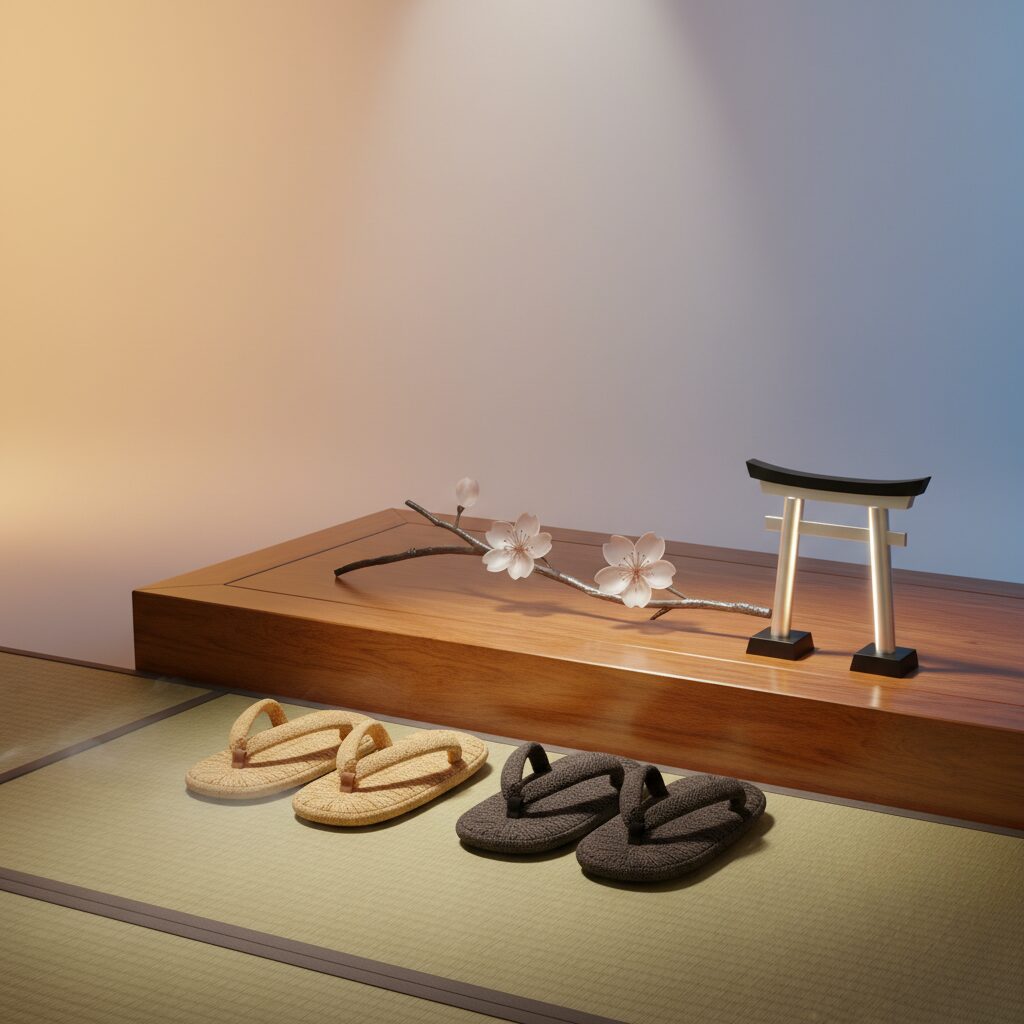
Often, your host will offer you a pair of slippers (surippa). It is polite to accept and wear them. This completes the transition, substituting your outdoor footwear for indoor shoes. In some more traditional homes, you might even find a separate pair of slippers designated exclusively for use inside the restroom. This further highlights the intense attention to separating spaces and maintaining cleanliness. The slippers worn throughout the house must not come into contact with the restroom area, which is associated with waste. The genkan is the starting point for this entire system of spatial awareness.
The Practicality Behind the Purity
While the uchi-soto concept forms the deep cultural foundation for the genkan, its origins also stem from simple historical practicality. Japan experiences four distinct seasons, including a rainy season (tsuyu) and snowy winters in many areas. For centuries, roads were unpaved, and removing shoes was a highly practical way to keep mud, water, and dust from being tracked inside the home.
A Legacy of Cleanliness
This practical necessity was heightened by the traditional Japanese lifestyle, which is lived much closer to the floor. People sat on cushions (zabuton) placed on tatami mats to eat and socialize, and slept on futons spread directly on the tatami. The floor was more than just a surface to walk on; it was a space for daily life. Keeping it impeccably clean was not only an aesthetic choice but a matter of hygiene and comfort. The genkan served as an essential buffer, ensuring the living area stayed spotless. This cultural practice has remained steadfast even as lifestyles have modernized and floors are now mainly hardwood or carpeted. The principle remains consistent: the floor is an extension of the living space and must be kept clean.
The Modern Genkan: Adapting to New Lifestyles
The design of the genkan has evolved to fit modern Japanese living, though its purpose has not changed. In a small Tokyo apartment where space is extremely limited, the genkan may not be a separate area but simply a small section with a different flooring material—such as tile instead of wood—and a slight, one-inch drop. Yet that drop remains, and the boundary is still honored. The space may be compact, but its significance is powerful.
Today’s genkan has also become a logistical center for urban life. It’s where umbrella stands are neatly arranged, keys hang from hooks, and often a small shelf holds the family seal used to receive packages. Delivery drivers in Japan seldom enter the home; the exchange—passing the package and obtaining a signature or seal—takes place entirely in the doma. The delivery person stays in the soto space, while the resident accepts the package from their uchi area, standing on the raised agarikamachi. This everyday interaction perfectly embodies the genkan‘s role as both a social and physical boundary.
Navigating the Genkan as a Visitor

For any foreigner visiting or living in Japan, mastering genkan etiquette is Lesson Number One in showing cultural respect. It’s a simple set of actions, but executing them correctly reveals a level of awareness that your hosts will deeply appreciate. On the other hand, getting them wrong can result in a significant, though unspoken, social faux pas.
Unspoken Rules for Guests
First and foremost, remember the golden rule: never step on the raised floor of the agarikamachi wearing your outdoor shoes. The easiest way to ensure this is to step into the doma, close the door behind you, and then, while standing on the lower level, turn to face away from the interior of the house. If needed, sit on the edge of the agarikamachi, remove your shoes, and place them to the side on the doma. Next, swing your legs around and stand up into the main house without letting your stockinged feet touch the lower, “unclean” doma.
Once your shoes are off, arrange them neatly with the toes pointing toward the door. Your host may politely turn your shoes for you as a gesture of hospitality, but it’s best to do it yourself. This small detail conveys immense respect. If slippers are offered, make sure to use them. When leaving, reverse the process: slip your feet into your shoes on the doma without letting your socks or slippers touch the lower floor.
What Your Host is Thinking
A Japanese host will likely never correct a foreigner who makes a mistake in the genkan, as they tend to be very polite about such matters. However, they will notice. A guest who confidently walks onto the agarikamachi with their shoes on is unintentionally signaling a profound disregard for the sanctity of the home. This cultural oversight can immediately create an invisible barrier.
In contrast, a guest who performs the genkan ritual thoughtfully and correctly sends a powerful message. It says, “I recognize and respect the boundary you have established. I understand the distinction between the public world and your private sanctuary, and I am honored to be welcomed inside.” Even before uttering more than a simple greeting, you demonstrate cultural fluency and deep respect. In Japan, this small, sunken space by the door is where you make your genuine first impression.