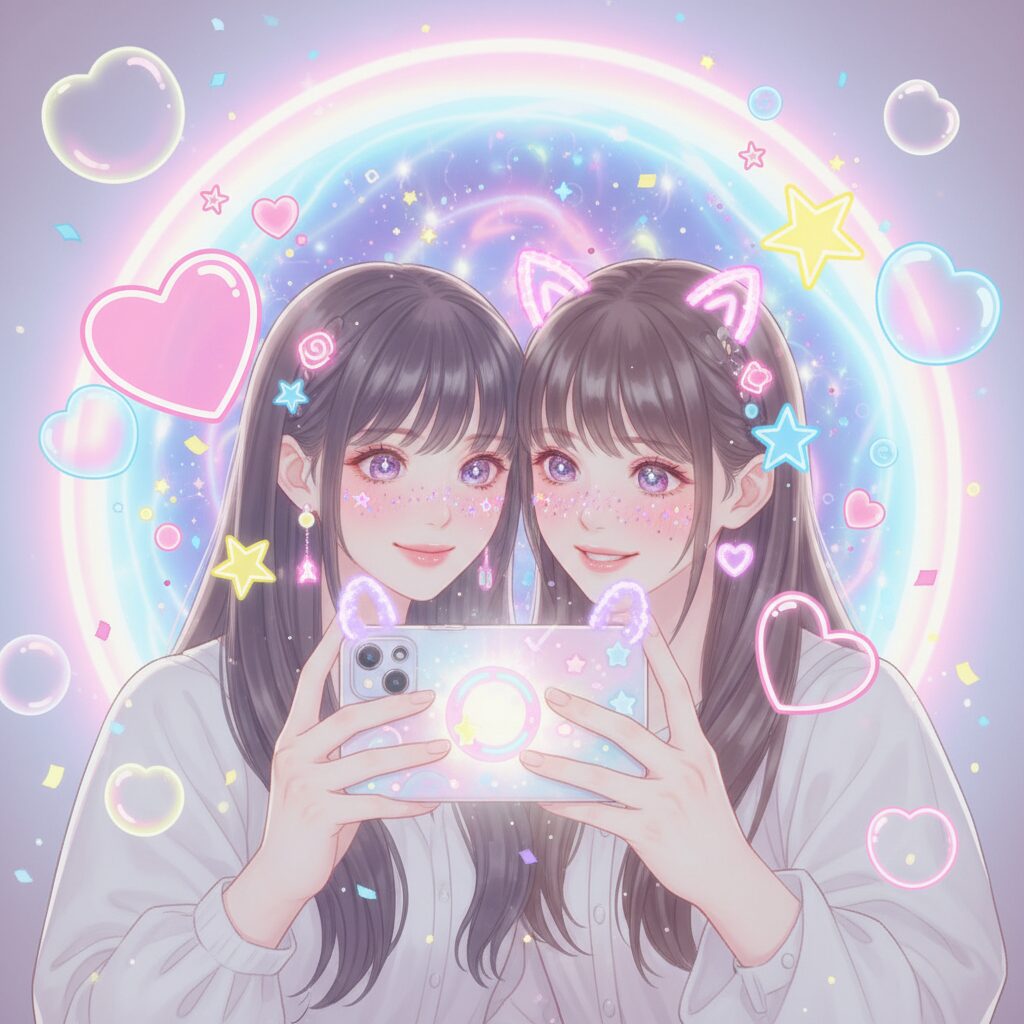
If you want to understand the modern, digitally-filtered face—the one staring back at you from a million Instagram stories and TikTok feeds, with its impossibly large eyes, flawless skin, and subtly reshaped jawline—you don’t start in Silicon Valley. You start in a noisy Japanese arcade, sometime around 1995. You start with a little sticker, a shared memory, and a phenomenon called Purikura.
To the uninitiated, Purikura might look like a simple photo booth. A relic, even. But to dismiss it as such is to miss the point entirely. It’s like calling a multi-course kaiseki dinner just “a meal.” Purikura was never just about taking a picture. It was a cultural engine, a social ritual, and a technological laboratory for identity curation. For millions of young Japanese women, it was the original platform for crafting and broadcasting an idealized self. It was the analog ancestor of every filter, every face-tuning app, and every carefully constructed selfie that defines our visual world today. Before we had Valencia and Clarendon, we had “Soft Smoky” and “Sparkle Eye” modes, chosen not with a tap of a finger, but by selecting a multi-ton machine that promised a specific version of beautiful.
This wasn’t about capturing reality. It was about manufacturing a better one. A cuter one. A more perfect one. It was a game, a performance, and a tangible piece of social currency all rolled into one. To understand the logic of Purikura is to understand the deeply human, and perhaps deeply Japanese, impulse to present a polished, perfected version of oneself to the world. It’s a story about technology, aesthetics, and the universal desire to be seen—not just as you are, but as you wish you could be.
The innovative impulse of Purikura extends beyond personal aesthetics and can also be seen in the vibrant world of itasha car culture, where Japanese creativity transforms everyday objects into moving canvases of self-expression.
The Birth of the Booth: More Than a Machine

Purikura burst onto Japanese youth culture in the mid-1990s, though its origins lie in the quiet development of arcade technology. The name itself is a portmanteau, combining “Print Club” (Purinto Kurabu) into a catchy, six-syllable term that became iconic. The idea was born from Sasaki Miho, a woman working at the game company Atlus in 1994. Her insight was simple yet profound: while photo booths existed, they were purely functional—used for passport photos or serious headshots. What if a photo booth could be fun? What if it could serve as a destination, an activity designed especially for girls?
In collaboration with Sega, Atlus launched the first Print Club machine in 1995, and it quickly became a huge success. The timing was ideal. Japan was deep in its “Lost Decade” following the economic bubble burst. The exuberance and money-driven confidence of the 1980s had vanished, leaving a generation of youths searching for affordable and accessible outlets for entertainment and self-expression. Arcades, or “game centers” in Japan, were already popular social spaces for young people—loud, semi-supervised indoor areas where you could spend hours with a few 100-yen coins.
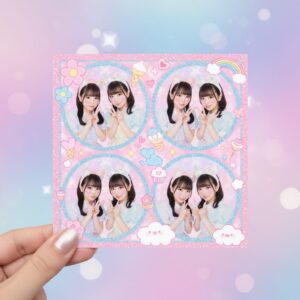
Into this scene, Purikura arrived like a revelation. The early machines were basic by today’s standards. You’d step into a booth, take several headshots against a plain background, and then—this was the magic—add digital stamps, frames, and handwritten messages on your photos using a stylus. The machine would then print a sheet of small, glossy stickers. The result was more than just a photograph; it was a collaborative creation, a personalized keepsake. You didn’t just take a picture with your friends; you made something together.
Its appeal was immediate and overwhelming, especially among high school girls. It tapped directly into the Japanese culture of kawaii (cuteness) and the deeply rooted customs of gift-giving and sharing. These weren’t photos to be stored away in albums; they were meant to be cut up with tiny scissors right in the arcade, exchanged, and carefully curated. A new form of social currency had been born.
Crafting the Ideal Face: The Aesthetic Arms Race
The true innovation of Purikura, and its closest connection to our contemporary filtered world, wasn’t the stickers themselves. It was the machine’s capability to alter your appearance. The competition wasn’t only among arcade owners; it was an aesthetic race, with each new machine generation offering increasingly advanced and transformative “beauty” features. This shift is where Purikura evolved from a simple novelty to a powerful means of identity construction.
Big Eyes, Big Dreams: The Dekame Revolution
From the beginning, the most desired feature was dekame (デカ目), or “big eyes.” Developers understood that users weren’t after realism; they pursued an idealized look inspired by anime and manga, where characters are known for their large, expressive eyes. The machines started using software that automatically detected the user’s eyes and enlarged them, often to exaggerated proportions. The irises were brightened, highlights added to create a glossy, sparkling effect, resulting in a look of enhanced youthfulness and innocence. Suddenly, the Purikura booth wasn’t just capturing your photo; it was transforming you into a living anime character. This marked a radical departure from Western photography’s traditional focus on capturing a “true” likeness. In Purikura’s world, the more altered, the better. It indicated you were using the latest, most advanced machine.
The Pursuit of Flawless Skin: Bihaku and Beyond
Next was the skin. The machines integrated powerful lighting setups, essentially mini studios with softboxes and ring lights designed to eliminate shadows, blemishes, or imperfections. This was paired with software that automatically smoothed the skin texture and, importantly, lightened the skin tone. This function, called bihaku (美白) or “beautifully white,” reflects a centuries-old East Asian beauty ideal, where fair skin has long been linked to beauty, class, and refinement. Purikura machines made this ideal instantly achievable. In the booth’s forgiving light, every user could attain luminous, poreless skin like a model’s. The software was so aggressive it often erased moles and freckles entirely, leaving a flawless, blank canvas. It was the original airbrushing, democratized and available for just 400 yen.
The Kogao Obsession
As the technology advanced, so did the range of physical ideals. Attention shifted to overall face shape. The kogao (小顔), or “small face,” aesthetic became crucial. A small, delicate, V-shaped jawline is regarded as a mark of beauty and femininity in Japan. Newer Purikura machines incorporated subtle—and sometimes overt—slimming effects, digitally narrowing the jawline and chin to create a more heart-shaped face. This was often combined with leg-lengthening features for full-body shots. In full-body booths, the camera was positioned low, and software stretched the lower half of the image, turning users into tall, slender, supermodel-like versions of themselves. The aim was never realism but a fantasy, a playful distortion everyone eagerly embraced.
This relentless pursuit of a specific, narrow beauty ideal might sound dystopian from a modern Western perspective, and in some respects, it was. Yet for the girls involved, it was largely seen as a form of play—a costume. Everyone knew it wasn’t real, and that was the point. The shared fiction was part of the fun. You weren’t trying to convince anyone that your eyes occupied a third of your face. You were creating a keepsake of a shared moment, filtered through the prevailing aesthetic of your community.
The Ritual and the Space: It’s Not Just a Photo
To grasp the essence of Purikura, you need to realize that taking the photo was just one small part of a broader, more intricate social ritual. The experience actually started before you even inserted your money into the machine.
The Arcade as a Sanctuary
First, consider the space itself. Purikura machines are seldom found alone. They are grouped together in dedicated sections of game centers, or sometimes housed within entire buildings devoted to this activity. These areas became informal social clubs for young women. They were typically brightly lit, decorated in pastel hues, and equipped with mirrors, hair straighteners, and counters for makeup touch-ups. This “powder room” section was an essential part of the pre-ritual, a place to prepare for the performance. In a society where teenagers had few public spaces to simply hang out, the Purikura corner served as a sanctuary. It was loud, chaotic, and predominantly female—a safe space to be playful and experiment with your look away from adult judgment or the male gaze.
Inside the Booth: A Performance Under Pressure
Choosing a machine was a tactical choice. Did you want the one known for natural-looking eye enlargement, or the one featuring the latest Sanrio character frames? Once selected, you and your friends—often squeezing three, four, or even five people into a booth designed for two—would start the performance. A timer would begin, a frantic countdown pushing you to cycle through a series of practiced poses. The peace sign, the “crying” face, the hand-heart, the “toothache” pose with a hand on the cheek to highlight the jawline—a whole vocabulary of gestures that evolved specifically for the Purikura booth. The green screen behind you offered a wide range of digital backdrops, from Tokyo cityscapes to fields of virtual flowers, further distancing the image from reality.
The Creative Frenzy: Decorating the Canvas
Following the lightning-fast photo session, the ritual advanced to the second phase: decoration. The group would gather at a separate console outside the booth where the images appeared on a large touchscreen. Again, a strict timer began, usually only a few minutes, sparking a creative panic. This was the moment for collaboration. “Add a heart here!” “Write ‘BFFs’ on this one!” “More sparkles!” Using styluses, you would unleash a flood of digital glitter, stamps, borders, and handwritten messages. This stage was loud and lively—a flurry of fingers and voices working together to personalize the blank canvas of their faces. The ticking clock left no time for overthinking. It was pure, instinctive aesthetic expression.
The Final Act: Cutting and Curating
Finally, the machine would whir and produce a single sheet of stickers. This physical item was the prize. The group would then congregate, using the provided scissors to carefully divide the photos. Negotiations would take place over who received which shot. These stickers were the tangible result of the entire experience. They were used to decorate phone cases, pencil cases, and school binders. Most importantly, they were lovingly glued into a purichō (プリ帳), a dedicated Purikura album. This little book became a physical embodiment of one’s social life. Flipping through a friend’s purichō felt like scrolling through their social media feed today. It was a record of friendships, inside jokes, and aesthetic phases, a physical archive of who you were and who you spent your time with.
Bridging the Analog and the Digital
Although Purikura is often remembered for its physical stickers, the industry was impressively skilled at adapting to new technologies. It effortlessly connected the analog world of printed photos with the emerging digital realm of the internet and mobile phones, laying the foundation for the social media revolution.
As Japan’s advanced mobile phone culture blossomed in the late 1990s and early 2000s with the garakei (Galapagos phone), Purikura machines evolved accordingly. They began offering a service where, for a small additional fee, photos could be sent directly to your phone. Each machine had a unique ID or QR code. Users would visit a specific website, enter the code, and download their beautified portraits. This was transformative.
Suddenly, the Purikura image was freed from its physical sticker form. It could become a phone wallpaper, be shared via infrared, or, most importantly, be uploaded to online profiles. During the era of early social networking sites like Mixi, a user’s profile picture was almost always a heavily edited Purikura photo. It became the accepted visual language for online self-representation. The intention was not to show your real-life appearance but to project an idealized digital avatar with big eyes and flawless skin, created in the controlled environment of the booth.
This early merger of physical experience and digital sharing precisely set the stage for Instagram’s core logic. You go somewhere with friends, have an experience, capture it with a photo, apply a filter to enhance it, and upload it to share with your network. Purikura included all these steps, though in a more ritualized and physically grounded way. The booth was the setting, the machine acted as the filter, and the purichō or mobile phone download was the act of sharing. The smooth shift from sticker to mobile download familiarized an entire generation with the idea that a photograph was not a finished product but raw data to be enhanced and shared.
The Purikura Legacy in Every Selfie
The heyday of Purikura has passed. Although these machines still remain in Japanese arcades, they are no longer the cultural giants they once were. The advent of smartphones with high-quality front-facing cameras and advanced photo-editing apps has made the physical booth less essential. Why spend 400 yen when you can achieve a similar—or even more personalized—effect for free with an app like Snow, Meitu, or even Instagram’s built-in filters?
However, to say Purikura is gone is to overlook its lingering presence. Its influence is everywhere. Each time you use a filter that slims your face, brightens your eyes, or smooths your skin, you are engaging in the aesthetic logic that Purikura perfected decades ago. While the technology has grown more sophisticated and personalized, the core desire remains the same: to narrow the gap between the real self and the ideal self.
What’s remarkable is how the aesthetic pioneered in Japanese arcades has become a global norm. The big eyes, small face, and flawless skin popularized by Purikura are now familiar features in filters used worldwide, often by people unaware of the term. Japan’s deep cultural comfort with curated, non-realistic self-representation—a visual tradition stretching from the stylized figures of ukiyo-e woodblock prints to the expressive characters of contemporary manga and anime—provided the ideal setting for this technology to thrive. Purikura was simply the 20th-century expression of this idea. It normalized the digitally altered portrait long before the rest of the world caught up.
So, the next time you scroll through a social media feed, pay attention to the faces. Notice the subtle (and not-so-subtle) enhancements. Remember that this visual language wasn’t born in a Cupertino lab; it was born in a noisy arcade, inside a cramped booth filled with laughing high school girls. It was born on a small, glossy sticker—a memento of friendship and a carefully crafted fantasy. The filter is now in your phone, but its soul still resides in the machine. Purikura didn’t just predict the future of the selfie; it created the blueprint.