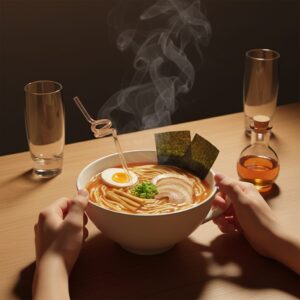
You’re sitting at a narrow wooden counter in Tokyo, wedged between a salaryman loosening his tie and a student hunched over a textbook. The air is thick with the savory alchemy of pork bone broth and the sharp scent of scallions. Before you sits a steaming, perfect bowl of ramen. The chef, a silent master behind the counter, gives a curt nod. You pick up your chopsticks, lift a bundle of noodles, and then you hear it: a chorus of thunderous, unabashed slurping from every corner of the tiny shop. To a Western ear, it sounds like the height of bad table manners. It’s the kind of noise your parents told you to stop making. But here, in the heart of Japan’s most beloved culinary institution, it’s not just acceptable; it’s practically a requirement. This isn’t rudeness. This is respect. This is ritual.
The disconnect is jarring for many visitors. How can a culture so famously obsessed with politeness, subtlety, and public decorum embrace such a loud, seemingly messy way of eating? The answer, like the broth simmering in the pot, is deep and complex. The slurp is not a thoughtless noise; it is a multi-layered act of communication, a piece of practical science, and a crucial part of a performance that unfolds in thousands of ramen shops every day. To understand the slurp is to understand the soul of ramen itself. It’s an invitation to cast aside foreign notions of etiquette and participate in a ceremony where flavor, function, and feeling are inextricably linked. This isn’t just about noodle soup. It’s about appreciating a craft with all your senses, and sound is one of the most important.
Japan’s vibrant culinary scene not only celebrates the art of ramen slurping but also invites you to discover equally intriguing cultural tokens like souvenir boxes that encapsulate the nation’s rich heritage.
The Ramen-ya as a Theater

Before you even taste the noodles, you must understand the space. A traditional ramen-ya is not a restaurant in the Western sense. It isn’t a place for leisurely dates or extended, meandering conversations. It is a stage, where you are both the audience and a participant in a highly specific, time-honored performance. The experience is designed for focus, efficiency, and a deep appreciation of the singular dish being served.
The Chef’s Stage
Most ramen shops are small, intimate, and centered around an open kitchen. The counter offers the front row seat. There are no walls separating you from the creator. You watch the taisho, or master, moving with an economy of motion that borders on meditative. Every movement is precise and practiced: the flick of the wrist to drain noodles from boiling water, the careful ladling of rich, opaque broth, the artful placement of a slice of chashu pork, and the final flourish of green onions. This is not just cooking; it is a performance of skill refined over years, sometimes decades.
The steam, the clatter of bowls, the rhythmic sounds of the kitchen—all contribute to the atmosphere. The open kitchen isn’t a trendy design choice; it’s fundamental to the experience. It builds anticipation and, more importantly, a sense of connection and respect for the craft. You are witnessing the culmination of hours, often days, of preparation. The broth may have been simmering for more than 24 hours to extract every last bit of flavor from bones and aromatics. The tare, the secret seasoning base, might be a recipe passed down through generations. By observing the chef, you implicitly acknowledge the immense effort that has gone into your single bowl.
The Unspoken Contract
This theatrical setting fosters an unspoken contract between the chef and customer. The chef’s role is to deliver a perfect bowl of ramen at its absolute peak. Your role is to eat it immediately and with focused enjoyment. This is why you’ll often find ticket machines, or kenbaiki, at the entrance. You make your choice, pay, and hand the ticket to the chef before you even sit down. This system is brilliantly efficient. It eliminates the fuss of ordering and paying, allowing the chef to concentrate on the ramen and you to concentrate on eating.
Once the bowl is placed before you, the clock starts ticking. This is not the time to scroll through your phone or snap a dozen photos for social media. The ramen is a fleeting masterpiece. The noodles, cooked to a perfect al dente texture known as koshi, will immediately begin to absorb the hot broth. Within minutes, they will soften and lose their essential chewiness, a regrettable state called nobiru. Allowing this to happen is a disrespect to the chef’s timing and craft. The silent, shared understanding in the shop is that the ramen is the priority. Everyone is there for the same reason, creating a communal, almost reverent atmosphere of focused consumption.
The Symphony of the Slurp: Function and Feeling
This is where the slurp becomes part of the experience. It represents the customer’s key contribution to the ritual—a sound that is both highly practical and emotionally meaningful. It serves as the connection between appreciating the craftsmanship and physically savoring its outcome.
The Science of Flavor and Temperature
First, there’s the straightforward physics involved. Ramen is served piping hot. It must be; the high temperature is crucial for melting fats in the broth and releasing the full range of aromas. Trying to eat the noodles politely with a fork, or taking small, quiet bites, would either burn your mouth or force you to wait until the bowl cools, by which time the noodles would become disappointingly soggy.
Slurping offers an ingenious solution. By rapidly inhaling the noodles, you draw a stream of cool air alongside the hot noodles and broth. This sudden cooling makes the food just palatable as it enters your mouth. It’s a highly effective way to cool the dish, allowing you to enjoy it at its perfect temperature while preserving its quality.
But it goes far beyond temperature alone. Slurping also aerates the broth. Similar to swirling a glass of wine to introduce oxygen and release its bouquet, slurping mixes air into the broth and noodles. This action stirs the aromatic compounds, sending them to your olfactory receptors at the back of your nose. Much of what we experience as taste is actually smell. Through slurping, you engage your sense of smell more fully than by simply sipping, greatly enhancing the complex flavors of ramen—the rich umami of the broth, the subtle sweetness of the tare, the fragrance of the aroma oil. You are, quite literally, tasting it more completely.
A Conversation Without Words
Beyond the practical science, slurping is the most important form of communication with the chef. In the intimate space of a ramen-ya, your audible enjoyment serves as immediate, unmistakable feedback—an expression of pure satisfaction.
Picture the chef, who has devoted their life to this singular craft. They don’t engage in small talk. Their focus is total. They measure their success not by words, but by your actions. An empty bowl is a positive sign. An empty bowl accompanied by energetic, enthusiastic slurps is the highest praise—it is akin to a standing ovation.
Your slurp says, “This is delicious.” It says, “I recognize this must be eaten now, at its prime.” Most importantly, it says, “I value the tremendous effort you have invested in this bowl.” A quiet diner, no matter how much they enjoy the meal inwardly, can be misread. Is the soup too cold? Are the noodles unsatisfactory? Silence breeds ambiguity. A slurp is a clear, definitive statement of approval that cuts through the noise and steam of the kitchen.
This auditory feedback generates a wonderful, cyclical energy in the shop. The sound of satisfied customers energizes the chef, who continues crafting bowl after bowl of perfection. It’s a symbiotic connection founded on a shared passion for ramen, expressed not through words, but through sound and mindful action.
The Rules Beyond the Noise

Of course, proper ramen etiquette involves more than just making noise. The slurp is part of a larger set of customs meant to enhance the experience and show respect for the food, the chef, and your fellow diners. Knowing these customs will help you navigate the ramen-ya like a local.
Tools of the Trade: Chopsticks and Spoon
You’ll be provided with a pair of chopsticks and a large, deep spoon known as a renge. Each serves a specific purpose. When your bowl arrives, the first thing you should do is use the renge to taste the broth on its own. The broth is the heart of the ramen, the base for everything else. Taking a moment to savor its flavor before mixing everything together demonstrates a discerning palate.
After that, the chopsticks become your main tool for eating the noodles. Pick up a small portion of noodles from the bowl, bring them to your mouth, and begin the slurp. The renge acts as your supporting tool. You can use it to hold toppings like the soft-boiled egg or slices of pork, or to catch any stray noodles. Its primary role, however, is to deliver the delicious broth to your mouth between bites of noodles. Generally, it’s considered poor form to coil your noodles into the spoon like spaghetti. The two tools complement each other but do not replace one another’s functions.
The Final Act: To Drink the Broth or Not
Finishing your entire bowl, noodles and all, is expected. But what about the broth? Drinking every last drop is regarded as the ultimate tribute to the chef’s skill. It shows that you found their creation so irresistible that no drop could be wasted. It’s common to see diners lift the bowl to their lips to drink the remaining broth—this is not considered rude at all.
That said, no one will be offended if you don’t. Ramen broth is often very rich, fatty, and high in sodium. For health reasons, many Japanese people leave some soup behind. The key is to enjoy it to your own satisfaction. The chef already knows you appreciate their work through your slurps. Finishing the broth is simply a bonus, a final exclamation point to a delicious meal.
The Cultural Context of Sound
The acceptance of slurping is not unusual; it aligns with a broader Japanese cultural perspective that context is everything. An action considered rude in one setting can be entirely appropriate in another.
Situational Etiquette
Japanese society follows a flexible set of behavioral rules that vary depending on the context. You wouldn’t slurp at a formal kaiseki multi-course dinner or during a tranquil tea ceremony. Those occasions demand quiet reverence and gentle movements. The ramen-ya, however, is another world. It is a place of hearty, rustic, and immediate enjoyment. The etiquette reflects the nature of both the food and the atmosphere.
This principle applies to other noodle dishes as well. Soba and udon noodles are also meant to be slurped. This technique is especially important with cold soba, as slurping helps carry the aroma of the buckwheat to your senses. In contrast, you would not slurp spaghetti in Japan. It is considered a foreign dish, to be eaten with a fork, and follows its own set of etiquette. The rules are specific to the food, not a general license to be noisy.
Sound as a Sign of Life
In Western cultures, many food-related sounds are viewed as unwelcome disruptions to quiet dining. In Japan, certain sounds are inherently connected to the deliciousness and freshness of the food itself. Consider the sharp sizzle of tempura hitting hot oil, or the satisfying hiss of meat on a grill at a yakiniku restaurant. These sounds are not seen as disturbances; they are part of the multisensory experience of eating. They signify food being prepared and enjoyed at its best.
The slurp of noodles fits perfectly into this category. It is the sound of vitality, of a hot, life-giving meal being savored with enthusiasm. It transforms eating from a polite, sterile routine into something more visceral, more engaged, and ultimately, more pleasurable. It acknowledges that food is not only about nourishment; it is a full-bodied experience that should engage all the senses, including hearing.
Embracing the Ritual

For those unfamiliar, the first slurp can feel awkward. It might seem performative or even incorrect. My advice is straightforward: just go for it. Don’t overthink it. Tune into the rhythm of the shop around you. The sounds of other diners will guide you. It’s not about being the loudest person in the room; it’s about letting go of your inhibitions and eating with genuine, undistracted focus.
Pick up some noodles. Bring them to your lips. And inhale. Let the warm, savory broth coat your palate as the aromas awaken your senses. Let the sound of your enjoyment speak to the chef. In that moment, you cease to be just a tourist observing a foreign custom. You become part of a ritual that connects you to the chef, to those around you, and to a fundamental aspect of Japanese culinary culture.
The ramen slurp is more than a technique. It’s a philosophy. It’s a reminder that sometimes, the most respectful act is to shed formality and embrace the moment with sincere, audible delight. It offers a glimpse into a culture that finds deep meaning in a simple bowl of noodles, and profound communication in a simple, satisfying sound.