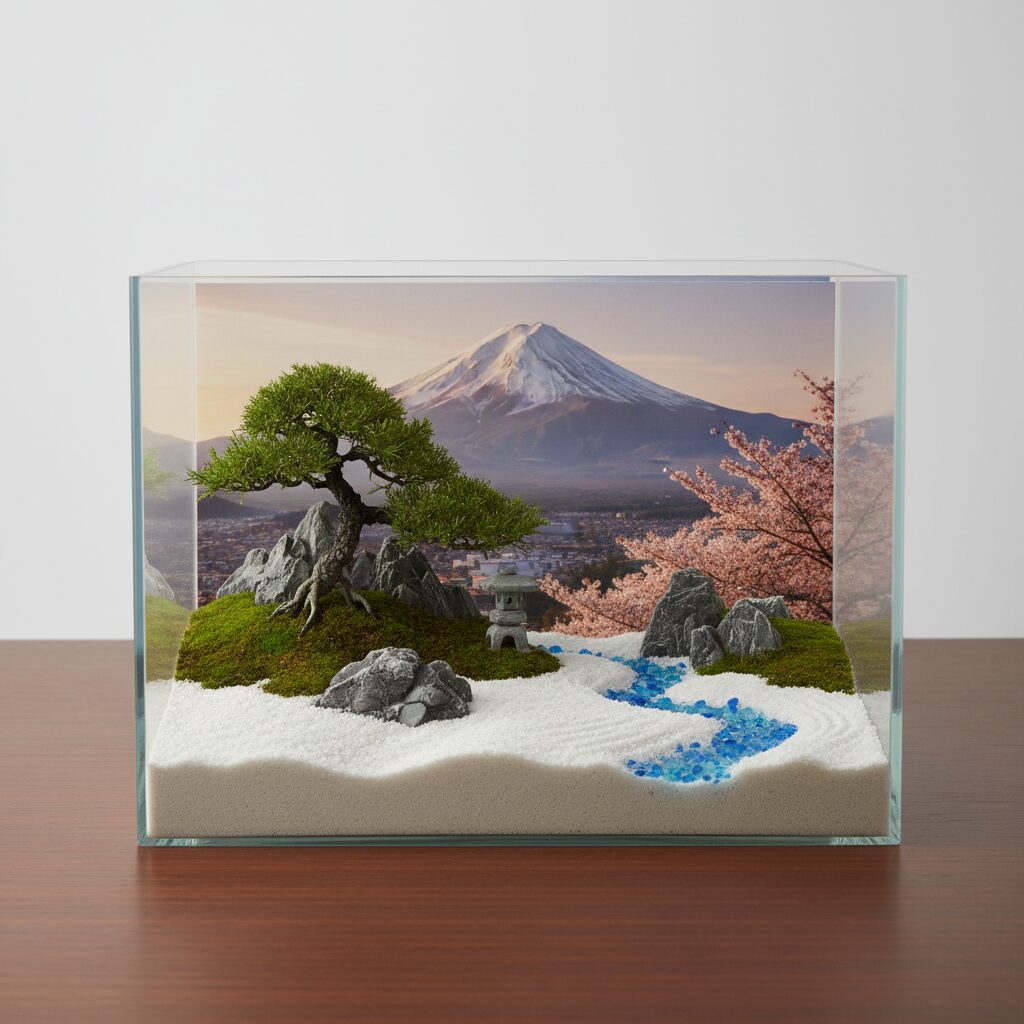
Walk into a classic Japanese garden, and your first impression is one of control. Every rock seems placed with intention, every tree is meticulously pruned, and the moss looks like it was vacuumed that morning. It feels like a perfect, self-contained world, a miniature universe sealed off from the chaos outside. It’s beautiful, serene, and intensely deliberate. But then, as you follow the winding path and turn a corner, you see it. Through a carefully shaped opening in the trees, or over a low, unassuming wall, a distant mountain peak rises, perfectly framed. Suddenly, the entire scale of the garden shatters and expands. That mountain, kilometers away, feels like it’s the garden’s dramatic finale. It’s the most important feature in the entire landscape, and yet it doesn’t belong to the garden at all.
This is shakkei. Written with the characters for “borrow” (借) and “scenery” (景), it translates to “borrowed scenery.” It’s one of the most profound and clever principles in Japanese landscape design, a technique where the garden actively incorporates views from outside its own borders into its composition. That distant mountain, a neighboring forest, the roof of a temple pagoda, or even a section of the sky—these are not accidental backdrops. They are deliberately captured and framed, becoming the focal point of the entire design. It’s a design philosophy that understands that the most valuable part of a space might be what lies beyond it. This isn’t just about getting a nice view; it’s a deep statement about the Japanese relationship with nature, space, and the illusion of boundaries. It’s an architectural sleight of hand that transforms a small, finite plot of land into a portal to the infinite.
By embracing the deliberate intersection of nature and design in shakkei, Japan simultaneously showcases its mastery in spatial artistry through remarkably resonant sanctuaries where even sound is intricately crafted.
More Than a Pretty Picture: The Philosophy of Borrowing
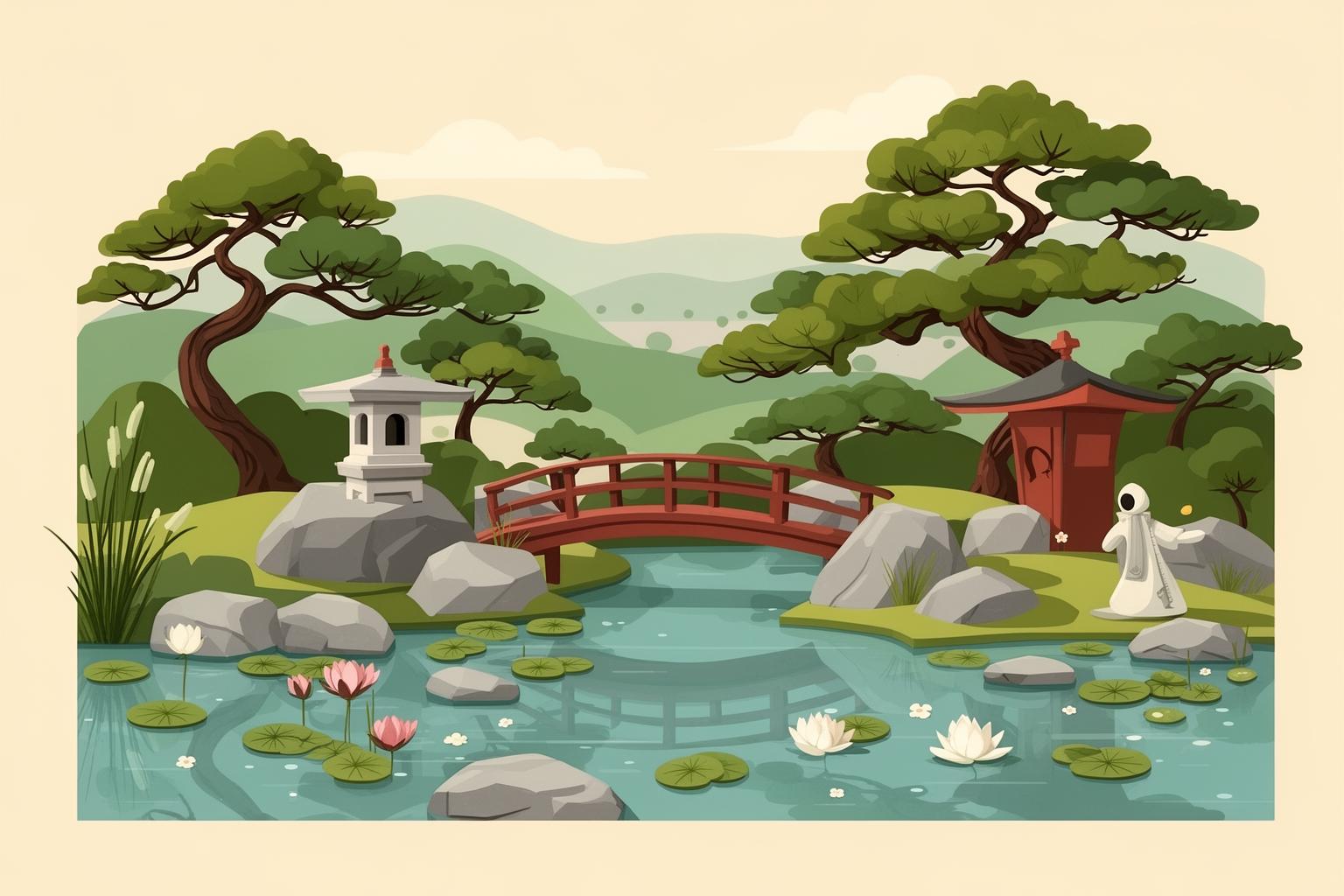
At its core, shakkei is a philosophical act disguised as a design decision. In the West, gardens have traditionally symbolized man’s dominance over nature. Consider the formal gardens of Versailles, with their strict geometric layouts and determination to tame the wild into submission. The wall enclosing a European garden serves as a declaration of ownership and separation: this is mine, and that is the outside world. Shakkei, however, operates on a completely opposite principle. It proposes that a firm boundary between human-made space and the natural world is not only undesirable but ultimately illusory. The aim is not to conquer nature, but to engage in a respectful dialogue with it.
Blurring the Boundaries
The act of “borrowing” scenery is a profound exercise in humility. It recognizes that no matter how skillfully a gardener arranges rocks or prunes a pine tree, they can never replicate the grandeur of a mountain range shaped by time or the simple beauty of a forest that has endured for centuries. So why compete? Instead, the designer chooses to collaborate. The garden becomes a foreground, a carefully crafted stage designed to showcase the majesty of the natural world. This approach is deeply connected to Japan’s indigenous Shinto beliefs, which perceive divinity (kami) in natural elements like mountains, ancient trees, and waterfalls. A mountain is not merely a pile of rocks; it is a powerful presence. To frame it within your garden is to honor it, inviting its spirit into your personal space without trying to possess it.
This idea also aligns with Buddhist concepts of interconnectedness and the impermanent nature of all things. By dissolving the solid visual barrier between garden and landscape, shakkei reminds the observer that everything is part of a larger, unified whole. The garden does not end at the fence line. Your personal space flows into the shared landscape, which in turn becomes part of your everyday experience. It visually expresses the notion that we are not separate from our environment but deeply embedded within it. The design encourages you to look beyond what is immediate and owned, and to appreciate your place within a much grander context.
The Art of Miegakure (Hide and Reveal)
Importantly, shakkei is not always about embracing a wide, panoramic view. A truly great borrowed scene is rarely revealed all at once. Japanese design holds a deep respect for the principle of miegakure, meaning “hide and reveal.” The most beautiful things are often partially hidden, hinted at before being fully unveiled. This technique is skillfully employed in gardens using shakkei.
You might catch a glimpse of a borrowed mountain peak through a latticed screen or glimpse the top of a pagoda over a strategically placed hedge. The path might lead you through a dense bamboo grove where the outside world disappears, only to suddenly open onto a clearing revealing the borrowed scenery in its full splendor. This interplay of concealment and revelation makes the experience much more meaningful. It transforms the viewer from a passive onlooker into an active participant in discovery. You must move through the space, your curiosity stirred, to fully earn the view. This creates a narrative within the garden, a sequence of experiences that builds anticipation and culminates in a moment of awe. It’s the difference between seeing a beautiful painting and being led on a treasure hunt where the painting is the ultimate prize. The journey makes the destination even more significant.
The Four Types of Shakkei: A Designer’s Toolkit
While the core philosophy remains consistent, shakkei is not a singular, uniform concept. Garden designers have created a refined vocabulary to classify the various methods of borrowing scenery. Understanding these four primary types highlights the technique’s adaptability and nuance, demonstrating how it can be tailored to settings ranging from an imperial villa to a small urban courtyard. Each type addresses a distinct design challenge and evokes a unique emotional response.
Enshaku (Distant Borrowing)
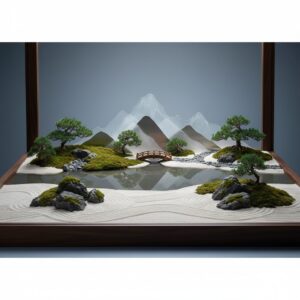
This is the most renowned and striking form of shakkei. Enshaku (遠借) involves incorporating a large, distant natural element, usually a mountain, into the garden’s design. This method generates a breathtaking sense of scale, making a garden only a few acres in size feel as expansive as the entire valley. The crucial aspect is establishing a seamless visual link between the garden and the distant feature. The middle ground plays a vital role here—a pruned bush might reflect the mountain’s slope, or a pond’s surface might mirror the sky, bridging foreground and background. The famous garden at Kyoto’s Shugaku-in Imperial Villa exemplifies enshaku. Ascending to the highest teahouse, the garden’s components—the pond, hedges, and bridges—are all arranged to guide the eye toward the majestic form of Mount Hiei, which crowns the scene. The mountain acts as the garden’s steadfast anchor, symbolizing permanence and putting the human-scale elements into perspective.
Rinshaku (Adjacent Borrowing)
Not every garden is lucky enough to have a mountain as a neighbor. Rinshaku (隣借) is a more intimate, neighborly form of borrowing. It involves incorporating elements from adjacent properties—a neighbor’s grove of trees, the wall of a nearby temple, or even a particularly beautiful cherry tree across the fence. This is a common and practical technique in densely populated urban areas where space is limited. The design often includes a low fence or a carefully positioned window that frames the desired view while excluding less attractive elements. Murin-an, a stunning Meiji-era villa in Kyoto, is famous for borrowing trees from the neighboring temple grounds, making its own garden feel far more lush and expansive than it truly is. Rinshaku reflects a shared aesthetic and a sense of community. It depends on the unspoken agreement that beauty is a resource to be shared, not hoarded—a quiet, visual collaboration across property boundaries.
Gyoshaku (Upward Borrowing)
What if your view is completely blocked on all sides? In the confined space of an urban courtyard garden, or tsuboniwa, horizontal views are often impossible. This is where gyoshaku (仰借), or upward borrowing, becomes essential. When outward views are blocked, you look upward. The garden is designed to draw the eye skyward, borrowing the sky, clouds, moon, or the silhouette of a passing bird. The tsuboniwa’s composition—a lone stone lantern, a water basin, a carefully placed maple sapling—frames the ever-shifting canvas of the sky. This technique connects the smallest, most enclosed spaces to the vastness of the cosmos. The garden’s mood changes with the weather and time of day: bright and open under a blue sky, introspective beneath a grey one, and magical under a full moon. It’s a brilliant solution that turns a limitation—the absence of a view—into an opportunity for a different kind of connection with nature.
Fushaku (Downward Borrowing)
Perhaps the most subtle of all, fushaku (俯借) involves borrowing a view from below. This can be literal, such as a garden on a slope incorporating a view of a river or valley beneath it. More often, however, it involves borrowing reflections. The calm surface of a pond becomes a canvas for reflecting the sky, clouds, and surrounding trees. The designers of Kyoto’s Golden Pavilion (Kinkaku-ji) understood this well—the temple’s true brilliance arguably lies not in the structure itself but in its perfect, shimmering reflection on the mirror pond, a borrowed, perfected image of reality. Fushaku can also be auditory—the sound of a nearby waterfall or hidden stream that you hear but cannot see is a form of borrowed scenery for the ears. By engaging senses beyond sight, it deepens the immersive garden experience, creating a richer, more complex atmosphere.
The Frame is Everything: Controlling the View
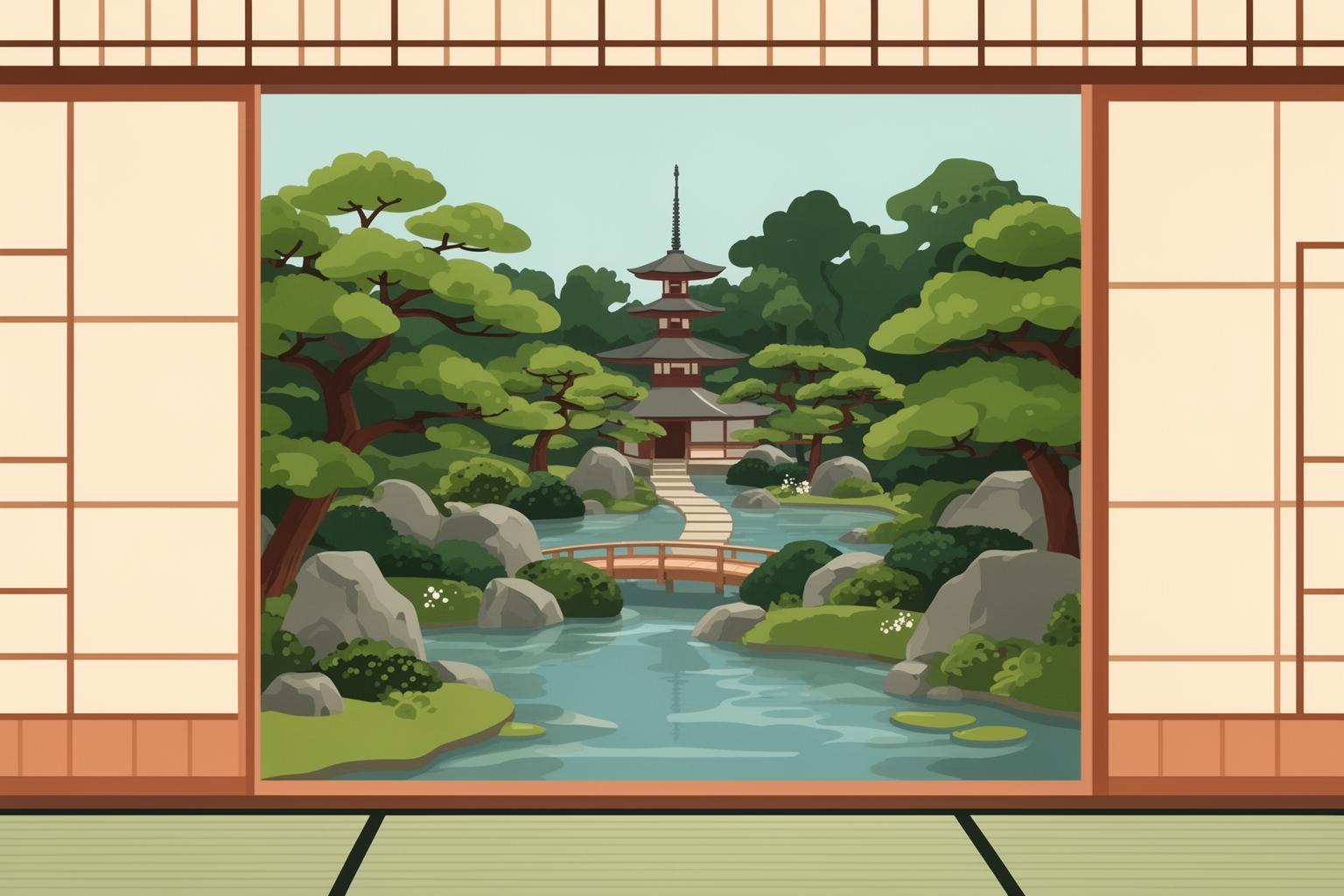
None of this enchantment occurs by chance. A stunning view becomes shakkei only when it is deliberately framed and harmonized. The artistry lies not merely in identifying a potential borrowed view, but in understanding exactly how to compose and showcase it. For centuries, Japanese architects and garden designers have been experts in this curated revelation, using architectural elements and landscape features to direct the viewer’s experience with cinematic precision.
The Window as a Living Painting
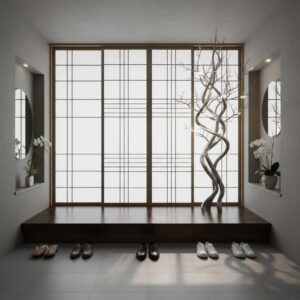
In numerous temples and villas, the architecture itself serves as the main instrument for creating shakkei. A window is never simply a window; it functions as a frame. Its size, shape, and placement are all carefully planned. A circular window, called a yoshimado or “window of enlightenment,” might capture a single perfect branch of a maple tree set against the backdrop of a borrowed hill. A low, wide horizontal window in a study might be placed at eye level when seated on a tatami mat, offering a panoramic “living scroll” of the garden and the landscape beyond. The Adachi Museum of Art stands as a modern emblem of this concept. Its enormous plate-glass windows look out onto a flawless garden but are designed as frames for living masterpieces. The garden outside and the mountains beyond are the true exhibits, perfectly composed and presented through the museum’s architecture. By controlling the vantage point, the building guides you exactly on what to see and how to see it, transforming a natural view into a work of fine art.
The “Middle Ground” as Connector
The most accomplished examples of shakkei succeed because they skillfully manage the transition between the immediate foreground, the garden’s middle ground, and the distant borrowed scenery. Without a carefully considered middle ground, a distant mountain can appear disconnected, like a poster hung on a wall. To create a seamless, three-dimensional composition, designers incorporate elements within the garden to bridge this visual and psychological distance. A hedge may be clipped into a rounded form that echoes the distant hills. A cluster of dark, rugged rocks in the foreground might reflect the texture of a volcanic peak in the background. A line of trees might be planted to obscure the unappealing urban sprawl at the base of a mountain, linking the garden directly to the pristine nature above. This middle layer acts as the connective tissue. It tricks the eye into perceiving the entire scene, from the moss beneath your feet to the peak on the horizon, as a single continuous, harmonious landscape.
Shakkei in the Modern World: Beyond Traditional Gardens
While its origins are rooted in classical gardens, the philosophy of shakkei is arguably more relevant today than ever before. In the densely packed, vertically oriented cities of modern Japan, architects and designers are continually seeking ways to create a sense of spaciousness and a connection to nature within limited spaces. The principles of borrowing and framing have become indispensable tools in their repertoire.
Urban Apartments and “Borrowed Cityscapes”
Enter a well-designed modern Tokyo apartment, and you’ll often find a wall almost entirely made of glass. This isn’t merely a nod to modernist aesthetics; it is pure shakkei. The window serves not just as a source of light but as a frame for a “borrowed cityscape.” It might showcase a view of the Tokyo Skytree, a nearby patch of greenery from a park, or even the abstract, dynamic beauty of elevated train lines. The view becomes the primary decorative element in a minimalist interior. By framing the city, the apartment absorbs its energy and scale, making the small living space feel like part of the vast urban ecosystem. The architect uses the city itself as borrowed scenery, discovering beauty in the man-made landscape and inviting it inside.
The Psychological Effect: An Antidote to Enclosure
Ultimately, the lasting impact of shakkei is psychological. In a culture and country where physical space is often scarce, this design philosophy provides a powerful mental release. It broadens one’s perceived world without the need to own more land. A tiny garden with a borrowed view feels infinitely larger than a large garden enclosed by a high wall. It fosters an outward-looking perspective, encouraging appreciation for the world beyond one’s immediate control. You cannot possess the mountain, control the clouds, or own the neighbor’s forest. You can only appreciate them. Shakkei imparts a quiet lesson in finding contentment and beauty in what is shared and transient. It is both a design strategy and a mindset: a way of seeing the world not as a collection of separate, walled-off properties, but as a single, interconnected landscape in which we are fortunate to have a view.
Visiting the Masters: Where to See Shakkei in Action
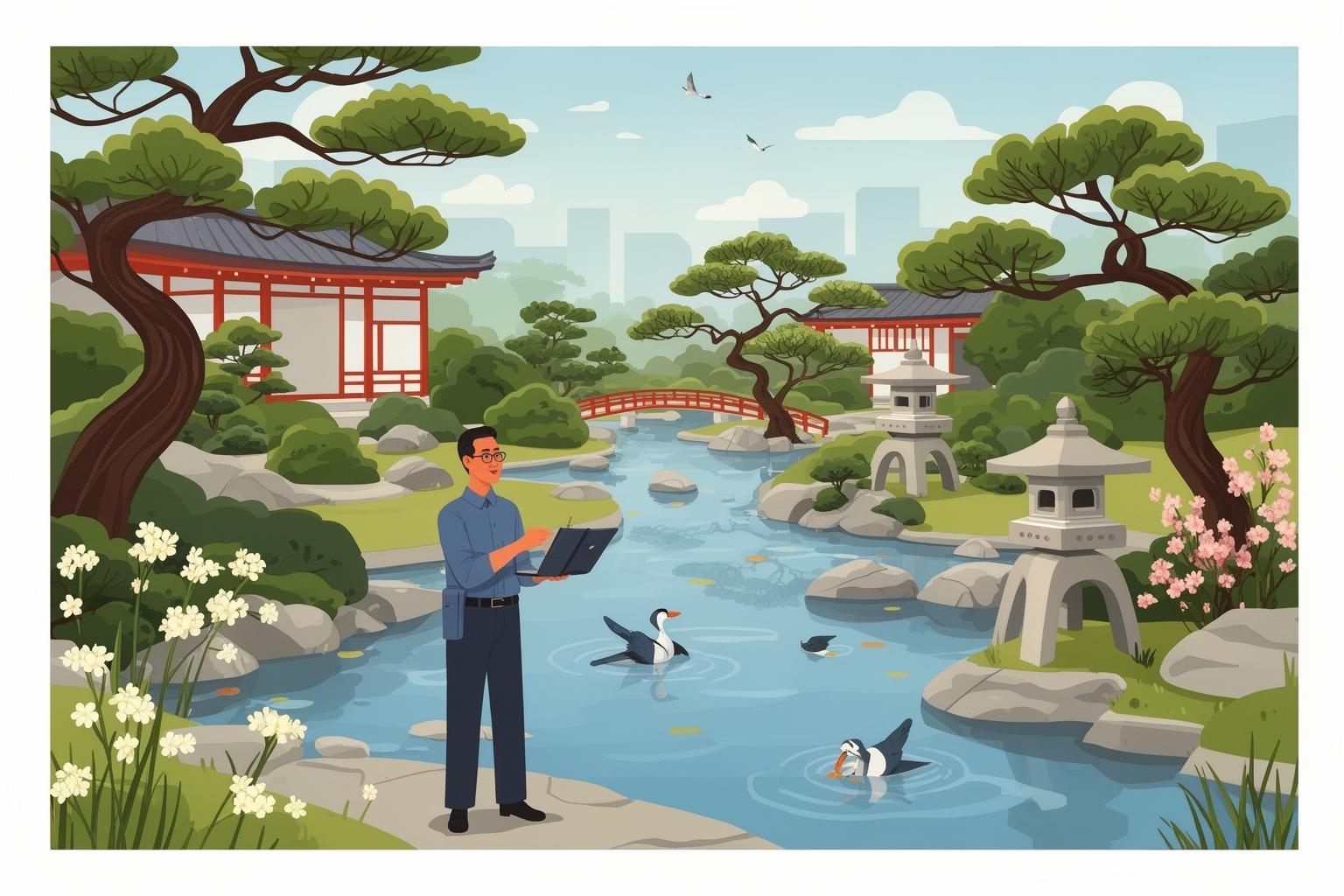
To truly grasp shakkei, you need to experience it firsthand. Reading about it offers some insight, but standing in a garden and feeling that sudden, breathtaking expansion of space is entirely different. Japan is home to countless examples, yet a few stand out as flawless embodiments of the art.
Adachi Museum of Art, Shimane
Consistently ranked as the best garden in Japan for nearly two decades, the Adachi Museum of Art is perhaps the most perfect, albeit highly curated, example of shakkei. The garden is designed not for walking through but for viewing from inside the museum through large windows. These frames showcase a series of “living paintings” that blend the meticulously manicured garden in the foreground seamlessly with the natural mountains in the background. It is a true masterpiece of control, composition, and borrowing.
Shugaku-in Imperial Villa, Kyoto
For a grand, classical enshaku experience, nothing compares to Shugaku-in. This sprawling villa, built in the 17th century for an emperor, features gardens laid out across three levels on a hillside. The highlight is reaching the highest level, where the Rinun-tei teahouse offers an unmatched panoramic view over a large pond, Kyoto city, and the surrounding mountains. It is shakkei on an imperial scale, designed to inspire awe.
Murin-an, Kyoto
This Meiji-era garden showcases a more modern and naturalistic approach to shakkei. Unlike the highly structured gardens of the past, Murin-an features a bright, open lawn and a cheerful stream. Its brilliance lies in how it gently incorporates the lush forests of the nearby Higashiyama mountains as its backdrop. The garden’s edges almost dissolve, creating an invitingly relaxed and spacious atmosphere. It is a prime example of rinshaku executed with effortless elegance.
Tenryu-ji, Kyoto
The Sogenchi Teien (garden) at Tenryu-ji in Arashiyama stands as one of the oldest and most influential examples of shakkei. Designed in the 14th century by the renowned monk Muso Soseki, the garden uses the dramatic mountains of Arashiyama, including Kameyama and Ogurayama, as its living backdrop. The arrangement of rocks in the foreground is said to echo the shape of the mountains, creating a perfect harmony between the man-made and the divine. Sitting on the veranda of the main hall and gazing out over this view is to witness the birth of a fundamental Japanese aesthetic.