If you’ve spent any time in Japan, or even just watched a few Japanese films, you’ve witnessed the ritual. It’s a moment of pause, a quiet transition that happens every time someone enters a home. The door opens, but the person doesn’t just walk in. They stop. There’s a brief exchange of greetings, and then, a practiced, fluid motion: they slip off their shoes, turn them neatly to face the door they just entered, and step up into the main living space. This all happens in a specific, designated area right by the entrance. This area, this crucial buffer zone between the public street and the private home, is called the `genkan` (玄関).
To a first-time visitor, it might seem like a simple matter of cleanliness, a practical way to avoid tracking dirt onto the floors. And on one level, it is. But to leave the explanation there is to miss the point entirely. The `genkan` is not merely a Japanese mudroom or foyer. It is a physical manifestation of one of the most fundamental concepts in Japanese society: the clear, sharp, and profound distinction between outside (`soto`, 外) and inside (`uchi`, 内). It’s a stage for social etiquette, a symbolic airlock, and in many ways, the most important border crossing in the country. Understanding what happens here—and why it happens with such unspoken precision—is the first step to truly understanding the social geography of Japan. This small patch of floor is where the outside world ends and the private sanctuary of the home begins, and crossing that line is an act loaded with meaning.
This delicate interplay between exterior and interior spaces finds a parallel in the art of the borrowed view, where nature and design merge to redefine the boundaries of perception.
More Than a Mudroom: The Anatomy of a Threshold

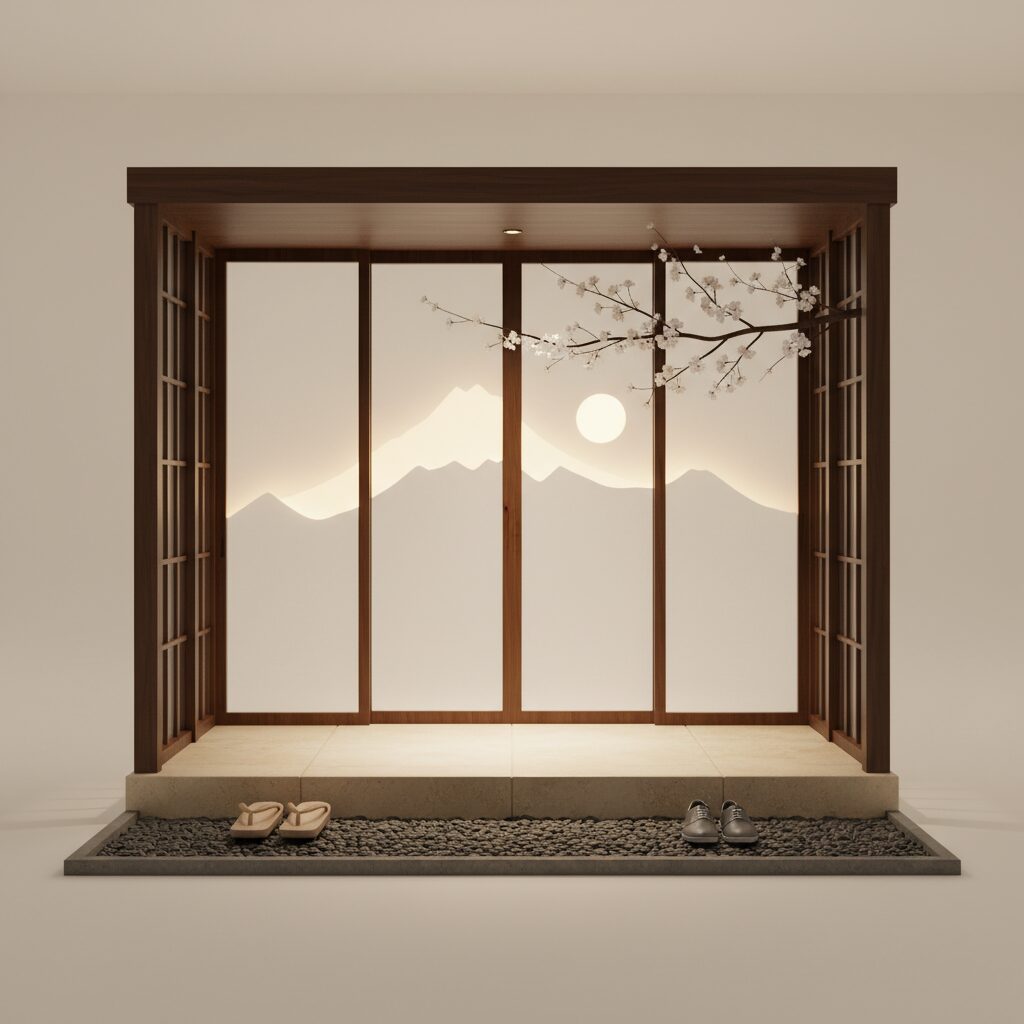
To understand the cultural significance of the `genkan`, you first need to recognize its physical structure. It is an architectural space of separation, designed with a refined and unwavering logic. Every Japanese home, whether it’s a large traditional house in the countryside or a compact apartment in Tokyo, has one. While the form may differ, the underlying principles stay the same.
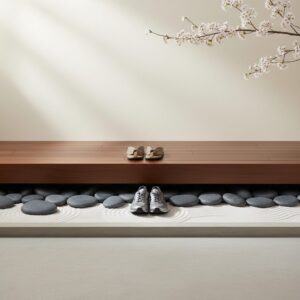
At the base is the `doma` (土間), the lower level you step onto directly from outside. It’s usually made from hard, durable materials such as tile, stone, or polished concrete. The term “doma,” meaning “earth space,” originates from the packed-earth floors of traditional farmhouses and merchant residences. This area represents the `soto` part of the entrance—both functionally and symbolically, it remains connected to the outside world. This is where shoes are removed and left. It serves as a space for brief, practical exchanges; for instance, a mail carrier might hand you a package here, or a neighbor could drop off some shared vegetables, but they won’t proceed further unless explicitly invited. Their feet, and the interaction itself, stay firmly grounded on the `doma`.
The most crucial element separating the `doma` from the house’s interior is a single raised step known as the `agarikまち` (上がり框). Typically a polished wooden beam, it creates a distinct physical boundary. Though only a few inches tall, its symbolic significance is profound. This step marks the line: crossing over the `agarikまち` means you are formally welcomed inside, transitioning from `soto` to `uchi`. Your bare or stockinged feet must never touch the `doma`, just as your outdoor shoes must never contact the raised interior floor. Crossing is a deliberate act. You sit at the edge or balance gracefully, removing your shoes on the lower level before swinging your legs up and over into the clean, protected inner space. This simple wooden beam serves as a gate, checkpoint, and declaration that the rules of interaction have shifted.
Lastly, you will almost always find a `getabako` (下駄箱), or shoe cabinet. Its primary role is clear: to store shoes and keep the entrance organized. But it also functions to contain the “outside” world. Shoes that have walked city streets, train platforms, and public sidewalks are stored here, neatly arranged and separated from the inner living areas. The `getabako` reinforces the `genkan`’s role as a filtration system—a place where the dirt and dust of the public sphere are shed before entering the purity of the private space.
The Dance of Shoes
Shoe etiquette in the `genkan` is a quiet, choreographed ritual that reveals much about one’s respect for others. Simply taking off your shoes isn’t sufficient—how you do it matters. The proper way is to step out of your shoes facing into the house, then turn around, crouch down, and arrange them neatly with the toes pointing toward the door. This practice isn’t just about tidiness; it’s an act of thoughtfulness and respect. By positioning your shoes so they are ready for a smooth exit, you show your host that you are a considerate guest, mindful of the flow and harmony of the space. Leaving shoes piled carelessly in the `doma` signals a lack of attention and disrupts the household’s order. For a host, witnessing a guest perform this small act of mindfulness is an immediate indication of good manners and social awareness.
Uchi-Soto: The Invisible Wall Made Real
The architectural design of the `genkan` serves as the hardware, while the cultural concept of `uchi-soto` acts as the software operating on it. This principle is arguably the most crucial key to understanding Japanese social interaction, with the `genkan` serving as its classroom.
`Uchi` (内) means “inside.” It refers not only to your physical home but also to your inner circle: family, close-knit work teams, or clubs. Communication within the `uchi` group is more direct, informal, and relaxed, marked by a shared identity, a sense of belonging, and mutual obligations. It is a space of relative comfort and intimacy.
`Soto` (外) means “outside.” It includes everyone else: strangers, acquaintances, people from other companies, and society at large. Interactions in the `soto` realm follow formal, polite, and distant codes of conduct. Language becomes more honorific (`keigo`), and a certain professional or social distance is maintained. This system is not cold or unfriendly but is designed to show respect and ensure smooth, conflict-free interactions in the public domain.
This is not a simple binary of “friends versus strangers.” Rather, it is a fluid, concentric circle of relationships. Your family is `uchi`. Your company is `uchi` when dealing with a client company (`soto`), but within your company, your immediate team is `uchi`, while another department might be `soto`. The `genkan`, however, represents the clearest `uchi-soto` boundary of all: the one safeguarding the family home.
The physical act of stepping over the `agarikまち` is the tangible transition from the `soto` world to the `uchi` world. When a delivery person stands on the `doma`, they acknowledge that they are `soto`. They fulfill their professional role without intruding into the private `uchi` space. When you briefly chat with a neighbor who remains in the `genkan`, you both recognize a friendly but not deeply intimate relationship—an interaction that does not yet warrant full entry into the home’s inner sanctum.
The Gravity of an Invitation
This is why the invitation to fully enter a Japanese home carries such significance. The phrase a host uses is `“Douzo, o-agari kudasai”` (どうぞ、お上がりください), which literally means “Please, rise up.” It is not a casual “Come on in,” but a formal, deliberate gesture welcoming someone from the `soto` domain into the `uchi` domain. Accepting this invitation means you have been trusted and invited into the family’s personal space.
Because of this, the invitation is not always accepted immediately. A guest—especially one delivering a gift or making a brief visit—may initially decline politely, a gesture known as `enryo`. They might say something like, `“Sugu shitsurei shimasu node”` (“I’ll be leaving right away, so…”), implying they do not want to impose. This is part of a delicate social dance. The host typically insists, and only then does the guest acquiesce, perform the shoe ritual, and step inside. This ritual demonstrates that both parties understand the importance of the boundary and navigate it with mutual respect. It contrasts sharply with Western culture, where a casual visitor might be immediately invited into the living room, shoes still on.
Cleanliness, Both Physical and Spiritual

The functional purpose of the `genkan` is, naturally, hygiene. In a country where people traditionally sat, ate, and slept on `tatami` mats on the floor, maintaining the living area free from outside dirt was crucial. This custom continues even today, despite most homes having wooden floors and chairs. The floor is still regarded as a cleaner, more intimate surface compared to many Western cultures. You will frequently see people sitting on the floor in living rooms, and children play there constantly. The idea of wearing shoes that have been on public streets and subways while walking on that same surface feels culturally unsettling.
However, the concept of cleanliness in Japan extends beyond the physical. It is deeply connected with Shinto spiritual ideas of purity and pollution. Shintoism, Japan’s indigenous religion, distinguishes between `hare` (pure, clean, sacred) and `kegare` (impure, polluted, defiled). The outside world, with its unknown elements, chaos, and potential spiritual “dirt,” represents `kegare`. The home is a `hare` space, a sanctuary that must be shielded from external pollution.
The `genkan` functions as a purification area. Taking off your shoes symbolizes shedding the `kegare` brought from the `soto` world before entering the pure `uchi` space. It is a ritual that cleanses you, preparing you to enter a protected environment. This practice extends beyond private homes: shoes are removed when entering temples, sacred spaces. It’s also observed in many traditional restaurants, inns (`ryokan`), and even some clinics and schools. The raised floor marks a transition, signaling a shift into a space that demands a different level of respect and cleanliness, both literal and symbolic.
The Modern Genkan and Its Enduring Power
You might expect this custom to disappear amid modern architecture and Western influences. Yet the `genkan` has shown remarkable endurance. Step into any newly constructed, ultra-modern apartment building in Tokyo, and you will still find one. It might be smaller—a modest recessed tile square by the door—and the `agarikまち` could be a barely noticeable shift in floor height, but it remains. The psychological boundary it represents is so deeply embedded that a home without it feels incomplete, almost improper.
The space has evolved, naturally. Contemporary `genkan` often include stylish storage, mirrors, and spots for keys or decorations. However, its essential role as a social and physical filter remains intact. It is the first and last space you engage with in a home, where greetings (`Ittekimasu` – I’m going; `Tadaima` – I’m home) and farewells (`Itterasshai` – Go and come back; `Okaerinasai` – Welcome home) take place. These paired phrases, exchanged across the `genkan` threshold, form the daily rhythm of Japanese family life, reinforcing the home as a stable base from which one ventures into the `soto` world and returns to the safety of `uchi`.
Ultimately, the `genkan` shows that in Japan, spaces are never neutral. They carry social meaning. The simple act of removing one’s shoes is a gesture of respect, a recognition of the private home’s sanctity, and participation in a shared cultural understanding refined over centuries. It is a quiet enactment of the boundary between the public and private self. Thus, this small, modest entryway does more than just welcome you—it offers a profound and immediate lesson in the foundational logic of Japanese society, all before you even step inside.