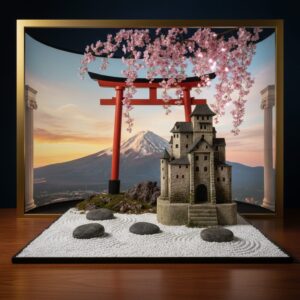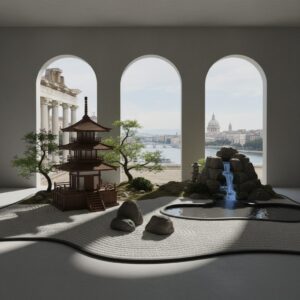
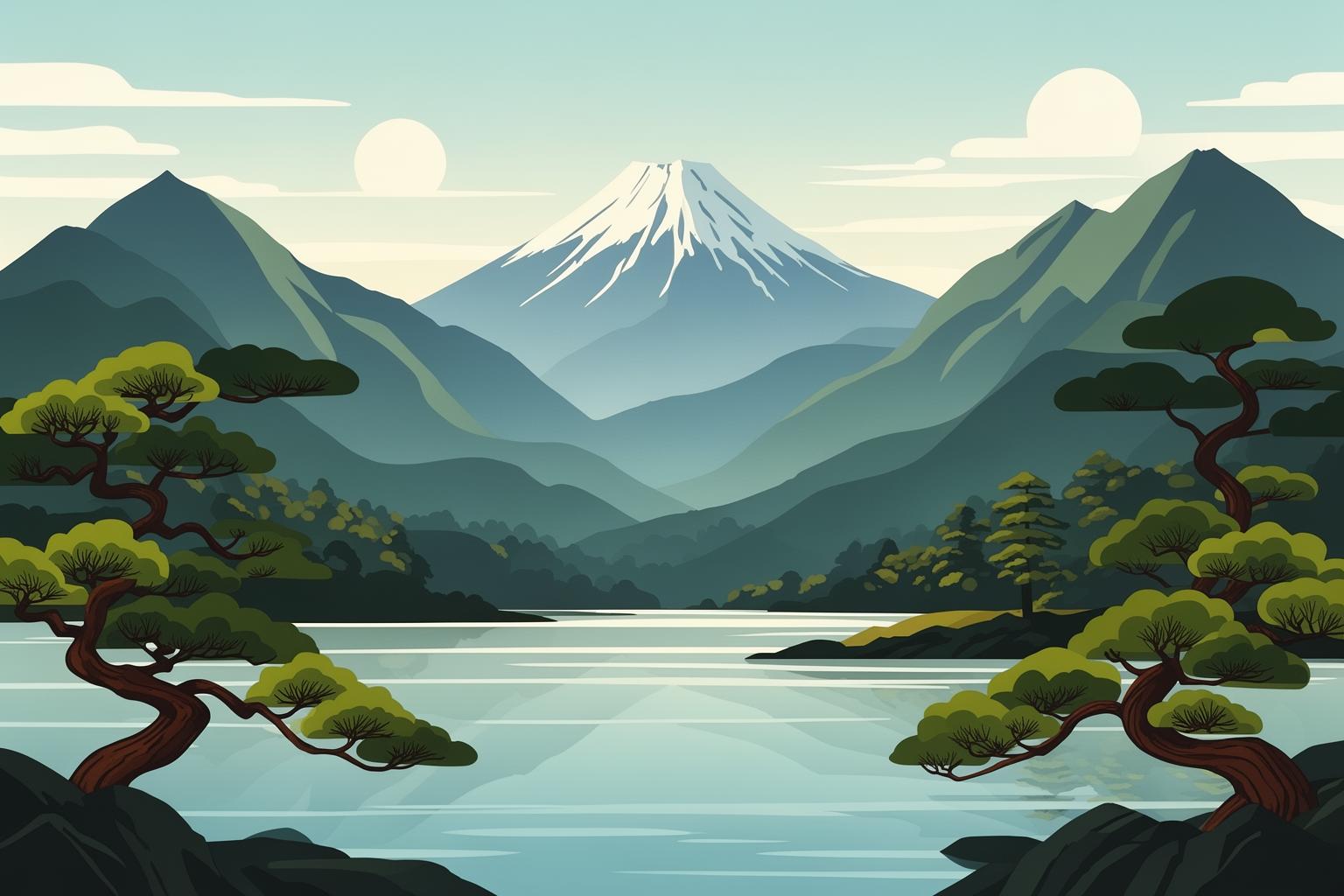
Stand in one of Kyoto’s great gardens—say, the sublime grounds of the Shugaku-in Imperial Villa—and you’ll feel it. Beyond the meticulously placed rocks and carp-filled ponds, beyond the expertly pruned pines that seem to bow in welcome, there’s a sense of boundless space. Your eye is drawn past the garden’s edge to the forested slopes of Mount Hiei rising in the distance, its peak wreathed in morning mist. The mountain isn’t just a backdrop; it feels like an integral part of the garden itself, the final, epic brushstroke on a living canvas. This isn’t an accident. It’s a masterful illusion and a profound design philosophy known as shakkei.
Shakkei (借景) translates to “borrowed scenery.” It’s a concept central to Japanese landscape architecture, but it speaks volumes about the culture’s broader relationship with nature and space. The idea is to seamlessly incorporate the surrounding landscape—a distant mountain, a neighboring forest, even the ocean—into the garden’s composition, making the outside world an essential component of the interior design. It’s a technique that dissolves boundaries, creating a sense of continuity between the human-made and the natural, the small and the vast. This isn’t just about getting a nice view. It’s about fundamentally rethinking what a garden is: not a self-contained paradise sealed off from the world, but a curated portal that frames and enhances the beauty that already exists beyond its walls.
The seamless integration of expansive natural vistas with meticulously designed spaces exemplifies the transformative power of borrowed scenery in redefining the garden experience.
Beyond the Walls: A Philosophy of Connection
To truly understand shakkei, you must let go of the Western idea of a garden as a space enclosed by fences and gates, a plot of land where nature is subdued and ordered by human intention. Consider the formal gardens of Versailles, with their strict symmetry and geometric accuracy. They are magnificent, but their beauty represents conquest and control, a statement of human dominance over the wild. These gardens create a clearly defined, artificial world entirely separate from the untamed landscape beyond.
A Japanese garden founded on the principle of shakkei is based on a fundamentally different concept. It begins with humility. The designer recognizes that no human creation can ever match the grandeur of a distant mountain or the quiet dignity of an ancient forest. So, instead of competing with that beauty, they choose to collaborate with it. The garden becomes a work of elegant suggestion, a microcosm meant to connect with the macrocosm.
The characters themselves convey the meaning. The first, shaku (借), means to borrow or lend. It suggests a temporary and respectful act, not a permanent claim. The garden does not own the mountain; it is simply granted the privilege of its presence. The second character, kei (景), means scenery or view. Together, they express a deep, mutual relationship between the garden and its surroundings. The garden provides the distant scenery with context and a frame, while the scenery in return offers the garden a sense of scale, depth, and life it could never achieve alone.
This philosophy is about integration, not separation. In a shakkei design, the garden wall is not a rigid boundary shouting, “The world ends here.” It serves as a permeable membrane, a carefully positioned element meant to be seen through, over, or around. It acts as a tool for framing the view and guiding the visitor’s gaze, but never for completely cutting off the connection to the larger world.
The Mechanics of Borrowing: Curating the Natural World
Incorporating a mountain into your backyard isn’t as simple as just leaving a gap in the hedge. Shakkei is an intricate art form that depends on several key techniques to create a seamless and convincing illusion. While it may appear effortless and natural, every element stems from careful calculation and artistic intention.
Framing the Perfect View
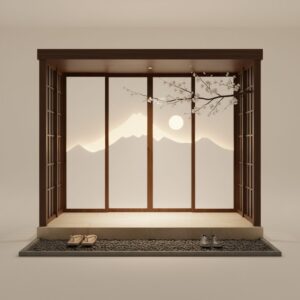
The most fundamental technique is framing. Just as a painter uses a frame to draw attention to the subject of a painting, a garden designer uses elements within the garden to shape the distant view. This might be a strategically placed gate, the overhanging branch of a maple tree, or the view through a circular window (marumado) in a teahouse. These frames serve two purposes: they block out visual distractions—such as unwanted buildings, power lines, or less appealing parts of the landscape—and they amplify the impact of what is visible. By narrowing the field of vision, the designer transforms the distant scenery from a passive background into a focal point, a “living picture” that becomes the garden’s central feature.
The Art of the Middle Ground
A successful shakkei garden is never just foreground and background. The essential component that connects everything is the middle ground. Without it, the illusion collapses. You can’t simply have a patch of raked gravel followed by a mountain five kilometers away; the visual jump is too great. The designer needs to create a smooth, believable transition between the garden and the borrowed view.
This is often accomplished through a technique known as mimicry. Trees and shrubs in the middle ground may be pruned into rounded shapes that mirror the contours of the distant hills. A cluster of dark, rugged rocks in the garden can evoke the distant mountain range on a smaller scale. A carefully shaped hedge might act as a visual bridge, with its top line flowing seamlessly into the forested slopes beyond the wall. The texture and color of the elements are equally important. The deep green moss in the garden might correspond to the dark green cedar forest on the mountain, creating visual continuity that tricks the eye into perceiving it all as a single unified landscape.
Playing with Scale and Perspective
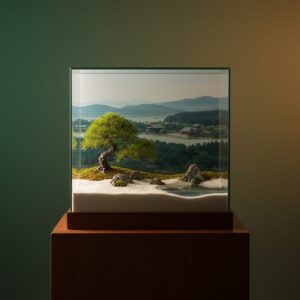
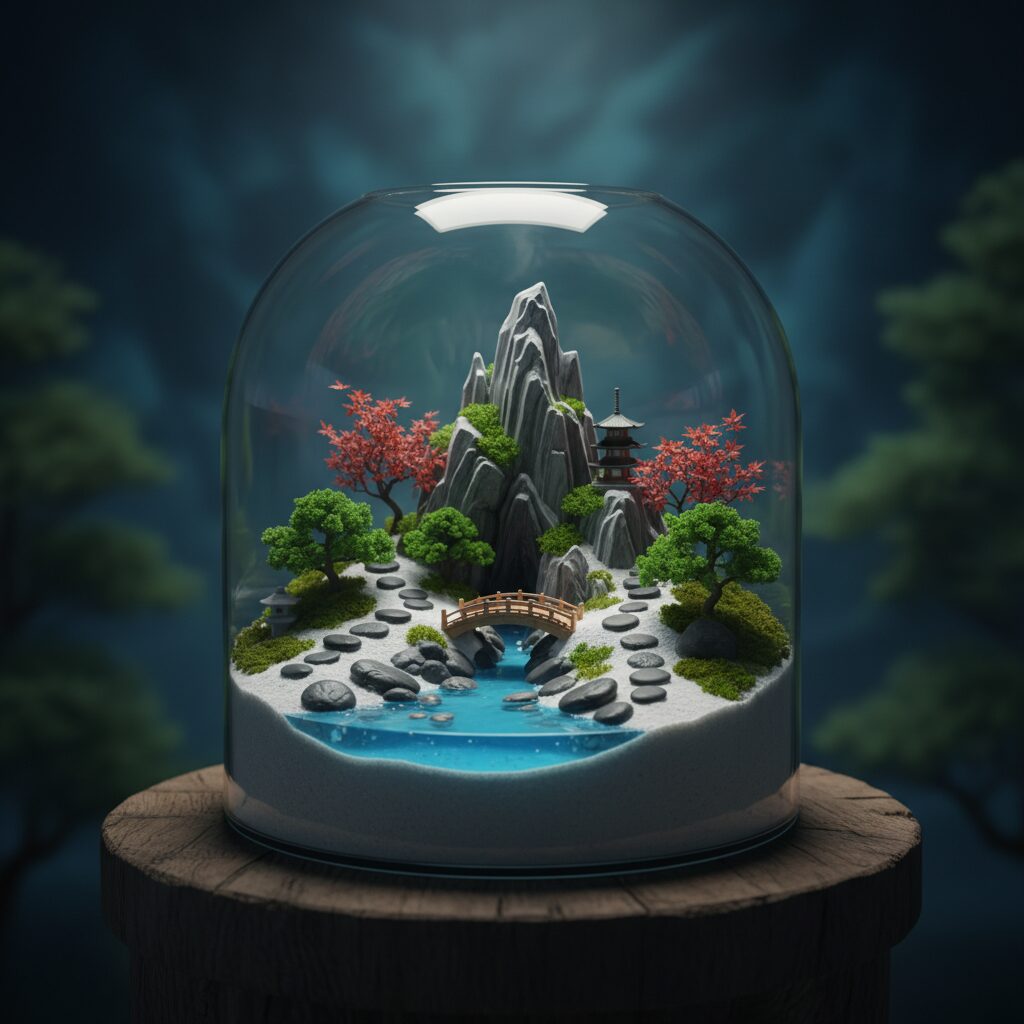
Shakkei is also a masterclass in manipulating perspective. Designers often place larger objects, like prominent rocks or lanterns, in the foreground, with progressively smaller elements guiding the eye toward the back of the garden. This forced perspective enhances the sense of depth and makes the distant borrowed scenery feel even more majestic and remote. The garden itself frequently acts as a miniature, idealized version of the larger world. The famous sand gardens (karesansui) provide a perfect example. Raked white gravel symbolizes the ocean, while a few artfully placed rocks represent mountainous islands. When such a garden borrows the view of an actual body of water or a real mountain, the connection becomes deeply powerful. The symbolic landscape within the garden prepares the mind to appreciate the real landscape beyond it.
The Four Categories of Borrowed Scenery
While the concept of shakkei is holistic, Japanese aesthetes have traditionally divided it into four primary types according to the location and nature of the borrowed view. Understanding these categories enhances appreciation of the subtlety and diversity within this design tradition.
Enshaku (遠借) – Distant Borrowing
This is the classic and most striking form of shakkei, involving the use of a large, distant natural feature. It is almost always a mountain but may also be a hill, volcano, or even the sea. The key is that the feature is far away, creating a sense of grandeur and scale. The Shugaku-in Imperial Villa’s borrowing of Mount Hiei is a prime example, while the Tenryu-ji temple garden in Arashiyama, which frames the nearby mountains of Arashiyama and Kameyama, is another well-known instance. This type of borrowing links the garden to the epic, almost timeless qualities of the natural world.
Rinshaku (隣借) – Adjacent Borrowing
Not all borrowed scenery lies far off. Rinshaku involves borrowing from the garden’s immediate surroundings. This could be the roofline of a neighboring temple, a striking bamboo grove in an adjacent park, or even a pagoda peeking over the wall. This technique creates a dialogue with the garden’s direct environment, weaving it into the local architectural and natural fabric. It recognizes that the garden exists within a community of spaces and aims to harmonize with them rather than exclude them. The gardens of the Adachi Museum of Art are a modern masterpiece of this approach, seamlessly integrating the surrounding natural mountains so that the boundary between garden and landscape becomes indistinguishable.
Gyōshaku (仰借) – Upward Borrowing
Gyōshaku draws the viewer’s gaze upward. This form of borrowing uses elements above the garden, such as the sky, passing clouds, or the canopy of very tall trees just outside the walls. By directing attention upward, the garden fosters a sense of openness and verticality. Picture a small, enclosed courtyard garden where the focus is not on a rock formation but on how the walls frame a perfect square of blue sky, making it a dynamic element that shifts with the weather and time of day.
Fushaku (俯借) – Downward Borrowing
Less common yet equally refined, fushaku involves borrowing a view from below. This technique is typically applied in gardens situated on hillsides or cliffs, where the designer incorporates a view of a river, lake, or valley floor into the composition. The viewer looks down from a vantage point, evoking a feeling of elevation and serene detachment. The garden becomes a perch from which to contemplate the world unfolding beneath.
A Window into the Japanese Mindset
Ultimately, shakkei is much more than a clever horticultural technique. It is a tangible expression of several fundamental principles of Japanese culture and its understanding of space. It unveils a worldview where boundaries between elements are fluid and interconnected.
First, it reflects a deep-rooted belief in the continuity between humanity and nature. The garden is not a barrier against the wild; it serves as a bridge to it. This merging of inside (uchi) and outside (soto) is a profound statement. It implies that a meaningful life is found not by separating oneself from the world, but by discovering one’s rightful place within it. The ideal space is one engaged in continuous, respectful interaction with its surroundings.
Second, shakkei highlights the significance of context and attentiveness to place. A garden cannot be created in isolation. Its design must respond to the unique character of its setting. The mountains, forests, and sky existed first. The designer’s role is not to impose preconceived ideas on the land, but to listen to what the land offers and craft something that enhances it. This respect for context is a defining trait of Japanese aesthetics, from architecture to ikebana.
Finally, the borrowed scenery introduces the dimension of time and impermanence into the garden. The garden’s central focus—the distant mountain—is a living presence. It transforms with the seasons, from spring’s fresh greens to autumn’s fiery maples and the stark white of winter snow. It shifts with the weather, appearing and fading in mist and rain. It varies with the time of day, as shadows lengthen and colors evolve from dawn to dusk. Consequently, the garden is never static. It is a dynamic work that honors transient beauty, embodying the core aesthetic concept of mono no aware. The garden’s perfection lies in its perpetual change, reminding viewers of life’s beautiful and fleeting nature.
So the next time you visit a Japanese garden, allow your gaze to wander. Look beyond the perfectly raked sand and carefully arranged stones. Look over the wall, through the gate, beyond the trimmed pines. The garden invites you to see not only what lies within its borders but also to appreciate its connection to the vast, living world beyond. The true masterpiece of the garden may well be the one that was borrowed.