You’ve seen them. Of course, you have. Walk down almost any commercial street in Japan, from a bustling Tokyo shotengai to a quiet side alley in Kyoto, and you’ll find them glistening under the lights of a restaurant display case. A perfect bowl of ramen, the pork slices gleaming with fat, the broth captured in a state of perpetual steaminess. A plate of spaghetti bolognese, the sauce a rich, impossible red, each strand of pasta perfectly distinct. A towering parfait, its layers of cream, fruit, and ice cream so crisp and vivid they defy the laws of physics and thermodynamics. You stare, your stomach rumbles, and then your brain catches up. It’s not real. It’s all a beautiful, elaborate, and utterly convincing lie. This is the world of shokuhin sampuru, Japan’s art of fake food.
But to dismiss these creations as mere plastic decorations would be a profound misunderstanding. It would be like calling a beautifully crafted menu just a list of ingredients. In Japan, these food samples are far more than that. They are a silent language, a cultural handshake, and a crucial part of the ritual of dining out. They are a promise made solid, a tool of communication that transcends language barriers and ensures one of the most important things in Japanese customer service: the perfect management of expectations. These hyper-realistic models aren’t just there to look pretty; they are there to tell you a story, to guide your choice, and to guarantee that the delicious image in the window is exactly what will land on your table. They are a uniquely Japanese solution to a universal problem, born from a specific moment in history and polished into a remarkable art form.
For a closer look at how these intricate samples blend art and deception, explore the psychological artistry behind Japan’s fake food to uncover deeper cultural insights.
The Birth of a Delicious Illusion
The story of shokuhin sampuru doesn’t start in the kitchens of ancient Japan. It is actually a surprisingly modern invention, emerging during the nation’s rapid modernization in the Taisho (1912-1926) and early Showa (1926-1989) periods. As Japan opened up to the world, so did its palate. Department stores began to feature grand dining halls, and restaurants serving yōshoku—Western-style dishes adapted for Japanese tastes, such as curry rice, tonkatsu, and omurice—became popular. There was just one problem: most Japanese people were unfamiliar with these foods. A written menu describing an “omelet with rice” was an abstract concept. How large was it? What did it look like? Was it worth the price?
Enter Takizo Iwasaki, a craftsman from Gujo Hachiman, a small town in Gifu Prefecture. His origin story has become somewhat legendary. One evening in 1917, while watching the patterns created by dripping wax from a candle into water, he was inspired. The delicate, floral shapes reminded him of his wife’s cooking. He began to experiment. His moment of success arrived when he made a wax model of an omelet, complete with a dusting of ketchup, so realistic that his wife couldn’t distinguish it from the real dish. He had discovered the key. Iwasaki realized he could create three-dimensional, full-color visual menus to clarify these new, exotic dishes for the public.
He established his company, Iwasaki Mokei, in 1932, and the idea quickly gained traction. Restaurants, especially those in the growing department stores, immediately recognized its value. These wax models were not merely advertisements; they served as educational tools. They offered a tangible, visual reference that words alone could not provide. Customers could see the portion size, ingredients, and presentation before making a decision. It was a groundbreaking way to connect culinary curiosity with consumer confidence. The ritual of choosing a meal began not at the table, but rather on the sidewalk, before a glass case filled with flawless, inedible promises.
From Wax to Vinyl: The Craft of Hyper-Realism
The artistry behind shokuhin sampuru exemplifies the Japanese spirit of monozukuri, or craftsmanship. This is far from a mass-produced, factory-line operation. It’s a careful, hands-on process that combines technical skill with an artist’s eye, a craft handed down through apprenticeships. While early models were crafted from fragile, heat-sensitive paraffin wax, the industry underwent a transformation after World War II with the introduction of polyvinyl chloride (PVC), a durable and versatile plastic enabling even greater realism.
The creation process is intricately detailed and always starts with the real dish. A restaurant doesn’t simply send a photo; it sends an actual, perfectly prepared meal to the sampuru workshop. The artisans, true shokunin, immediately begin their work.
First, they make a mold. The real food is carefully arranged and dipped into liquid silicone. The silicone captures every tiny detail—the crumb texture of bread, the grain of a fish filet, the crinkle of a lettuce leaf. Once the mold sets, the real food is removed and the mold cleaned. This becomes the canvas.
Next is casting. Liquid vinyl chloride, tinted to match the food’s base colors, is poured into the mold. It is then heated in an oven until solidified into a durable plastic replica. This initial piece is often pale and lifeless, merely a shadow of the final product. The magic unfolds in the finishing stages.
This is where craftsmanship transforms into high art. Highly skilled painters take over, using airbrushes and fine brushes to breathe life into the model. They are masters of illusion. They know how to paint the glistening sheen of fatty tuna, how to replicate the subtle browning on a gyoza, how to mimic the translucent quality of an onion slice. Every detail is thoughtfully rendered. Grill marks are seared on with a heated tool. Sauces are layered with different glazes to add depth. For something like a bowl of ramen, each element—the noodles, meat, egg, scallions—is created and painted separately before being meticulously assembled in the bowl, with broth (a clear resin) poured in last to seal everything perfectly. They even employ techniques to imitate the fizz in a glass of beer or the condensation on a chilled glass. The aim is not just realism, but an idealized form of it. The food sample must represent the dish at its absolute best.
The Functional Beauty of the Food Sample

In an era dominated by Instagram, QR-code menus, and high-resolution digital displays, one might question why this analog art form continues to endure. The explanation lies in its profound integration into the Japanese dining ritual and the cultural values it embodies. Shokuhin sampuru fulfill a role that a photograph on a screen simply cannot.
The Ritual of Choosing
The display case outside a restaurant marks the first step of the dining experience. It transforms browsing into a tactile activity. You don’t just scroll; you stroll. You pause, you point, you converse. The three-dimensional presence of the food makes it more immediate and tempting. It offers a moment of shared anticipation and decision-making before you even enter the establishment. It sets a calm, unhurried tone for the meal ahead.
The Promise of Precision
Above all, a food sample serves as a contract. In Japanese culture, ambiguity in service is frequently avoided. The sample makes a clear statement: “This is what you will receive.” Not something similar, nor an artistic impression, but this exact dish, with this portion size and these ingredients. It removes the risk of disappointment, a major offense in the realm of Japanese hospitality, or omotenashi. This visual assurance offers customers a strong sense of security. It resonates with a cultural preference for clarity and dependability. You are not merely ordering food; you are ordering a known, verified item.
The Universal Language of Hunger
For those who don’t speak Japanese, the sampuru system is a blessing. It smoothly breaks down the language barrier that can make ordering in a foreign country daunting. There’s no need to fumble with translation apps or grapple with an unfamiliar script. You can simply lead the waiter outside and point. “Kore o kudasai.” This one, please. It is an elegant, straightforward, and universally understood method of communication. It opens up the entire culinary landscape of Japan to everyone, creating a welcoming atmosphere where the only focus is on what looks most delicious.
The Sampuru Economy: A Niche Industry of Perfectionists
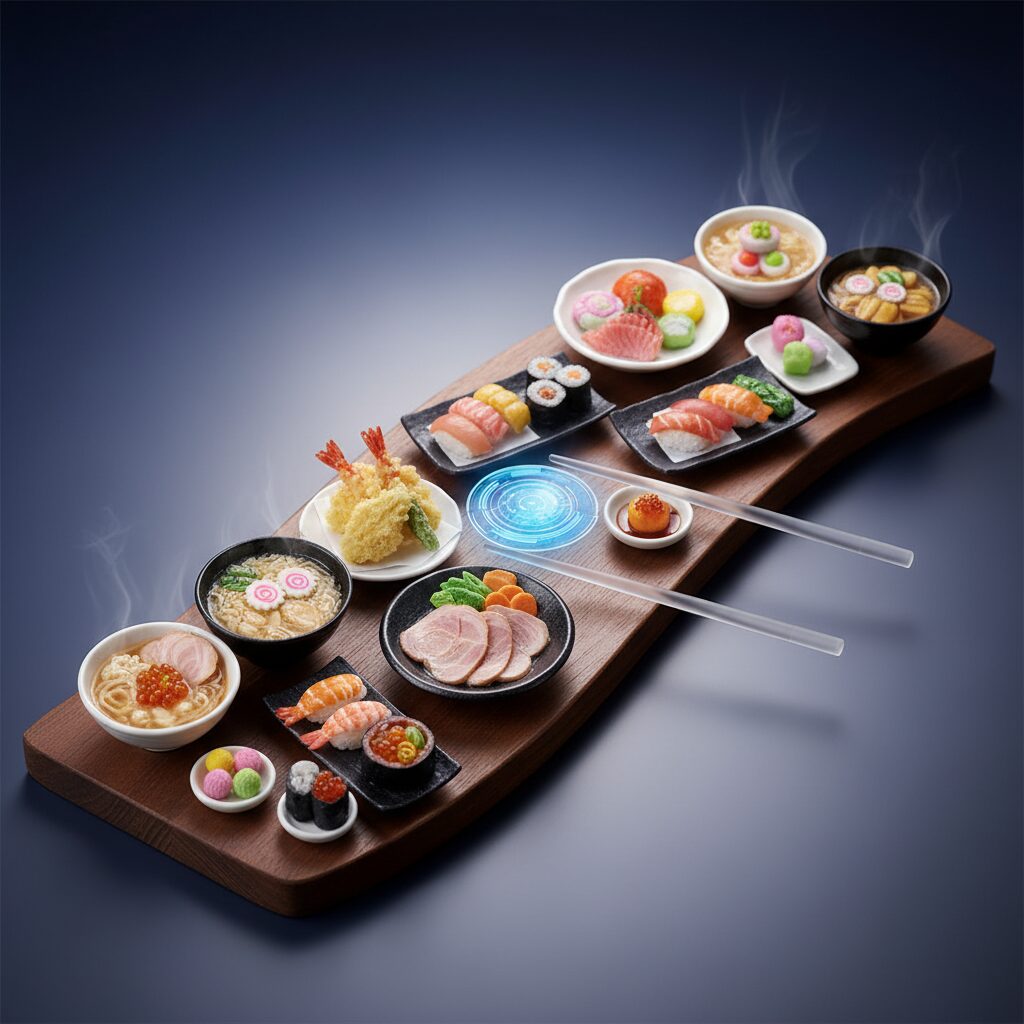
This commitment to plastic perfection underpins a surprisingly strong and specialized industry. Although workshops are spread throughout Japan, the undisputed hub is Kappabashi Kitchen Street in Tokyo. Located between Ueno and Asakusa, this street is a paradise for anyone in the restaurant trade and, for tourists, feels like a surreal open-air museum. Shop after shop showcases an edible world in plastic: rows of sushi, heaps of tempura, countless varieties of ramen, and delicate, intricate cakes. Restaurateurs visit to commission custom samples, often bringing their own tableware to ensure the final model is an exact one-to-one replica of their dishes.
This craftsmanship comes at a cost. Shokuhin sampuru represent a significant investment for restaurants. A simple dish might cost around $50-$100, but a complex, multi-item meal like a full bento box or an elaborate noodle soup can cost several hundred dollars. An entire window display might require an investment of thousands. Yet, for many restaurant owners, it remains a cost-effective marketing tool that operates 24/7, quietly attracting customers and simplifying the ordering process. The artisans behind these works are highly respected in their craft, and though the industry is small, it stands as a proud emblem of Japanese craftsmanship.
Beyond the Restaurant Window: Sampuru as Pop Culture

In recent decades, shokuhin sampuru have moved beyond their purely commercial role and have become a quirky and cherished aspect of Japanese pop culture. The very craftsmanship that makes them so effective has also turned them into objects of fascination, sparking a thriving market for sampuru-themed souvenirs.
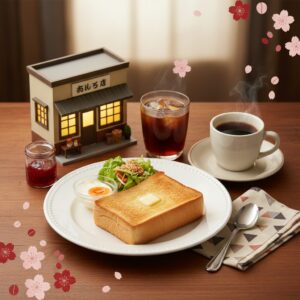
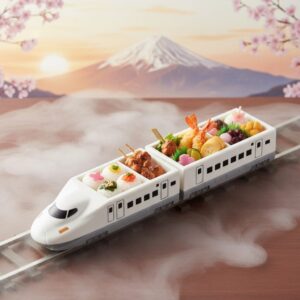
Stroll through any tourist-heavy area, and you’ll encounter them: miniature plates of gyoza doubling as keychains, slices of toast serving as phone stands, or a piece of nigiri sushi transformed into a USB drive. These items celebrate the craft in a fun, portable way, allowing people to bring home a piece of this unique Japanese art form.
Additionally, the craft has evolved into an interactive experience. Workshops, particularly in places like Gujo Hachiman and Kappabashi, now offer DIY classes for both tourists and locals. There, you can learn traditional wax techniques to create surprisingly lifelike tempura shrimp and heads of lettuce. This hands-on approach deepens appreciation for the skill involved and turns sampuru from mere objects into memorable cultural experiences. It’s a clever adaptation, ensuring the craft’s survival by blending entertainment with education.
A Final Taste
The next time you find yourself captivated by a food display window in Japan, take a moment to look closer. Notice the artistry in the subtle char on a piece of grilled eel, the careful placement of a single green pea, the impossible sheen on a dollop of cream. Understand that what you are seeing is not just a clever marketing trick. It is a piece of cultural history, a solution born out of necessity that has blossomed into an art form. It is a communication tool, a promise of quality, and a silent ambassador for Japanese cuisine.
Shokuhin sampuru are a testament to a culture that finds beauty in precision and values honesty—even when presented as a perfect, delicious illusion. They capture the essence of a dish at its ideal moment and preserve it forever, serving as both an invitation and a guarantee, proving that sometimes, what you see is exactly what you get.