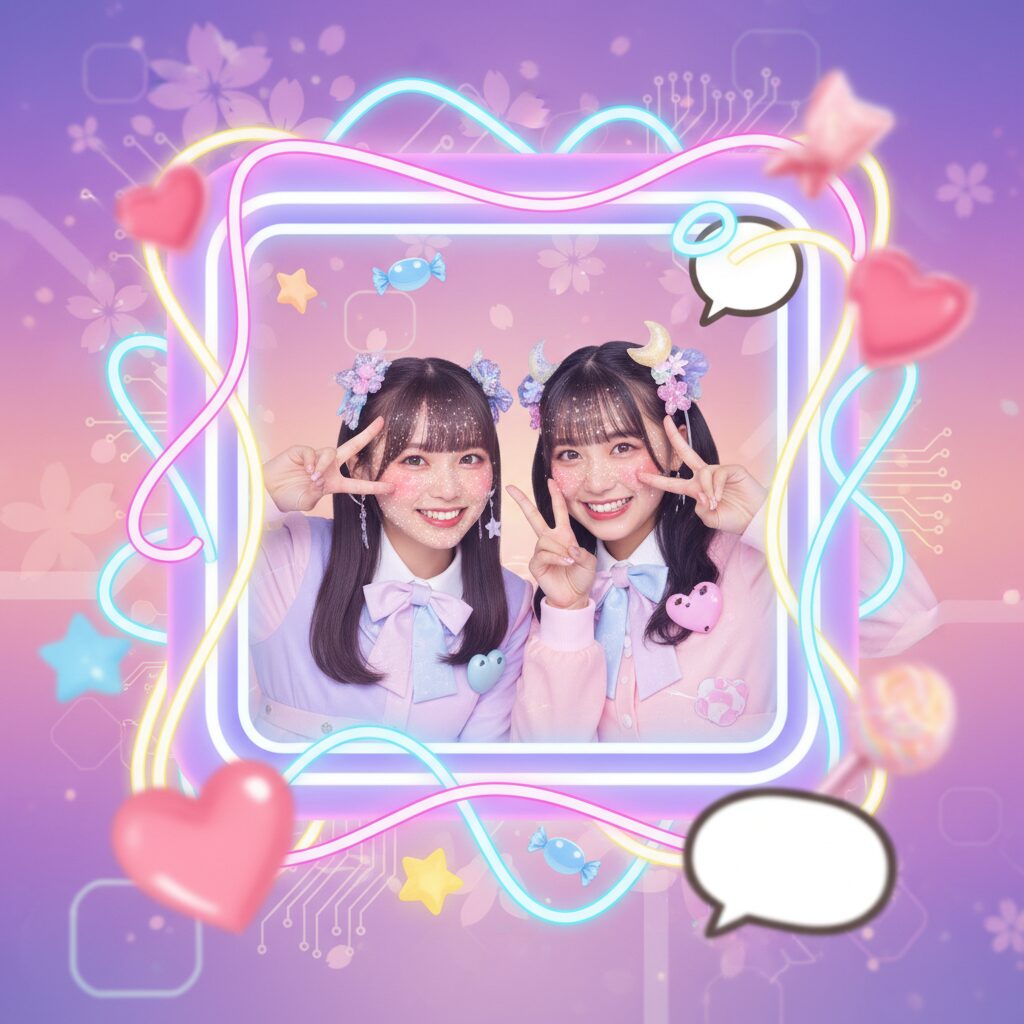
Walk into the games floor of any major electronics store in Japan, or find a dedicated arcade—a ge-sen—and you’ll hear it. A cacophony of digital chirps, upbeat J-pop, and the high-pitched, encouraging voices of unseen digital guides. You’ll see it, too: rows of brightly lit, extravagantly decorated booths, each promising a unique fantasy. Welcome to the world of Purikura. To the uninitiated, these look like simple photo booths, a relic from a pre-smartphone era. But to dismiss them as such is to fundamentally misunderstand a cornerstone of Japanese youth culture. Purikura, a portmanteau of purinto kurabu (print club), is not just about taking a picture. It’s a ritual, a creative medium, a social currency, and a vibrant subculture all its own. The final product isn’t just a photo; it’s an artifact, a tangible piece of a shared memory that gets collected, traded, and cherished in ways a file on your phone never could be. It’s a hobby built on the art of transforming a fleeting moment into a physical token of friendship. To understand Purikura is to understand a uniquely Japanese approach to memory, aesthetics, and social bonding.
This interplay between tangible nostalgia and cutting-edge digital trends is similarly reflected in how Japan’s digital community revolution is reshaping youth culture.
The Anatomy of a Purikura Session
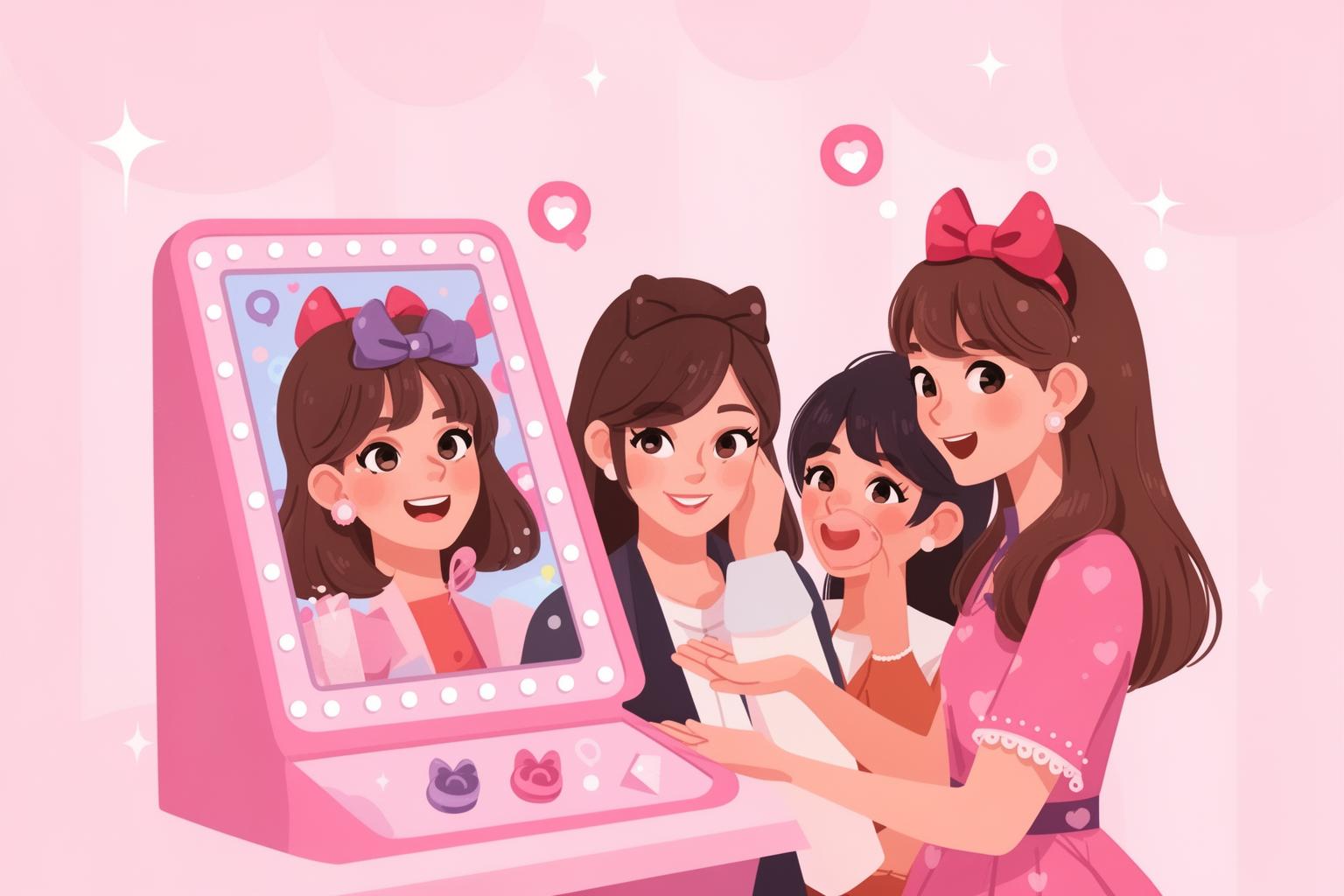
The experience starts well before you enter the booth. The first step is selecting your machine—a critical choice not made lightly. The exteriors are covered with images of models whose features have been digitally enhanced to nearly unreal levels of cuteness: huge, sparkling eyes; flawless, porcelain skin; and impossibly sharp, V-line jaws. Each machine has a name—’Melulu’, ‘AROUND20’, ‘97% Face’—and offers a different aesthetic. One might focus on a soft, dreamy appearance, while another adopts a sharp, fashion-magazine look. Your selection sets the tone for the entire creative journey. It’s a mutual understanding among friends about the kind of idealized reality you want to craft together.
After inserting your ¥400 or ¥500 into the slot, the curtain closes, and you enter a different world. Inside, the booth becomes a small, private stage. A large screen controls the action, with a relentlessly cheerful voice counting down timers and suggesting poses. “Three, two, one… smile!” It’s a frantic and often amusing performance against a stark green backdrop. You and your friends scramble to mimic the on-screen examples—forming hearts with your hands, pointing to your cheeks, making peace signs. There’s no time for self-consciousness; the pace is too fast, and the energy too high. This shared, slightly chaotic moment is the foundation of the bonding ritual.
The real magic begins after the camera flashes for the last time. You’re guided to the rakugaki (doodling) corner, an external editing station with two touchscreens and styluses. Here the photo transforms into a canvas. The clock ticks down again, usually allowing just a few precious minutes, and a flurry of collaborative decisions starts. The software presents a dizzying array of tools. You can enlarge your eyes, slim your face, smooth your skin, and apply digital makeup from blush to lipstick. Then come the decorations: an endless collection of stamps, from cute animals and sparkling jewels to seasonal designs. You can add messages, include the date, and choose from dozens of stylized fonts. It’s a negotiation. “Should we make our eyes bigger?” “Which pen color looks best?” “Quick, add the sparkles!” Everyone has a voice. When the timer finally runs out, the machine processes your creation.
A minute later, a warm, glossy sheet of stickers appears from the slot. The final part of the ritual is cutting and sharing the spoils. Most sheets feature a main set of larger photos alongside several smaller copies. Scissors are almost always provided. The group gathers closely, carefully dividing each sticker. Deciding who gets which picture is its own delicate social dance. The session isn’t complete until everyone has their share—a tangible souvenir of the last fifteen minutes of shared creativity and laughter.
From Souvenir to Social Currency
That freshly cut sticker is more than just a keepsake. It holds immediate social significance. For decades, the main place for these photos has been the purikura-chō, or Purikura album. This is far from a simple photo album; it serves as a carefully curated diary of one’s social life. Often small enough to fit in a handbag, these notebooks become deeply personal artifacts. The pages are not only filled with the stickers but also handwritten notes, inside jokes, and dates. They form a tangible timeline of friendships.
Exchanging Purikura is a fundamental act of friendship. When you meet a friend, especially during your teenage years, taking Purikura together is a common ritual. Afterward, you swap stickers—you give one from your session for their album, and they do the same for you. This exchange carries a powerful meaning: “This moment we shared is important enough to remember. You are part of my story, and I want to be part of yours.” It’s a reciprocal bond made physical.
Browsing through someone’s purikura-chō is like exploring a map of their social world. You notice the development of friendships—who appears often, who fades away. You can observe changes in fashion, hairstyles, and makeup trends. These albums serve as intimate archives of youth, holding memories of school trips, summer festivals, birthdays, and everyday after-school hangouts. The stickers inside are proof that you were there, that you belonged. Before social media, this was the primary method for publicly documenting and sharing your social life within your close circle.
Even today, when digital photos can be shared instantly with thousands, the physical exchange of a Purikura sticker still holds its power. It demands physical presence. It’s a private exchange between two people, not a broadcast to an audience. The sticker becomes a token, a small but tangible proof of a real-world connection.
The Art of Decoration: Beyond the Booth
The life of a Purikura sticker doesn’t always conclude in an album. Many are repurposed to personalize everyday items. This is where Purikura connects with Japan’s broader deco (decoration) culture—the impulse to decorate and customize mass-produced goods.
Take a closer look at a Japanese high school student’s belongings, and you’ll often see Purikura. They are stuck on the back of phone cases, creating a collage of familiar faces surrounding the device you use to communicate with those friends. They embellish pencil cases, notebooks, and diaries. They slip inside the clear plastic of student ID holders and train pass cases. This is more than decoration; it’s a way of building identity. By covering your possessions with pictures of your friends, you openly declare who you are and whom you belong with. Your social circle becomes part of your personal identity.
This decorative act adds extra significance to the sticker. A photo placed in an album serves as a memory to revisit. A photo stuck on a phone case is a constant, public-facing reminder of your social bonds. It silently announces to the world the people you cherish.
The creative process also extends to the sticker itself. Even after the intensive digital editing, people often add another layer of analogue customization. Using fine-tipped permanent markers, they write directly on the sticker, inserting small messages, hearts, or inside jokes that weren’t possible in the booth. This final, handwritten detail makes the sticker even more unique. It bridges the gap between the hyper-digitized look of the photo and the personal, physical world of the owner.
Why It Endures in the Age of the Selfie
It’s a valid question: in a world where every smartphone boasts a high-quality camera and countless editing apps, why do people still pay to squeeze into a booth and print tiny stickers? The continued popularity of Purikura reveals what digital media simply cannot offer.
The most straightforward reason is tangibility. A photo on a screen is fleeting. It exists in a vast, intangible cloud, one among thousands. It can be endlessly copied and holds little inherent value. A Purikura sticker, on the other hand, is a unique, physical item. You can hold it in your hand. You can give it to someone. It can become creased, faded, or lost. This rarity and fragility give it worth. It’s something real from the physical world, not just a collection of pixels.
Moreover, Purikura provides a very particular kind of escapism. It was never about capturing reality. It’s about crafting a kawaii (cute), idealized version of reality. The bold beautifying effects—the eye enlargement, the skin smoothing—are not intended to mislead. They serve as a form of playful performance. Everyone is aware of this shared understanding. The aim is to create a hyper-real, fantastical version of yourselves together. This is a distinct kind of performance compared to the carefully curated “authenticity” on Instagram. Purikura is unapologetically artificial, and that’s exactly the point. It’s a funhouse mirror, not a window.
Most importantly, Purikura is a focused, shared experience. Taking a selfie can be a spontaneous, individual act. A Purikura session, in contrast, is a planned event. It’s a destination. The booth itself provides a private, intimate space for a group of friends to be silly and creative together. The entire process, from picking the machine to cutting the stickers, is a collaborative ritual. The final sticker sheet is more than just a picture; it’s a memento of the good times you shared. It’s evidence of a shared experience, not merely a shared image.
Ultimately, Purikura is an ideal microcosm of a particular type of Japanese cultural expression. It blends a love of technology, a distinct kawaii aesthetic, and a deep respect for tangible objects and social rituals. It has endured the digital revolution not by competing with it, but by offering something fundamentally different: a private, playful, and physical way to celebrate and strengthen the bonds of friendship. Long after digital files on our phones have been lost to corrupted hard drives or forgotten passwords, a faded Purikura sticker, tucked inside an old notebook, will persist—a small, shiny monument to a moment in time shared with a friend.