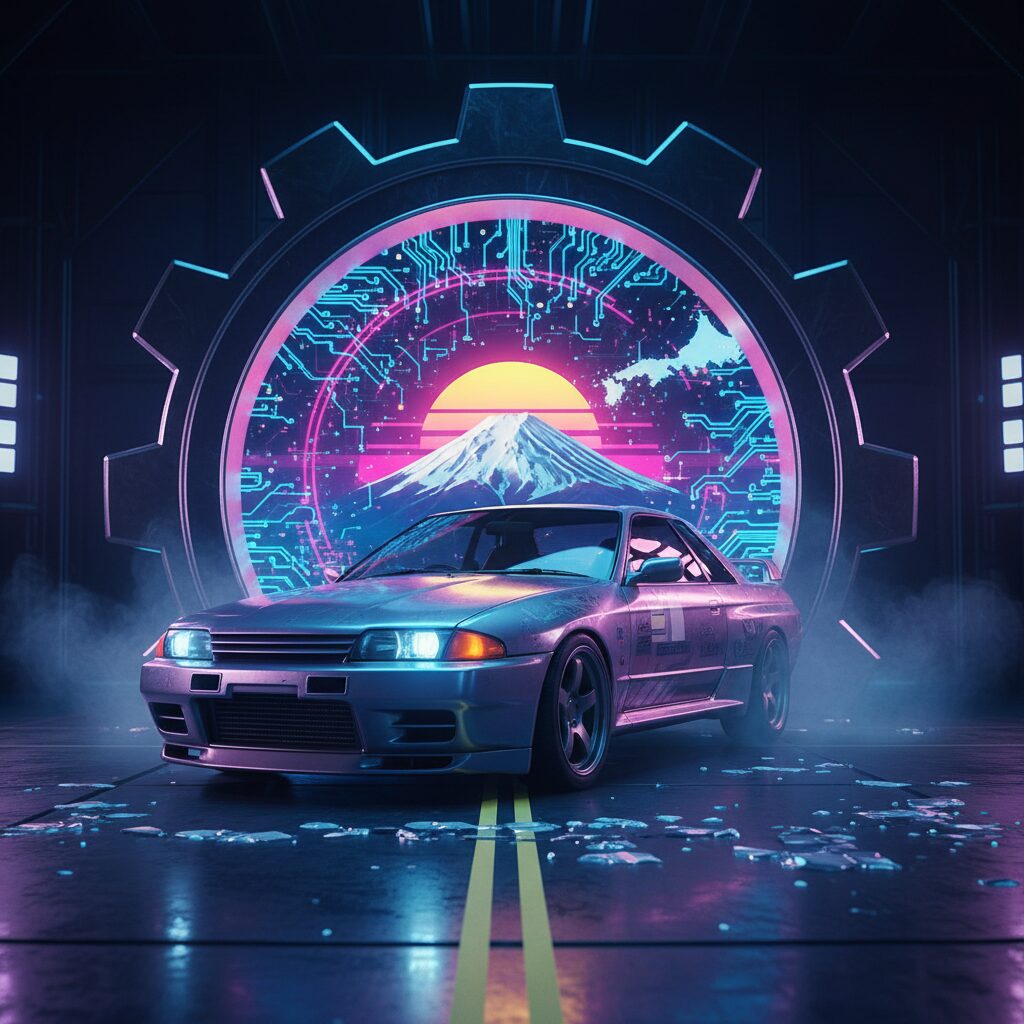
Ask someone what “JDM” means, and you’ll likely get an image of a slammed Honda Civic with a loud exhaust or a neon-drenched Nissan Skyline drifting through a fictionalized Tokyo night. That’s the surface level, the pop culture caricature. But to a global community of die-hard enthusiasts, JDM—Japanese Domestic Market—isn’t just a style. It’s a philosophy. It’s a specific, unrepeatable moment in automotive history, primarily centered on the 1990s, when Japanese car manufacturers, flush with cash and ambition, built some of the most meticulously engineered, brilliantly overbuilt, and deeply soulful machines the world has ever seen.
These aren’t just old cars. They are legends. The Toyota Supra, Nissan Skyline GT-R, Mazda RX-7, Acura NSX, Mitsubishi Lancer Evolution, Subaru Impreza WRX STI. Names spoken with a certain reverence. Decades after they rolled off the assembly line, their values are skyrocketing, and an entire subculture is dedicated to preserving, modifying, and celebrating them. The question is, why? Why does a thirty-year-old Toyota command more respect—and often, more money—than many brand-new performance cars? It wasn’t just about being fast. It was about how they were fast. It was about a fanatical devotion to engineering precision, a deep understanding of the connection between driver and machine, and a cultural moment that turned these cars from mere transportation into objects of near-mythical status. To understand the cult of 90s JDM, you have to look past the spoilers and stickers and peer into the soul of the machine itself.
The passion fueling these legendary machines finds a fascinating parallel in the evolution of Japan’s innovative trends, as seen in the country’s transformative kawaii pop culture export.
The Bubble Economy’s Blank Check

To understand why these cars exist, you first need to comprehend Japan in the late 1980s. This period marked the height of the Japanese asset price bubble, known as the “Bubble Keizai.” The economy was booming with a force rarely seen worldwide. Japanese corporations were acquiring foreign assets, the Nikkei index was reaching unprecedented heights, and there was widespread national confidence and technological optimism. For automakers in the country, this translated into an unparalleled era of research and development.
This was no longer about economical, sensible Corollas and Civics. It was about demonstrating technological dominance on the global stage. Engineering teams received what was essentially a blank check with a clear directive: build the best car possible, push boundaries, and disregard the cost. It was a matter of national and corporate pride. Honda aimed to challenge Ferrari with the NSX, enlisting legendary Formula 1 driver Ayrton Senna to help perfect its chassis. Nissan revived the iconic “GT-R” badge for its R32 Skyline, striving to create a machine so advanced it could dominate Group A touring car racing. Mazda invested heavily in refining the unconventional rotary engine. This was a conflict waged not on battlefields, but in engine labs and on test tracks.
The outcome was a generation of cars that were extravagantly over-engineered for typical road use. They were crafted with a level of durability and technological sophistication unnecessary for everyday driving because their real purpose was to make a statement. This economic anomaly fostered the ideal environment for the legends that would emerge, supplying the financial resources for a surge of automotive innovation.
Engineering as an Art Form: The Philosophy of “Overkill”
The true essence of the 90s JDM legend lies in the metal itself. These cars were not merely assembled; they were meticulously crafted with a dedication to detail that bordered on obsession. This philosophy of “over-engineering” meant that components were designed to endure stresses far beyond what they would typically face on public roads. It wasn’t just good engineering; it was a legacy gifted to the future tuning community.
The Engine as the Heartbeat
At the center of every great JDM car was an equally remarkable engine, many of which have become icons in their own right. These powerplants were masterpieces of durability and ingenious design, often restrained by a domestic industry agreement.
Take Toyota’s 2JZ-GTE, the inline-six engine from the A80 Supra. It’s renowned not only for its smooth power delivery courtesy of its sequential twin-turbochargers but also for its insanely strong iron block and forged internals. From the factory, it was a powerful engine, yet tuners quickly uncovered its hidden potential: the stock bottom end could reliably handle two, three, or even four times the factory horsepower with the right supporting modifications. Toyota didn’t build an engine for just 320 horsepower—it was essentially a race engine made available to the public.
Then there was Nissan’s RB26DETT, the heart of the Skyline GT-R. This 2.6-liter twin-turbo inline-six was engineered from the ground up to endure the rigors of motorsport. It was a high-revving, technologically advanced unit that, like the 2JZ, was built to tolerate tremendous punishment. Meanwhile, Honda pursued a different approach with its B-series and H-series engines, refining its VTEC (Variable Valve Timing and Lift Electronic Control) system. VTEC was a stroke of brilliance, enabling a small-displacement engine to be quiet and efficient at low RPMs, then transform into a high-revving, screaming monster at the press of an electronic switch. This gave Honda’s cars a dual personality—a sensible commuter by day and a race-bred beast on demand.
This engineering excellence was paradoxically shaped by a limitation: the notorious “Gentleman’s Agreement.” In the late 1980s, Japanese automakers informally agreed to cap the advertised horsepower of their domestic performance cars at 280 PS (276 horsepower) to avoid a horsepower war and promote safety. This didn’t imply the cars only produced 276 horsepower; many generated more straight from the showroom. More importantly, it pushed engineers to emphasize other performance facets. Instead of merely chasing peak power, they honed torque curves, throttle response, and chassis dynamics. It also meant these engines were fundamentally under-stressed, making them remarkably easy to “de-restrict” and unleash their vast true potential.
A Symphony of Systems: Beyond the Powertrain
Japanese engineers knew that a great car depends on more than just a great engine. The 90s witnessed a surge of innovation in chassis dynamics, all-wheel drive, and aerodynamics, producing comprehensive performance machines.
The R32, R33, and R34 Nissan Skyline GT-Rs were perhaps the pinnacle of this development. Their ATTESA E-TS (Advanced Total Traction Engineering System for All-Terrain with Electronic Torque Split) all-wheel-drive system was groundbreaking. It primarily operated as a rear-wheel-drive car for nimble handling, but a sophisticated system of sensors and a computer-controlled clutch could instantly direct up to 50% of the power to the front wheels when slip was detected. Together with four-wheel steering, the GT-R achieved a level of grip and all-weather capability that seemed to defy physics. It earned the nickname “Godzilla” in Australia for its domination in touring car races.
Mitsubishi’s Lancer Evolution and Subaru’s Impreza WRX STI, born from fierce World Rally Championship competition, brought similar technology to the masses. Their sophisticated, computer-controlled all-wheel-drive systems, featuring active differentials, could vector torque not only between front and rear axles but also between left and right wheels, helping to steer the car through corners with exceptional precision.
At the other end of the spectrum was Mazda. With models like the RX-7 (FD3S) and Miata (MX-5), the focus was less on high-tech wizardry and more on purity and balance. The RX-7, powered by its compact, lightweight twin-rotor Wankel engine, allowed designers to position the engine behind the front axle, achieving an ideal 50/50 weight distribution. The car embodied the philosophy of jinba ittai, a Japanese term meaning “horse and rider as one.” Every input from the driver was met with an immediate and predictable response. It was about forging a sense of connection and harmony—a distinctly Japanese approach to performance that prized feedback and balance over sheer power.
The Driver-Centric Cockpit: A Connection, Not an Isolation
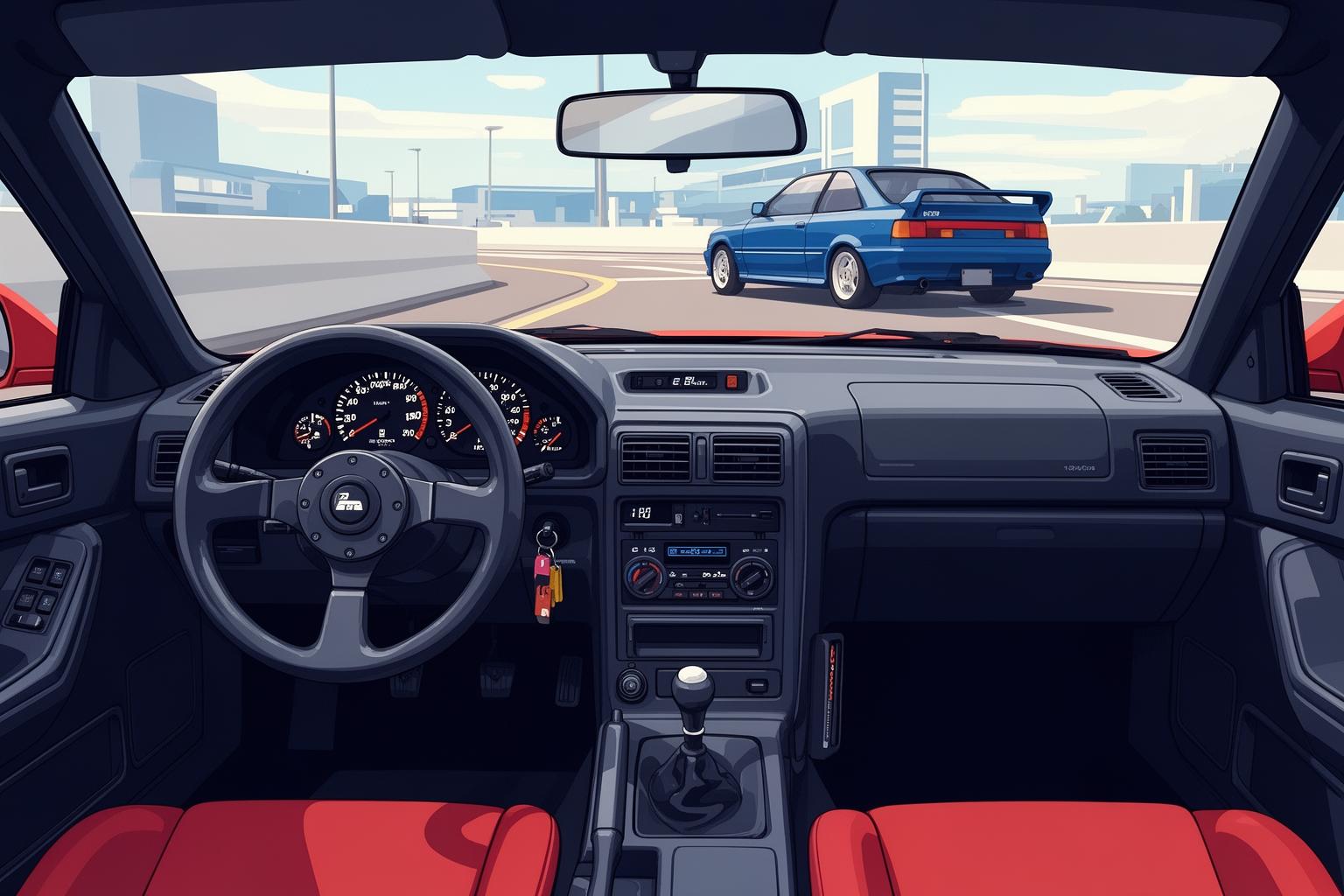
This philosophy of connection extended to the car’s interior. While European luxury brands were starting to fill their vehicles with wood trim and plush, isolating cabins, Japanese manufacturers focused on designing cockpits that were spartan, functional, and unapologetically centered on the act of driving.
Sit inside a 90s Supra, NSX, or RX-7, and you’ll find everything oriented toward the driver. The center console is often angled inward, placing climate and audio controls within easy reach. The gauges are large, clear, and simple analog dials—without distracting digital screens. The shifter has a short, mechanical throw, the steering wheel delivers unfiltered feedback from the road, and the seats are bolstered to hold you firmly in place during aggressive cornering.
There was an inherent honesty to these interiors. The materials weren’t always luxurious—this was, after all, the era of hard Japanese plastics—but they were durable and purposeful. The design communicated the car’s intent clearly: this is a machine for driving, not for being chauffeured. It aimed to minimize distraction and maximize the sensory information flowing from the car to the driver. This created a tactile, analog experience that is increasingly rare in modern vehicles, which often use technology to insulate the driver from the mechanical workings of the car.
From Touge to Global Phenomenon: The Cultural Catalyst
Brilliant engineering by itself doesn’t create a global cult following. The legend of 90s JDM was propelled and shared worldwide through a perfect storm of cultural influences that transformed these cars into icons.
At its core was the domestic tuning scene in Japan. Due to their robust construction, these cars served as ideal blank canvases for customization. A vast aftermarket industry, featuring companies like HKS, GReddy, Blitz, and Mine’s, emerged to provide everything from exhaust systems to large turbochargers. This culture was chronicled and celebrated in Japanese car magazines such as Option and Drift Tengoku, and in video series like Best Motoring, which showcased professional race drivers pushing tuned cars to their limits on tracks like Tsukuba.
This niche culture was then exported and romanticized globally. The manga and anime series Initial D narrated the story of a young driver named Takumi Fujiwara, who delivered tofu for his father’s shop in a modest Toyota AE86, perfecting his skills on the mountain passes (touge) of Gunma. The series became an international sensation, elevating the AE86 to legendary status and introducing the world to the art of drifting. It wasn’t just about the cars; it encompassed the discipline, the technique, and the underdog spirit.
Perhaps the most influential spark was the video game Gran Turismo for the Sony PlayStation. Created by the detail-oriented Kazunori Yamauchi, Gran Turismo was a tribute to the automobile, with its car roster heavily featuring JDM legends. For the first time, kids in America, Europe, and beyond could virtually “drive” and customize a Skyline GT-R, a Lancer Evolution, or a Supra. They could learn the specifications, experience the handling, and fall in love with these cars years before they were legally available in their own countries. The game became a virtual encyclopedia and an introduction to an entire generation of JDM fans.
The Legacy: Why We Still Care

So why, in an era of electric hypercars boasting outrageous acceleration, do we remain so captivated by these thirty-year-old Japanese machines? Because they symbolize something that has largely vanished. They are relics from a unique moment in history when a booming economy, intense corporate pride, and a culture of engineering excellence came together.
Modern performance cars are, by nearly every objective measure, faster, safer, and more efficient. Yet they are also heavier, more complex, and often less engaging. They come loaded with driver aids, electronic safeguards, and infotainment systems that can dilute the pure joy of driving. The 90s JDM legends offer a distinct alternative. They are analog within a digital world. They demand focus and skill. Piloting a modified Supra with a single turbo swap or a twitchy, lightweight RX-7 calls for respect and concentration. But the payoff is a raw, mechanical, and deeply immersive connection between driver and machine.
They are not merely relics of the past. They serve as rolling testaments to an era when cars were crafted with a tangible soul, born from the ambitions of engineers free to dream. That’s why they are more than just collector’s items. They stand as icons of a global faith, whose gospel of engineering purity and driver-centered design continues to resonate today.