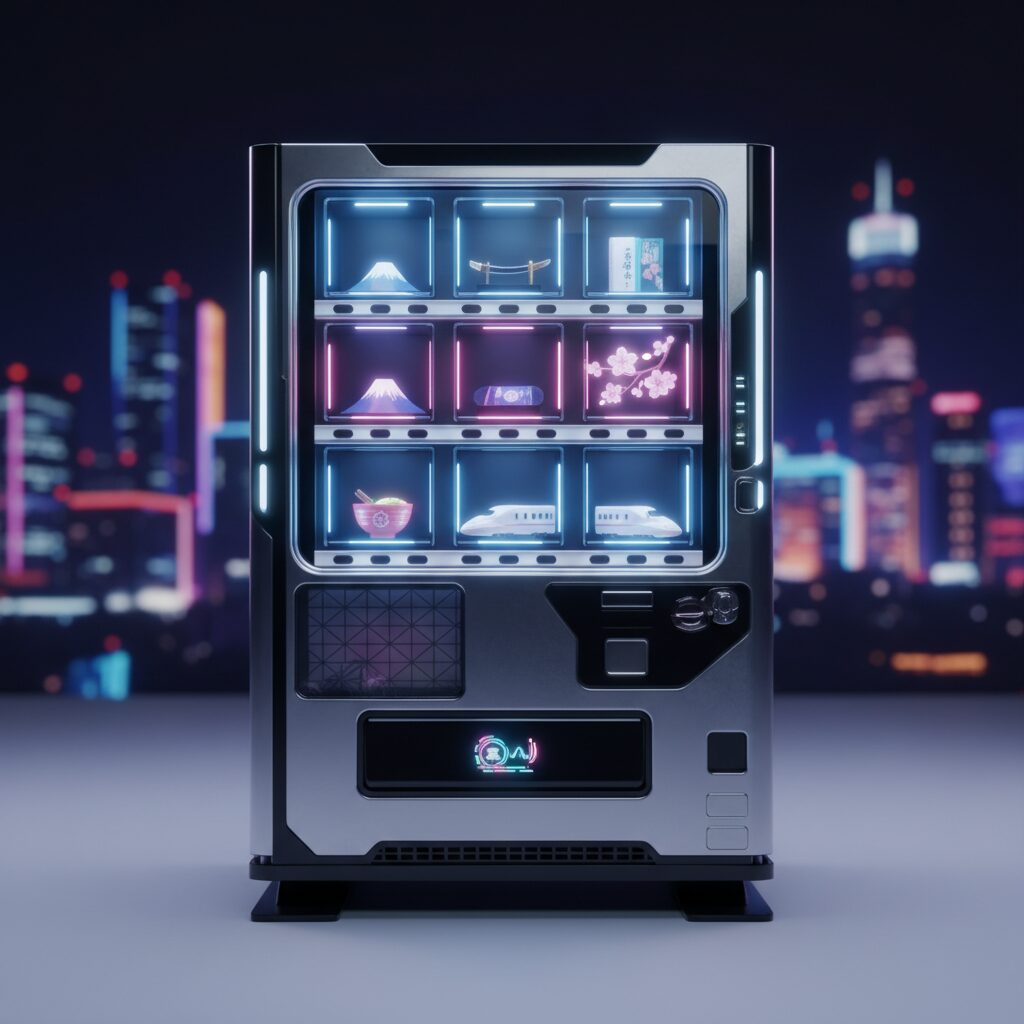
You see them before you even really notice them. They’re part of the scenery, as fundamental to the Japanese streetscape as tiled roofs and intricate wiring. A glowing rectangle of light humming quietly in the Tokyo midnight, a solitary sentinel standing guard over a sleepy rural intersection, a surprising splash of color next to a mountain shrine. I’m talking about the jihanki, the Japanese vending machine. And if you’ve spent any time here, you know they’re not just for drinks. They are an entire ecosystem, a silent, 24/7 retail network that offers everything from hot coffee and cold beer to flying fish soup stock, surgical masks, and even edible insects.
The first question that usually comes to mind is simple: why? Why are there over four million of these things scattered across the country? That’s roughly one for every 30 people. The second question, often asked with a sense of disbelief, is how? How do they survive without being vandalized, emptied of their cash, or smashed to pieces? It’s a valid question for anyone coming from a country where a lone machine filled with money and goods would have the life expectancy of a snowflake in a furnace. But to understand the vending machine in Japan is to understand something essential about the culture itself. It’s not just about convenience. It’s a story of social trust, economic pressures, and a national obsession with efficiency and novelty. This isn’t just a subculture for collectors; it’s a fundamental utility that reflects the very vibe of modern Japanese life.
This exploration of Japan’s unique vending machine ecosystem mirrors the captivating blend of tradition and modernity found in its intricate model train universe.
A Society Engineered for Efficiency
At its essence, the vending machine serves as a solution—addressing a range of uniquely Japanese problems and priorities. To understand their widespread presence, one must consider the pressures that shape daily life in Japan, especially in the expansive urban centers where the majority of the population lives and works.
The Currency of Time
Life in a Japanese city moves at an unyielding pace, synchronized to train schedules timed in seconds rather than minutes. For millions of office workers, the salaryman, time is an invaluable and limited resource. Their daily routine is a lesson in efficiency. There’s no room for a leisurely chat with a barista in the morning; only enough time to quickly grab a can of hot BOSS coffee from a machine on the station platform before the train doors close. Stopping at a liquor store on the way home isn’t an option; just enough time remains to pick up a cold Asahi Super Dry from the machine on your corner to enjoy with dinner.
Vending machines enable smooth, frictionless transactions. They remove the need for small talk, waiting in lines, or anything that might steal precious seconds from an already packed schedule. In a culture that often values efficiency over personal interaction in commercial exchanges, the vending machine acts as the ideal intermediary: silent, swift, and consistently dependable. It is a vital piece of infrastructure that keeps a constantly moving society running smoothly.
The Economic Equation
Beyond the cultural emphasis on speed, significant economic factors also influence their prevalence. Japan possesses one of the world’s oldest populations and, consequently, a shrinking labor force. Staffing a 24/7 convenience store, let alone a small kiosk, is both challenging and costly. In contrast, a vending machine operates continuously without the need for holidays, sick days, or retirement benefits. Its sole requirements are electricity and occasional restocking.
For business owners—ranging from large beverage giants like Suntory and Kirin to small local farmers—the calculation is straightforward. A machine represents a low-overhead, low-risk employee. It can occupy a small, otherwise unused slice of space—whether in an alleyway or a neglected corner of a parking lot—and generate income. This practical economic reasoning is a core factor behind their vast numbers. Vending machines are not merely convenient; they are a wise business choice in a country confronting distinctive demographic challenges.
The Unspoken Contract: Trust as Infrastructure
This explains the why, but it doesn’t address the how. How does this multi-billion-dollar network of unattended cash boxes manage to survive? The answer lies in one of the most defining, yet often unnoticed, features of Japanese society: an exceptionally high level of public trust combined with an incredibly low crime rate.
An Invisible Shield of Social Order
For the vast majority of Japanese people, the idea of smashing a vending machine to steal a few thousand yen and some drinks is simply not even considered. It’s not just about fearing punishment, although the police are indeed effective. Rather, the act itself is a serious breach of the social contract. It violates the collective understanding that public spaces must be respected. Property—whether owned by an individual or a company—is treated with a fundamental level of care.
This doesn’t stem from any inherent moral superiority. Instead, it reflects a culture that places great importance on group harmony and civic responsibility. Causing public disturbances or damaging shared property brings about a social shame far more compelling than the risk of legal consequences. In effect, every citizen acts as a passive security guard, and the shared expectation of order forms an invisible shield around each machine.
The Power of Proximity
This social fabric is further strengthened by the physical environment. Japan is an incredibly densely populated country. Even in residential areas, homes are tightly packed. A vending machine is rarely isolated. It sits within sight of apartment windows, a neighbor’s front door, or a street with a constant flow of pedestrians. The sense of anonymity that might encourage vandalism in a sprawling suburb elsewhere simply doesn’t exist in the same way here.
These machines become an ordinary part of the neighborhood’s landscape. Residents grow accustomed to their familiar glow. Damaging one would feel like knocking over a neighbor’s potted plant or keying their car—an unmistakably antisocial act that would be noticed and, more importantly, condemned. It belongs to the street, and therefore, it belongs to everyone.
Beyond the Beverage: A Universe of Niche Offerings
While cans of coffee, tea, and beer form the foundation of the vending machine empire, it’s the strange and wonderful outliers that transform them from mere convenience into a cultural phenomenon. This is where you witness the experimental, playful, and hyper-specific aspects of Japanese consumerism.
The Corporate Test Kitchen
Have you ever wondered who actually buys a can of carbonated pancake-flavored soda or a bottle of chilled sweet potato soup? Often, the answer is nobody for long. For beverage giants, vending machines act as the ultimate low-risk laboratory for market research. Before investing in a nationwide advertising campaign and securing valuable supermarket shelf space, they can test a quirky new product in a few thousand machines. If it sells, it could be a potential hit; if it fails, it can be withdrawn with minimal financial loss. This ongoing cycle of trial and error drives the endless variety and excitement of discovery for consumers. You never know what strange new flavor you might encounter.
The Rise of the Hyper-Niche Machine
This is where the true subculture thrives. Beyond the corporate giants, you find machines catering to extremely specific needs and local tastes. These are often operated by small, independent businesses to extend their reach beyond normal hours.
In some neighborhoods, you’ll encounter machines selling dashi, the essential soup stock of Japanese cuisine. These aren’t just powder packets; they’re often bottles of artisanal, locally made broth, sometimes with a grilled flying fish included for flavor. Who is this for? It’s for the serious home cook who runs out of their preferred stock mid-recipe, or someone who values authentic flavor but lacks the time to make it from scratch. It reflects a foundational culinary standard that is uniquely Japanese.
Elsewhere, you’ll find machines offering fresh farm eggs, bags of rice from local growers, or even hot, crispy French fries. In Akihabara, you might discover canned bread or machines vending collectible figurines. These aren’t just novelties; they serve as direct-to-consumer storefronts, connecting producers with their customers around the clock.
A Destination in Itself
For some, the vending machine represents more than just a point of sale. It can serve as a landmark, a gathering spot, and even a reason to travel. This is where passive infrastructure becomes an active subculture, beloved by enthusiasts and documented by digital pilgrims.
The Roadside Oasis
Travel along any major highway or rural route late at night, and you will eventually encounter a “jihanki corner.” This is a grouping of a dozen or more machines, brightly illuminated, often situated in the middle of nowhere. There may be a simple bench and a few recycling bins. For long-haul truck drivers, these are vital rest stops—a place to enjoy a hot meal of noodles or curry from a retro machine, a strong coffee, and a moment of calm. For local teenagers in towns with little to do, it can be a hangout spot, a social hub powered by fluorescent lights and inexpensive soda.
The Nostalgia Hunters
In Japan, there is a devoted community of enthusiasts who seek out and document vintage vending machines. These aren’t sleek, modern digital-screen models but clunky, mechanical relics from the Showa Era (1926-1989) that dispense items like hot toast in a cardboard box or a bottle of milk with a paper cap. Discovering one of these feels like a form of urban archaeology. They are remnants of a more analog past, and for many, they inspire a strong sense of natsukashii, a tender, nostalgic longing for bygone days. These machines have become pilgrimage sites, with their locations shared online and their dwindling numbers mourned by a passionate subculture.
The Silent, Glowing Companion
Ultimately, the Japanese vending machine is more than just a box that sells items. It stands as a symbol—a quiet testament to a society built on trust and efficiency. It serves as a small beacon of safety, its light piercing through a dark alley, reassuring you that you are not truly alone. It embodies a culture of self-service and seamless living, where you can obtain what you need without engaging in the social dance of a retail transaction.
It is the salaryman’s first coffee and last beer. It is the hiker’s reward at the summit—yes, they are even found there. It is the farmer’s unmanned stall and the novelty hunter’s treasure trove. It is a silent, humming, ever-present companion in the daily journey of life in Japan. It asks for nothing, yet is always there when you need it. In that simple, dependable presence, it reveals more about this country than a thousand guidebooks ever could.