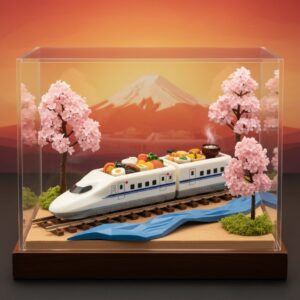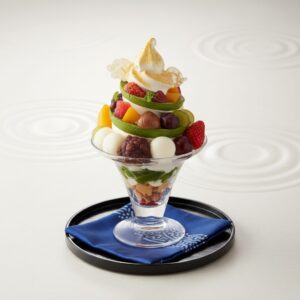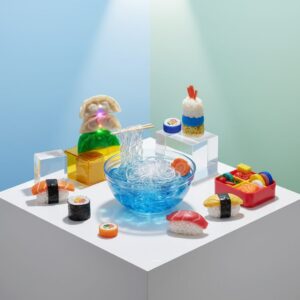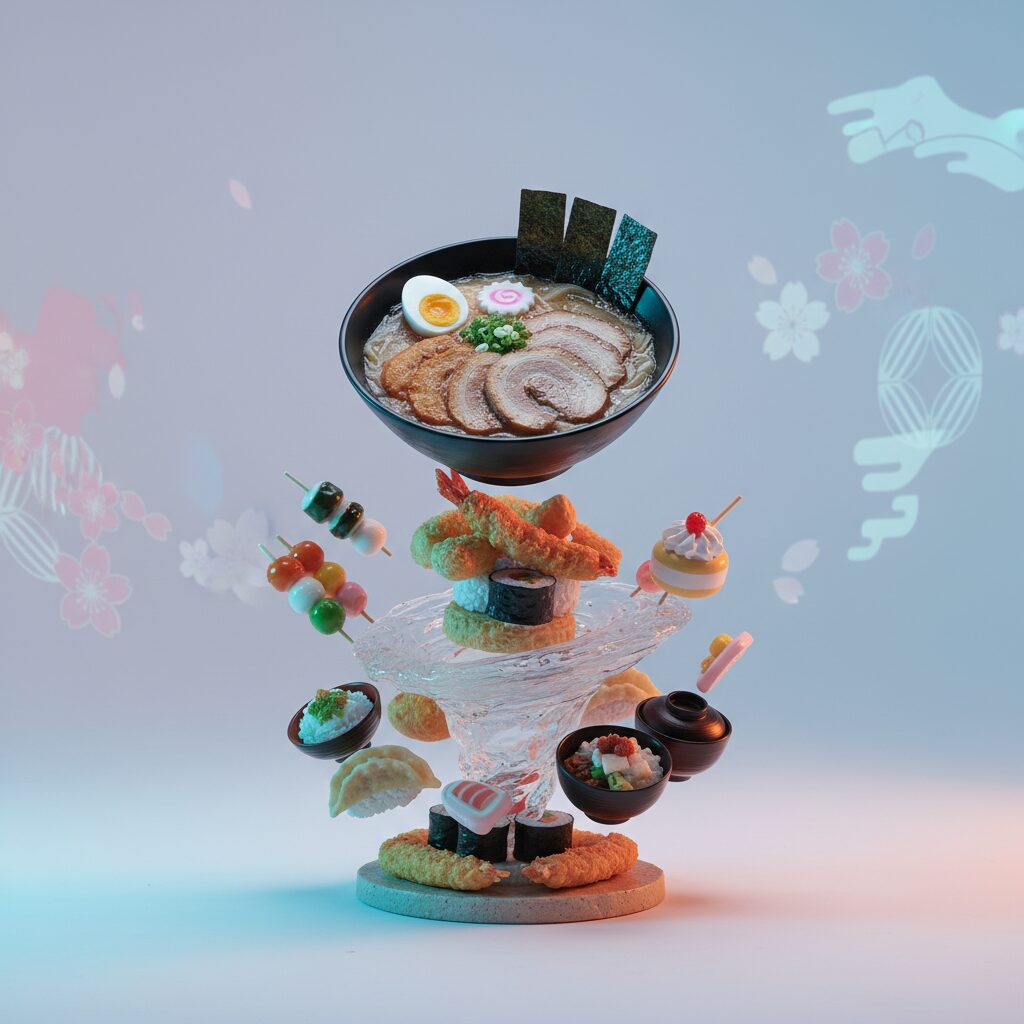
You’ve seen them. Of course you have. Stroll down almost any commercial street in Japan, from a bustling Tokyo shotengai to a quiet side alley in Kyoto, and you’ll inevitably be stopped by a restaurant window. Not by the smells, not yet, but by the sight. A glass case, brightly lit, displaying a full menu rendered in three dimensions. A perfect, glistening bowl of ramen, its broth frozen mid-ripple. A plate of tonkatsu, each breadcrumb seemingly hand-placed, sitting next to a pile of shredded cabbage so fine it looks like it could blow away. A slice of strawberry shortcake with a sheen so fresh you almost expect to smell the cream. This is the world of shokuhin sanpuru—literally, “food samples.”
The first reaction for many outsiders is a mix of awe and amusement. The realism is astonishing, but the concept itself can feel a little… well, kitsch. A bit dated, maybe. A relic from a time before Instagram and glossy photo menus. It’s easy to assume they’re a tourist trap, a simple way to say “curry rice” or “tempura” without words. And while they certainly do that, to dismiss them as a mere convenience for foreigners is to miss the point entirely. These plastic models are not just a quirky feature of the Japanese streetscape; they are a deeply ingrained cultural tool, a sophisticated system of communication and hospitality that operates on a level most people never notice. They are a physical manifestation of an unspoken social contract, and understanding them reveals a fundamental truth about the Japanese mindset: a deep-seated desire for clarity, predictability, and the quiet elimination of social friction.
These meticulously crafted food samples exemplify Japan’s unique blend of hospitality and artistry, a concept explored further in the art of shokuhin sampuru.
The Birth of a Solution: A History of Misunderstanding
The story of food samples doesn’t start with marketing cleverness but with cultural misunderstanding. In the early 20th century, as Japan opened its doors and Western ideas poured in, Western food arrived alongside them. Dishes such as curry, omelets, and breaded cutlets were unfamiliar to the Japanese palate and imagination. A restaurant owner in the 1920s couldn’t simply list omurice (omelet rice) on a menu and expect customers to know what it was. How do you explain a fluffy egg covering ketchup-flavored fried rice to someone who has never encountered such a dish? Verbal explanations fell short. Hand-drawn images were often crude and unappealing.
This gap in communication was unintentionally addressed by Iwasaki Takizo, a man from rural Gifu prefecture. According to industry folklore, in 1932 he was experimenting with wax for anatomical models when a drop fell into water, forming a delicate, flower-like shape. In a sudden moment of inspiration, he recognized its potential. He made a prototype wax omelet, complete with a drizzle of ketchup, and showed it to his wife. It was so lifelike that she couldn’t tell it was artificial. Soon after, a popular restaurant in Osaka commissioned him to create a full menu display. It became a sensation. Suddenly, customers could clearly see what they were ordering. The confusion vanished, replaced by understanding and desire.
What Iwasaki created was more than just a clever replica; it was a communication tool perfectly suited for the time. It enabled restaurants to introduce new, foreign dishes without lengthy, awkward explanations. It served as a bridge between the familiar and the unfamiliar, allowing Japanese diners to confidently explore a new culinary world. The industry he established in his hometown of Gujo Hachiman—which remains the heart of sample production today—was founded not on the novelty of fake food, but on its significant role in fostering clarity.
The Language of No Words: Sanpuru as a Universal Menu
The most obvious function of food samples is to bridge language barriers, and they accomplish this task perfectly. For a tourist who can’t read a single Japanese character, the display case is a blessing. You can simply step outside, point to the plastic tempura udon, and say, “Kore o kudasai” (This one, please). It’s a graceful, foolproof system. However, this is only the surface level. The truly intriguing part is why food samples are equally indispensable for Japanese customers.
The Promise of Precision
In many cultures, a menu photo is an idealized depiction of the dish, a kind of culinary glamor shot. You order the burger, and what arrives is a disappointing, flattened version of the towering masterpiece in the picture. This gap between expectation and reality is largely unacceptable in Japan. The shokuhin sanpuru is a solemn promise. It is a commitment from the restaurant to the customer: what you see is exactly what you will receive. The number of shrimp in the tempura, the exact arrangement of toppings on the ramen, the portion size of the rice—it is all carefully replicated.
This goes beyond honesty; it’s about managing expectations and preventing disappointment, which is a central aspect of good service. The customer can make a fully informed decision, free from the worry of the unknown. They know the portion size will be suitable, they know what ingredients are included, and they know how it will look when served. This one-to-one match between the model and the meal is a strong expression of seijitsu, a concept that blends sincerity, honesty, and faithfulness. The plastic food isn’t fake; it’s an accurate preview.
The Engine of Efficiency
Pass by a busy lunch spot in a business district around noon, and you’ll see this system at its best. Office workers don’t crowd inside, debating over a menu. They gather outside, in front of the display case. They scan the choices, make their selection, and often purchase a ticket from a vending machine right at the entrance before speaking to anyone. By the time they sit down, their order is already in the kitchen.
This pre-entry decision-making significantly speeds up the entire dining process. It cuts down ordering time, reduces staff interaction, and boosts table turnover. In a culture that values efficiency and smooth public experiences, this is a brilliant piece of social engineering. The food sample display isn’t just advertising; it’s the first step in a finely tuned system designed to feed people quickly and seamlessly, without hassle or delay. It lets a person evaluate price, portion, and appeal all within seconds from the sidewalk, a vital advantage during a brief lunch break.
Clarifying Complexity
Japanese cuisine often includes set meals, or teishoku, which feature a main dish, rice, miso soup, and several small side dishes (kobachi). Describing what’s included in a teishoku on a written menu can be lengthy and confusing. Which pickles are served today? What’s in the small seasonal vegetable dish? The food sample display instantly resolves this complexity. It presents the entire meal, component by component, giving the customer a clear and immediate understanding of the value and composition of what they are ordering. It transforms an abstract list of items into a concrete, tangible meal, making the decision easier and more appealing.
The Art of Deception, The Spirit of Hospitality
To truly appreciate the cultural significance of shokuhin sanpuru, you must recognize the extraordinary craftsmanship involved in their creation. These are not mass-produced plastic toys churned out by automated factories. Each piece is predominantly handmade by skilled artisans through a meticulous, multi-step process. The commitment to realism is intense, almost transcendent.
Typically, the process starts with the restaurant sending the actual dish to the sample factory. Artisans then create a silicone mold from the food items—a piece of grilled salmon, a slice of tamagoyaki, a perfectly shaped gyoza. Liquid vinyl chloride is poured into these molds and baked until it hardens. But this is merely the beginning. The true artistry lies in the painting and finishing stages.
Using airbrushes and fine-tipped brushes, artisans replicate colors with astonishing precision. They don’t simply paint a piece of tuna red; they capture subtle color gradients, the translucency of the flesh, and the delicate white lines of fat. Techniques are employed to recreate grill marks on steak, bubbly browned cheese on pizza, and the glistening moisture on sashimi. A single bowl of ramen may comprise dozens of individually crafted components—the noodles, pork slices, bamboo shoots, egg, seaweed—all assembled by hand. The condensation on a cold beer glass is recreated using a special gel, while the frothy, “just-poured” head is itself an artwork. This is not mere imitation; it is a form of exquisite, high-fidelity simulation.
Craftsmanship as Omotenashi
What drives this obsessive attention to detail? In Japan, the effort behind an object is considered just as important as the object itself. This craftsmanship directly embodies omotenashi, the Japanese ideal of wholehearted, anticipatory hospitality. Restaurants invest significant resources—a single elaborate display can cost over a thousand dollars—to show respect. They take the time and care to present their offerings with absolute clarity and beauty before you even decide to enter.
This act of showing rather than telling serves as a silent form of service. The restaurant anticipates your questions: How large is it? What accompanies it? What does it really look like?—and answers them all without needing to be asked. It is a thoughtful gesture meant to put you at ease and enhance your experience. The sample’s beauty and realism reflect the pride the restaurant takes in its food. A sloppy, faded sample signals a careless kitchen; a vibrant, pristine one conveys quality, care, and dedication to excellence.
Beyond the Restaurant: Sanpuru in the Modern Age
While their primary function remains outside restaurants, the realm of shokuhin sanpuru has grown in intriguing directions. Their artistic and kitschy charm has made them sought-after souvenirs. In shops in Tokyo’s Kappabashi Kitchen Town or their origin, Gujo Hachiman, you can find hyper-realistic sushi keychains, bacon-and-egg phone cases, and spaghetti-fork pendants.
This growth has sparked a surge in DIY workshops where visitors can craft their own samples, often tempura or lettuce. The lettuce-making process is especially enchanting, involving dripping warm, colored wax into hot water, where it forms a thin film that you gather and fold into a leaf shape. These workshops have shifted the craft from mere function into a form of entertainment and cultural participation.
Outside of tourism, food modeling technology has practical uses in other areas. Nutritionists and dietitians employ hyper-realistic models to teach portion sizes and healthy eating habits. Medical schools use models of organs and tissues for surgical practice. The skill of creating flawless replicas has become surprisingly adaptable.
The Unspoken Contract
So, the next time you find yourself staring at one of those brightly lit windows, look beyond the initial novelty. Don’t just see plastic food. See the elegant answer to a century-old communication challenge. See a sophisticated tool for urban efficiency, designed to keep the lunchtime rush moving smoothly. See the tangible expression of a promise from a chef to a diner, a contract of honesty and sincerity crafted in vinyl and paint.
Above all, see the quiet embodiment of hospitality. Understand that the immense skill and effort invested in that fake bowl of noodles is a gesture of respect toward you, the customer. It’s a way to make your experience simpler, clearer, and more enjoyable. The shokuhin sanpuru is not a trick or a gimmick. It’s a reflection of a culture that values clarity over ambiguity, predictability over surprise, and a silent, thoughtful anticipation of another’s needs. It stands as one of Japan’s most ingenious and sincere forms of communication, hidden in plain sight.