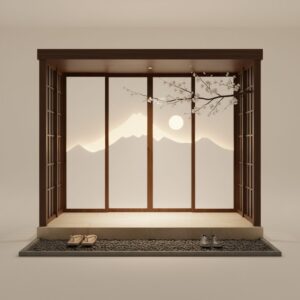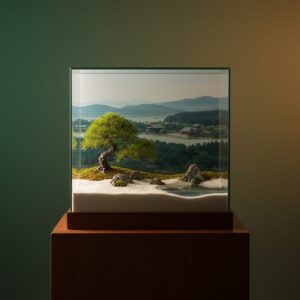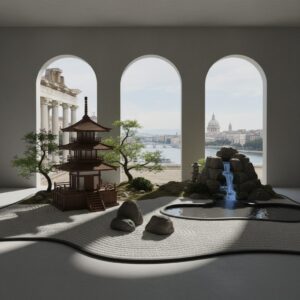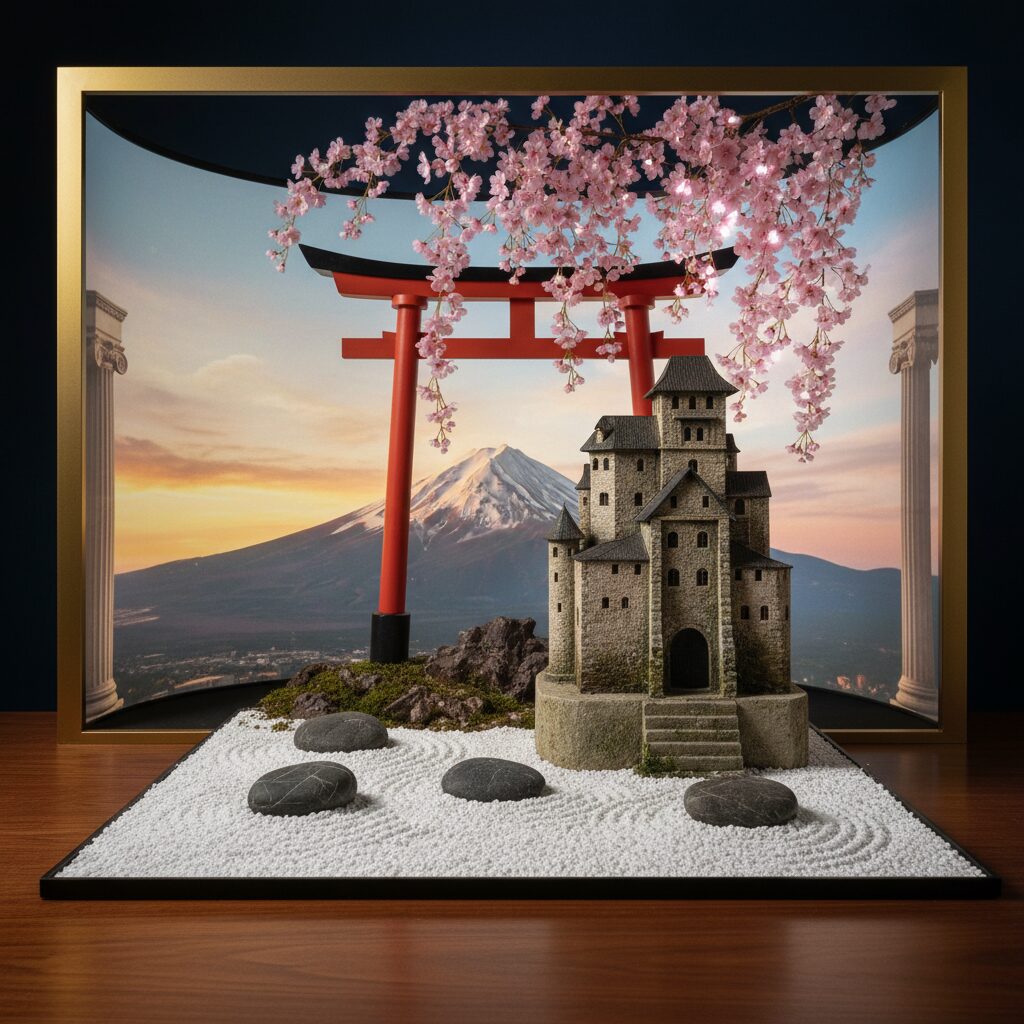
You’re standing in a Japanese garden, perhaps in Kyoto. It’s not enormous, not by the standards of a European palace, but it feels boundless. The moss is a perfect velvet, the stones are placed with an almost divine sense of purpose, and a manicured pine leans just so over a placid pond. Yet, your eye is drawn past the garden’s edge, over a low, clipped hedge, to a distant mountain ridge, its silhouette softened by the morning haze. Suddenly, that mountain is part of the garden, too. The composition doesn’t end at the wall; it pulls the entire horizon into its embrace. What you’re experiencing isn’t an accident. It’s a centuries-old design philosophy called shakkei.
Translated literally, shakkei (借景) means “borrowed scenery.” It’s the art of capturing and incorporating the landscape outside the physical boundaries of a garden into its own design, making it a fundamental part of the composition. This isn’t simply about having a nice view. It’s a deliberate, highly sophisticated technique that transforms a finite plot of land into an experience of infinite space. It’s a statement about nature, aesthetics, and humanity’s place in the world, all expressed through the careful framing of a view you can see but never own. Understanding shakkei is to understand a core tenet of the Japanese spatial imagination, where the line between the human-made and the natural is not a hard border, but a soft, permeable membrane.
Understanding how shakkei blurs the boundary between cultivated spaces and the untamed landscape invites a deeper look into shakkei techniques.
The Art of the Frame
At its core, shakkei is an artful act of composition. The garden designer takes on the role of a landscape photographer, using elements within the garden—such as trees, hedges, ponds, rock formations, and architectural features like windows and gates—to craft a perfect frame for a distant view. It’s a method of inclusion, conveying the idea, “That mountain over there? It’s part of this, too.” The garden serves as the middle ground connecting the viewer in the foreground with the vastness beyond.
More Than a Backdrop
It’s important to recognize that the borrowed element is not merely passive scenery. The success of shakkei relies on a dynamic interplay between the garden and the landscape beyond it. Shapes, textures, and colors within the garden are often selected to echo or complement the borrowed view. For instance, a cluster of rugged, dark stones might be arranged to mirror the profile of a distant mountain range. A maple tree’s foliage might be nurtured to blaze with crimson, reflecting the autumn hues of a faraway hillside.
This creates a visual resonance, a dialogue between near and far. The garden does more than point toward the view; it harmonizes with it, drawing it into a unified artistic expression. The boundary fades not just physically but aesthetically. You aren’t just looking at a view from a garden; you are immersed in a single cohesive space.
The Four Kinds of Borrowing
Classical garden treatises classify shakkei into four main types, illustrating the subtlety and range of the concept. It is not always about capturing a grand mountain vista.
Enshaku (遠借) – Distant Borrowing: The most well-known and dramatic form of shakkei, involving the incorporation of a distant natural feature—such as a mountain, hill range, or distinctive forest—into the garden’s design. The iconic gardens of Kyoto excel at this, borrowing views of the city’s surrounding Higashiyama and Arashiyama mountains.
Rinshaku (隣借) – Adjacent Borrowing: A more intimate and neighborly form of borrowing. A garden might incorporate trees from a neighboring property, the elegant roofline of a nearby temple, or a pagoda rising just above the walls, relying on a shared landscape and visual exchange between properties.
Gyōshaku (仰借) – Upward Borrowing: This type directs the gaze upward, framing views of the sky, passing clouds, or the canopy of a tall forest lying just beyond the garden’s boundary. It borrows the ever-changing canvas of the heavens.
Fushaku (俯借) – Downward Borrowing: The subtlest form, where the gaze is directed downward. A classic example is a pond positioned to perfectly reflect the sky or surrounding trees, effectively “borrowing” the sky through reflection. It can also refer to a hillside garden that incorporates views down into a valley or stream below.
A Worldview in a Garden
Why go to such lengths? The motivation behind shakkei is deeply philosophical, revealing a worldview that contrasts sharply with the Western tradition of landscape design. While a formal French garden like Versailles showcases human domination over nature—taming it into perfect geometric shapes—a Japanese garden using shakkei expresses harmony with nature.
Dissolving Boundaries, Expanding the Mind
The most profound impact of shakkei is the psychological expansion of space. In a densely populated country like Japan, where private land is often limited, this technique is a stroke of genius. It makes a small garden feel vast and open, connected to something far greater than itself. The garden’s walls cease to be restrictions and instead become framing elements. They don’t just enclose; they highlight. This has a powerful influence on the mind. By visually dissolving the barrier between personal space and the wider world, the garden fosters a sense of continuity and belonging. It quietly implies that you are not separate from the world, but a part of it.
This reflects profound currents in Japanese thought, especially from Zen Buddhism and Shintoism. Nature is not to be conquered, walled off, or exploited. It is a living entity of which humans are merely one component. A shakkei garden is a tangible expression of this belief. The designer is less imposing their will on the land and more curating a perspective, guiding the viewer to recognize a connection that already exists.
The Humility of Borrowing
There is a beautiful humility inherent in the act of “borrowing.” You cannot own a mountain. You cannot possess the moon or the shifting clouds. The garden designer employing shakkei acknowledges this from the start. They accept that the most powerful element of their creation lies completely beyond their control. This acceptance of the unownable is a fundamental principle.
The borrowed scenery is ever-changing. The mountain transforms with the seasons—from the fresh green of spring to the fiery reds of autumn, from snow-dusted winter to mist-shrouded rainy season. The garden does not resist this change; it embraces it. It becomes a stage for the passage of time and the impermanence of all things—the Buddhist concept of mujō (無常). By linking the controlled, manicured garden space with the wild, uncontrollable world beyond, the designer creates a setting for meditation on this essential truth.
Living Masterpieces
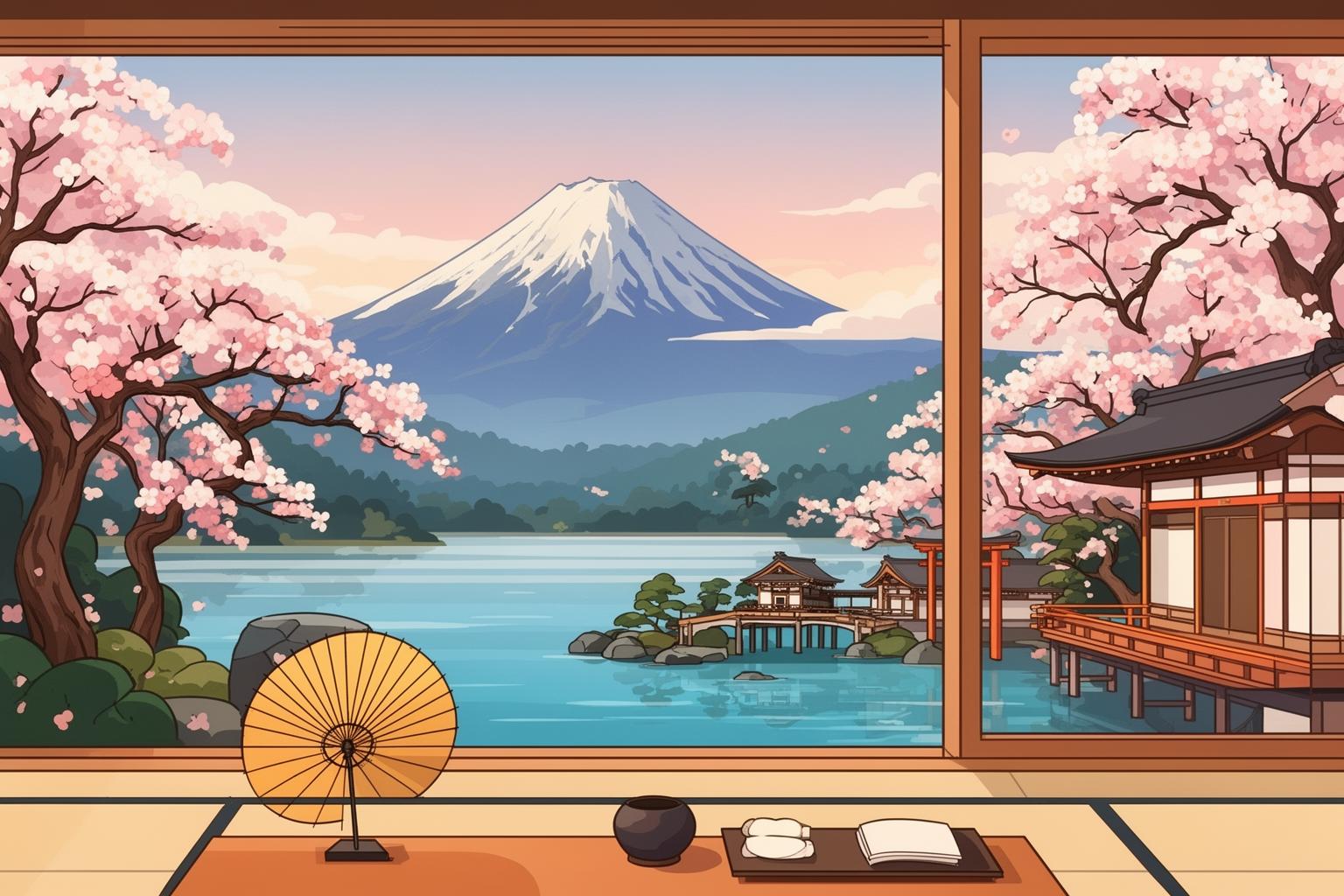
To truly understand shakkei, you need to witness it firsthand. While many gardens utilize this technique, only a select few exemplify it as a flawless art form.
Shugakuin Imperial Villa, Kyoto
Arguably the grandest and most awe-inspiring example of shakkei in Japan is the Shugakuin Imperial Villa, located in Kyoto’s northeastern hills. It comprises not just one garden but a series of gardens and villas spread across an expansive estate. The visit is experienced as a procession. You stroll through lower gardens along pathways that deliberately obscure the ultimate view, building anticipation. Eventually, you reach the Upper Villa and a pavilion beside a large pond. The breathtaking scene that unfolds is simply astonishing. Below, the pond and its carefully crafted islands serve as the middle ground. Beyond that, a sea of clipped hedges forms a strong horizontal line, and further still, the entire cityscape of Kyoto spreads out, with the western mountains providing a majestic backdrop. The scale is vast, and the blend of human-made and natural elements is flawless. It exemplifies distant borrowing, or enshaku.
Tenryu-ji Temple, Arashiyama, Kyoto
The garden at Tenryu-ji, a prominent Zen temple in Arashiyama, is a masterful example of seamless integration. The Sogenchi Pond Garden, created by the renowned monk Musō Soseki in the 14th century, is stunning on its own, featuring carefully positioned rocks and shoreline. Yet its true brilliance lies in how it flawlessly incorporates the surrounding Arashiyama mountains as its backdrop. The garden’s gentle slope, the tree arrangements, and even the forms of the rocks appear to flow into the forested hills beyond the temple grounds. There is no abrupt edge or visual interruption. Rather than feeling like a space in front of the mountains, the garden resembles the foothills of those mountains, idealized and brought into form.
Adachi Museum of Art, Shimane Prefecture
If you think shakkei belongs only to the past, the Adachi Museum of Art demonstrates that it remains a vibrant, living tradition. Consistently ranked as having the best garden in Japan for over twenty years, the museum treats its gardens as part of its art collection. Large picture windows inside the museum serve as frames for the “living paintings” outside. These are not ordinary gardens; they are pristine landscapes borrowing the natural mountains of Shimane Prefecture as their backdrop. The effect is multi-layered—you are inside a building, looking through a frame, at a perfectly composed garden, which itself frames a natural mountain. This is shakkei within shakkei, a testament to the enduring strength of this design principle in a contemporary setting.
An Unspoken Agreement
Maintaining a shakkei garden is an ongoing, dynamic endeavor. It is not a fixed image that, once established, is complete. The gardener engages in a continuous dialogue with the surrounding landscape.
The Gardener’s Endless Duty
The trees and shrubs within the garden that form the “frame” for the borrowed scenery must be consistently pruned and shaped. The aim is to keep the view open and unobstructed. A branch that grows too tall can block a mountain peak. A hedge that becomes too dense can break the visual link. The gardener must remain attentive, always considering the relationship between foreground and background. This demands a deep knowledge of horticulture and an even greater artistic sensitivity. The work is never finished, as nature is constantly growing and evolving.
The Delicate Agreement
In an increasingly urbanized Japan, shakkei also underscores a fragile, often implicit social agreement. When a garden borrows the roof of a neighboring temple (rinshaku), it depends on that temple’s continued presence. When it borrows a view of a green hillside, it relies on that hillside not being transformed into housing or concrete structures. The history of modern Japan is filled with heartbreaking stories of centuries-old borrowed views being destroyed overnight by new development. This deepens our appreciation for these gardens, as they embody not only a connection to nature but also a bond with a shared community landscape that is becoming scarce.
Ultimately, shakkei is much more than a clever technique to make a small space appear larger. It is a visible philosophy. It quietly resists the notion that we are separate from our environment. It invites you to stand in a thoughtfully crafted space and look beyond its edges, to discover beauty not in possession but in connection, not in confinement but in openness. It imparts a profound truth: sometimes the most vital part of what you’ve created is the part you never built at all.