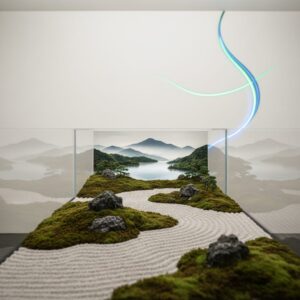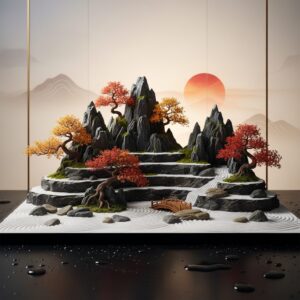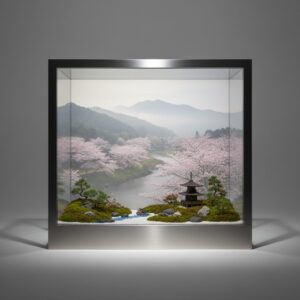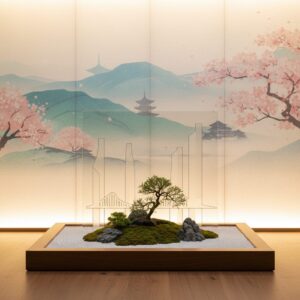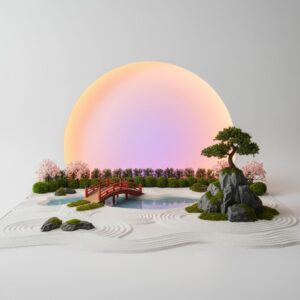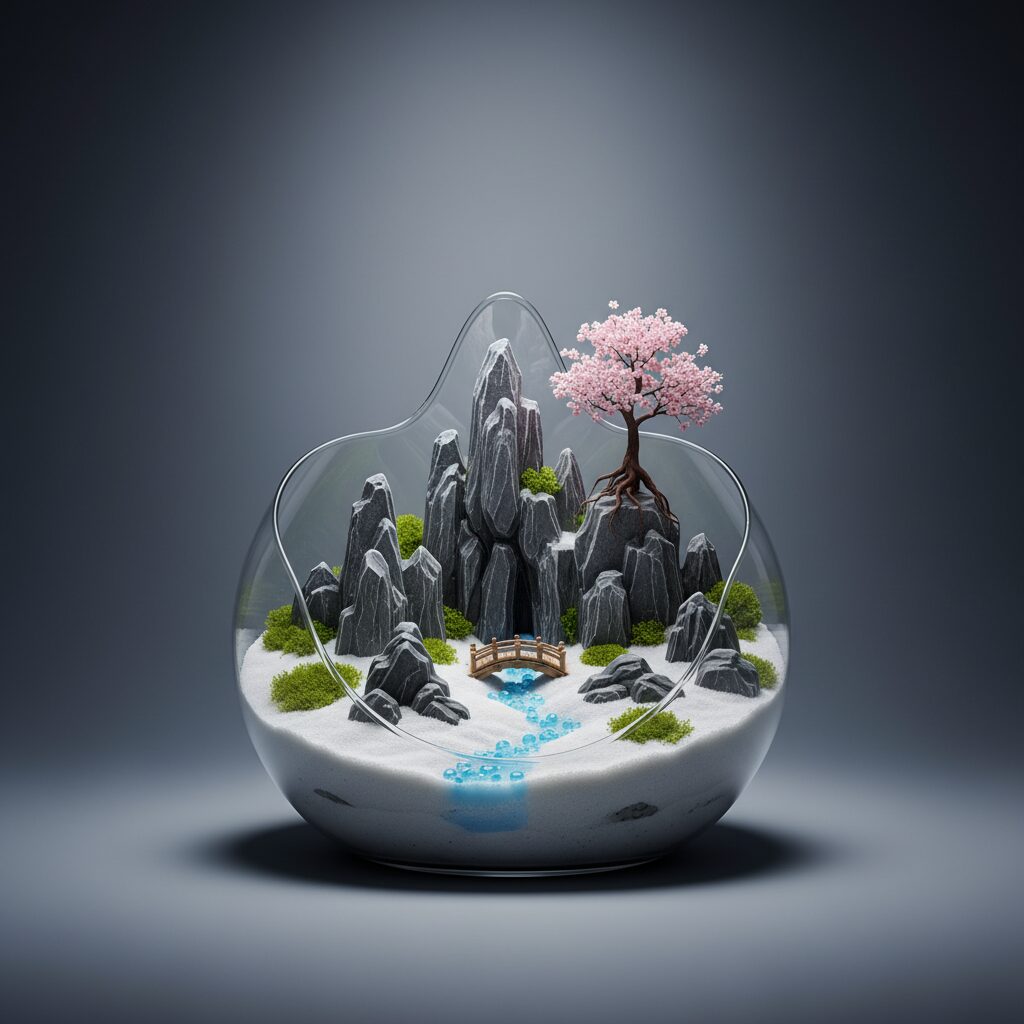
You’re standing in a Japanese garden, maybe somewhere in the quiet hills of Kyoto. It’s perfect. Every rock seems placed by gravity itself, moss carpets the ground in fifty shades of green, and a stone lantern stands in silent contemplation. The space feels serene, complete. But then you notice something else. Your eyes are drawn past the meticulously raked sand, beyond the carefully pruned pine, to the towering peak of a mountain miles away. The mountain isn’t in the garden, of course. Yet, somehow, it feels like the most important part of it. It doesn’t feel like a background; it feels like the garden’s final, most magnificent wall.
What you’re experiencing is a foundational principle of Japanese landscape design called shakkei, or 「借景」. The characters literally mean “borrowed scenery.” It’s a technique, but it’s also a profound philosophy. Instead of building walls to create a self-contained paradise, the garden designer intentionally incorporates the surrounding landscape—a distant mountain, a dense forest, even the roof of a neighboring temple—into the garden’s own composition. It’s a quiet act of appropriation, not to own the view, but to connect with it. This isn’t just about finding a spot with a nice backdrop. It’s a deeply conscious effort to dissolve the boundary between the finite, man-made space of the garden and the infinite, untamable world of nature beyond. It’s a design choice that says, “This small space I have created is beautiful, but it is made infinitely more beautiful by acknowledging the world it is a part of.”
Akin to how the garden’s open vista dissolves the barrier between crafted space and the vast natural world, the sacred threshold of the genkan offers another perspective on how Japanese design deftly bridges boundaries.
The Philosophy of Borrowing
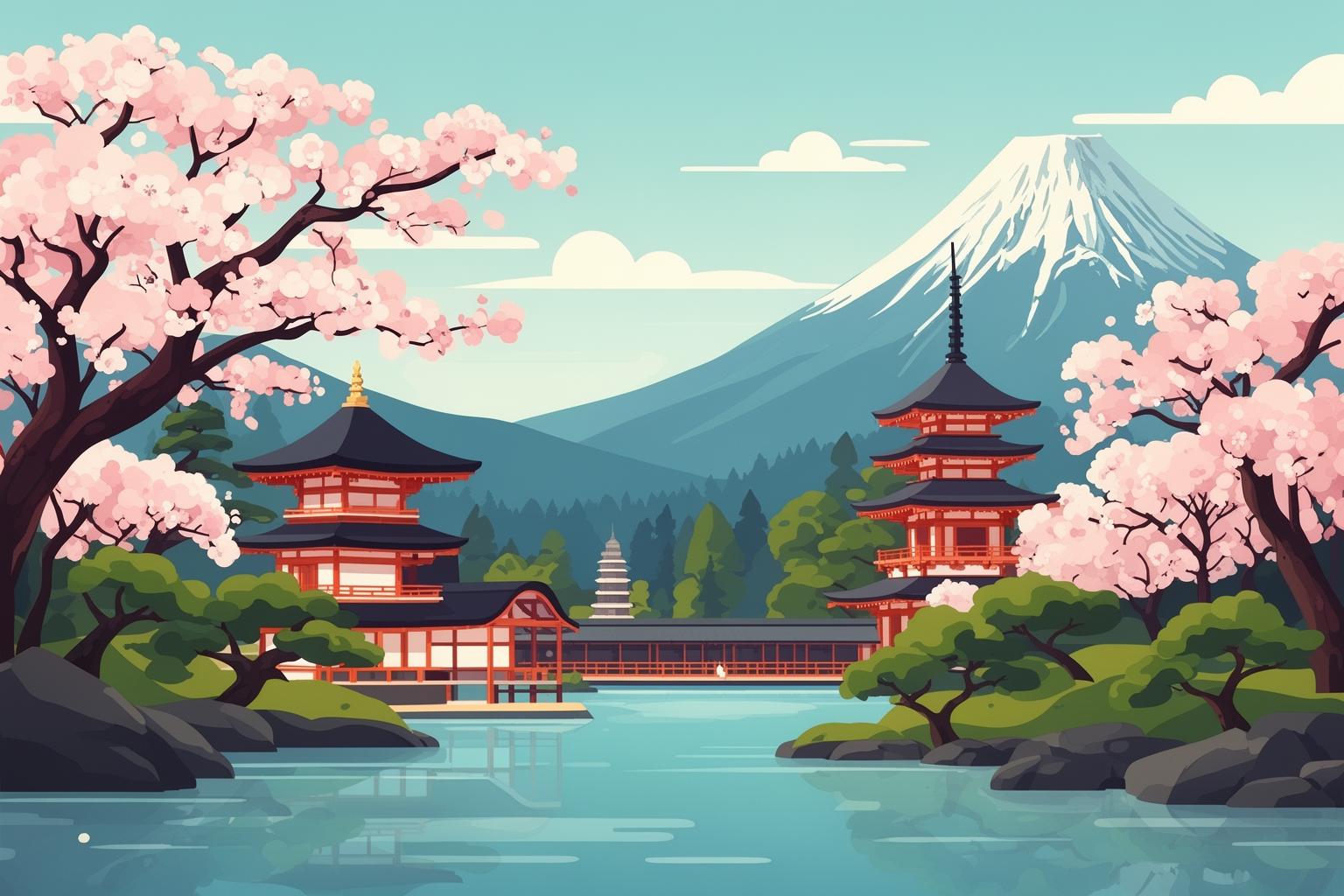
So, why choose to do this? In a culture renowned for its mastery of detail and control within confined spaces, why deliberately designate the focal point as something beyond your control? The answer lies at the convergence of Zen Buddhist philosophy and native Shinto beliefs.
At its essence, shakkei expresses humility and recognizes interconnectedness. Shintoism, Japan’s indigenous religion, has long believed that divinity, or kami, dwells in natural objects—ancient trees, commanding waterfalls, and imposing mountains. To enclose a garden and shut out these powerful natural elements would be to sever oneself from the sacred. A garden that borrows the view of a mountain is, in effect, honoring the kami of that mountain, inviting its presence into the cultivated space.
Zen Buddhism contributes an additional aspect. A fundamental principle of Zen is the realization that the self is not separate from the universe. The boundary between you and the surrounding world is an illusion. Shakkei makes this philosophical idea concrete. By softening the physical divide between the garden (the controlled, immediate environment) and the landscape beyond (the vast, uncontrolled world), the designer crafts a space that invites the mind to do the same. The garden becomes a meditative place where you can reflect on your own connection to the greater whole.
There’s also a practical side. Japan is a mountainous nation where usable land is often scarce. Shakkei offers a brilliant solution to the challenge of creating a sense of spaciousness within a limited area. It’s a visual illusion that makes a small garden appear boundless. By guiding the eye outward, the design achieves a profound feeling of depth and scale that cannot be accomplished with internal elements alone. It’s a form of landscape alchemy, transforming a small plot into a gateway to a vast panorama.
The Art of the Perfect Loan
Simply having a mountain in the distance does not automatically create shakkei. The technique is much more intentional and skillful than merely leaving a gap in the fence. Achieving success requires a deep mastery of composition, framing, and perspective. The aim is to make the borrowed element feel not only visible but essential and inevitable.
Framing the View
The most crucial technique is framing. The distant scenery is rarely shown as a wide-open, all-encompassing vista. Instead, the designer carefully selects the view, using elements within the garden as a natural picture frame. This could be the overhanging branches of a maple tree, the pillars of a temple veranda, a circular window (marumado) in a teahouse, or a precisely trimmed opening in a hedge. This framing serves two purposes. First, it directs the viewer’s attention, turning the distant view from mere background into a deliberate focal point. Second, it creates a sense of layering and depth, making the composition more dynamic and engaging.
Connecting the Middle Ground
Equally important is the space between the garden and the borrowed view—the middle ground. If this transition is too sudden, the effect falls apart. The designer must skillfully bridge this gap, often by using visual echoes. For instance, if the borrowed scenery is a forested hill, the garden might include trees with similar shapes or textures. If it’s a rocky mountain, carefully placed stones might appear in the foreground to create a visual link. This produces a seamless flow, tricking the eye into perceiving the garden and the distant landscape as one unified whole.
Playing with Perspective
Japanese garden designers excel at forced perspective. To enhance the sense of depth, they often position larger, more detailed elements like rocks and lanterns in the foreground, while those in the middle ground are smaller and less distinct. This manipulation of scale makes the distant borrowed scenery feel even farther away and grander, increasing the feeling of spaciousness and magnificence.
Masterpieces of Borrowed Scenery
To fully appreciate the power of shakkei, you need to witness it firsthand. Some of Japan’s most renowned gardens are defined by their skillful use of borrowed scenery.
Tenryu-ji Temple, Kyoto
Arguably the most iconic example is the garden at Tenryu-ji in Arashiyama, Kyoto. The Sogenchi Teien (Sogen Pond Garden), designed by the Zen master Muso Soseki in the 14th century, is a UNESCO World Heritage site. The garden itself is a stunning arrangement of a large pond, strategically placed rocks symbolizing Buddhist legends, and a carpet of white sand. However, its true brilliance lies in what it incorporates from beyond its boundaries. The garden gazes directly out onto the mountains of Arashiyama, including Kameyama and Ogurayama, whose forested slopes are famed for their cherry blossoms in spring and vibrant maple leaves in autumn. These mountains don’t merely form a backdrop; they serve as the garden’s back wall and main focal point. The pond’s shape seems to mimic the hills’ curves, and the entire design is so harmoniously integrated that it feels as though the mountains themselves were sculpted to complete the scene.
Shugakuin Imperial Villa, Kyoto
For a grander and more expansive example, there is the Shugakuin Imperial Villa in northern Kyoto. Built in the 17th century for Emperor Go-Mizunoo, this represents landscape design on a monumental scale. The villa includes three separate gardens set on a large hillside, and the Upper Villa exemplifies shakkei at its peak. Here, the designer created a large artificial pond by damming a stream, and the view from its shores is breathtaking. A massive clipped hedge acts as the garden’s immediate boundary but mainly serves to frame the panoramic vista of the surrounding mountains and the city of Kyoto below. The designer didn’t just borrow a single mountain; they borrowed the entire landscape, incorporating rice paddies, forests, and distant peaks into a sweeping, dynamic portrait that shifts dramatically with the seasons.
Adachi Museum of Art, Shimane
While many famous examples are centuries old, shakkei remains a living tradition. The Adachi Museum of Art, located in rural Shimane Prefecture, is a modern masterpiece. Founded in 1970 by Adachi Zenko, the museum is as renowned for its gardens as it is for its collection of modern Japanese art. The gardens have been ranked the best in Japan for over two decades running. Here, the concept reaches its logical conclusion: the museum’s windows are treated as literal picture frames. As you move through the galleries, you encounter large windows that showcase perfectly composed, living paintings. The meticulously tended garden of white gravel, moss, and pines in the foreground blends seamlessly with the natural, untamed mountains in the background. It is a striking demonstration of how to flawlessly bridge the gap between the man-made and the natural, a living embodiment of the shakkei philosophy.
A Worldview in Miniature
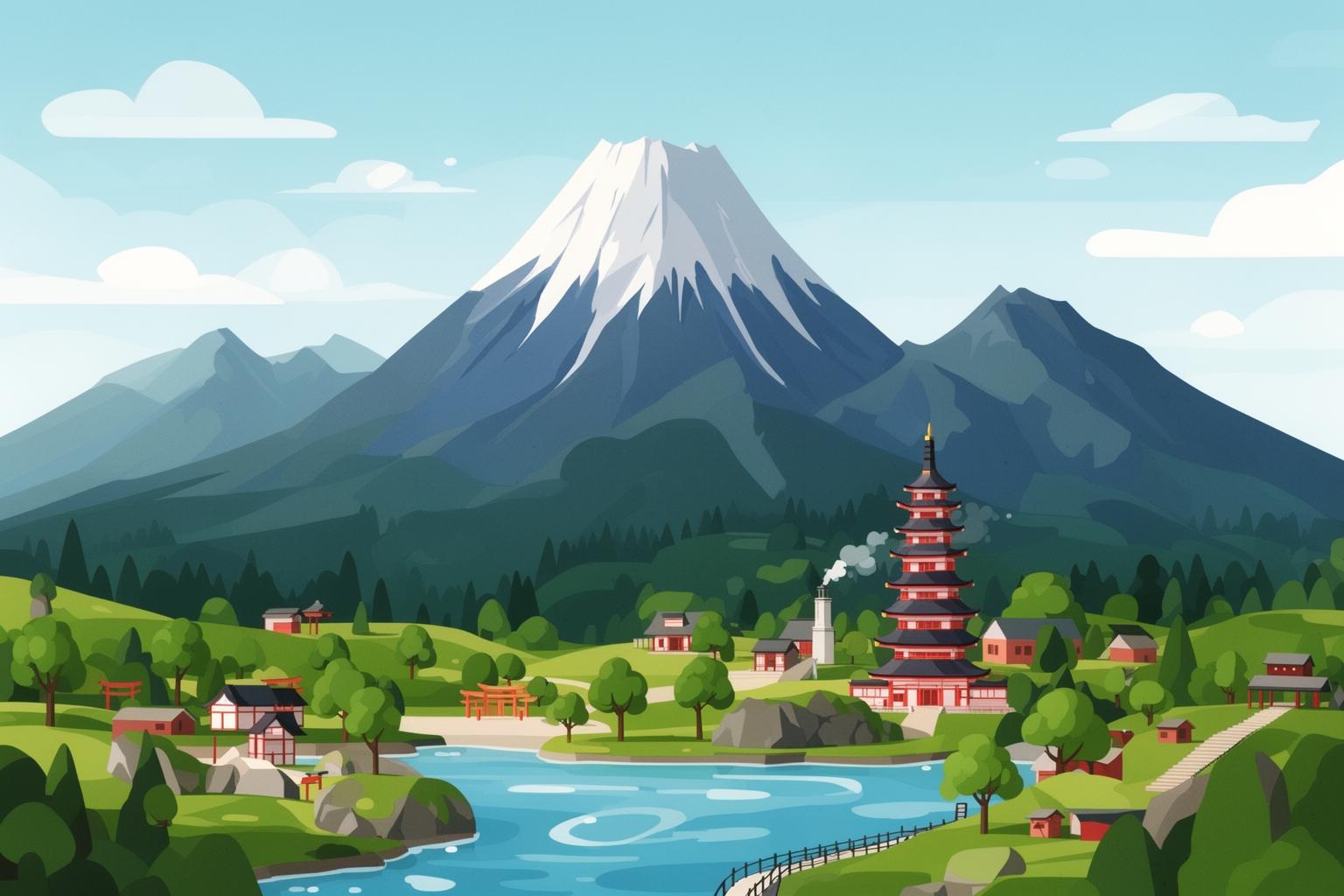
Ultimately, shakkei is far more than just a clever perspective trick. It reflects a worldview that blurs the boundary between humanity and nature, between what is created and what is given. It embodies Japanese aesthetic ideals such as wabi-sabi by embracing the unpredictable beauty of the changing seasons and weather as an integral part of the garden. A garden that borrows scenery is never fixed; it is continuously reshaped by passing clouds, shifting light, and seasonal colors.
It also expresses a deep sense of place. A shakkei garden could not exist anywhere else in the world. Its identity is deeply connected to its unique surroundings. Rather than imposing itself on the environment, it engages in a respectful dialogue with it. The designer does not attempt to create a perfect, isolated world but seeks the perfect way to view the world that already exists.
So, the next time you find yourself in a Japanese garden, let your eyes wander beyond the boundaries. Look for what has been borrowed. You may discover that the most beautiful part of the garden lies not within its walls, but miles away, standing quietly and majestically against the sky.