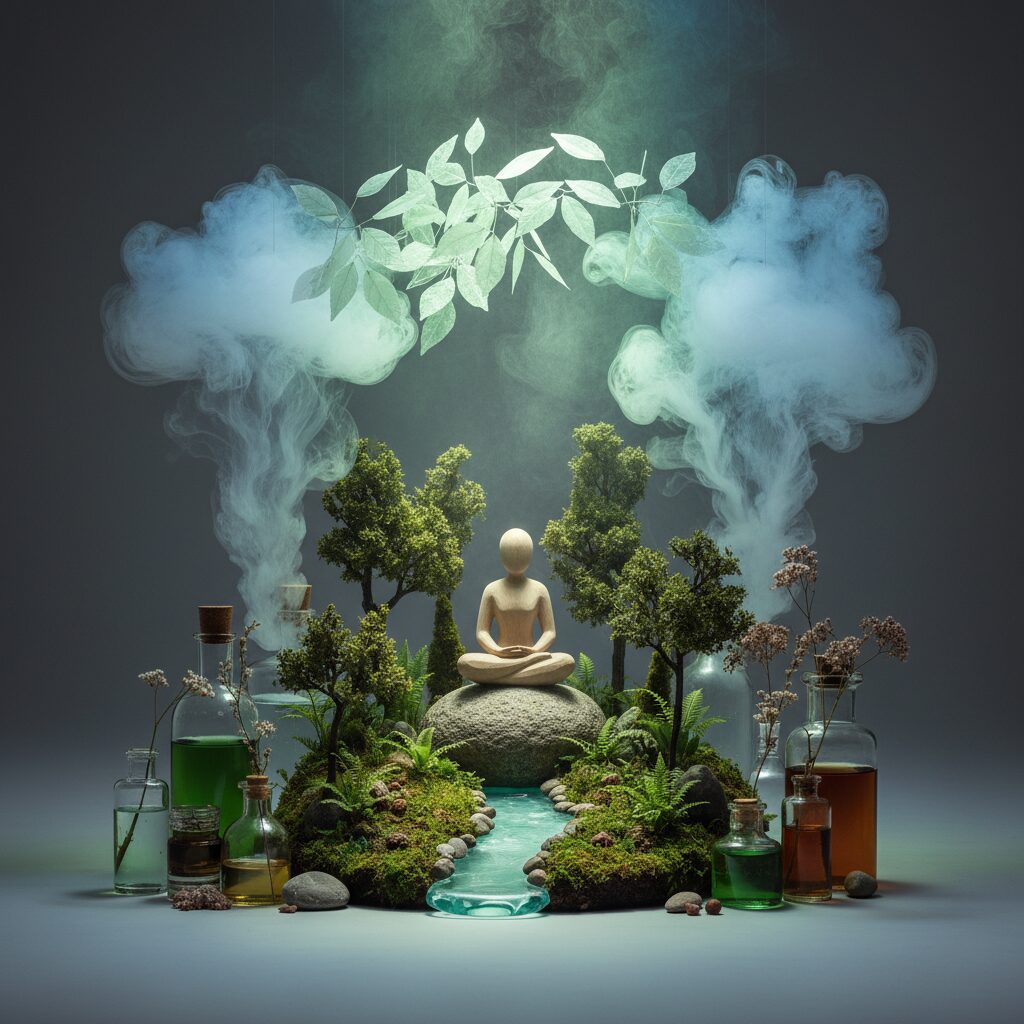
You know that feeling. The one that creeps up on you during rush hour on the Yamanote Line, packed so tightly you can feel the collective sigh of a million obligations. It’s the low hum of fluorescent lights in a convenience store at 2 a.m., the relentless visual noise of Shibuya Crossing, the bone-deep weariness that comes from living in a city that never, ever sleeps. It’s the feeling of being profoundly disconnected from anything that feels real, ancient, or quiet. Then, you step into a forest. The air changes instantly, tasting green and damp. The only sound is the rustle of leaves and the distant call of a bird. The city’s frantic pulse is replaced by the slow, steady heartbeat of the earth. Your shoulders drop an inch. You breathe deeper. This isn’t just a change of scenery; it’s a physiological shift. In Japan, they have a name for this deliberate, therapeutic immersion in nature: shinrinyoku, or ‘forest bathing.’ And it’s far more than a poetic label for a pleasant stroll. It’s a scientifically validated, culturally resonant prescription for the ills of modern life, born from a specific moment in Japanese history when the nation was literally working itself to death.
The immersive calm of forest bathing also echoes Japan’s timeless approach to nature, as reflected in its seasonal calendar traditions that reveal the subtle interplay between the seasons and the art of living.
The Pressure Cooker: The Birth of a Modern Malady
To grasp why Japan found it necessary to formally create something as seemingly instinctive as ‘walking in the woods,’ you must first understand the uniquely intense pressures of its post-war development. The idea of shinrinyoku didn’t arise from a mere wellness trend vacuum. It was a direct reaction to a public health crisis decades in the making.
From Economic Miracle to Human Cost
The story begins with Japan’s remarkable post-war recovery. The nation rebuilt itself from ruins into an economic powerhouse with breathtaking speed. This ‘economic miracle’ was driven by relentless hard work and a strong sense of collective purpose. Cities such as Tokyo, Osaka, and Nagoya grew into sprawling megalopolises, drawing millions from rural areas into a new urban world of concrete, steel, and neon. This reality was shaped by the rise of the ‘salaryman’—the corporate warrior in a dark suit, whose life was devoted to his company. The arrangement was straightforward: lifelong employment in exchange for unwavering loyalty and grueling long hours. The six-day workweek was common, and staying late at the office wasn’t just expected; it was a mark of pride. Commutes were long and exhausting. Living spaces shrank into compact apartments, stacked high above the streets. Within a single generation, a significant portion of the population shifted from living close to rice paddies and mountains to spending nearly all their time indoors, under artificial light, ruled by the clock.
This relentless drive yielded incredible results, culminating in the hyper-inflated ‘Bubble Economy’ of the late 1980s. Yet the human body and mind were paying a heavy toll. Continuous stress, sleep deprivation, and physical disconnection from nature began showing disturbing effects.
The Body Keeps the Score: Karoshi and Burnout
By the 1980s, a chilling new term entered the Japanese vocabulary: karoshi, meaning ‘death from overwork.’ Reports surfaced of seemingly healthy executives in their prime suddenly collapsing at their desks from strokes or heart attacks. It became so widespread that it was acknowledged as a legal and social issue. The government began collecting data. Karoshi represented the most extreme manifestation of a pervasive stress epidemic. Stress-related conditions, ranging from chronic hypertension and autoimmune diseases to severe depression and anxiety, were soaring. The national nervous system was worn thin. The very foundation of Japan’s success—its hardworking, tireless workforce—was starting to crumble. It was clear that action was necessary. The government and medical professionals began seeking accessible, affordable, and preventive public health measures. The solution, it turned out, was all around them. Japan is, after all, a country that is nearly 70 percent forested. The challenge was persuading a city-bound population that the remedy for their modern ailments awaited beneath the canopy of a cedar grove.
The Prescription: Science Gives Nature a Name
Japanese culture highly values evidence and precision. Simply advising people to “Go take a walk, it’s good for you,” would not suffice. For the idea to be recognized as a legitimate therapy, it required a name, a methodology, and, most importantly, scientific validation. This marked the moment when intuition evolved into a nationwide health initiative.
The Ministry’s Mandate
In 1982, the Ministry of Agriculture, Forestry and Fisheries made a clever decision. They introduced the term shinrinyoku. It was a masterstroke in marketing. The term sounded official and almost medicinal, transforming a simple activity into a purposeful practice. This was not merely recreation; it was therapeutic immersion, involving the bathing of your senses in the forest environment. The campaign served two goals. First, it was a public health effort aimed at countering the increasing urban stress. Second, it sought to encourage people to visit and appreciate the country’s vast, underused forests, thereby promoting conservation and rural tourism. They proposed establishing ‘forest therapy trails’ and began advocating that the nation’s greatest natural resource was also a potent form of preventative medicine.
Putting Intuition to the Test
The concept was elegant but demanded data. The real research began in the 1990s and gained momentum in the early 2000s, led by scientists such as Dr. Qing Li of Nippon Medical School in Tokyo. Researchers throughout Japan conducted rigorous experiments to compare the physiological effects of spending time in forest settings versus urban environments. Their findings supplied the solid evidence shinrinyoku needed for serious recognition.
Phytoncides: The Forest’s Invisible Medicine
A major breakthrough involved phytoncides—antimicrobial volatile organic compounds released by trees and plants to defend themselves against germs and insects. When walking through a pine or cypress forest, the distinct, fresh scent you inhale is phytoncides. Dr. Li’s studies showed that breathing in these compounds had a profound impact on the immune system. Participants who spent several days in a forest saw a significant rise in both the number and activity of Natural Killer (NK) cells, a type of white blood cell crucial in combating tumors and viruses. This immune boost was not fleeting; increased NK cell activity could last up to a week after the forest visit.
The Stress Hormone Switch
Researchers also assessed the direct effects on stress by measuring saliva samples from participants before and after time spent in both forest and urban environments. The contrast was clear. Cortisol levels—the body’s main stress hormone—were consistently and significantly reduced following forest walks. In contrast, walking through urban areas often had no effect or sometimes even increased cortisol levels. Forest bathing demonstrated a clear ability to calm the body’s hormonal stress response.
Calming the Nervous System
Additional studies examined the autonomic nervous system, which regulates involuntary bodily functions such as heart rate, blood pressure, and digestion. This system is divided into two branches: the sympathetic system (responsible for the ‘fight-or-flight’ response) and the parasympathetic system (responsible for the ‘rest-and-digest’ state). Modern urban life tends to keep the sympathetic nervous system chronically activated. Research revealed that shinrinyoku had the opposite effect. Participants showed lower blood pressure, a slower heart rate, and increased heart rate variability—all signs that the parasympathetic nervous system had been engaged. On a fundamental level, the forest signaled their bodies that it was safe to relax.
With this expanding body of evidence, shinrinyoku gained official legitimacy. The government began certifying certain locations as ‘Forest Therapy Bases’—trails scientifically proven to provide relaxation and health benefits. It became more than just a pleasant concept; it became recognized medicine.
The Cultural Roots: Why It Resonated So Deeply
Science provided the evidence, but the reason shinrinyoku was so readily embraced lies deeply embedded in the Japanese cultural psyche. The belief that nature embodies power, purity, and solace is not a modern concept borrowed from wellness trends. It is a fundamental pillar of Japanese identity, intricately woven into its religions, philosophy, and art for over a thousand years.
A Shinto Sensibility: The Divinity in Nature
Long before Buddhism arrived, Japan’s native religion was Shinto, the ‘Way of the Gods.’ Shinto is animistic, meaning it perceives no strict boundary between the physical and spiritual realms. It teaches that kami—gods, spirits, or divine essences—inhabit all things, especially awe-inspiring natural phenomena. An ancient, towering cedar tree (shinboku), a dramatic waterfall, or a uniquely shaped rock can be revered as a kami. Shinto shrines are typically located in natural settings, often within sacred groves of trees (chinju no mori). The renowned Meiji Jingu in Tokyo, for example, is more than just a collection of buildings; it is a vast, man-made forest, a sanctuary of tranquility in the heart of the world’s largest metropolis. For the Japanese, a forest is not merely a grouping of trees; it has always been a place of spiritual power and purity, a site for connecting with something greater than oneself. Shinrinyoku directly taps into this ancient, deeply rooted reverence.
A Buddhist View: Mindfulness and Impermanence
The arrival of Zen Buddhism in the 12th century added another layer of significance. Zen emphasizes mindfulness, meditation, and direct engagement with the present moment. Shinrinyoku is essentially a form of walking meditation. It is not about reaching a goal or tallying steps, but about slowly engaging all five senses. It involves noticing how sunlight filters through leaves, the intricate patterns of moss on stone, the scent of damp earth after rain, and the sound of a running stream. This profound sensory focus embodies the essence of mindfulness. Additionally, Japanese aesthetics, profoundly influenced by Buddhism, value concepts like wabi-sabi—finding beauty in imperfection and transience—and mono no aware—a gentle sadness for the fleeting nature of things. A forest serves as a perfect setting to experience these ideas. In the cycle of budding leaves, fallen blossoms, and decaying wood, one witnesses the profound beauty of life, death, and renewal.
The Artist’s Gaze: Nature as a Muse
This profound connection is evident throughout Japanese art. From the iconic woodblock prints (ukiyo-e) by Hokusai and Hiroshige, featuring Mount Fuji, crashing waves, and twisted pine trees, to the subtle seasonal references essential in haiku poetry. Nature has never been merely a backdrop in Japanese culture; it is the principal subject, a boundless source of inspiration and philosophical reflection. This pre-existing cultural framework meant that when the government promoted the forest as a source of healing, the idea felt neither foreign nor contrived. It felt like a return to something vital and deeply familiar.
The Modern Forest Bath: An Essential Escape
So what does it really mean to ‘forest bathe’ today? It is the opposite of a vigorous hike or workout. The aim is to wander, not to conquer. A typical session might cover only a kilometer or two over several hours. The first instruction is always the same: leave your phone behind. You are encouraged to slow down, breathe, see, listen, smell, and touch. You may be guided to find a comfortable spot to simply sit and observe for twenty minutes, allowing the forest’s soundscape to wash over you. You might lie on your back and watch the canopy sway against the sky, a practice called ‘tree gazing.’ It’s about letting go of the focused attention required in city life and embracing a gentle, open awareness. It’s a deliberate act of unplugging from the digital world and reconnecting with the analog one. Shinrinyoku became a recognized refuge because it was an ideal remedy for the specific issues of Japanese urban life—stress, overwork, and a deep nature deficit—but its power is rooted in something far older. It is a modern solution, presented with scientific language, that draws its true strength from ancient spiritual and cultural traditions. Though it originated from a distinctly Japanese crisis, its worldwide popularity today shows that the urge to disconnect from screens and reconnect with the living world is a universal human need. Japan simply had the insight to name it and demonstrate what we already felt in our hearts: the forest is ready to heal us, if only we take the time to enter.