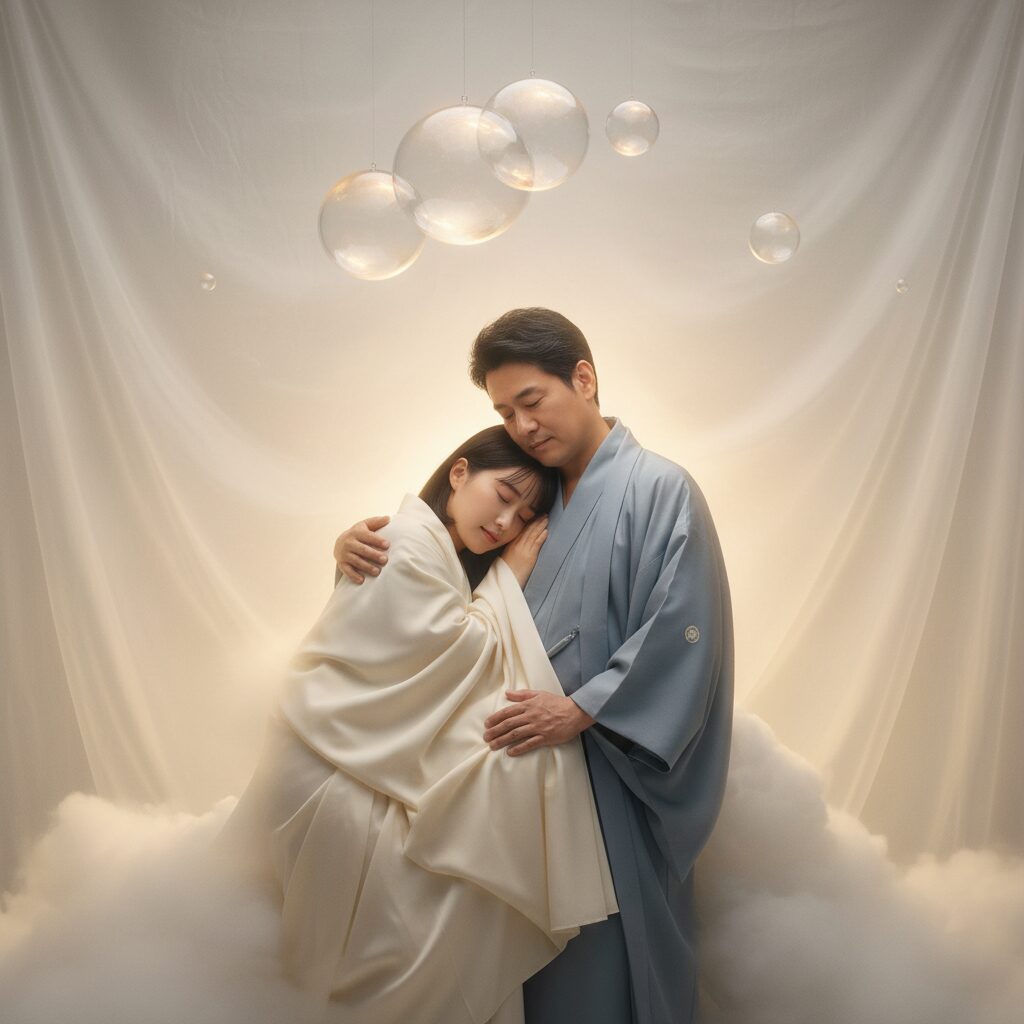
You see it, but you don’t know what you’re seeing. A junior colleague sheepishly asks her boss to double-check a simple email for the third time, a request he indulges with a paternal sigh and a smile. A grown man pouts playfully when his friend grabs the last piece of karaage chicken, and the friend, rolling his eyes, offers it back. A woman on the phone with her mother makes a slightly whiny, demanding request for a specific home-cooked meal when she visits next weekend. To an outsider, particularly one raised on a steady diet of Western individualism, these scenes can look like immaturity, a lack of self-reliance, or simple childishness. But you’re not seeing a weakness. You’re witnessing a fundamental pillar of Japanese society in action: amae.
The word, written with the kanji 甘え, is famously difficult to translate. Standard dictionaries might offer “indulgence,” “dependence,” or “presuming upon another’s love,” but these words are clinical and stripped of their emotional core. They fail to capture the warmth, the trust, and the profound intimacy the concept represents. At its heart, amae is the desire to be loved and accepted unconditionally, the ability to let your guard down and depend on another person’s goodwill. It’s the quiet confidence that someone cares enough about you to cater to your needs and desires, even when they’re a little unreasonable. It is the opposite of the rugged individualism that champions self-sufficiency as the ultimate virtue. In Japan, learning to skillfully give and receive amae is not a sign of immaturity; it is a sign of emotional and social intelligence, the very glue that holds close relationships together.
This intricate form of emotional intimacy mirrors Japan’s reverence for the natural world, as seen in nature worship, which highlights how cultural values effortlessly blend human connection with a profound respect for nature.
The Roots of Amae: Mother, Child, and the Ideal Bond
To truly understand amae, you need to trace it back to its origins—not just in an individual’s life, but in the concept’s formal examination. The term was introduced to the global stage by Japanese psychoanalyst Takeo Doi in his influential 1971 work, The Anatomy of Dependence (Amae no Kōzō). Doi proposed that amae is more than a cultural peculiarity; it is a universal human emotion, one that Japanese culture has distinctively named, nurtured, and woven into its social fabric.
For Doi, the quintessential example of amae is the bond between an infant and its mother. Imagine a baby, safe in its mother’s arms, who doesn’t need to verbalize requests for warmth, nourishment, or comfort—the baby’s needs are foreseen and fulfilled. There is a blissful, undifferentiated unity. At its core, the baby senses it has the right to this love and care. This feeling—this passive anticipation of indulgence—is the purest expression of amae. It represents a state of total and unconditional dependence, regarded within the Japanese psychological perspective as a paradise of connection.
Here lies a significant cultural difference. Many Western psychological frameworks, especially Freudian ones, see maturity as separation. A child must detach from the mother, form an independent identity, and become self-sufficient. This process is one of individuation. However, in the Japanese context, this original connection is not something to be cut off and left in the past. Rather, it remains the lasting ideal for all important relationships across life. The aim is not complete independence but to reestablish that feeling of secure, trusting dependence with your family, partner, close friends, and even trusted colleagues. Preserving this connection is not viewed as a sign of immaturity; instead, it is considered a success in fostering deep, meaningful human bonds.
Amae in Action: How It Plays Out in Daily Life
The theory is one thing, but the true power of amae lies in its everyday practice. It is a subtle, ongoing negotiation that reinforces the unseen bonds between people across nearly every aspect of life. Once you learn to recognize it, you will notice it everywhere—a silent language of intimacy.
In the Workplace (Shokuba)
The Japanese workplace, with its pronounced hierarchies and focus on group harmony, provides fertile ground for amae. The central relationship here is between a senior (senpai) and a junior (kōhai). This relationship goes beyond a simple mentor-mentee dynamic; it embodies a bond of mutual obligation, resembling that of an older and younger sibling.
A kōhai might rely on their senpai in ways that would seem unprofessional in a Western office. They might ask for help with tasks they should manage themselves, seek advice on personal matters, or request that the senpai speak to a manager on their behalf. This is not necessarily about incompetence. Rather, it is an expression of amae—a way of saying, “I trust you, I look up to you, and I am placing myself under your care.”
The senpai, in turn, is expected to indulge this amae. Refusing would be seen as cold and could harm the relationship. By offering guidance, support, and sometimes even taking responsibility for a junior’s mistakes, the senpai fulfills their part of the relationship. This indulgence strengthens the bond, fostering loyalty and helping the team function smoothly. For instance, a junior employee might linger by a senior’s desk at the end of a long day, hesitating before saying, “Could you just take one more quick look at this proposal before I send it? I’m a bit worried.” The request is a display of vulnerability, an appeal for reassurance. The senior, understanding the underlying message, agrees—because the act is less about the proposal itself and more about reinforcing their supportive role and affirming the junior’s place on the team.
Between Friends and Lovers (Yūjin to Koibito)
In personal relationships, amae becomes the currency of affection. It is how trust is tested and affirmed. Between romantic partners, it can appear as behavior that might otherwise be seen as “needy” or “demanding.” One partner might insist the other peel an orange for them or pout until they agree to watch a particular movie. This is not about power struggles; rather, it is a delicate dance of intimacy.
The person practicing amae makes themselves vulnerable, essentially asking, “Do you love me enough to do this small, slightly unreasonable thing for me?” The other’s indulgence answers, “Yes, I do.” Refusing or responding with “Do it yourself” may be interpreted as emotional distance. Being able to show your unguarded, dependent side is proof of feeling safe in the relationship. A partner who never asks for anything, who is entirely self-sufficient, can be perceived as cold or uncaring (tsumetai), as if they are not fully invested in the shared emotional space of the relationship.
This dynamic is also evident among close friends. One friend might call another late at night to vent about a minor issue, expecting a sympathetic ear. They might “forget” their wallet and expect the friend to cover their meal, knowing the favor will be returned later. These are not lapses in responsibility but affirmations of their bond. Each act of indulgence reinforces the unspoken agreement: “We are in this together. You can count on me, and I can count on you.”
Within the Family (Kazoku)
Nowhere is amae more accepted or expected than within the family. This is its natural setting, where the original mother-child bond is most directly replicated. It’s common for adult children, even those married with families of their own, to revert to dependance when visiting their parents. A son in his forties might return to his childhood home expecting his elderly mother to cook his favorite dishes and do his laundry—and she will often do so gladly.
To a Western observer, this might seem like arrested development. But within the Japanese cultural context, it is a ritual that reaffirms familial roles and love. The son’s amae enables his mother to continue her role as nurturing caregiver, which provides her with identity and satisfaction. The son, in return, is able to momentarily shed the pressures of adult life and feel unconditionally cared for. It is a return to the safety and security of the primal bond—a mutual act that strengthens family ties. Here, the dependence itself is the point.
The Unspoken Rules: When Amae is Welcome and When It Crosses the Line
This is not to imply that amae is a free-for-all of emotional indulgence. It is regulated by a complex and implicit set of rules, and successfully navigating them demands a high level of social sensitivity. The most crucial of these rules is the distinction between uchi (inside) and soto (outside).
Amae is reserved exclusively for your uchi group—your inner circle. This includes family, your romantic partner, childhood friends, and your team at work. Within this circle, a certain degree of dependence is not only accepted but expected. Attempting to amaeru with someone in the soto group—a stranger, a business client, a new acquaintance, or someone from a different department—would be a serious social faux pas. It would be regarded as presumptuous, intrusive, and highly inappropriate. You have not yet earned the right to rely on their goodwill.
Knowing when, where, and with whom to employ amae is a vital social skill connected to the concept of kūki o yomu, or “reading the air.” One must be able to gauge the nature of a relationship and the suitable level of intimacy. Overstepping by seeking too much amae too soon can ruin a developing relationship. The amount of amae deemed acceptable serves as a measure of closeness between two people.
There is also a delicate boundary between appropriate amae and mere selfishness (wagamama). Someone who constantly makes demands without ever reciprocating, who takes indulgence for granted, is not skillfully practicing amae; they are simply spoiled. Conversely, a person who never expresses amae, never asks for help, or shows vulnerability can be perceived as distant (tanpaku) or overly formal (tanin gyōgi), creating a barrier to genuine intimacy. The ideal is a balanced, reciprocal exchange. You indulge a friend’s moment of need today, with the unspoken understanding that they will support you tomorrow.
A Different Kind of Strength: Reframing Dependence
At its essence, understanding amae demands a fundamental shift in how dependence is viewed. In Western culture, dependence is often seen as a liability, a weakness to overcome on the journey to becoming a strong, self-reliant individual. Independence is the ultimate goal. However, amae offers a different perspective on strength—one grounded in interdependence.
It recognizes a simple human reality: we are social beings who need one another. By creating a cultural space where people feel safe to be vulnerable and depend on each other, amae fosters remarkably resilient social bonds. It cultivates a deep sense of psychological security. Knowing that you have an inner circle to lean on—people who accept your moments of vulnerability without judgment—provides a vital buffer against life’s stresses.
While Takeo Doi emphasized the distinctiveness of amae in Japan, this relational philosophy resonates throughout East Asia. In Chinese culture, the concept of sājiāo (撒嬌) carries a similar nuance, especially in romantic and familial settings. Sājiāo often involves a more explicit, playful, or coquettish expression of dependence to evoke affection and indulgence. It serves as a means of softening interactions and expressing intimacy. Though sājiāo tends to be more overtly performative and commonly used by women, whereas amae is a more pervasive, often unspoken, aspect embedded in Japan’s hierarchical social fabric, both highlight a shared cultural principle: interdependence is not a weakness but the very foundation of strong relationships.
The Flip Side: When Amae Turns Toxic
Certainly, no social dynamic is without its darker aspects. When unhealthy, amae can become a means of manipulation and control. It may encourage co-dependent relationships in which individuals are discouraged from achieving personal autonomy, trapping them in a cycle of learned helplessness.
In the workplace, the boundary between the supportive senpai-kōhai relationship and power harassment (pawa-hara) can become alarmingly unclear. A superior might exploit this dynamic, imposing unreasonable personal demands on a subordinate under the pretense of mentorship. The junior employee feels cornered, as rejecting the boss’s “amae” might be perceived as insubordination and a refusal to embrace the company’s family-like culture.
Moreover, the ongoing pressure to preserve group harmony (wa) by accepting another’s amae can be draining. It often leads to underlying resentment when the balance of give-and-take is uneven. People may feel compelled to agree to requests they find burdensome simply to avoid upsetting the relationship, creating a passive-aggressive tension that simmers beneath a façade of agreeableness.
Beyond Childishness: A New Lens on Intimacy
Despite its potential drawbacks, amae remains an essential and beautiful element of Japanese culture. It is incorrect to dismiss it as mere childishness. In reality, it is a sophisticated and subtle form of communication, serving as a means of building and sustaining intimacy in a society that often prefers indirectness over bluntness.
Amae is a language rooted in trust. Making yourself vulnerable and dependent expresses faith in a relationship. Accepting and nurturing that vulnerability reaffirms the bond. This ongoing, reciprocal process weaves individuals into a strong social fabric.
For those from cultures that value radical self-reliance, amae presents a profound and challenging lesson. It suggests that true strength may not come from standing alone, but from having the courage to depend on others and the grace to allow them to depend on you. It reminds us that there is a deep, enduring beauty in mutual dependence—a paradise of connection we left behind in infancy but can rediscover in each other with enough trust.