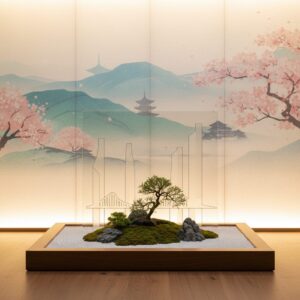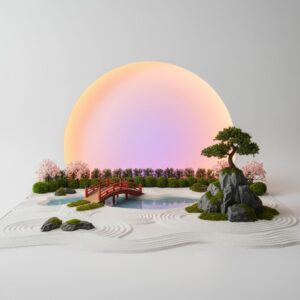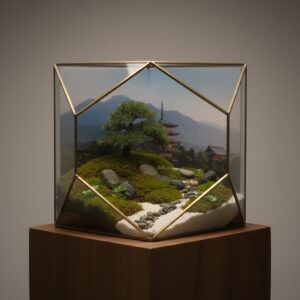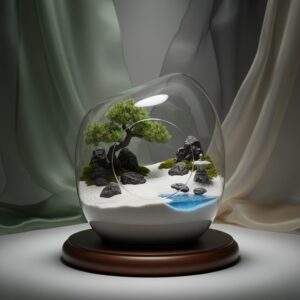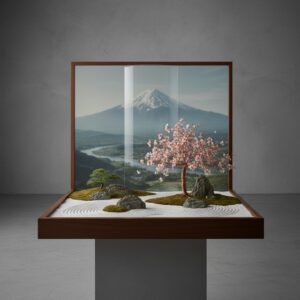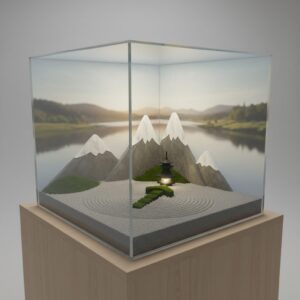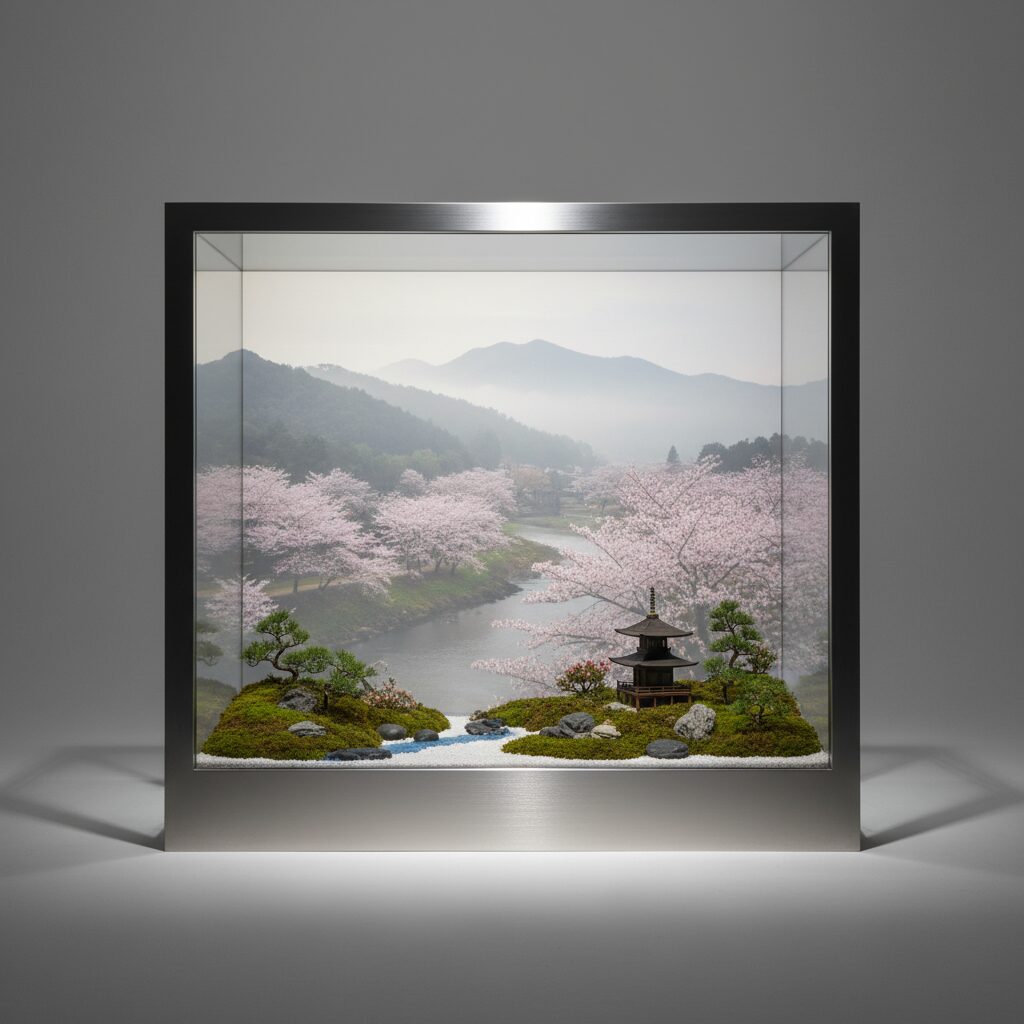
Stand in one of Kyoto’s great gardens—say, at the Shugaku-in Imperial Villa—and you might feel a strange sense of spatial disorientation. The garden itself is meticulously composed, with raked gravel, moss-covered stones, and carefully pruned pines. It’s a contained, human-scaled world. Yet, your eyes are inevitably pulled upward and outward, past the garden’s edge, to the sloping silhouette of Mount Hiei against the sky. The mountain doesn’t feel like a backdrop; it feels like the garden’s final, most magnificent feature, placed there by the designer. The boundary between the curated foreground and the wild, distant landscape seems to dissolve. You are in a garden, but you are also in the mountains. This is not an accident. It’s a deliberate, profoundly Japanese design philosophy known as shakkei.
Translated literally, shakkei (借景) means “borrowed scenery.” It is the art of incorporating the surrounding landscape into the composition of a garden. Instead of building walls to block out the world, the garden designer uses them as a frame, carefully curating a view that captures a distant mountain, a neighboring temple’s pagoda, or even just a sliver of the open sky. It’s a technique that makes a small space feel vast and connects the intimate, man-made environment to the grand, untamed power of nature. But to see shakkei as merely a clever trick to create an illusion of space is to miss the point entirely. It is a physical manifestation of a cultural mindset—a statement about humanity’s place within the natural world, the porousness of boundaries, and the beauty of appreciating what you can never truly own.
The integration of meticulously curated garden elements with the vast, embracing wilderness invites readers to explore Japan’s unique concept of borrowed scenery and its cultural significance.
Beyond the Garden Wall: The Philosophy of Shakkei
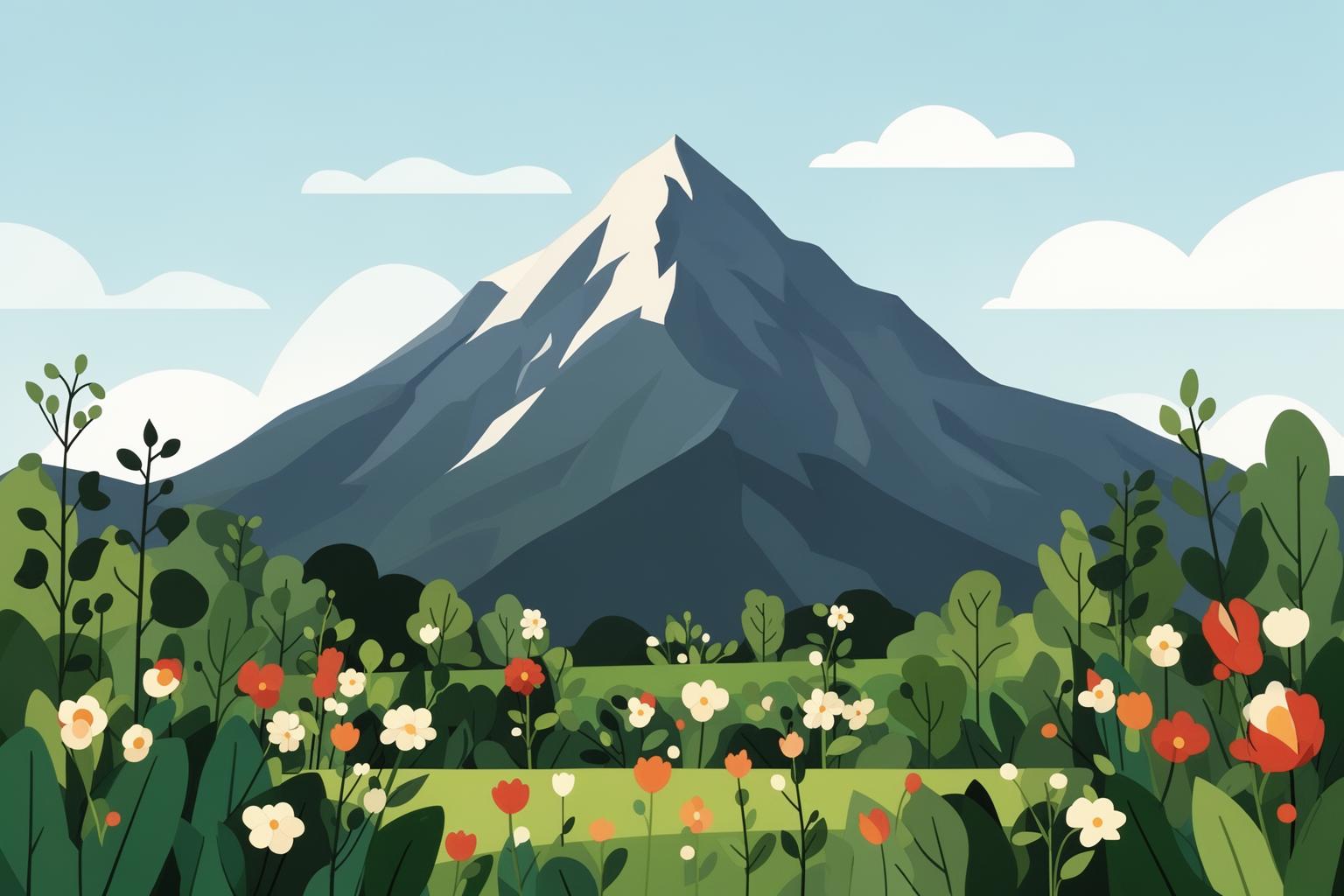
The fundamental principle of shakkei involves a radical redefinition of a garden’s purpose. In many Western traditions, a garden is seen as an enclosure, a space carved out from the wilderness and tamed for human enjoyment. Its walls serve to create privacy, to keep the outside world at bay. Shakkei reverses this logic. Here, the garden’s edge—whether a low hedge, a strategically placed fence, or the eaves of a building—acts as a proscenium arch. Its role is not to block the view but to guide it. It directs your gaze, transforming a chaotic natural panorama into a focused, living painting.
A Frame, Not a Fence
Imagine you are an artist. Nature has provided you with a masterpiece—a series of rolling hills, an ancient forest, the sea. You cannot recreate it. So what do you do? You don’t try to compete. Instead, you build a frame. The garden becomes this frame—a carefully composed middle ground meant to enhance and honor the distant masterpiece. The shape of a manicured azalea bush might echo the curve of a far-off hill. A line of stones might lead the eye directly toward a waterfall on a distant slope. The garden doesn’t end at its physical boundary; it extends all the way to the horizon. This act of framing is one of deep reverence. It acknowledges that the most beautiful elements are often beyond our control. The designer’s genius lies not in creation, but in curation.
Humility in Design
This approach is rooted in a Shinto and Zen Buddhist worldview that sees humanity as part of nature, not its conqueror. There is profound humility in shakkei. The garden designer recognizes that their work is secondary to the majesty of the borrowed view. They do not impose their will on the landscape but enter into a dialogue with it. This is a quiet collaboration between human artistry and natural grandeur. The aim is harmony, not dominance. By “borrowing” the scenery, the designer acknowledges that it does not belong to them. It cannot be bought, owned, or contained. It can only be appreciated, and the garden serves as a beautiful, contemplative platform from which to do so.
The Four Types of Borrowed Scenery
Japanese aesthetes and garden masters have classified shakkei into four distinct types, based on the direction and scale of the borrowing. Understanding these categories highlights the versatility and subtlety of the concept, demonstrating how it can be applied through grand, sweeping gestures or in small, intimate moments. It serves as a vocabulary for perceiving and composing with the world beyond the wall.
Enshaku (遠借) – The Distant Borrow
This is the most iconic and dramatic form of shakkei. Enshaku means borrowing from afar. It involves capturing a significant, large-scale landmark such as a mountain, a range of hills, or the ocean. The famous gardens of Kyoto are masters of this technique, using Mount Hiei and Mount Arashiyama as essential compositional elements. The effect is breathtaking. The garden’s foreground, filled with intimate details, provides a sense of scale that makes the distant mountain feel both immense and intimately connected to your position. The vastness of the world is drawn into a personal, contemplative space. It demands a privileged location with an uninterrupted view, making it the most ambitious form of borrowed scenery.
Rinshaku (隣借) – The Neighboring Borrow
Not every garden enjoys a mountain view. Rinshaku, or neighboring borrow, is a more modest and common form of the art. It entails incorporating features from an adjacent property—perhaps the elegant roofline of a neighboring temple, a striking bamboo grove in another yard, or even a beautiful wall. This type of shakkei fosters a sense of shared aesthetic space. It implies that beauty need not be privately owned. Your neighbor’s exquisite cherry tree, when framed by your window, becomes part of your spring scenery. It softens the rigid boundaries of property and creates a visual community, weaving separate spaces into a single, harmonious townscape. It represents a quiet, respectful nod to the beauty created by others.
Gyōshaku (仰借) – The Upward Borrow
At times, the most dramatic scenery lies directly above. Gyōshaku, the upward borrow, involves framing views of the sky, clouds, or the canopy of towering trees that lie just beyond the garden’s perimeter. This technique is often employed in small, enclosed urban gardens where horizontal views are blocked. By cutting a window in a wall that reveals only the sky, or designing a courtyard open to the heavens, the garden achieves a sense of infinite vertical space. The borrowed element is always changing—the slow drift of clouds, the shifting daylight from dawn to dusk, the pattern of stars on a clear night. It connects the grounded, earthy space of the garden to the ephemeral and celestial.
Fushaku (俯借) – The Downward Borrow
Just as borrowing from above is possible, one can also borrow from below. Fushaku, or the downward borrow, is the technique of incorporating a view that lies beneath the garden. It’s typically utilized in gardens built on hillsides or cliffs, where the designer can frame a stunning vista down into a valley, river, or lake. A classic example is using the surface of a pond within the garden to borrow reflections of the sky, clouds, and surrounding trees. In this way, the vastness of the heavens is brought down to earth, captured within the water. This technique plays with perspective and reflection, creating a layered, multi-dimensional experience within the garden space.
The Living Composition: Shakkei in Practice
Merely having a pleasant view does not qualify as shakkei. This principle is active, demanding great skill and foresight from the garden designer. They must act as a conductor, meticulously managing not only the garden itself but also how the viewer perceives the connection between the garden and the borrowed landscape. Several related concepts are often used to make the borrowing appear seamless and dynamic.
The Art of Concealment and Reveal
A masterful shakkei garden seldom displays its borrowed view all at once. Instead, it employs a technique called miegakure (見え隠れ), meaning “hide and reveal.” As you stroll along a winding path, the distant mountain may appear and vanish, glimpsed through the twisted branches of a pine tree, then blocked by a small hill, only to be fully unveiled from the veranda of a teahouse. This creates a sense of discovery and anticipation. It encourages mindful movement and prevents the view from becoming a fixed, postcard-like image. The scenery becomes a living element in the garden experience, and the garden is a journey toward its full appreciation.
Orchestrating the Middle Ground
The effectiveness of shakkei depends on the harmonious transition between the foreground (the garden), the middle ground (the framing elements), and the background (the borrowed scenery). The designer must carefully craft this middle ground to bridge the visual distance. The texture of moss on a stone lantern might be selected to complement the rich green of a distant forest. The gentle slope of a manicured hill in the garden might echo the grander slope of the borrowed mountain. Trees are pruned not only for their individual shape but also to form an ideal window through which to view the scene. This careful orchestration ensures the eye moves smoothly from near to far, making the entire composition feel cohesive and unified.
What Shakkei Says About Space and Self

Ultimately, shakkei is much more than just an architectural or horticultural technique. It represents a worldview brought to life. It challenges contemporary Western ideas about property, boundaries, and the separation between the human environment and the natural world. It provides an alternative perspective on our place within the broader landscape.
Dissolving Boundaries
In a world fixated on ownership and clear divisions, shakkei suggests a more fluid reality. The garden is not an isolated bubble; rather, it acts as a porous membrane, intentionally linked to the world beyond. This reflects a cultural viewpoint that sees less of a strict division between uchi (inside) and soto (outside), or between self and other. By visually folding a distant mountain into one’s personal space, the garden’s owner is reminded of their role within a much larger ecosystem. The mountain exists in their garden, and their garden exists within the mountain’s landscape. It is a powerful expression of interconnectedness.
The Power of the Void
Shakkei also serves as a masterclass in the Japanese aesthetic principle of ma (間), the deliberate use of negative or empty space. The impact of a borrowed mountain view lies precisely in the expansive, empty space between the observer and the mountain. The designer does not fill this space but respects it. This interval, this void, generates the sense of depth, scale, and longing. It reminds us that what is absent can be just as significant as what is present. The space between elements creates meaning and relationship, which is a fundamental tenet of Japanese aesthetics.
So, the next time you find yourself in a Japanese garden and sense its boundaries extending to the horizon, you’ll recognize the influence of shakkei. It’s a design philosophy that imparts a profound lesson: you don’t need to own something to appreciate its beauty. You don’t need to erect walls to feel at peace. Sometimes, the most beautiful act is to create a perfect frame for the world that already exists, realizing in the process that you were never truly separate from it.