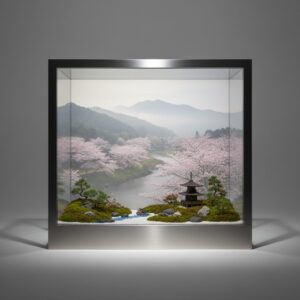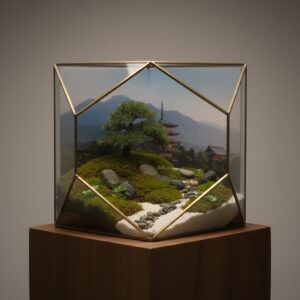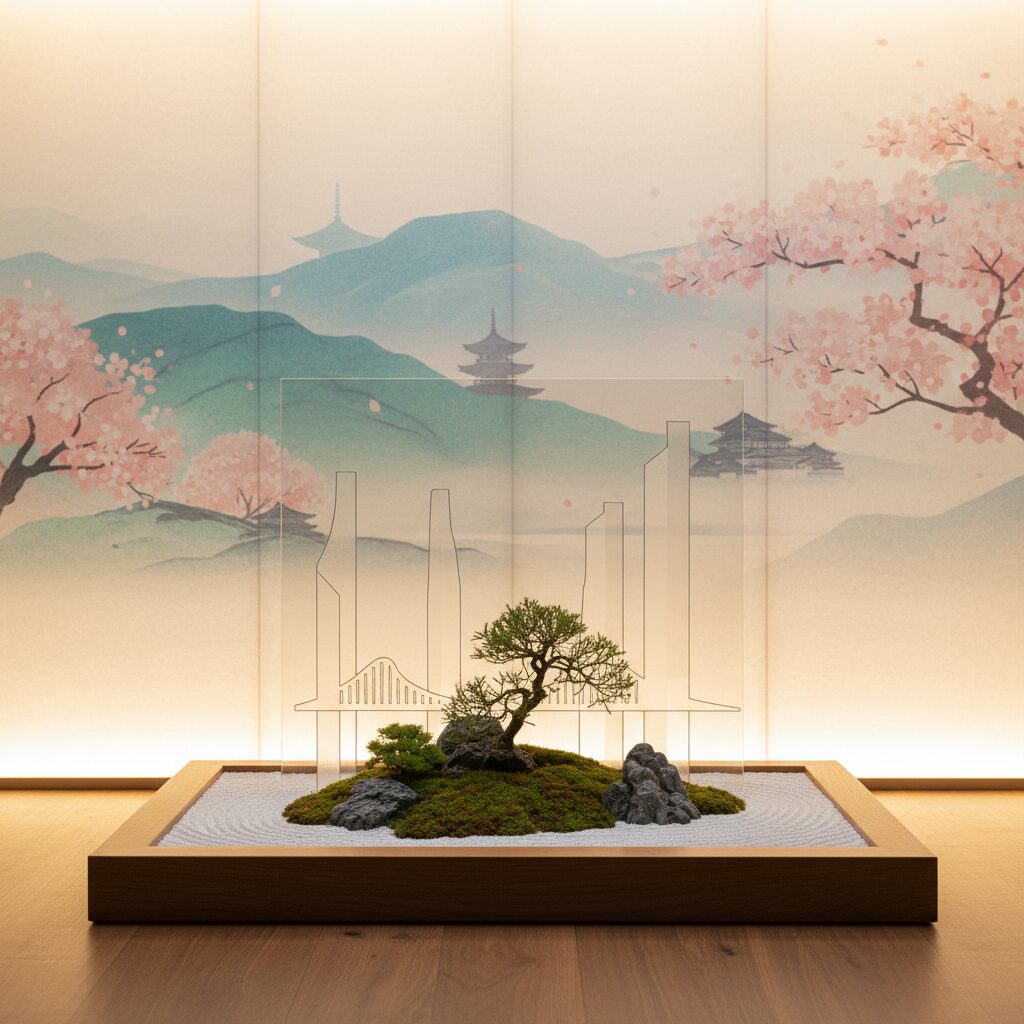
Imagine the most perfect garden you can. You’re probably picturing meticulously pruned trees, artfully placed stones, maybe a tranquil pond with colorful koi gliding beneath the surface. Every element is deliberately chosen and placed, a self-contained world of serene beauty. Now, what if I told you that in many of Japan’s most breathtaking gardens, the most important feature isn’t even in the garden at all? It’s the mountain range shimmering in the distance, the roof of a neighboring temple, or even the vast, empty sky above. This is the essence of one of the most profound and subtle concepts in Japanese aesthetics: shakkei, or “borrowed scenery.”
It’s a design principle that, on the surface, seems simple. You frame a view of something outside the garden’s walls and incorporate it into the garden’s composition. But this simple act is a radical statement. In a world obsessed with ownership and control, shakkei proposes that the greatest beauty comes from acknowledging and embracing what lies beyond our own small patch of earth. It’s an art form that intentionally blurs the line between the human-made and the natural, the finite and the infinite. To understand shakkei is to understand a fundamental aspect of the Japanese worldview—a perspective that sees humanity not as the master of nature, but as a small, harmonious part of a much larger, interconnected whole. It’s a lesson taught not in a classroom, but in the quiet contemplation of a view that has been perfectly, almost invisibly, framed for you.
This boundary-blurring approach is further illuminated in how Japanese gardens borrow the horizon to extend a garden’s visual narrative beyond its own confines.
The Illusion of Infinity
At its essence, shakkei is a brilliant technique of spatial manipulation. By definition, a garden is an enclosed area with clear boundaries: walls, fences, hedges. These lines distinguish the curated space inside from the wild world outside. Shakkei is the skill of making those boundaries vanish. It is a visual illusion that extends the perceived garden space to the horizon, creating a sense of depth and grandeur that would otherwise be impossible to construct.
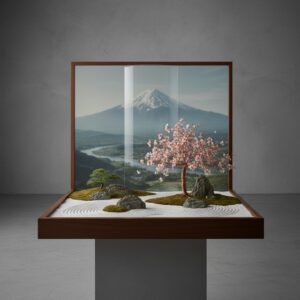
Imagine the garden as a giant picture frame. The elements inside—the carefully trimmed bushes in the foreground, stone lanterns, the edge of a veranda—are not merely beautiful objects. They serve as compositional tools guiding your eye to the main attraction: the borrowed view. A low, clipped hedge may hide the cluttered middle ground, allowing a clear visual leap from the garden’s mossy floor straight to the slope of a distant mountain. The dark pillars of a temple hall might frame a particular peak, turning it into a living painting that shifts with the light and seasons.
This is not a passive occurrence of having a pleasant view by chance. Every rock and tree placement is a deliberate choice to enhance and honor the borrowed element. The designer acts as a director, meticulously orchestrating the viewer’s experience. They may create a winding path that hides the view until the perfect moment, unveiling it suddenly for maximum emotional effect. They might use a pond to reflect the sky or distant hills, bringing the outside world into the garden’s core. The aim is to achieve a seamless fusion where the garden and the landscape beyond form a single, unified work of art. Even a small, three-acre garden can feel as expansive as a national park because it has embraced the entire panorama as part of its identity.
More Than Just a Pretty View: The Philosophy Behind Shakkei
To regard shakkei as merely a clever design trick is to entirely miss its significance. It is a tangible expression of a deep-rooted cultural and philosophical view on the relationship between humans and nature. This is where shakkei transcends being just a gardening technique to become a profound reflection of Japanese culture.
Primarily, it embodies a profound respect for nature, rather than a desire to dominate it. Western formal gardens, such as those at Versailles, often convey a sense of absolute human control over nature, characterized by geometric precision, straight lines, and symmetrical patterns—nature subdued and shaped to conform to human order. Conversely, Japanese gardens, with shakkei at the forefront, express the opposite tendency. The gardener does not attempt to replicate the distant mountain within the garden walls; such an effort would be arrogant and futile. Instead, they show humility, acknowledging the sublime and uncontrollable beauty of the mountain, choosing to honor it and engage in a dialogue with it. The garden becomes a space where the human artist collaborates with the vast, untamed canvas of the world.
This worldview is deeply influenced by Zen Buddhism principles, which have shaped Japanese aesthetics for centuries. A central idea in Zen is interconnectedness—the understanding that all things are part of a single, flowing reality. Shakkei perfectly embodies this concept by visually dissolving the artificial boundary between the ‘self’ (the garden) and the ‘other’ (the world beyond). By borrowing the scenery, the garden acknowledges that it is not an isolated creation but intrinsically connected to the broader environment. Viewing a shakkei garden is a meditative experience. The borrowed landscape serves as a constant reminder of a reality larger than oneself, encouraging the observer to transcend their immediate surroundings and reflect on their place in the universe.
This philosophy also engages a fundamental aspect of Japanese spatial thinking known as uchi-soto (内 Soto 外), or inside/outside. This cultural distinction governs social relationships and physical spaces, delineating a clear divide between the trusted inner circle and the outside world. For example, a traditional Japanese house features multiple layers separating the private interior from the public exterior. Shakkei elegantly subverts this concept by creating a space that is clearly uchi—a private, controlled garden—while intentionally inviting the soto world in, making it the centerpiece. This act of visual integration suggests a desire for harmony between these two spheres, establishing a fluid boundary where the curated and the wild coexist in perfect balance.
The Four Types of Borrowed Scenery
Although the concept feels holistic, traditional Japanese garden theory classifies shakkei into four distinct types based on the direction and distance of the borrowed element. Understanding these reveals the subtlety and purpose behind each design.
Enshaku (遠借): Distant Borrowing
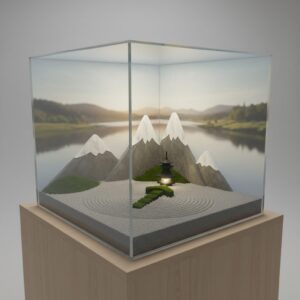
This is the most renowned and dramatic form of shakkei, involving the incorporation of a significant landscape feature such as a mountain, a range of hills, or the sea into the garden’s view. It represents shakkei on a grand scale, aiming to evoke a sense of the sublime. The garden serves as a foreground, a beautiful prelude to the majestic power of the distant scenery. Renowned gardens like Shugaku-in Imperial Villa in Kyoto master enshaku, using Mount Hiei and the surrounding Higashiyama mountains as their striking backdrop.
Rinshaku (隣借): Adjacent Borrowing
More intimate and subtle, rinshaku involves borrowing elements from a neighboring property, such as a striking pine tree in the adjacent garden, the elegant tiled roof of a nearby temple, or a small bamboo grove. This approach embeds the garden within its immediate context and community, symbolizing shared beauty and recognizing that the aesthetic landscape extends beyond property boundaries. It requires a delicate sensibility, framing the neighbor’s feature naturally and intentionally, as if it were an integral part of the garden’s design.
Gyōshaku (仰借): Upward Borrowing
This form of shakkei draws the gaze upward. Borrowed elements include the sky itself, passing clouds, the moon, or the canopy of very tall trees whose trunks lie outside the garden walls. By designing a garden that is relatively open or has a low profile, the sky becomes a dynamic, ever-changing ceiling for the space. The reflection of the sky in a pond is a classic technique of gyōshaku, effectively bringing the heavens down to earth and imparting a sense of boundless vertical space.
Fushaku (俯借): Downward Borrowing
Perhaps the least common but equally striking, fushaku involves borrowing a view below the primary vantage point. This is typically used in gardens situated on hillsides or cliffs. From a veranda or viewing pavilion, the eye is led downward to borrow the view of a river in a valley below, rooftops of a town, or the shimmering surface of a lake. This creates a powerful sense of elevation and perspective, making the viewer feel as though they are floating above the landscape.
The Master’s Touch: Seeing Shakkei in Action
To truly understand the power of shakkei, you need to see it—or better yet, experience it. The concept comes to life in gardens crafted by masters who grasped not only horticulture but also perception, philosophy, and emotion.
Shugaku-in Imperial Villa, Kyoto
This is the undisputed grand masterpiece of enshaku. Built in the 17th century for Emperor Go-Mizunoo, Shugaku-in is a vast estate made up of three separate villas and gardens situated on a hillside in northeastern Kyoto. The magic unfolds in the Upper Villa. As you stroll along the winding paths, the view is often deliberately hidden by trees and hills. Then, you reach the edge of a large, magnificent pond. Suddenly, the entire landscape reveals itself. Across the water, the meticulously tended garden gives way to the powerful, untamed slopes of the surrounding mountains. The boundary between the garden’s edge and the mountain forest is nearly invisible. The pond, called Yokuryu-chi (Dragon Basking Pond), mirrors the sky and hills, creating a flawless blend of all elements. It doesn’t seem like you are viewing a mountain from a garden; it feels as though the mountain is an integral part of the garden itself.
Entsu-ji Temple, Kyoto
If Shugaku-in is a grand symphony, Entsu-ji is a piece of minimalist chamber music. This small, serene temple in northern Kyoto offers one of the most precise and intellectually pure demonstrations of shakkei. The garden is viewed from the temple’s main hall. The veranda’s wooden pillars and the perfectly clipped hedge of camellia and tea bushes form a rigid, geometric frame. Through this living window, you see a perfectly composed view of Mount Hiei in the distance. The garden itself consists mostly of moss and a few carefully placed stones. All its design energy is concentrated on one thing: framing that mountain. The experience is deeply meditative. The frame compels you to focus, to notice the subtle shifts in light on the mountain’s surface and the clouds drifting past its peak. It is a masterclass in control and restraint, where the designer has done just enough to showcase the natural beauty of the world beyond.
Adachi Museum of Art, Shimane Prefecture
For proof that shakkei is not merely a thing of the past, look no further than the Adachi Museum of Art. Established in 1970, its gardens have been ranked the best in Japan for over two decades. The museum’s founder, Adachi Zenko, believed the garden itself to be a “living Japanese painting.” The realization of this vision is stunning. The vast windows of the museum act as picture frames, through which visitors view the gardens from inside. The gardens—from the Dry Landscape Garden to the Moss Garden—are impeccably maintained. But the true brilliance lies in how they seamlessly merge with the natural mountains and forests beyond the museum’s grounds. The gardeners prune their trees to echo the shapes of the distant mountains. The white gravel of the dry garden flows toward the hills like a river. The museum even actively cares for parts of the mountain it does not own, securing permission to ensure the borrowed view remains immaculate. It is a modern, uncompromising, and perfect embodiment of the shakkei ideal.
The Art of Not Building: Space, Emptiness, and the Japanese Mindset
Ultimately, the brilliance of shakkei resides not in what is added, but in what is omitted. It is a design philosophy grounded in the power of absence. The garden designer doesn’t clutter the space with more elements; they craft a void for nature to fill. This directly connects to another essential Japanese aesthetic concept: ma (間). Ma is often rendered as negative space, yet it is more than mere emptiness. It represents an active, intentional interval or pause, a space filled with energy and potential. In music, it is the silence between notes; in conversation, it is the meaningful pause. In a shakkei garden, the open space between the garden’s edge and the distant mountain embodies ma. It is this gap, this void, that forges the connection and imparts depth and resonance to the composition.
This highlights a profound cultural tendency toward harmony rather than dominance. The shakkei artist embraces the limitations of their creation. They recognize they cannot improve the mountain, so they simply don’t try. Their artistry lies in creating the ideal context for appreciating the mountain. It is an act of deep humility and respect, acknowledging that human creation attains its highest purpose when it harmonizes gracefully within the larger, pre-existing order of the natural world. It is a subtle yet resolute rejection of ego. The garden is not a monument to its creator’s skill, but a quiet stage set to showcase the beauty of something far older and grander.
Beyond the Garden Wall
Once you grasp the principle of shakkei, you begin to notice it everywhere in Japan, not only in gardens. It shows up in architecture, where a window is strategically positioned to frame a cherry tree. You find it in floral arrangements (ikebana), where the empty space around the flowers holds as much significance as the flowers themselves. Essentially, it represents a worldview.
It’s a mindset that encourages you to view your own space—your home, your work, your life—not as an isolated bubble but as interconnected with a broader context. It serves as a reminder that beauty often exists just beyond our own boundaries, in things we neither own nor control. In a world that persistently pushes us to acquire, build, and fill every vacant spot, shakkei offers a radical alternative: the art of borrowing. It implies that sometimes, the most elegant and meaningful act is simply to create a beautiful frame for the world already present, and in doing so, to become part of it.