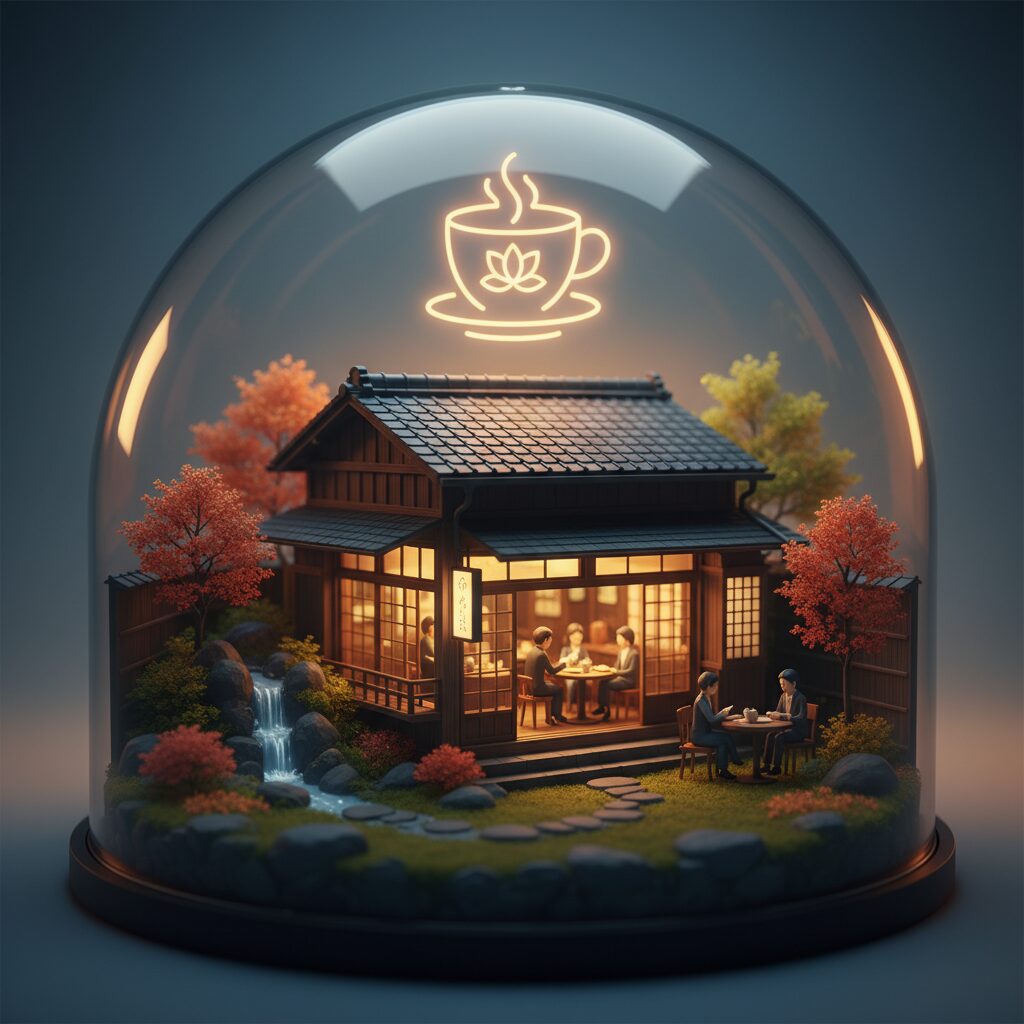
Walk past the gleaming facades of a Starbucks or a Blue Bottle in any major Japanese city, and you’ll see a familiar scene: laptops glowing, people taking calls, the energetic hum of productivity and social connection. It’s a globalized template for what a café should be. But tucked away in a quiet backstreet, down a flight of narrow stairs, or behind a nondescript door with a small, handwritten sign, lies an entirely different universe. Push open the heavy wooden door, and a small bell chimes, announcing your arrival not into a business, but into a pocket of suspended time. This is the world of the kissaten, Japan’s traditional coffee house, and it is the antithesis of the modern café. It’s a space designed not for connection, but for disconnection; not for collaboration, but for contemplation.
The air inside is thick with the ghosts of conversations from decades past, the scent of dark-roast coffee brewed with painstaking slowness, and often, the faint, sweet smell of old tobacco smoke trapped in the velvet upholstery. The light is low, the music is hushed, and the patrons sit alone, absorbed in paperbacks, notebooks, or their own thoughts. You might be wondering why such places exist, and more importantly, why they continue to endure in a culture so often associated with relentless modernity and group-oriented dynamics. The answer isn’t just about nostalgia or a taste for a certain kind of coffee. The kissaten is a masterful piece of social architecture, a physical space meticulously crafted to serve a deep-seated cultural need for solitude, privacy, and a moment of quiet refuge from the demands of the outside world. To understand a kissaten is to understand a crucial, unspoken dimension of Japanese life.
The serenity of a kissaten stands in quiet contrast to today’s fast-paced digital realm, and exploring the digital Purikura evolution reveals how modern Japan continually reinterprets its cultural icons.
The Architecture of Introspection
The first thing you notice about a kissaten isn’t any particular object, but rather the overwhelming sense of enclosure. These spaces are not open and airy, designed for communal interaction. Instead, they are intentionally compartmentalized, constructed to create private worlds within a public room. This atmosphere is achieved through a distinctive set of design elements that work together to diminish the noise of the outside world and focus your attention inward. It’s a design philosophy that values the individual’s psychological comfort more than efficient space utilization or social mingling.
The Sanctity of the Booth
Forget the shared tables and hard wooden chairs typical of modern cafés. The core element of the classic kissaten is the booth. These are not the low, vinyl-covered booths of an American diner. Rather, they are imposing structures, often made of dark, heavy wood, with backs that rise well above head height when seated. Upholstered in fabrics such as deep red or forest green velvet, corduroy, or worn leather, they do more than simply offer seating; they form walls. Sliding into one makes the rest of the room fade away. Your peripheral vision is blocked from seeing neighbors. The high backs absorb sound, muffling the already hushed conversations of other patrons and the clatter of ceramic on saucer.
This architectural choice directly reflects the Japanese cultural concept of personal space. In a country with dense cities and often small living quarters, the ability to create a psychological bubble is highly valued. The kissaten booth is the tangible expression of that bubble. It offers a semi-private domain where you are shielded from others’ gaze, free to be an anonymous observer or fully retreat into your own world. It’s a space that permits solitude, non-productivity, allowing you simply to exist without social performance. The materials themselves—the plush, noise-dampening velvet and solid, unyielding wood—enhance the sensation of a secure, personal sanctuary.
A World Lit by Amber
Lighting in a kissaten is never an afterthought; it’s a primary tool for setting mood. You will almost never encounter harsh, overhead fluorescent lights. Instead, the illumination is warm, indirect, and thoughtfully dim. Light sources often serve as focal points: ornate, vaguely European-style stained-glass lamps hang low over each table, brass sconces adorn wood-paneled walls, or a single intricate chandelier casts a soft amber glow throughout the room. The result is an atmosphere that feels perpetually like twilight.
This dim light serves two purposes. Functionally, it reduces visual stimulation, encouraging your eyes and mind to relax. The focused pool of light on your table transforms it into a personal stage for your book, notebook, or coffee, while the rest of the room melts into a soft, indistinct background. Psychologically, the low lighting fosters intimacy and privacy. It resembles a private study or quiet library rather than a commercial space. It signals that the setting isn’t meant for bright, energetic activity but for calm, focused reflection. The warm yellow-to-amber tones are inherently soothing, sharply contrasting the cool, blue-white glow of office buildings and convenience stores. Stepping into a kissaten feels like applying a sepia filter to the world, immediately slowing your sense of time.
The Curated Soundscape
A kissaten is rarely silent but never loud. Its soundscape is managed as carefully as its lighting. Soft materials—velvet seats, thick carpets, heavy curtains—absorb sound superbly, eliminating the harsh echoes and clatter common in modern cafés with hard surfaces. What remains is a gentle ambient hum. Often, the dominant sound is not conversation but the owner’s carefully chosen music, the “Master’s” selection.
This is not an algorithm-generated pop playlist. Typically, the music is instrumental, leaning heavily toward classical or mid-century jazz. A well-worn vinyl record might softly crackle on a turntable behind the counter, reflecting the Master’s particular and often deeply cherished tastes. This choice is key. The absence of lyrics in any language prevents distraction. The music becomes a texture, another layer supporting concentration rather than demanding attention. It establishes a sophisticated, contemplative mood and implicitly discourages loud, boisterous talk that would feel out of place. The quiet, meticulous sounds of the Master at work—the hiss of a siphon brewer, the gentle pouring of water, the soft clink of a spoon—become parts of this intentional, calming symphony.
The Ritual of Unhurried Time
Beyond its physical design, the experience inside a kissaten is shaped by a set of unwritten rules and rituals that distinguish it from any other food and beverage venue. The service, the menu, and even the rhythm of the interaction are all carefully attuned to preserve the sanctuary-like ambiance. The transaction takes a backseat to the simple experience of being in the space.
The Domain of the Master
The individual behind the counter is not a “barista” in the contemporary sense. They are the “Master” (masutā), a title that signifies ownership, skill, and quiet authority. Typically the sole staff member, the Master remains a steady, unobtrusive presence. They don’t greet you with forced enthusiasm or ask your name to write on a cup. Interaction is minimal, formal, and deeply respectful. A nod, a glass of water set quietly on the table, and your order taken without fuss. The Master’s attention is devoted to their craft.
Observing a kissaten Master prepare coffee is a lesson in mindfulness. It is a slow, deliberate procedure. They may use a glass siphon brewer resembling a chemistry experiment, carefully controlling the flame and timing the immersion. Or they may perform a meticulous pour-over, allowing the water to bloom in the grounds with practiced accuracy. This measured pace is contagious. It serves as a silent invitation to slow down as well. There is no rush. Your coffee will be ready when it is ready. The Master is the guardian of the kissaten’s atmosphere, and their calm, focused presence sets the tone for the entire space.
The Unspoken Agreement: Coffee as Rent
A cup of coffee at a kissaten may seem costly, often priced well above that of a large chain. But you aren’t merely paying for the drink itself. You are paying for the time and the space. This is the unspoken contract of the kissaten. For the price of that single, carefully crafted cup of coffee, you are granted the right to occupy your seat as long as you wish. There are no subtle prompts to leave, no staff clearing your table moments after you finish. You won’t be disturbed; your water glass will be refilled quietly, and you will be left entirely to your own devices.
This approach is worlds apart from the fast-turnover mindset of modern fast-casual dining. It transforms the customer into a temporary resident rather than just a consumer. People come here to read an entire novel, write a thesis chapter, sketch, or simply sit and reflect for hours. The high price filters for a clientele that comprehends and respects this agreement. It ensures the space is filled with individuals seeking the quiet refuge it offers, thereby reinforcing the very atmosphere they desire.
A Cultural Necessity
So why did this particular kind of space develop, and why has it endured? The kissaten is more than just a quaint artifact; it functions as a crucial “third space” with a distinct and lasting role in Japanese society. It represents a culturally crafted response to the demands of urban living and collective social expectations.
A Socially Approved Refuge
Japanese culture strongly emphasizes the group—whether in the workplace, family, or school setting. While this fosters a strong sense of social unity, it can also be exhausting. The pressure to sustain harmony (wa) and remain constantly mindful of one’s duties to others is considerable. The kissaten offers a socially acceptable release valve. It is a place where one can be physically situated in a public area yet mentally detached from the group. You can be alone without feeling isolated, anonymous without experiencing loneliness.
For the salaried worker, it serves as a spot to unwind between a long workday and the commute home. For a writer or student, it offers a quiet office away from the interruptions of a small apartment. It’s neutral territory where the roles and expectations of work and home are temporarily put aside. Here, you are not an employee, boss, parent, or child; you are simply an individual, free to retreat within your own thoughts.
An Analog Sanctuary in a Digital Age
In ultra-modern cities like Tokyo, where life is saturated with digital technology, constant connectivity, and an overload of sensory input, the kissaten stands as a stronghold of the analog. Many traditional cafés deliberately do not provide Wi-Fi. Power outlets are scarce. The focus is not on digital productivity but rather its opposite: deep, uninterrupted reflection.
The entire setting encourages putting your phone away. The dim lighting discourages screen use. The quiet ambiance makes a phone call feel intrusive. Instead, the space is designed for engagement with physical media: the rustling of newspaper pages, the texture of a book cover, the scratch of a pen on paper. This intentional break from the digital whirlwind is perhaps the kissaten’s most valuable role today. It provides a rare chance for mono-tasking in a world that demands multitasking—a peaceful environment to listen to your own thoughts.
Ultimately, the kissaten is more than just a venue for coffee. It is a thoughtfully preserved cultural institution, a room meant to evoke the feeling of a private study in a public setting. Its lasting charm lies in its quiet, steadfast resistance to change, offering a stable and tranquil refuge amid the relentless flow of modern life. It stands as a reminder that the most precious spaces are not always those that connect us with others, but those that allow us to reconnect with ourselves.