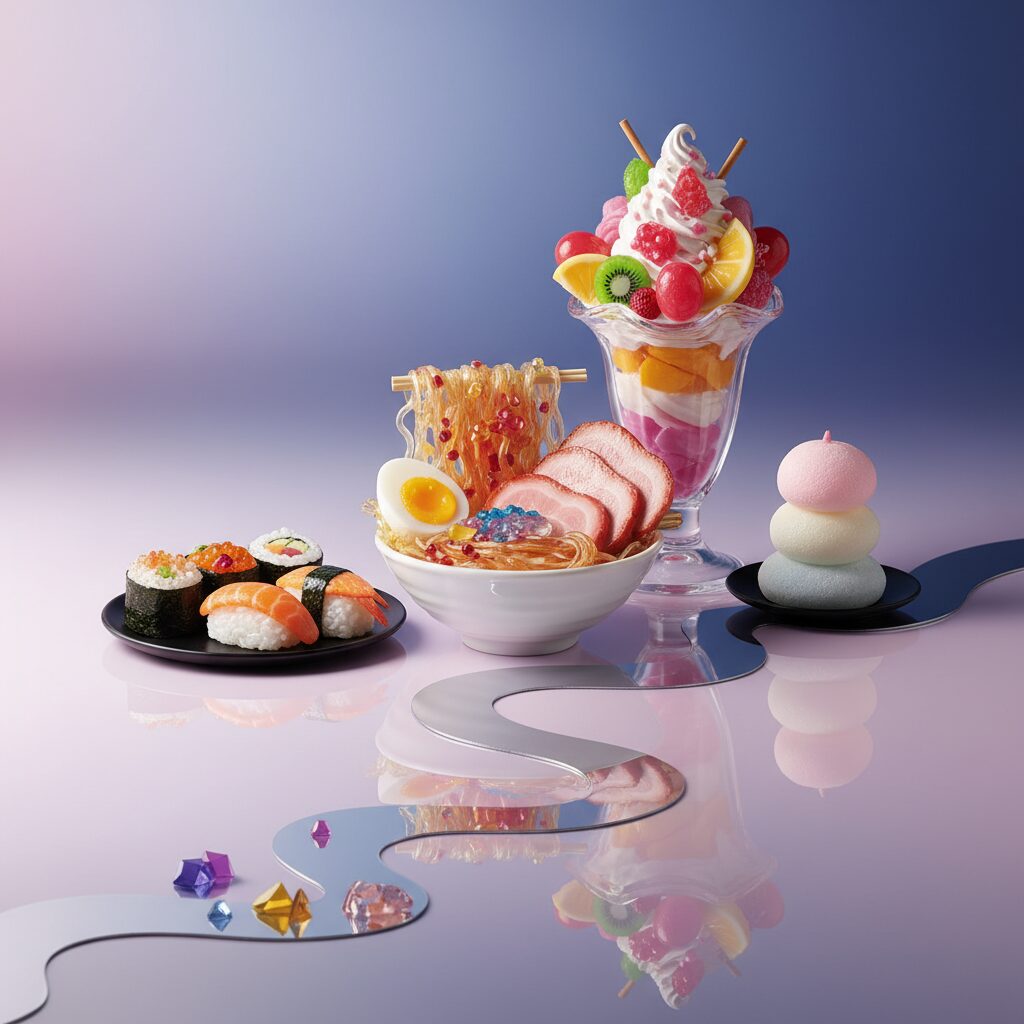
You’ve seen them. Peer into the window of almost any restaurant in Japan, from a high-end sushi counter in Ginza to a humble ramen shop tucked down a Kyoto alleyway, and you’ll find an immaculate, glistening display. It’s a full-course meal, frozen in time. A perfect bowl of tonkotsu ramen with noodles suspended mid-air by a pair of floating chopsticks. A plate of tempura so crisp you can almost hear the crunch. A slice of strawberry shortcake with impossibly glossy fruit and perfectly textured cream. It looks delicious. It looks real. But it’s a lie. A beautiful, intricate, and culturally significant lie. This is the world of shokuhin sampuru (食品サンプル), or fake food samples, a uniquely Japanese art form that is equal parts meticulous craftsmanship and brilliant commercial psychology. For the first-time visitor, it’s a charming quirk. But once you live here, you realize it’s something far deeper. These models aren’t just decoration; they are a visual contract, a silent promise, and a window into the Japanese mindset about service, trust, and the elimination of uncertainty.
This delicate interplay between art and reality in Japan not only captivates the palate but also resonates in the bold strategies of modern Japanese corporate warriors who redefine both their craft and the business arena.
A Visual Contract: The Promise on the Plate

At its core, the food sample system is founded on a simple yet powerful concept: what you see is what you get. In many parts of the world, a menu photo represents an idealized fantasy—a glamour shot of the dish at its best, often styled with motor oil and glue. You order it, only to receive a distant, less appealing version. This is not the case in Japan. The shokuhin sample displayed in the window is not an advertisement; it serves as a blueprint. The bowl of ramen that arrives at your table will have the same number of pork slices, the same placement of seaweed, and the same glistening sheen on the broth. It is a demonstration of profound commercial honesty. This practice grew for very practical reasons. In the early 20th century, as Western-style dishes like omurice and tonkatsu gained popularity, many Japanese diners were unsure of what to expect. The models provided a crucial bridge, a three-dimensional explanation that went beyond written descriptions. For foreign visitors today, they fulfill the same role, offering a universal language of food that transcends any language barrier. You can simply point and say, “kore o onegaishimasu” (this one, please), confident in knowing exactly what will arrive.
The Elimination of Anxiety
This system reflects a broader cultural preference for clarity and the avoidance of confusion or trouble. Ordering food in a foreign country can be stressful. You grapple with an unfamiliar menu, uncertain about portion sizes, ingredients, or even how the final dish will look. The shokuhin sample eliminates all those uncertainties. It answers every question before you even ask. How large is the portion? Just look at the model. What comes with the set meal? It’s all displayed on the plastic tray. Does the curry contain potatoes and carrots? You can see them suspended in the fake sauce. This preemptive problem-solving is a cornerstone of Japanese hospitality, or omotenashi. The goal is to anticipate customers’ needs—and anxieties—and address them smoothly. By presenting a perfect replica, the restaurant removes the risk of disappointment. You, the customer, are relieved of the burden of uncertainty, able to make an informed decision without any friction. It turns ordering from a potential gamble into a confident, stress-free experience.
The Silent Salesman
A photograph can be ignored. A written menu can be overlooked. But a three-dimensional, hyper-realistic plate of food carries a powerful, almost magnetic presence. Shokuhin samples are the ultimate silent salesmen. They work around the clock, drawing pedestrians in from the street with a tangible promise of deliciousness. A picture might show you a steak, but a sample reveals its thickness, the texture of its seared crust, and the way the fake butter begins to melt on top. This tangible quality elicits a more visceral reaction. You’re not just reading about food; you’re experiencing a preview of it. This is why restaurants invest significant sums—a single, intricate dish model can cost hundreds of dollars—to replicate their menus. The return on investment is evident. In a crowded restaurant scene, often stacked floor upon floor in the same building, a vivid, appetizing window display is the most effective way to stand out and capture the fleeting attention of hungry passersby.
The Birth of an Industry: From Wax to Vinyl Chloride
The entire industry traces back to one man and an accidental work of art. In the early 1920s, Takizo Iwasaki, a man from Gifu prefecture, was creating anatomical models out of wax. The story goes that one evening at home, while experimenting, a drop of hot wax fell into a bucket of water, blooming and rippling into a flower-like shape. Later, his wife made a wax-covered omelet for him, and when he saw it, a lightbulb went on—he realized he could apply his craft to food. In 1932, he opened his first factory in Osaka and presented a perfectly replicated “omurice” to a local department store restaurant. The management was so impressed they couldn’t distinguish the fake from the real, and thus an industry was born. His company, Iwasaki Co., Ltd., still dominates a large portion of the market today.
The Material Evolution
For the first several decades, shokuhin sample were made exclusively from paraffin wax. Though effective, it had its flaws: the models were fragile, melted under hot display lights or summer sun, and their colors faded over time. The real breakthrough came after World War II with the widespread availability of plastics. In the 1970s and 80s, manufacturers made a crucial shift to polyvinyl chloride (PVC). This new material was transformative—it was highly durable, heat-resistant, and retained its color and shape indefinitely. More importantly, it enabled a level of detail wax could never achieve. With PVC, artisans could capture the delicate texture of a single grain of rice, the porous surface of a block of tofu, or the subtle translucence of a slice of raw squid. This technological advancement allowed shokuhin sample to evolve from convincing replicas into the hyper-realistic works of art seen today.
The Craftsmen’s Republic
While the industry spans the nation, its spiritual home remains the small town of Gujo Hachiman in Gifu, Takizo Iwasaki’s home prefecture. A significant portion of all food models in Japan are still produced here by a handful of legendary companies. Walking through Gujo Hachiman, you sense the industry’s presence everywhere. It’s not a place of huge, automated factories but rather smaller workshops, where skilled artisans—often trained for years—practice their craft. This is not merely manufacturing but a highly respected form of craftsmanship passed down through generations. These artisans don’t simply replicate food; they interpret it, capturing its most appealing essence and preserving it in plastic. Their profound understanding of how food looks, cooks, and feels is what makes the final product so utterly convincing.
The Anatomy of a Perfect Fake

The creation of a shokuhin sample is an incredibly meticulous fusion of art and science. It starts with the restaurant preparing an ideal, real version of the dish they want replicated. This dish is quickly sent to the sample workshop, where the artisans immediately begin their work.
The Mold-Making Process
The first step involves deconstruction. The artisans carefully dismantle the dish, piece by piece. This real food is then used to form molds. The main elements, such as a piece of chicken or a slice of fish, are immersed in liquid silicone. Once the silicone hardens, it forms a perfect negative mold, capturing every pore, fiber, and surface detail. For more intricate items, like a bowl of soup or a plate of spaghetti, multiple molds are created for each individual ingredient—every single noodle, piece of onion, and bean sprout. Nothing is left to chance.
The Art of Color and Texture
After the molds are prepared, liquid PVC is poured in and heated in an oven until it solidifies. The pieces emerge as blank, colorless plastic forms. This is when the true craftsmanship begins. Using photographs and memory of the original dish, the artisans start painting. Employing a mix of airbrushes and fine-tipped brushes, they apply layers of color with remarkable precision. They don’t simply paint a piece of tuna red; they capture the subtle color gradients, the white fat lines, and the moist sheen of fresh fish. They meticulously reproduce the charred grill marks on yakitori, the golden-brown crispiness of a tonkatsu crust, and the delicate dusting of powdered sugar on desserts. It’s a masterclass in photorealism applied to plastic.
Assembling the Illusion
Once all components are molded and painted, the final stage is assembly. The artisan rebuilds the dish, piece by piece, arranging them exactly as in the original. This often includes clever techniques to create dynamic, appetizing scenes. The iconic floating noodles are achieved by securing them to a fork or chopsticks with a clear acrylic support. To simulate the surface of miso soup, a clear vinyl layer is stretched over the bowl, with tiny tofu cubes and seaweed slivers carefully placed on top to give the impression they are suspended in liquid. The finished piece is often coated with a clear gloss or urethane layer, giving it that fresh, just-made sheen. The completed sample is then delivered back to the restaurant—a flawless, eternal replica of their culinary masterpiece.
Beyond the Restaurant Window
While their primary role remains commercial, shokuhin samples have grown well beyond mere restaurant display pieces. They have become a cherished and quirky aspect of Japanese pop culture, admired for their craftsmanship and nostalgic appeal. Nowadays, the art of food samples is applied to almost anything. Across souvenir shops nationwide, especially in Tokyo’s kitchenware district, Kappabashi, you can purchase incredibly realistic keychains shaped like gyoza, magnets resembling sushi, and USB drives disguised as shrimp tempura. These items attract not only tourists but also Japanese people who enjoy the humor and artistry behind these miniature creations.
The Rise of DIY Workshops
The intrigue surrounding the craft has sparked a surge in DIY shokuhin sample workshops. Both tourists and locals converge on spots in Kappabashi and Gujo Hachiman to try their hand at traditional wax techniques. Guided by a master, you can learn to flick colored wax into warm water to form the delicate, lacy shape of tempura or carefully construct a vibrant, multi-layered ice cream parfait. It’s a fun, hands-on activity that fosters a deeper appreciation for the skill behind the real dishes. This has transformed what was once a B2B industrial craft into an accessible cultural experience.
A Fading Necessity? The Digital Menu Challenge
With the rise of tablets, QR code menus, and high-resolution food photos on Instagram, it’s natural to wonder if physical food samples are becoming obsolete. This is a fair question. Some newer, modern restaurants are replacing traditional window displays with slick, digital-first alternatives. Yet, shokuhin samples persist. They have become so deeply embedded in the visual identity of Japanese dining that their absence is more noticeable than their presence. They evoke tradition, reliability, and nostalgic comfort that digital screens cannot replicate. While their practical use may decline in certain settings, their cultural and aesthetic significance remains strong. They have evolved from purely utilitarian tools into beloved cultural icons.
So the next time you find yourself in Japan, captivated by a window filled with plastic feasts, take a moment to look closely. Admire the artistry in the glistening fat of a slice of chashu pork or the individual seeds on a slice of kiwi. What you’re seeing is more than clever marketing. It’s a tribute to a culture that values honesty, anticipates customers’ needs, and elevates a commercial object to the status of high art. It’s a silent, delicious promise, beautifully crafted in plastic.